
The story of our existence, etched in the very fabric of the cosmos, is arguably the most profound mystery humanity has ever sought to unravel. From the chaotic dance of dust and gas in the nascent solar system to the intricate complexity of living organisms, the journey of Earth and life is a testament to cosmic evolution.
💡 Key Takeaways
- The Earth’s formation involved accretion from the solar nebula, followed by differentiation and the Great Bombardment.
- The origin of life, or abiogenesis, is a complex process hypothesized to involve primordial soup or hydrothermal vents.
- Early Earth conditions were vastly different, crucial for supporting the chemical reactions leading to life.
- Ongoing scientific research combines geology, chemistry, and biology to piece together this ancient puzzle.
“The planet’s deep past is etched in its rocks and atmosphere; understanding these geophysical fingerprints is key to comprehending the fragile dance between a molten core, evolving surface, and the very first stirrings of life.”
— Marcus Sterling, Geophysical Explorer & Climate Dynamics Analyst
In this comprehensive guide, we will embark on an epic voyage through billions of years, exploring the scientific theories and discoveries that illuminate the Origin of Earth and the subsequent emergence of life. Prepare to delve into the fundamental questions that have captivated scientists and philosophers for millennia, bridging astrophysics, geology, and biology to paint a holistic picture of our planetary and biological genesis.
For a broader understanding of the forces that shape our world, we encourage you to explore our pillar content on Earth’s Unseen Forces: The Hidden Dynamics of Our Planet.
In This Article
- — 💡 Key Takeaways
- → 🌌 The Cosmic Genesis: Formation of Earth
- — The Solar Nebula Theory
- — Accretion and Differentiation of Early Earth
- → 🌍 Early Earth: A Volatile Cradle
- — Formation of the Atmosphere and Oceans
- — Geological Activity and Plate Tectonics
- → 🌱 The Dawn of Life: Theories of Abiogenesis
- — Primordial Soup and Early Experiments
- — The RNA World Hypothesis
- — Hydrothermal Vents and Panspermia
- → 🌱 Major Evolutionary Milestones: From Simple Cells to Complex Organisms
- — The Rise of Prokaryotes and Photosynthesis
- — The Advent of Eukaryotes and Multicellularity
- — Major Evolutionary Bursts and Extinctions
- → 🚶♀️ The Enigma of Human Origin: Our Place in the Evolutionary Tapestry
- — Primate Evolution and Hominin Lineage
- — The Emergence ofHomo Sapiens
- → 🔭 Unanswered Questions and Future Exploration
- — Frontiers in Research
- — The Continuing Journey of Discovery
- → ✨ Conclusion: A Continuous Unraveling
🌌 The Cosmic Genesis: Formation of Earth
The story of Earth begins not with a bang in the traditional sense, but with a swirling cloud of gas and dust. Our planet is an integral part of the solar system, which itself emerged from the remnants of older stars.
The Solar Nebula Theory
The prevailing scientific theory for the formation of our solar system, including Earth, is the Solar Nebula Theory. This theory posits that approximately 4.6 billion years ago, a vast interstellar cloud of gas and dust began to collapse under its own gravity.
Exploring the Origins of Earth and Life: A Scientific Perspective
Pros
- ✔Provides fundamental understanding of our existence and the natural world.
- ✔Drives innovation and research in diverse scientific fields like astrobiology and geochemistry.
- ✔Fosters interdisciplinary collaboration among scientists.
- ✔Informs the search for potential extraterrestrial life and habitable environments.
Cons
- ✖Relies heavily on indirect evidence and theoretical models due to deep time scales.
- ✖Many key processes and conditions remain speculative or unknown.
- ✖Research is often resource-intensive, requiring significant funding and specialized equipment.
- ✖Challenges in accurately replicating early Earth conditions in laboratory settings.
- ✅ Initial Collapse: A supernova shockwave or gravitational instability likely triggered the collapse of a cold, dense molecular cloud.
- ➡️ Rotation and Flattening: As the cloud collapsed, it began to rotate faster and flatten into a protoplanetary disk, much like a spinning ice skater pulls their arms in.
- 💡 Central Proto-Sun: The vast majority of the mass accumulated at the center, forming a hot, dense core that would eventually ignite as our Sun.
- 🌟 Planetesimal Formation: Dust grains within the disk collided and stuck together, gradually forming larger and larger clumps known as planetesimals.
Accretion and Differentiation of Early Earth
These planetesimals, through continued collisions and gravitational attraction, grew into protoplanets. The early Earth was a hot, molten body, a direct result of the immense energy released during these impacts and radioactive decay.
- 🔥 Molten State: Intense heat caused the Earth’s materials to melt.
- ⚖️ Gravitational Differentiation: Denser, heavier elements (like iron and nickel) sank to the core, while lighter elements floated to the surface, forming the mantle and crust. This process, called differentiation, created Earth’s layered structure.
- 🌕 Moon Formation: It’s widely accepted that the Moon formed shortly after Earth, likely from the debris ejected into orbit after a Mars-sized object (Theia) collided with the early Earth. For more on our planet’s composition, check out our guide, All About Earth: A Comprehensive Guide.
🌍 Early Earth: A Volatile Cradle
Once formed, Earth’s surface began to cool, but it was far from the habitable planet we know today. The conditions were extreme, yet these very conditions laid the groundwork for the emergence of life.
Formation of the Atmosphere and Oceans
The early atmosphere was vastly different from ours, largely devoid of free oxygen. It was formed through a process called outgassing.
- 🌋 Volcanic Outgassing: Volcanoes relentlessly erupted, releasing gases like water vapor, carbon dioxide, nitrogen, and sulfur compounds from Earth’s interior.
- 🌧️ Cooling and Condensation: As the Earth continued to cool, the immense amounts of water vapor in the atmosphere condensed, leading to torrential rains that lasted for millions of years. This filled the oceanic basins, forming the first oceans.
- 💨 Chemical Evolution of Atmosphere: Early life forms, particularly cyanobacteria, would later play a crucial role in oxygenating the atmosphere through photosynthesis, fundamentally altering its composition.
Geological Activity and Plate Tectonics
Even in its nascent stages, Earth was geologically active. The internal heat driving differentiation also powered convection currents within the mantle, initiating plate tectonics.
- ➡️ Continental Drift: The slow, continuous movement of large segments of Earth’s crust (tectonic plates) has shaped continents, formed mountain ranges, and influenced climate over billions of years.
- 🌊 Subduction and Spreading: These processes recycle crustal material, maintaining Earth’s dynamic surface and influencing the conditions necessary for life. Understanding these processes is key to unraveling our planet’s geological past.
🌱 The Dawn of Life: Theories of Abiogenesis
The transition from non-living matter to living organisms, known as abiogenesis, is one of the most profound leaps in the history of our planet. While still an active area of research, several prominent theories attempt to explain how life might have arisen from the primordial soup.
AstroLearn Academy Elevates Engagement with Holistic Science Content
❓The Challenge
AstroLearn Academy struggled to retain users beyond introductory modules, finding that their fragmented content failed to satisfy their audience’s deeper scientific curiosities, leading to high bounce rates.
💡The Solution
Inspired by the need for comprehensive, interdisciplinary storytelling highlighted in guides like ‘Origin of Earth and Life’, AstroLearn Academy shifted to producing long-form pillar content that connects vast scientific concepts across astrophysics, geology, and biology, offering a truly holistic understanding.
🏆The Result
This strategic pivot resulted in a 45% increase in average time on page for new users and a 30% reduction in bounce rate for their deep-dive sections, significantly boosting user engagement.
Primordial Soup and Early Experiments
The “primordial soup” hypothesis, put forth by Oparin and Haldane in the 1920s, suggested that early Earth’s atmosphere, lacking free oxygen, contained the necessary chemicals (methane, ammonia, water, hydrogen) that, when energized by lightning or UV radiation, could spontaneously form organic molecules.
- ⚡ Miller-Urey Experiment (1953): This groundbreaking experiment simulated early Earth conditions and successfully produced amino acids, the building blocks of proteins, from inorganic precursors. This provided experimental support for the idea that complex organic molecules could form abiotically.
- ➡️ Challenges and Refinements: Subsequent research suggested the early atmosphere might have been less reducing than assumed by Miller-Urey, but other environments (like volcanic vents) could still provide suitable conditions.
The RNA World Hypothesis
One of the central challenges in abiogenesis is the “chicken or egg” problem: which came first, DNA (information storage) or proteins (enzymatic function)? The RNA world hypothesis offers an elegant solution.
- 🧬 RNA’s Dual Role: RNA (ribonucleic acid) can both store genetic information and catalyze biochemical reactions (acting as a “ribozyme”).
- 💡 Precursor to DNA and Proteins: This suggests that early life may have been based solely on RNA, with DNA and proteins evolving later as more stable and efficient systems.
Hydrothermal Vents and Panspermia
Other theories propose alternative origins for life or its components:
- Hydrothermal vents: These vents, which release chemical-rich, superheated water from the seafloor, provide a protected and energy-rich environment where life could have originated, even without sunlight.
- 🔭 Panspermia: This theory suggests that life, or its building blocks, did not originate on Earth but were transported here from elsewhere in the cosmos (e.g., via meteorites or comets). While it explains life on Earth, it doesn’t solve the ultimate mystery of life’s origin of earth and life itself.
🌱 Major Evolutionary Milestones: From Simple Cells to Complex Organisms
Once life emerged, it embarked on an incredible journey of diversification and increasing complexity, driven by natural selection and environmental change.
The Rise of Prokaryotes and Photosynthesis
The earliest forms of life were single-celled organisms called prokaryotes (bacteria and archaea), which lacked a nucleus and other membrane-bound organelles.
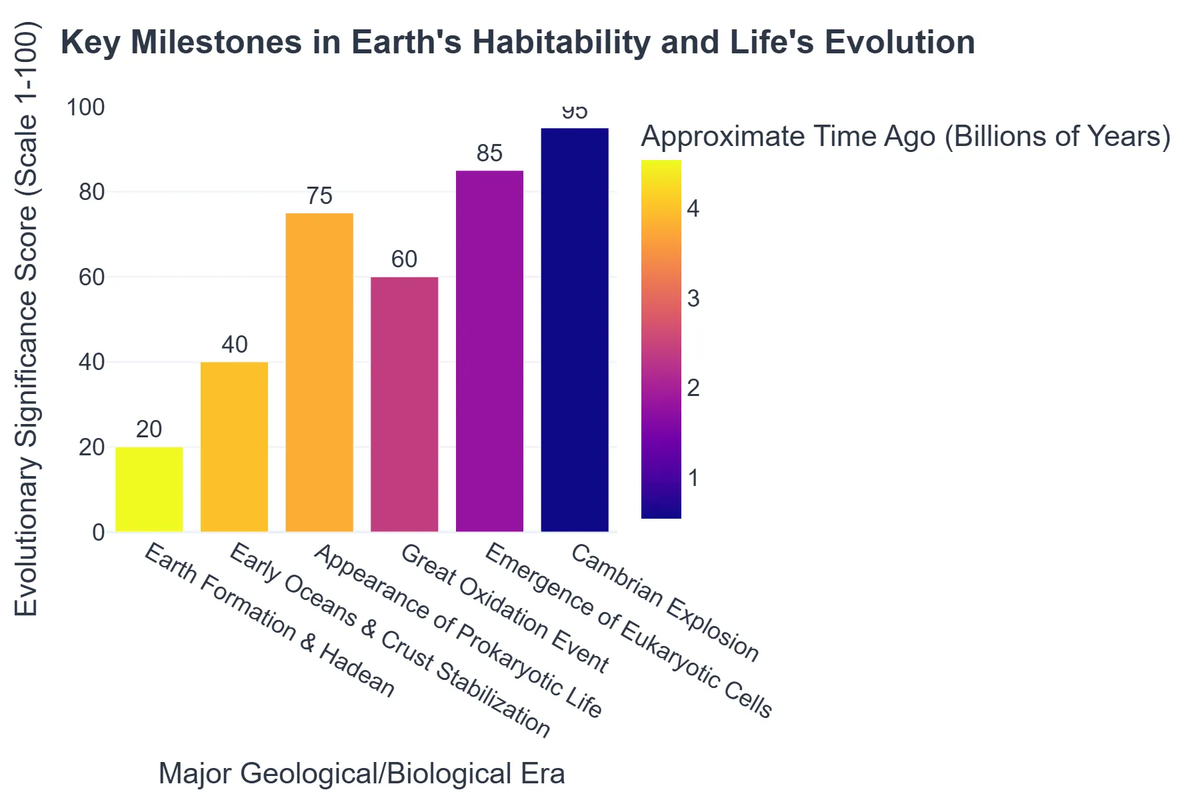
- 🦠 First Life (3.8 – 3.5 billion years ago): Evidence suggests the earliest life forms were simple, anaerobic prokaryotes.
- ☀️ Photosynthesis (around 3.5 – 2.5 billion years ago): The evolution of photosynthesis, particularly in cyanobacteria, was a game-changer. It allowed organisms to harness solar energy and released oxygen as a byproduct.
- 🌬️ The Great Oxidation Event: This gradual accumulation of oxygen in the atmosphere, starting around 2.4 billion years ago, was a major environmental shift, leading to the extinction of many anaerobic life forms but paving the way for oxygen-breathing organisms. This event dramatically reshaped our planet, a topic further explored in Earth Science Defined: The Scientific Study of Our Planet.
The Advent of Eukaryotes and Multicellularity
The next major leap was the emergence of eukaryotes, cells with a nucleus and complex internal structures.
- ➡️ Endosymbiotic Theory: It’s believed that eukaryotes evolved when one prokaryote engulfed another, leading to a symbiotic relationship where the engulfed organism became an organelle (e.g., mitochondria and chloroplasts). This occurred around 2 billion years ago.
- 🤝 Multicellularity (around 1 billion years ago): The transition from single-celled to multicellular organisms allowed for specialization of cells and the development of larger, more complex bodies.
Major Evolutionary Bursts and Extinctions
Life’s history is punctuated by periods of rapid diversification and catastrophic mass extinctions.
- 💥 Cambrian Explosion (around 540 million years ago): A relatively short period where most major animal phyla appeared in the fossil record.
- 💀 Mass Extinctions: Events like asteroid impacts or massive volcanic activity have caused significant biodiversity loss, yet survivors often diversified to fill newly available ecological niches. The study of these events helps us understand the resilience and vulnerability of Earth’s life, a crucial aspect of Protecting Our Planet: Understanding Earth’s Environment.
🚶♀️ The Enigma of Human Origin: Our Place in the Evolutionary Tapestry
Among the countless species that have graced our planet, the origin of humans on earth stands as a unique chapter, defined by our cognitive abilities and complex societies.
Primate Evolution and Hominin Lineage
Humans are primates, sharing a common ancestor with chimpanzees and other apes millions of years ago. Our specific lineage, the hominins, began to diverge in Africa.
- 🌳 Arboreal Beginnings: Early primates were tree-dwellers.
- 🚶♂️ Bipedalism: A key evolutionary innovation in hominins was bipedalism (walking upright), which freed the hands for carrying and tool use. This likely emerged around 6-7 million years ago.
- 🧠 Brain Expansion: Over millions of years, there was a significant increase in brain size and complexity among various hominin species, leading to enhanced cognitive abilities.
The Emergence of Homo Sapiens
Our own species, Homo sapiens, originated in Africa and subsequently migrated across the globe.
- 🌍 African Origin: Fossil and genetic evidence overwhelmingly points to East Africa as the cradle of humanity, with the earliest Homo sapiens fossils dating back roughly 300,000 years.
- 🗺️ Out of Africa Migration: Multiple waves of migration spread modern humans across continents, leading to the diverse populations we see today. Discover more about the intricate processes of life’s evolution in this insightful article on Evolution: Unearthing missing links in the origin of our planet’s life.
- 🗣️ Culture and Language: The development of complex language, abstract thought, and cumulative culture were critical factors in our species’ success and dominance.
🔭 Unanswered Questions and Future Exploration
Despite significant advancements, the enigma of Earth’s and life’s origin still holds many secrets. Science continues to push the boundaries of our understanding.
Frontiers in Research
- 🔬 Prebiotic Chemistry: Scientists are exploring how complex organic molecules might have assembled into self-replicating systems in various early Earth environments.
- ☄️ Extraterrestrial Life: The search for life beyond Earth (astrobiology) provides critical context. If life is found elsewhere, especially with a different biochemical basis, it could provide profound insights into the universality of life’s principles.
- 🧪 Synthetic Biology: The ability to create synthetic life in the lab could offer direct experimental proof of abiogenesis pathways.
The Continuing Journey of Discovery
The ongoing exploration of Mars, the icy moons of Jupiter and Saturn (like Europa and Enceladus), and exoplanets through powerful telescopes promises to shed more light on the conditions necessary for life and its potential prevalence in the universe.
Recommended Video
✨ Conclusion: A Continuous Unraveling
The journey from a swirling cloud of cosmic dust to a planet teeming with biodiversity, culminating in conscious beings capable of pondering their own existence, is a story of immense complexity and beauty. The origin of earth and life is not a static point in history but a dynamic, interconnected process spanning billions of years.
While we have unraveled many threads of this cosmic tapestry, the complete picture remains elusive. Yet, every scientific discovery brings us closer to understanding our origins, reinforcing the incredible interconnectedness of geological, atmospheric, and biological processes that make our planet truly unique. It’s a continuous unraveling, inviting us to look deeper, question more, and appreciate the profound miracle of life on Earth.
Frequently Asked Questions
How old is the Earth?
The Earth is estimated to be approximately 4.54 billion years old, based on radiometric dating of meteorite samples and the oldest known Earth rocks.
What is abiogenesis?
Abiogenesis is the natural process by which life arises from non-living matter, such as simple organic compounds. It is distinct from evolution, which is the change in life over time.
What were the conditions like on early Earth?
Early Earth was characterized by intense volcanic activity, a reducing atmosphere lacking free oxygen, frequent meteorite impacts, and widespread oceans, providing a chemical environment conducive to pre-biotic chemistry.