

Hominid Evolution: Unearthing Our Ancestors
The story of humanity is one of profound transformation, spanning millions of years and countless adaptations. It’s a journey from tree-dwelling primates to the complex, globally distributed species we are today. Understanding hominid evolution is not just an academic exercise; it’s an essential exploration into our very identity, revealing the deep roots of our biology, behavior, and civilization.
💡 Key Takeaways
- Hominid evolution is a complex process spanning millions of years, marked by significant anatomical and behavioral changes.
- Key evolutionary milestones include bipedalism, increased brain size, and the development of sophisticated tool-making.
- Major hominid species like Australopithecus, Homo erectus, and Neanderthals each contributed uniquely to our lineage.
- Ongoing fossil discoveries and genetic research continually refine our understanding of human origins and migrations.
“The fossil record, though fragmented, provides an unparalleled window into the incredible journey of our species, constantly challenging and refining our understanding of what it means to be human.”
— Dr. Evelyn Reed, Professor of Paleoanthropology, University of Cambridge
In this comprehensive guide, we’ll delve into the groundbreaking discoveries, pivotal milestones, and the diverse lineage that shaped our ancestral past. Prepare to uncover the remarkable narrative of how we became human.
In This Article
- → Hominid Evolution: Unearthing Our Ancestors
- — 💡 Key Takeaways
- → Understanding Hominid Evolution: A Brief Primer
- — What Defines a Hominid?
- — The Evolutionary Timeline: Millions of Years in the Making
- → Pivotal Milestones in Our Ancestral Journey
- — 🚶 Bipedalism: The Groundbreaking Shift
- — 🧠 Brain Enlargement and Cognitive Development
- — 🛠️ The Dawn of Tool Making
- — 🔥 Control of Fire: A Game Changer
- → Key Players: Major Hominid Genera and Species
- — Sahelanthropus, Orrorin, Ardipithecus: The Earliest Glimmers
- — Australopithecus: Our Southern Ape Relatives
- — Paranthropus: The Robust Lineage
- — Homo HabilisandHomo Erectus: The First Toolmakers and Wanderers
- — Homo HeidelbergensisandHomo Neanderthalensis: Bridging the Gap
- → Out of Africa: The Global Diaspora
- — Early Migrations and Dispersal
- — Interactions with Other Hominids
- → The Rise ofHomo Sapiens: Our Own Story
- — Cognitive Revolution and Cultural Complexity
- — Survival and Adaptation
- → Unearthing the Past: Ongoing Discoveries and Future Frontiers
- — The Role of Paleontology and Archaeology
- — New Technologies and Their Impact
- → Conclusion: Our Shared Ancestral Heritage
Understanding Hominid Evolution: A Brief Primer
Before we embark on this epic journey, it’s crucial to establish a clear understanding of the terms and concepts central to our discussion.
What Defines a Hominid?
The term “hominid” refers to the group consisting of all modern and extinct Great Apes (that is, modern humans, chimpanzees, gorillas, and orangutans and all their immediate ancestors). More specifically, in the context of human evolution, it often refers to the lineage leading directly to modern humans after the split from the chimpanzee lineage.
- ✅ Bipedalism: The most defining characteristic, walking habitually on two legs. This frees the hands for carrying, tool use, and other activities.
- ✅ Dental Structure: Changes in teeth size and enamel thickness, reflecting dietary shifts.
- ✅ Brain Size: While not immediate, a significant increase in brain volume relative to body size marks later hominid evolution.
The Evolutionary Timeline: Millions of Years in the Making
The path of human evolution is not a straight line but a complex branching tree, marked by periods of diversification, adaptation, and extinction. It began approximately 6-7 million years ago (mya) in Africa, with the divergence of the human lineage from that of chimpanzees. This vast timeline is crucial for appreciating the gradual yet monumental changes that occurred.
Pivotal Milestones in Our Ancestral Journey
Several key innovations and adaptations stand out as turning points in the story of early hominids, shaping the trajectory toward Homo sapiens.
🚶 Bipedalism: The Groundbreaking Shift
The earliest definitive evidence of bipedalism dates back approximately 6 million years ago with species like Orrorin tugenensis and Sahelanthropus tchadensis, further solidified by Ardipithecus ramidus around 4.4 million years ago. This was a critical adaptation, offering numerous advantages:
- ➡️ Efficient Locomotion: May have been more energy-efficient for long-distance travel in changing environments.
- ➡️ Enhanced Vision: Allowed hominids to see over tall grasses, spotting predators or prey.
- ➡️ Free Hands: Enabled carrying food, offspring, and eventually, the use of tools.
🧠 Brain Enlargement and Cognitive Development
While early hominids like Australopithecus had brains comparable in size to modern apes, a significant increase in brain size began with the genus Homo. This expansion, particularly in the prefrontal cortex, is linked to:
- 💡 Complex Problem Solving: The ability to plan, innovate, and adapt to diverse environments.
- 💡 Language Development: Though difficult to pinpoint, increased brain complexity is essential for the evolution of sophisticated communication.
- 💡 Social Cognition: Enhanced capacity for social bonding, cooperation, and understanding others’ intentions.
🛠️ The Dawn of Tool Making
The oldest undisputed stone tools, known as the Oldowan industry, date back to around 2.6 million years ago, associated with early Homo species like Homo habilis (“handy man”). These simple choppers and flakes revolutionized access to food resources, allowing for butchering carcasses and processing plant foods. Later advancements, like the Acheulean hand-axes of Homo erectus, demonstrated increasing cognitive complexity and foresight.
🔥 Control of Fire: A Game Changer
Evidence for the controlled use of fire becomes more widespread around 1 million to 800,000 years ago, largely attributed to Homo erectus. Fire provided a multitude of benefits:
- ➡️ Protection: Ward off predators.
- ➡️ Warmth: Allowed migration into colder climates.
- ➡️ Cooking: Made food more digestible, increasing nutrient absorption and reducing pathogens. This may have fueled further brain development.
- ➡️ Social Hub: Created a central gathering point, fostering social bonding and the development of culture.
Key Players: Major Hominid Genera and Species
Our family tree is rich with diverse species, each contributing to the mosaic of hominid evolution.
Sahelanthropus, Orrorin, Ardipithecus: The Earliest Glimmers
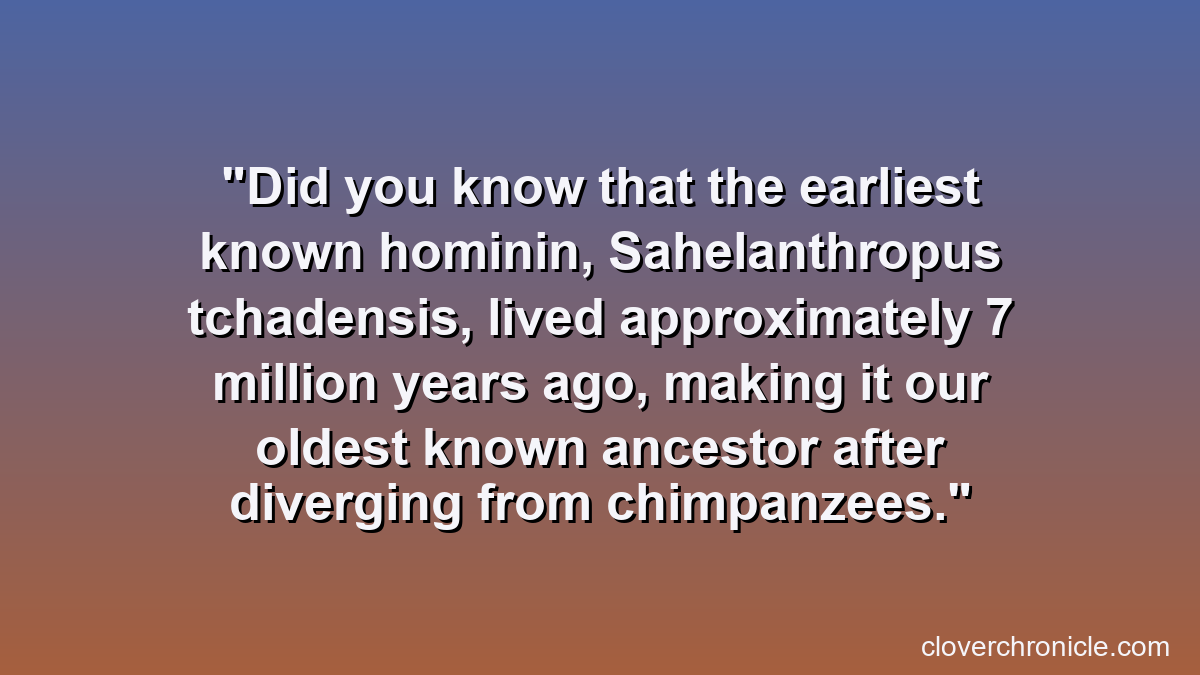
- ✅ Sahelanthropus tchadensis (~7-6 mya): Discovered in Chad, this early hominid had a mix of ape-like and human-like features, including a foramen magnum position suggesting bipedalism.
- ✅ Orrorin tugenensis (~6 mya): Found in Kenya, its femur structure points to early bipedal locomotion.
- ✅ Ardipithecus ramidus (~4.4 mya): Nicknamed “Ardi,” this Ethiopian find provided crucial insights into a mosaic bipedalism, adapting to both arboreal and terrestrial environments.
Australopithecus: Our Southern Ape Relatives
Flourishing between approximately 4 and 2 million years ago, the australopithecines were a diverse group of early hominids.
Exploring Hominid Evolution: Benefits and Challenges
Pros
- ✔Unravels our origins and place in the natural world.
- ✔Enhances understanding of human biology, behavior, and adaptations.
- ✔Provides insights into the long timeline of human development.
- ✔Promotes interdisciplinary scientific research and critical thinking.
Cons
- ✖Fragmentary fossil record leads to knowledge gaps.
- ✖Interpretations are subject to ongoing revision and debate.
- ✖Ethical sensitivities regarding excavation and handling of remains.
- ✖High costs and logistical challenges associated with fieldwork.
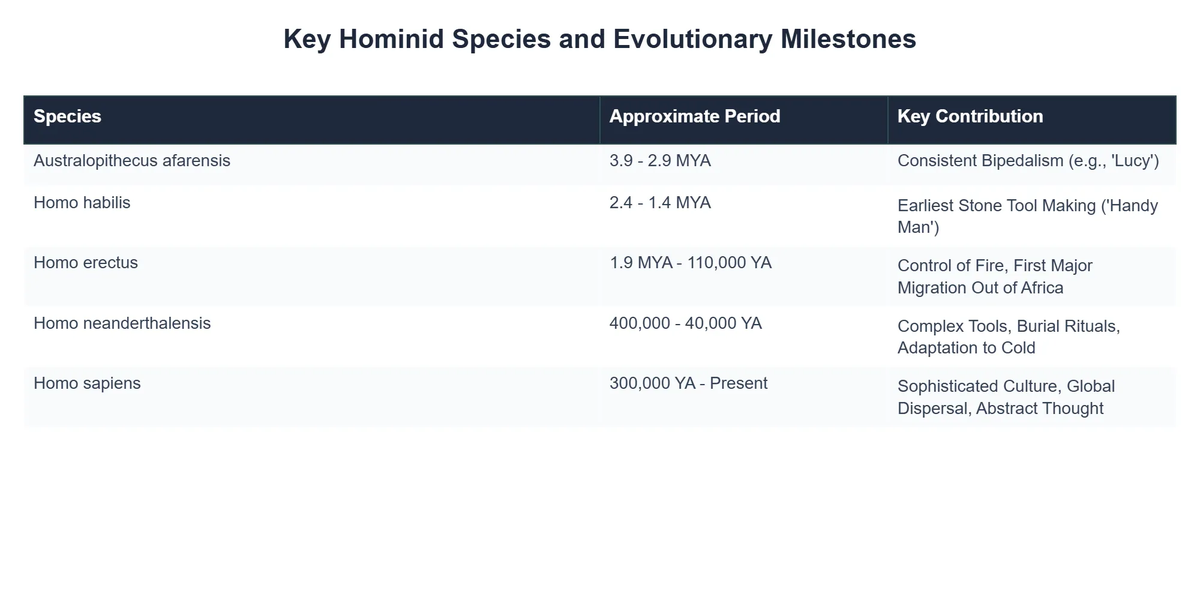
- 💡 Australopithecus afarensis (~3.9-2.9 mya): Best known through the discovery of “Lucy” in Ethiopia. Lucy’s discovery reshaped our understanding of human ancestry, confirming early bipedalism. They had small brains but walked upright.
- 💡 Australopithecus africanus (~3.3-2.1 mya): Found in South Africa, similar to afarensis but with some distinct facial features.
Paranthropus: The Robust Lineage
Coexisting with early Homo species, Paranthropus (2.7-1.2 mya) represents a robust lineage with massive jaws and teeth adapted for chewing tough plant material. Examples include P. aethiopicus, P. boisei, and P. robustus. They were an evolutionary side branch that eventually died out.
Homo Habilis and Homo Erectus: The First Toolmakers and Wanderers
- 🛠️ Homo habilis (~2.4-1.4 mya): The “handy man,” recognized for the first consistent use of stone tools. Had a slightly larger brain than australopithecines.
- 🚶 Homo erectus (~1.9 mya – 110,000 years ago): A remarkably successful and widespread species. They were the first hominids to leave Africa, adapting to diverse environments across Asia and Europe. They mastered fire and developed more sophisticated Acheulean tools.
Homo Heidelbergensis and Homo Neanderthalensis: Bridging the Gap
- 🌍 Homo heidelbergensis (~700,000-200,000 years ago): Believed to be the common ancestor of Neanderthals and modern humans, found in Africa, Europe, and possibly Asia.
- 💪 Homo neanderthalensis (~400,000-40,000 years ago): Adapted to cold climates in Eurasia, known for robust builds, advanced tool use (Mousterian), intentional burial of their dead, and even artistic expression. They coexisted and interbred with early Homo sapiens.
Out of Africa: The Global Diaspora
The narrative of human evolution is not confined to Africa. Several waves of migration saw hominids venturing into new continents, shaping the world as we know it.
Early Migrations and Dispersal
The first major “Out of Africa” event is associated with Homo erectus around 1.8 to 1.9 million years ago, leading to their widespread presence across Asia (e.g., “Peking Man,” “Java Man”). These early pioneers demonstrated remarkable adaptability, successfully colonizing diverse ecological zones.
Interactions with Other Hominids
As Homo sapiens emerged from Africa in later waves (around 70,000-100,000 years ago), they encountered other hominid populations already established in Eurasia, most notably Neanderthals and Denisovans. Genetic evidence confirms interbreeding events, meaning most non-African modern humans carry a small percentage of Neanderthal and/or Denisovan DNA. This highlights the complex, interconnected nature of our ancestral past.
The Rise of Homo Sapiens: Our Own Story
Our species, Homo sapiens, originated in Africa approximately 300,000 years ago. What set us apart and led to our global dominance?
Cognitive Revolution and Cultural Complexity
The “Cognitive Revolution” — a period marked by significant changes in human thinking and behavior — roughly coincides with the emergence of fully modern Homo sapiens. This era saw:
- 🎨 Symbolic Thought: Evident in cave art, personal ornaments, and complex burial rituals.
- 🗣️ Advanced Language: Facilitating complex social structures and knowledge transfer.
- 🌐 Sophisticated Toolmaking: Including blade technology and composite tools.
- 🏘️ Organized Societies: Leading to the development of early settlements and, much later, monumental structures like those discussed in Göbekli Tepe: Unearthing Humanity’s First Temple.
Survival and Adaptation
Homo sapiens‘ success lies in our unparalleled adaptability. We developed technologies and cultural practices that allowed us to thrive in almost every environment on Earth, from deserts to ice ages. Our capacity for cumulative culture – building upon previous generations’ knowledge – is a key differentiator.
Unearthing the Past: Ongoing Discoveries and Future Frontiers
The story of hominid evolution is far from complete. Every year brings new fossil finds, archaeological sites, and technological advancements that refine our understanding.
The Role of Paleontology and Archaeology
These fields are the bedrock of our knowledge. Paleontologists, specialists in unearthing ancient life, recover fossilized remains of our ancestors, providing direct evidence of their anatomy and chronology. Archaeologists uncover the material culture – tools, hearths, art – left behind by ancient hominids, revealing insights into their behavior and cognitive abilities. To understand the broader context of these discoveries, you might explore more about Latest Archaeology News: Unveiling the Past.
New Technologies and Their Impact
Advances in genetics (ancient DNA analysis), dating techniques (e.g., paleomagnetism, argon-argon dating), and imaging technologies are revolutionizing the field. These tools allow scientists to extract unprecedented amounts of information from even tiny fragments of bone or stone, refining timelines and revealing hidden connections. For instance, genetic studies have confirmed interbreeding between different hominid groups, adding layers of complexity to our family tree. The Natural History Museum provides excellent resources on how new techniques are used in human evolution research: Human evolution | Natural History Museum.
The PBS series, “Becoming Human,” also offers a fantastic visual journey into these discoveries and the scientists behind them: Becoming Human | NOVA | PBS.
Recommended Video
Conclusion: Our Shared Ancestral Heritage
The study of hominid evolution is a testament to the power of scientific inquiry and the enduring human desire to understand our origins. From the first tentative steps of bipedal apes in Africa to the global spread of Homo sapiens, our journey is one of remarkable resilience, innovation, and adaptation. Each fossil, each tool, each ancient DNA fragment adds another piece to the magnificent mosaic of our past, reminding us of our shared heritage and the deep history that binds us all. It’s a key part of the broader story of Lost Worlds & Forgotten Histories: Unearthing the Past’s Greatest Riddles.
What defines a hominid?
Hominids refer to the group consisting of all modern and extinct Great Apes, including humans, chimpanzees, gorillas, and orangutans, and their immediate ancestors. In a narrower sense, it often refers specifically to the human lineage after its divergence from other apes.
When did hominid evolution begin?
Hominid evolution is believed to have begun approximately 6-7 million years ago with the divergence of the human lineage from chimpanzees and bonobos in Africa.
What are the major milestones in hominid evolution?
Key milestones include the evolution of habitual bipedalism, the development of stone tools, significant increases in brain size, the control of fire, and the emergence of complex language and culture.
Where were the earliest hominid fossils found?
The earliest and most significant hominid fossil discoveries have predominantly been made in East Africa, particularly in regions of Ethiopia, Kenya, and Tanzania, which are often called the ‘Cradle of Humankind’.

