


UPSC Geology Optional: A Comprehensive Guide for Civil Services Aspirants
The Union Public Service Commission (UPSC) Civil Services Examination (CSE) is one of India’s most challenging competitive exams, demanding rigorous preparation and strategic subject selection. Among the array of optional subjects available, geology stands out as a unique and potentially highly rewarding choice. For aspirants with a keen interest in Earth’s Unseen Forces: The Hidden Dynamics of Our Planet and a scientific bent of mind, UPSC optional geology can be a game-changer. This guide aims to provide a definitive roadmap for civil services aspirants considering or already preparing with geology as their optional subject, offering clarity, strategy, and essential resources.
💡 Key Takeaways
- Understand the complete UPSC Geology Optional syllabus and exam pattern.
- Learn effective study strategies, including note-making and answer writing.
- Discover recommended books and online resources for comprehensive preparation.
- Gain insights into common challenges and how to overcome them for a high score.
“Geology is more than just rocks; it’s the fundamental story of Earth’s dynamics, offering unparalleled analytical depth. For UPSC, mastering this optional equips aspirants with a holistic understanding of our planet, a truly valuable asset for future civil servants.”
— Marcus Sterling, Geophysical Explorer & Climate Dynamics Analyst
Choosing the right optional subject is paramount for success in the UPSC Civil Services Mains Examination. It accounts for 500 marks, significantly impacting your final score. While subjects like Public Administration or Geography often see a high number of takers, geology, though less common, offers distinct advantages that we will explore in depth.
In This Article
- → UPSC Geology Optional: A Comprehensive Guide for Civil Services Aspirants
- — 💡 Key Takeaways
- → Why Choose Geology as an UPSC Optional?
- — Potential Challenges to Consider
- → Understanding the UPSC Geology Syllabus
- — Paper I: Principles of Geology
- — Paper II: Applied Geology and Economic Geology
- → Mastering the Geology Optional Exam: Preparation Strategies
- — 📖 Syllabus Deconstruction & Planning
- — 📚 Core Study Material
- — ✍️ Answer Writing Practice
- — 🔍 Analyzing UPSC Geology Previous Year Papers
- → Essential Resources for UPSC Geology Aspirants
- — 📚 Recommended Textbooks Categories
- — 🌐 Online Platforms & Communities
- → Common Challenges and How to Overcome Them
- — ⚙️ Technical Jargon and Concepts
- — 📈 Vastness of Syllabus
- — ✏️ Drawing Accurate Diagrams
- → Integrating Geology with General Studies
- → Conclusion
Why Choose Geology as an UPSC Optional?
Geology, the scientific study of Earth’s physical structure, substance, history, and the processes that act on it, offers a fascinating and logical subject for the UPSC CSE. While it might seem niche, it provides several compelling reasons for aspirants to consider it:
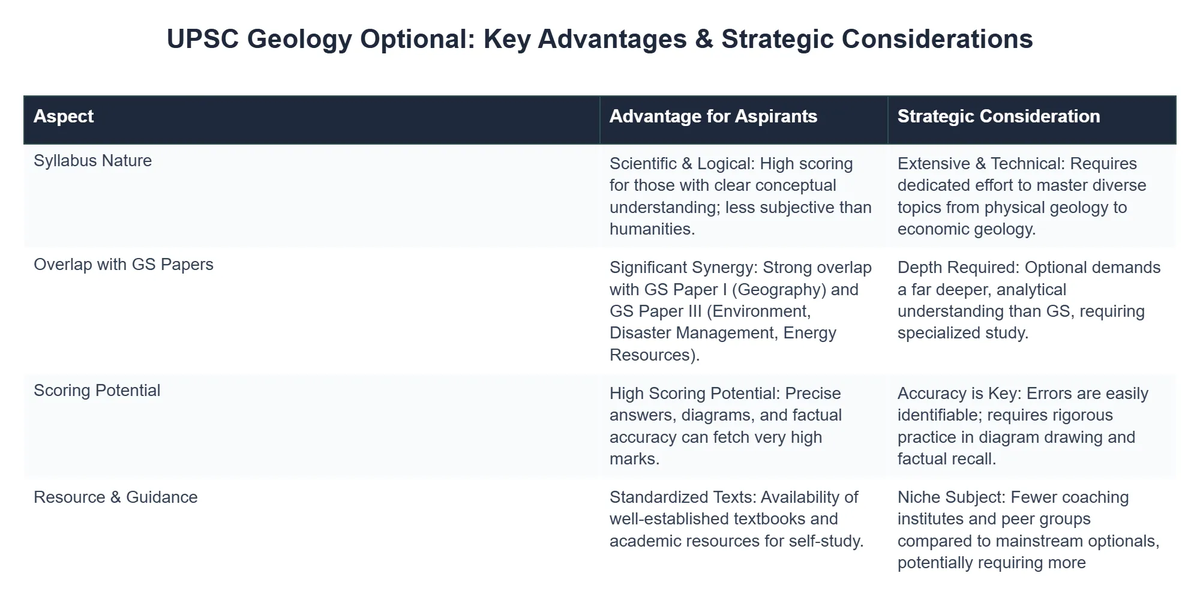
- ✅ Scientific and Logical Subject: Geology is a highly scientific discipline based on principles, theories, and empirical observations. This logical structure makes it easier to understand and remember concepts compared to more abstract humanities subjects.
- ✅ Static Syllabus: Unlike current affairs-heavy subjects, the core principles and concepts in the geology syllabus remain relatively stable. Once understood, the foundational knowledge doesn’t frequently change, reducing the need for constant updates.
- ✅ Scoring Potential: With precise answers, well-drawn diagrams, and a clear understanding of concepts, geology can be a high-scoring optional. Examiners often appreciate the clarity and exactness of scientific answers.
- ✅ Less Competition (Relatively): Compared to popular optionals, geology attracts fewer candidates. This can sometimes translate into better individual attention from coaching institutes (if opted for) and potentially a more focused evaluation environment.
- ✅ Overlapping with General Studies: Many topics in geology, such as mineral resources, natural hazards, environmental geology, and geomorphology, directly overlap with parts of General Studies Paper I (Geography) and Paper III (Environment, Disaster Management). This synergy provides an edge in GS preparation. For instance, understanding concepts like Isostasy in Geology: Earth’s Crust’s Gravitational Balance or Mountain Geology: Formation and Transformation of Peaks can significantly enrich your answers in Geography.
Potential Challenges to Consider
- ➡️ Technical Nature: The subject demands a basic understanding of scientific terminology and concepts, which might be a hurdle for candidates without a science background.
- ➡️ Limited Resources (Perceived): While quality resources exist, they might not be as widely advertised or easily accessible as those for more common optionals. However, with diligent research, you can find excellent `standard geology textbooks for UPSC`.
Before making your final decision, it’s advisable to review the detailed syllabus and consider your aptitude. For insights from serving officers who’ve cleared the exam, exploring platforms like Reddit’s UPSC community can be beneficial.
Understanding the UPSC Geology Syllabus
The UPSC geology syllabus is divided into two papers, each carrying 250 marks, totaling 500 marks for the optional subject. It covers a broad spectrum of geological disciplines, designed to test both theoretical knowledge and its practical application.
Paper I: Principles of Geology
This paper primarily focuses on fundamental geological concepts and processes:
- 💡 General Geology: Earth’s interior, plate tectonics, earthquakes, volcanism, orogeny.
- 💡 Geomorphology and Remote Sensing: Landforms, weathering, erosion, remote sensing principles and applications. Understanding surface processes like those leading to Regolith in Geology: Soil Formation and Planetary Surfaces is crucial here.
- 💡 Structural Geology: Folds, faults, joints, unconformities, mountain building.
- 💡 Palaeontology: Fossils, stratigraphy, geological time scale, evolution of life.
- 💡 Indian Stratigraphy: Detailed study of India’s geological history and rock formations.
- 💡 Hydrogeology and Engineering Geology: Groundwater, water resources, geological considerations in civil engineering projects.
Paper II: Applied Geology and Economic Geology
This paper delves into the practical and economic aspects of geology:
- 💡 Mineralogy and Geochemistry: Physical and optical properties of minerals, rock-forming minerals, geochemical cycles.
- 💡 Igneous and Metamorphic Petrology: Origin, classification, and structures of igneous and metamorphic rocks.
- 💡 Sedimentary Petrology: Processes of sedimentation, classification, and structures of sedimentary rocks.
- 💡 Economic Geology: Ore deposits, mineral resources of India, fuels (coal, petroleum, natural gas), nuclear minerals.
- 💡 Mining Geology: Prospecting, exploration, mining methods, environmental impacts of mining.
- 💡 Mineral Exploration: Geophysical and geochemical methods of exploration.
A thorough understanding of each topic and their interconnections is vital for comprehensive exam preparation.
Mastering the Geology Optional Exam: Preparation Strategies
Effective preparation for the UPSC Geology optional requires a systematic and disciplined approach. Here’s how to strategize your study:
📖 Syllabus Deconstruction & Planning
- ✅ Break Down Topics: Divide the vast syllabus into smaller, manageable units. Prioritize topics based on their weightage and your comfort level.
- ✅ Create a Study Schedule: Allocate specific time slots for each topic, ensuring you cover the entire syllabus well before the exam.
- ✅ Conceptual Clarity: Geology is about understanding processes. Don’t just memorize; grasp the ‘why’ and ‘how’ behind geological phenomena.
📚 Core Study Material
Identify and procure the most relevant `standard geology textbooks for UPSC`. Focus on comprehensive books that cover the entire syllabus rather than relying on fragmented notes. For specific sections, you might need to refer to specialized texts. Quality over quantity is key here.
✍️ Answer Writing Practice
This is arguably the most crucial part of your exam preparation. Simply knowing the material isn’t enough; you must be able to articulate it effectively under timed conditions.
- ➡️ Structure Your Answers: Follow an introduction-body-conclusion format. Use headings, subheadings, and bullet points to enhance readability.
- ➡️ Incorporate Diagrams: Geology is highly visual. Practice drawing neat, well-labelled diagrams (e.g., fault types, rock cycles, landforms). They can fetch significant marks.
- ➡️ Mock Tests: Regularly appear for mock tests to simulate exam conditions, identify weak areas, and improve time management.
🔍 Analyzing UPSC Geology Previous Year Papers
Studying `UPSC Geology previous year papers` is non-negotiable. This will give you invaluable insights into:
UPSC Geology Optional: Advantages and Disadvantages
Pros
- ✔Factual and logical, making it potentially high-scoring with clear concepts.
- ✔Static syllabus, reducing the need to constantly update knowledge.
- ✔Significant overlap with General Studies (GS) topics like Geography, Environment, and Disaster Management.
- ✔Less competition compared to traditionally popular optional subjects.
Cons
- ✖Requires a strong scientific background and aptitude for technical concepts.
- ✖Extensive syllabus that demands comprehensive study and memorization of terminology.
- ✖Limited availability of coaching and specialized study materials compared to other subjects.
- ✖Requires practice in drawing complex geological diagrams and maps.
- 💡 Question Patterns: Understand the type of questions asked (direct, analytical, application-based).
- 💡 Important Topics: Identify recurring themes and high-yield areas.
- 💡 Marking Scheme: Get a sense of how marks are allocated for different sections of an answer.
Solve these papers rigorously, treating them as actual exams. Self-assessment or peer review of these attempts is highly beneficial.
Essential Resources for UPSC Geology Aspirants
Building a strong foundation in geology requires access to the right study materials. While specific book recommendations may vary based on an individual’s learning style, here are categories of `standard geology textbooks for UPSC` and other resources that are generally recommended:
📚 Recommended Textbooks Categories
- ✅ General Geology/Physical Geology: Books covering Earth’s processes, landforms, plate tectonics, etc.
- ✅ Structural Geology: Texts focused on deformation of rocks, folds, faults.
- ✅ Mineralogy & Petrology: Books detailing minerals, igneous, sedimentary, and metamorphic rocks.
- ✅ Palaeontology & Indian Stratigraphy: Dedicated books for fossil studies and India’s geological history.
- ✅ Economic Geology: Resources on ore deposits, minerals, and fuels.
- ✅ Hydrogeology & Engineering Geology: Texts on groundwater and geotechnical aspects.
Always ensure you are referring to the latest editions of these books. Besides textbooks, consider geological maps, diagrams, and online resources from reputable universities or geological surveys.
🌐 Online Platforms & Communities
Leverage online forums and communities dedicated to UPSC preparation. Many aspirants share notes, strategies, and discuss doubts. However, be discerning about the information you consume.
Common Challenges and How to Overcome Them
Every optional subject presents its own set of hurdles. For geology, these often include:
⚙️ Technical Jargon and Concepts
Geology has its own unique vocabulary. Many aspirants, especially those from non-science backgrounds, find the initial learning curve steep.
- 💡 Strategy: Create a glossary of terms. Use flashcards for difficult concepts. Focus on understanding the root words and their implications. Break down complex processes into simpler steps.
📈 Vastness of Syllabus
The syllabus for geology optional is comprehensive, covering numerous sub-disciplines.
- 💡 Strategy: Prioritize high-yield topics based on `UPSC Geology previous year papers` analysis. Don’t aim for 100% mastery of every single detail; instead, aim for strong conceptual clarity across all major sections. Practice selective study where necessary, but ensure core topics are thoroughly covered.
✏️ Drawing Accurate Diagrams
Diagrams are integral to geology answers, but many aspirants struggle with drawing them neatly and accurately under time pressure.
- 💡 Strategy: Practice drawing diagrams regularly. Keep a separate notebook for diagrams. Label them clearly and precisely. Understand the geological significance of each feature depicted.
For more insights into why geology might be a less popular choice and the pros of opting for it, discussions on platforms like Quora can offer diverse perspectives from past aspirants.
Integrating Geology with General Studies
One of the hidden strengths of choosing geology as an optional is its significant overlap with various aspects of the General Studies papers, particularly GS Paper I (Geography) and GS Paper III (Environment, Disaster Management, Economy related to resources).
- 🌍 Geography (GS Paper I): Topics like geomorphology, climatology (indirectly), oceanography, and economic geography (resources) have strong geological underpinnings. For instance, understanding concepts of landform development, Badlands Geology: Erosion’s Striking Impact on Landscapes, or the distribution of mineral resources directly enriches your geographical answers.
- 🌿 Environment & Disaster Management (GS Paper III): Knowledge of natural hazards (earthquakes, volcanoes, tsunamis, landslides), environmental impacts of mining, groundwater management, and soil formation processes (e.g., Regolith in Geology: Soil Formation and Planetary Surfaces) provides a robust foundation for these topics.
- 💰 Economy (GS Paper III): The study of mineral and energy resources (coal, petroleum, natural gas, nuclear minerals) and their economic significance in India is directly covered in the geology syllabus and aids in GS.
By leveraging these overlaps, you can develop a holistic understanding of subjects, improve the quality of your GS answers with scientific depth, and save significant preparation time. A strong grasp of geological principles can even provide a unique perspective when discussing policies related to natural resources or disaster mitigation, reinforcing your understanding of Earth’s Unseen Forces: The Hidden Dynamics of Our Planet.
Recommended Video
Frequently Asked Questions
What are the best books for UPSC Geology optional?
Recommended books include ‘Physical Geology’ by Arthur Holmes, ‘Stratigraphy’ by M.S. Krishnan, and ‘Principles of Geochemistry’ by Brian Mason, among others specific to each topic in the syllabus.
How much time is needed to prepare Geology optional for UPSC?
Typically, 4-6 months of dedicated and focused preparation, combined with consistent revision and answer writing practice, is sufficient to cover the entire Geology optional syllabus effectively.
Is there much overlap between Geology optional and GS papers?
Yes, there’s significant overlap, particularly with GS Paper 1 (Geography, Physical Geography, Indian Geography) and aspects of Environment & Ecology in GS Paper 3, making it a synergistic choice for many aspirants.