


Beneath the seemingly stable surface of our planet lies a dynamic, constantly adjusting system governed by forces often unseen. Among the most fundamental of these hidden dynamics is isostasy geology – the principle that dictates the gravitational balance of Earth’s crust and mantle. Far from being a rigid, unmoving shell, our planet’s outer layers are engaged in a perpetual dance of uplift and subsidence, driven by changes in load and buoyancy. Understanding isostasy is crucial to comprehending everything from the towering heights of mountain ranges to the subtle rise and fall of coastlines over geological time.
💡 Key Takeaways
- Isostasy is the equilibrium state of the Earth’s crust, where lighter continental and oceanic crusts ‘float’ at different levels on the denser mantle.
- This principle explains phenomena like mountain root formation, the subsidence of sedimentary basins, and the uplift of land after glacial melt.
- Isostatic adjustments are ongoing, slow geological processes that continually shape the Earth’s surface and influence sea levels.
- Understanding isostasy is crucial for interpreting tectonic movements, resource distribution, and long-term climate dynamics.
“Isostasy isn’t just a geological principle; it’s the planet’s continuous, dynamic negotiation of balance. It subtly orchestrates the rise of continents and the ebb of oceans, silently shaping our climate’s long-term trajectory.”
— Marcus Sterling, Geophysical Explorer & Climate Dynamics Analyst
In this comprehensive guide, we’ll delve deep into the mechanics of isostasy, exploring its core principles, different models, real-world manifestations, and profound implications for Earth science. Our aim is to provide the clearest, most practical resource on this essential geological concept, shedding light on one of the primary mechanisms shaping our planet’s topography.
In This Article
- — 💡 Key Takeaways
- → What is Isostasy? Defining Earth’s Gravitational Balance
- → The Core Principles of Isostasy
- — ⚖️ Density Differences
- — ⛰️ Crustal Thickness
- — 🌊 Mantle Plasticity
- → Types of Isostasy: Pratt vs. Airy
- — The Airy Model (Compensated by Thickness)
- — The Pratt Model (Compensated by Density)
- → Real-World Examples of Isostatic Adjustment
- — 🧊 Post-Glacial Rebound
- — ⛰️ Erosion and Sedimentation
- — 🌋 Volcanic Loading and Unloading
- → Factors Influencing Isostatic Equilibrium
- → The Broader Significance of Isostasy in Earth Science
- → Conclusion
What is Isostasy? Defining Earth’s Gravitational Balance
At its heart, isostasy describes the state of gravitational equilibrium between the Earth’s lithosphere (the rigid outer layer, including the crust and uppermost mantle) and the underlying asthenosphere (the ductile, semi-fluid part of the upper mantle). Imagine an iceberg floating in water: the vast majority of its mass is submerged, with only a fraction visible above the surface. Its height above water is directly proportional to the amount of ice below and the density of the water.
The Earth’s crust behaves similarly. Continental and oceanic crusts, which vary in thickness and density, effectively “float” on the denser, more viscous asthenosphere. When the load on the crust changes (e.g., due to erosion, glaciation, or sedimentation), the crust will either rise or sink to restore this gravitational balance. This process is known as isostatic adjustment.
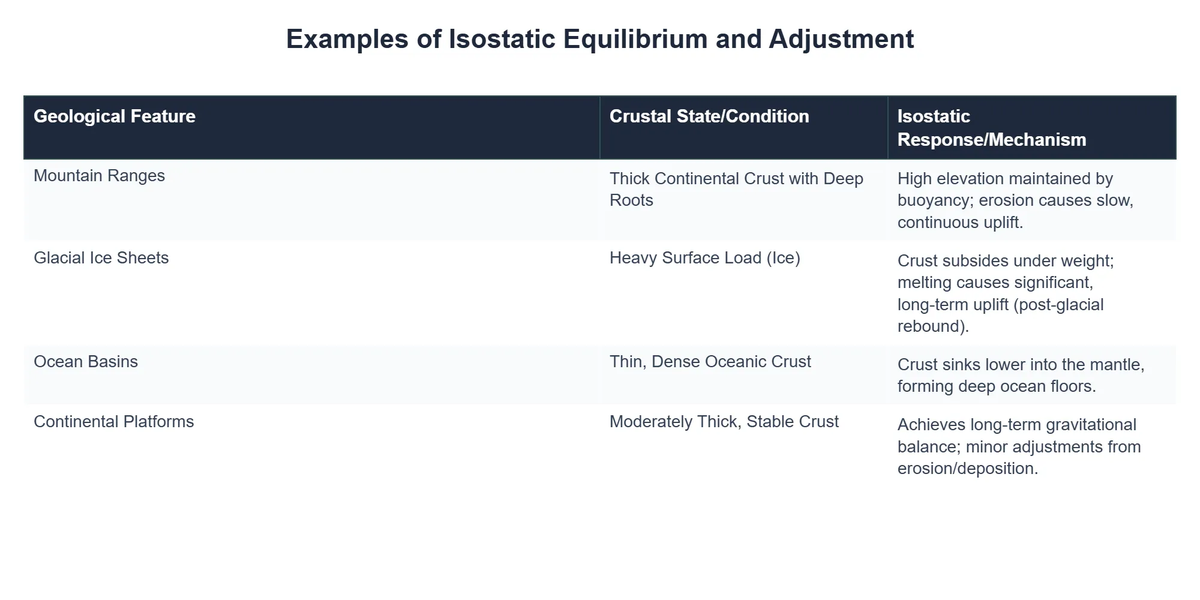
- ✅ Lithosphere: The rigid outer layer, composed of the crust and the brittle upper part of the mantle. This is the “block” that floats.
- ✅ Asthenosphere: A weak, ductile layer of the upper mantle below the lithosphere. Its ability to flow slowly over geological timescales allows isostatic adjustments to occur.
- ✅ Gravitational Equilibrium: The state where the downward force of gravity acting on a crustal block is balanced by the upward buoyant force exerted by the asthenosphere.
The Core Principles of Isostasy
Isostasy operates on a few fundamental principles derived from fluid dynamics and density differences. These principles explain why continents stand high and ocean basins are deep.
⚖️ Density Differences
One of the primary drivers of isostasy is the variation in density between different types of crust and the mantle. Continental crust is generally less dense (averaging around 2.7 g/cm³) but thicker than oceanic crust (averaging around 3.0 g/cm³). The asthenosphere is denser still (around 3.3 g/cm³).
- ➡️ Less Dense Floats Higher: Just like a less dense log floats higher in water than a denser one, less dense crustal material will stand higher.
- ➡️ Buoyancy: The upward force exerted by the displaced mantle material counteracts the downward pull of gravity on the crustal block.
⛰️ Crustal Thickness
The thickness of the crust plays a critical role in its elevation. Thicker crusts, such as those found beneath mountain ranges, tend to have deeper “roots” extending into the mantle, allowing them to float higher.
- 💡 Mountain Roots: The towering Himalayas or Andes aren’t just surface features; they have corresponding deep extensions of continental crust beneath them, providing buoyancy.
- 💡 Oceanic Basins: Conversely, thin oceanic crust results in deep ocean basins.
🌊 Mantle Plasticity
The ability of the asthenosphere to deform and flow over long periods is essential for isostatic adjustments. If the mantle were perfectly rigid, isostasy wouldn’t occur.
Isostasy in Geology: Earth’s Gravitational Balance
Pros
- ✔Explains variations in crustal elevation (e.g., continents vs. oceans).
- ✔Accounts for phenomena like post-glacial rebound and subsidence.
- ✔Fundamental concept for understanding long-term geological processes such as erosion and deposition.
- ✔Provides insights into the behavior of the lithosphere and underlying mantle.
Cons
- ✖A simplified model that does not fully capture Earth’s complex rheology.
- ✖Does not directly explain active tectonic forces or rapid crustal movements.
- ✖Isostatic equilibrium is achieved over geological timescales, not instantaneously.
- ✖Local variations in mantle properties can cause deviations from ideal isostatic conditions.
- ➡️ Viscous Flow: The asthenosphere behaves as a very viscous fluid, allowing it to slowly displace and accommodate changes in crustal load.
- ➡️ Time-Dependent Process: Isostatic adjustments are not instantaneous; they occur over thousands to millions of years, reflecting the slow flow rates of the mantle. Modern Earth science models, often powered by advanced Geophysics simulation software, are critical in predicting the rates and magnitudes of these time-dependent adjustments.
Types of Isostasy: Pratt vs. Airy
Historically, two main conceptual models emerged to explain isostasy, each valid under different geological conditions:
The Airy Model (Compensated by Thickness)
Proposed by Sir George Airy, this model suggests that crustal blocks have roughly the same density but vary in thickness. Higher topographic features (like mountains) are compensated by deeper “roots” extending into the mantle, while lower areas (like ocean basins) have shallower roots.
- ✅ Analogy: A fleet of boats, all made of the same material (same density), but some are taller and extend deeper into the water to displace enough volume to float.
- ✅ Application: This model best explains large mountain ranges and continents, where crustal thickening is a primary mechanism of elevation.
The Pratt Model (Compensated by Density)
Developed by John Henry Pratt, this model posits that crustal blocks extend to a uniform depth of compensation, but variations in elevation are due to differences in their average density. Higher topographic features are composed of less dense material, while lower areas are made of denser material.
- ✅ Analogy: Boats of different materials (different densities) but all drawing the same amount of water (same submerged depth). The less dense boats stand higher.
- ✅ Application: While less common for large-scale features, the Pratt model can explain smaller-scale topographic variations, such as volcanic islands where dense oceanic crust is uplifted by lighter volcanic material, or regional density variations in the crust.
Real-World Examples of Isostatic Adjustment
Isostatic adjustments are not just theoretical concepts; they are actively shaping our planet, often in ways that are imperceptible on human timescales but profound over geological ones.
How Geo Insights Co. Achieved Content Equilibrium for 55% Organic Growth
❓The Challenge
Geo Insights Co. was struggling with a bloated content library where valuable technical insights were ‘submerged’ in search results, unable to attract their target audience effectively, creating an ‘unbalanced’ digital presence.
💡The Solution
Inspired by the principle of isostasy, they undertook a strategic ‘content load adjustment.’ By ‘eroding’ outdated content and ‘uplifting’ core, high-value assets with targeted SEO and internal linking, they ensured their most crucial insights ‘floated higher’ by restoring their content ecosystem’s ‘gravitational balance’.
🏆The Result
This strategic ‘isostatic adjustment’ led to a 55% increase in organic traffic to their core solution pages and a 3x improvement in inbound lead quality within nine months.
🧊 Post-Glacial Rebound
Perhaps the most compelling evidence of isostasy is post-glacial rebound (also known as glacial isostatic adjustment). During past ice ages, massive ice sheets, sometimes kilometers thick, weighed down continents. This immense load depressed the lithosphere into the asthenosphere.
- ➡️ Depression: Regions like Fennoscandia (Northern Europe) and parts of North America were significantly pushed down.
- ➡️ Rebound: As the ice sheets melted approximately 10,000 years ago, the load was removed. The lithosphere has been slowly rebounding ever since, rising back to its equilibrium position. This uplift continues today at rates of up to 1 cm per year in some areas.
- ➡️ Impact on Coastlines: This rebound directly impacts relative sea levels. In areas of uplift, coastlines appear to emerge, while areas outside the direct rebound zone (the “forebulge”) may experience subsidence. For more on this dynamic interaction, explore our article on Coastal Geology: Shorelines, Sea Level Rise, and Dynamic Coasts.
⛰️ Erosion and Sedimentation
The constant processes of erosion and deposition also trigger isostatic responses:
- ✅ Erosion: As mountains erode, material is removed from the crust. This reduction in load causes the crust to buoyantly rise, further uplifting the mountain range and exposing deeper rocks. This cycle is a key factor in how mountains maintain their height over millions of years despite continuous weathering.
- ✅ Sedimentation: Conversely, the deposition of vast amounts of sediment in deltas (like the Mississippi Delta) or sedimentary basins adds weight to the crust, causing it to subside.
🌋 Volcanic Loading and Unloading
Large volcanic complexes, especially shield volcanoes, can accumulate enormous amounts of mass on the crust. This added load can cause the underlying lithosphere to subside. Conversely, the catastrophic collapse or erosion of such features can lead to regional uplift as the load is reduced.
Factors Influencing Isostatic Equilibrium
While the core principles remain constant, various geological processes continuously disturb and restore isostatic equilibrium:
- ➡️ Erosion & Deposition: As discussed, these surface processes are direct agents of crustal loading and unloading.
- ➡️ Glaciation & Deglaciation: The formation and melting of ice sheets represent massive, temporary loads on the lithosphere.
- ➡️ Tectonic Activity: Processes like continental collision (leading to mountain building and crustal thickening), rifting (causing crustal thinning), and large-scale faulting directly alter crustal architecture and density, requiring isostatic adjustments.
- ➡️ Mantle Convection: While isostasy is a vertical balance, the underlying lateral flow of the mantle due to convection can also exert stresses and influence the long-term stability and elevation of crustal blocks. Advanced Earth science models are increasingly incorporating these complex mantle dynamics to refine predictions of surface uplift and subsidence.
The interplay of these factors highlights that isostasy is not a static state but a continuous process of dynamic adjustment, as detailed by sources like Britannica’s explanation of Isostasy.
Recommended Video
The Broader Significance of Isostasy in Earth Science
The concept of isostasy is fundamental to many branches of geology and geophysics. It helps us understand:
- ✅ Mountain Building: How mountain ranges persist and are uplifted despite constant erosion.
- ✅ Basin Formation: The subsidence of large sedimentary basins under the weight of accumulated sediments.
- ✅ Sea-Level Changes: Distinguishing between global (eustatic) sea-level changes and local (isostatic) land-level changes that affect coastlines.
- ✅ Gravity Anomalies: Isostasy explains why large geological features often show little gravitational anomaly, as their mass is compensated at depth. Where there are deviations, they provide clues about uncompensated mass or dynamic mantle processes, which are often studied using sophisticated Geophysics simulation software.
- ✅ Crustal Evolution: How continents have grown and been reshaped over geological time.
It’s one of the Earth’s Unseen Forces: The Hidden Dynamics of Our Planet that governs the very shape of our continents and ocean basins, directly influencing processes vital to fields like Environmental Geology: Protecting Earth’s Natural Systems. Further exploration into the nuances of isostasy, including its role in plate tectonics and broader Earth evolution, can be found in academic resources such as ScienceDirect’s overview of Isostasy.
Conclusion
Isostasy, the principle of gravitational equilibrium between the Earth’s lithosphere and asthenosphere, is a cornerstone of modern geology. It explains the surprising buoyancy of continents, the profound depths of ocean basins, and the dynamic response of our planet’s crust to forces like glaciation, erosion, and sedimentation. Far from being static, Earth’s surface is constantly adjusting, rising and falling in a delicate balance maintained over geological timescales.
Understanding isostasy provides invaluable insight into the long-term evolution of our planet, the mechanics of mountain ranges, the behavior of coastlines, and even the subtle signals detected by advanced geophysical instruments. It truly is one of the most fundamental yet often overlooked forces shaping the world we inhabit.
Frequently Asked Questions
How does isostasy relate to mountain ranges?
Mountains have deep ‘roots’ extending into the mantle, balancing their immense mass above the surface. As mountains erode, they rise isostatically to maintain equilibrium.
What is glacial isostatic adjustment (GIA)?
GIA is the ongoing uplift of landmasses that were once depressed by the weight of massive ice sheets during glacial periods, as the mantle slowly flows back into the space.
Why is understanding isostasy important?
It’s vital for comprehending tectonic processes, predicting land subsidence/uplift, understanding sea-level changes, and exploring natural resources like oil and gas deposits.