


In the intricate dance between individuals and their environments, understanding why we act the way we do goes far beyond mere personal choice. It delves into the profound influence of the world around us. This is the realm of behavioral sociology, a vital field dedicated to uncovering how social contexts — from the micro-interactions of daily life to the macro-structures of society — profoundly shape our actions, thoughts, and even our very identities.
💡 Key Takeaways
- Individual behavior is deeply intertwined with and shaped by the social contexts in which it occurs.
- Social norms, cultural values, and group interactions are powerful determinants of human actions and choices.
- Behavioral sociology provides frameworks to understand how societal structures influence everyday behaviors, from consumption to communication.
- Analyzing behavior through a sociological lens offers critical insights into social problems and effective interventions.
“From a cognitive perspective, the brain constantly processes social cues, integrating them into our decision-making frameworks. Behavioral sociology illuminates the external architecture that subtly, yet profoundly, guides these internal processes.”
— Eleanor Vance, Neuroscience Communicator & Cognitive Psychologist
At The Human Enigma: Unlocking the Secrets of Our Body and Mind, we believe that true understanding of human behavior requires a multidisciplinary approach. Behavioral sociology offers a unique lens, moving beyond individual psychology to examine the collective forces that mold our responses and decisions. It provides critical insights into everything from our purchasing habits to our political affiliations, illustrating the invisible threads that connect us all.
In This Article
- — 💡 Key Takeaways
- → Unraveling Behavioral Sociology: The Foundation
- → 💡 Core Tenets: How Society Shapes Action
- — Social Learning Theory
- — Symbolic Interactionism
- — Social Exchange Theory
- → 🤝 Key Social Mechanisms: Norms, Roles, and Socialization
- — Social Norms: The Unwritten Rules
- — Social Roles: Scripts for Behavior
- — Socialization: Learning to Be Human
- → 🧠 The Intersection: Behavioral and Cognitive Sociology
- → ⚖️ Social Context and Decision-Making: Beyond the Individual
- → 🌍 Real-World Impact: Applications of Behavioral Sociology
- → Future Horizons: Evolution of Behavioral Sociology
- → Conclusion
Unraveling Behavioral Sociology: The Foundation
Behavioral sociology is a sub-discipline of sociology that focuses on the systematic study of human behavior in social contexts. It bridges the gap between individual psychological processes and broader sociological structures, arguing that our actions are not solely a product of internal states but are heavily influenced by external social stimuli, norms, and expectations.
Unlike purely psychological approaches that might focus on internal cognitive processes or personality traits, behavioral sociology emphasizes:
- ✅ The impact of social groups on individual actions.
- ✅ How social institutions (like family, education, government) shape behavior.
- ✅ The role of culture, norms, and values in guiding human conduct.
- ✅ The dynamic interplay between individual agency and social structure.
💡 Core Tenets: How Society Shapes Action
The field operates on several foundational principles that explain the intricate relationship between social context and individual behavior:
Social Learning Theory
This theory posits that individuals learn behaviors, attitudes, and emotional reactions through observation and imitation within their social environments. It highlights the importance of role models, reinforcement, and social interaction in the acquisition of behaviors.
- ➡️ Observational Learning: We learn by watching others, especially those we identify with or respect.
- ➡️ Reinforcement: Behaviors that are socially rewarded are more likely to be repeated.
- ➡️ Social Norms: Implicit or explicit rules within a group dictate acceptable behaviors.
Symbolic Interactionism
This perspective emphasizes the role of symbols and language as the core of human interaction. Our understanding of ourselves and the world is constructed through social interactions, where meanings are negotiated and shared. Behavior, therefore, is a response to these socially constructed meanings.
For more on how society fundamentally shapes us, explore our article on Behavioral Social Sciences: How Society Shapes Us.
Social Exchange Theory
Viewing social interactions as a series of exchanges, this theory suggests that individuals are motivated by a desire to maximize rewards and minimize costs in their relationships. Behaviors are chosen based on their perceived benefits and potential drawbacks within social contexts.
- 💰 Cost-Benefit Analysis: Individuals weigh the pros and cons of different actions.
- 🤝 Reciprocity: A common norm where people respond to positive actions with other positive actions.
🤝 Key Social Mechanisms: Norms, Roles, and Socialization
These concepts are central to understanding how social context influences our actions:
Social Norms: The Unwritten Rules
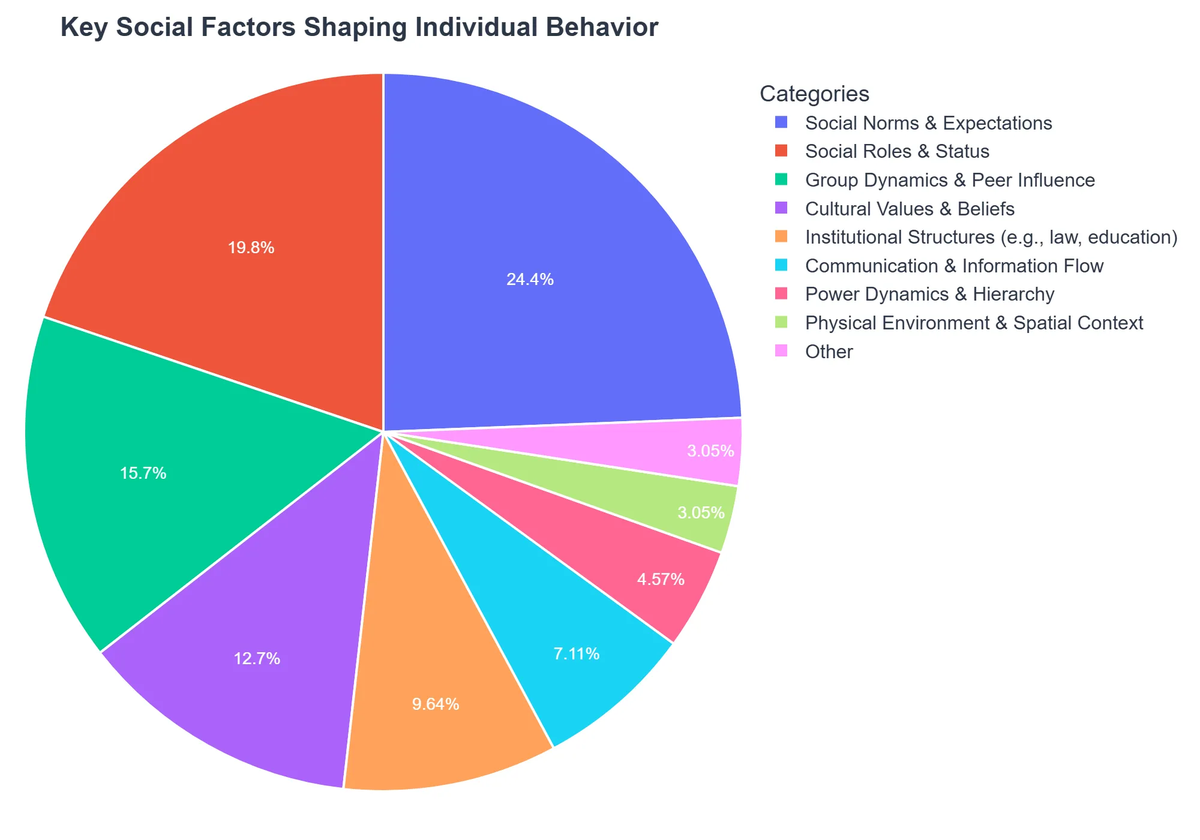
Social norms are shared expectations of behavior that guide members of a group or society. They can be formal (laws, regulations) or informal (customs, traditions) and significantly influence our daily choices. Violating norms often leads to social sanctions, while adhering to them brings acceptance.
Social Roles: Scripts for Behavior
A social role is a set of expectations and behaviors associated with a particular status or position in society (e.g., student, parent, employee). These roles provide a script for how we should act, influencing our actions in various settings.
Consider how different social roles lead to distinct behavioral patterns. For a deeper understanding of human interactions, you might find our insights on Social Behavioral Psychology: Understanding Human Interaction enlightening.
Socialization: Learning to Be Human
Socialization is the lifelong process through which individuals acquire the knowledge, skills, values, and behaviors necessary to function effectively within their society. It is the primary way social context shapes our fundamental understanding of the world and our place within it.
- 👨👩👧👦 Primary Socialization: Occurs in early childhood, primarily within the family.
- 🏫 Secondary Socialization: Occurs through schools, peer groups, media, and other institutions.
🧠 The Intersection: Behavioral and Cognitive Sociology
While behavioral sociology focuses on observable actions and external influences, cognitive sociology delves into the mental processes that mediate between social context and behavior. It explores how our perceptions, beliefs, memories, and decision-making processes are socially constructed and influenced by our interactions.
The two fields are complementary: behavioral sociology examines what we do in social contexts, while cognitive sociology helps understand how our minds process and interpret those contexts to produce behavior. It recognizes that our cognitive frameworks are not purely individual but are deeply embedded in shared social realities. This approach helps explain how social contexts influence our brain and behavior, as discussed in research by Frontiers for Young Minds.
⚖️ Social Context and Decision-Making: Beyond the Individual
Our decisions are rarely made in a vacuum. Behavioral sociology highlights how various social contexts sway our choices, from the mundane to the monumental.
- 🏘️ Community Influence: Local norms, community resources, and collective efficacy impact individual choices related to health, education, and civic engagement.
- 🌐 Group Dynamics: Conformity, obedience to authority, and groupthink demonstrate how powerfully groups can influence individual decisions, sometimes leading to actions contrary to personal beliefs.
- 🏛️ Institutional Impact: Policies, laws, and institutional structures (e.g., healthcare systems, legal frameworks) create incentives and constraints that guide behavior. For instance, research published in PMC illustrates how social determinants influence health behaviors.
🌍 Real-World Impact: Applications of Behavioral Sociology
The insights from behavioral sociology are invaluable across numerous sectors:
- Public Health: Understanding how social networks, cultural beliefs, and community structures influence health behaviors (e.g., vaccination rates, diet, exercise).
- Policy Making: Designing more effective public policies by accounting for social norms, group dynamics, and the likely behavioral responses of target populations.
- Marketing and Advertising: Leveraging social influence, group identification, and cultural values to shape consumer behavior.
- Education: Developing pedagogical approaches that recognize the social context of learning, peer influence, and the socialization process within schools.
- Organizational Behavior: Improving workplace dynamics, team cohesion, and leadership effectiveness by understanding social roles, norms, and communication patterns.
Understanding these broader frameworks is key to comprehending Social & Behavioral Science: Understanding Humanity as a whole.
Future Horizons: Evolution of Behavioral Sociology
As society grows increasingly complex and interconnected through digital technologies, behavioral sociology continues to evolve. New areas of study include:
- 📱 Digital Behavior: How online social networks, algorithms, and digital norms shape behavior.
- 📈 Big Data Analysis: Using large datasets to identify patterns in social behavior at scale.
- 🧪 Neuroscience Integration: Bridging with behavioral and cognitive neuroscience to understand the neural underpinnings of social influence.
The challenges lie in navigating the ethical implications of influencing behavior and adapting classical theories to rapidly changing social landscapes.

Recommended Video
Conclusion
Behavioral sociology provides an indispensable framework for understanding the profound influence of social context on human actions. By examining norms, roles, socialization, and the interplay with cognitive processes, it illuminates how our seemingly individual choices are deeply embedded in collective realities. As we navigate an ever-evolving world, recognizing these social forces is not just academically enriching; it’s essential for fostering more effective policies, healthier communities, and a deeper understanding of ourselves within the grand tapestry of human society.
Frequently Asked Questions
What is behavioral sociology?
Behavioral sociology is a subfield that examines how social structures, contexts, and interactions influence individual and collective human behavior, focusing on the interplay between micro-level actions and macro-level social forces.
How does social context affect individual actions?
Social context impacts individual actions through established norms, cultural values, social roles, group pressures, and the available resources or constraints, all of which subtly or overtly guide choices and responses.
Can behavioral sociology help predict human behavior?
While not deterministic, behavioral sociology offers robust frameworks and theories that can help predict patterns in human behavior by understanding the social conditions and contexts likely to elicit certain responses.
What are some key concepts in behavioral sociology?
Key concepts include social norms, roles, social influence, conformity, deviance, social exchange theory, symbolic interactionism, and the impact of social networks on individual behaviors.