China, a nation of immense geographical diversity, holds a geological story as vast and ancient as its civilization. From the soaring peaks of the Himalayas to the expansive eastern plains, the intricate tapestry of china geology reveals a dynamic past shaped by colossal tectonic forces and a future rich with natural resources. Understanding this profound geological heritage is key to comprehending not only China’s natural wealth but also its susceptibility to geological hazards.
💡 Key Takeaways
- China’s geology is characterized by a complex interplay of ancient cratons and younger orogenic belts.
- Major tectonic events, particularly the collision of the Indian and Eurasian plates, have profoundly shaped its landforms and resource distribution.
- The country is exceptionally rich in diverse mineral resources, critical for global industries.
- Understanding China’s geology is key to comprehending its environmental challenges and resource management strategies.
“China’s geological tapestry, woven from ancient continental fragments and the relentless thrust of tectonic collisions, serves as a dynamic laboratory for understanding Earth’s deep history and the formation of critical resources. It’s a prime example of how geophysical forces directly dictate global resource distribution.”
— Marcus Sterling, Geophysical Explorer & Climate Dynamics Analyst
This article delves into the complex geological framework of China, exploring the ancient tectonic events that sculpted its landscapes, the evolution of its crust over billions of years, and the extraordinary abundance of mineral and energy resources it possesses. For those keen to understand the deeper workings of our planet, China offers a prime example of Earth’s Unseen Forces: The Hidden Dynamics of Our Planet at play.
In This Article
- — 💡 Key Takeaways
- → 🌍 China’s Tectonic Setting: A Collision of Continents
- — ➡️ The North China Craton (NCC)
- — ➡️ The South China Block (SCB)
- — ➡️ The Tibetan Plateau and Himalayan Orogeny
- → ⏳ Ancient Geological Formations and Evolution
- — ✨ Precambrian Foundations
- — ✨ Paleozoic and Mesozoic Eras
- — ✨ Cenozoic Influences
- → ⛏️ China’s Abundant Mineral Resources
- — 🔥 Coal and Hydrocarbons
- — 💎 Rare Earth Elements (REEs)
- — ⚒️ Base Metals and Iron Ore
- — 🌟 Other Strategic Minerals
- → 💧 Geothermal and Water Resources
- — ♨️ Geothermal Potential
- — 🌊 Crucial Groundwater Systems
- → ⚠️ Geological Hazards and Mitigation
- — tremors Earthquakes
- — ⛰️ Landslides and Floods
- → 🔬 Exploring China’s Geology: Tools and Resources
- → Conclusion
🌍 China’s Tectonic Setting: A Collision of Continents
China’s geology is fundamentally defined by its position at the nexus of several major tectonic plates. It sits primarily on the Eurasian Plate, but its southern and western regions are profoundly influenced by the ongoing collision with the Indian Plate, while its eastern margins interact with the Pacific and Philippine Sea Plates. This complex interplay has resulted in a landscape of remarkable contrasts and intense geological activity.
➡️ The North China Craton (NCC)
The NCC is one of the oldest and most extensively studied continental blocks globally, with rocks dating back to the Archean Eon (over 2.5 billion years ago). It experienced significant modification and weakening during the Mesozoic era, a process known as cratonic destruction, which has had profound implications for its mineral potential and seismic activity.
➡️ The South China Block (SCB)
Comprising the Yangtze Craton and the Cathaysia Block, the SCB collided with the NCC during the Triassic period, forming a significant orogenic belt. This collision significantly contributed to the complex structural patterns observed across central and southern China.
➡️ The Tibetan Plateau and Himalayan Orogeny
Perhaps the most dramatic testament to China’s tectonic power is the Tibetan Plateau, the “Roof of the World.” Its formation began approximately 50 million years ago with the collision of the Indian Plate with the Eurasian Plate. This ongoing collision continues to uplift the Himalayas and the Tibetan Plateau, leading to:
- ✅ Extreme Topography: Creating the highest mountain ranges on Earth.
- ✅ High Seismic Activity: Frequent earthquakes across the region.
- ✅ Unique Drainage Systems: The source of many of Asia’s major rivers.
The tectonic and sedimentary responses to these major geological events have been extensively studied, providing crucial insights into continental dynamics. For more details on these large-scale transformations, refer to research on Geology: Exploring Earth’s Dynamic History and Processes and specific studies like the one found at Tectonic-sedimentary responses to major geological events.
⏳ Ancient Geological Formations and Evolution
China’s geological history spans billions of years, preserving records of supercontinent cycles, ancient oceans, and extensive volcanism. This deep time perspective is crucial for understanding the distribution of its vast mineral wealth.
✨ Precambrian Foundations
The oldest rocks in China, found in the North China Craton, date back over 3.8 billion years, representing some of Earth’s earliest continental crust. These ancient basement rocks form the foundation upon which younger sedimentary and volcanic sequences were deposited.
✨ Paleozoic and Mesozoic Eras
During the Paleozoic, large parts of China were covered by shallow seas, leading to the deposition of vast sedimentary sequences, including significant coal measures and marine carbonates. The Mesozoic era was a period of intense tectonic activity, with widespread magmatism, basin formation, and the assembly of the major blocks that now constitute modern China. This period is particularly important for the formation of various metallic ore deposits.
✨ Cenozoic Influences
The Cenozoic era has been dominated by the India-Asia collision, shaping the modern topography and influencing sedimentary basins. This ongoing process continues to deform the crust, creating new geological structures and influencing the distribution of younger resources.
⛏️ China’s Abundant Mineral Resources
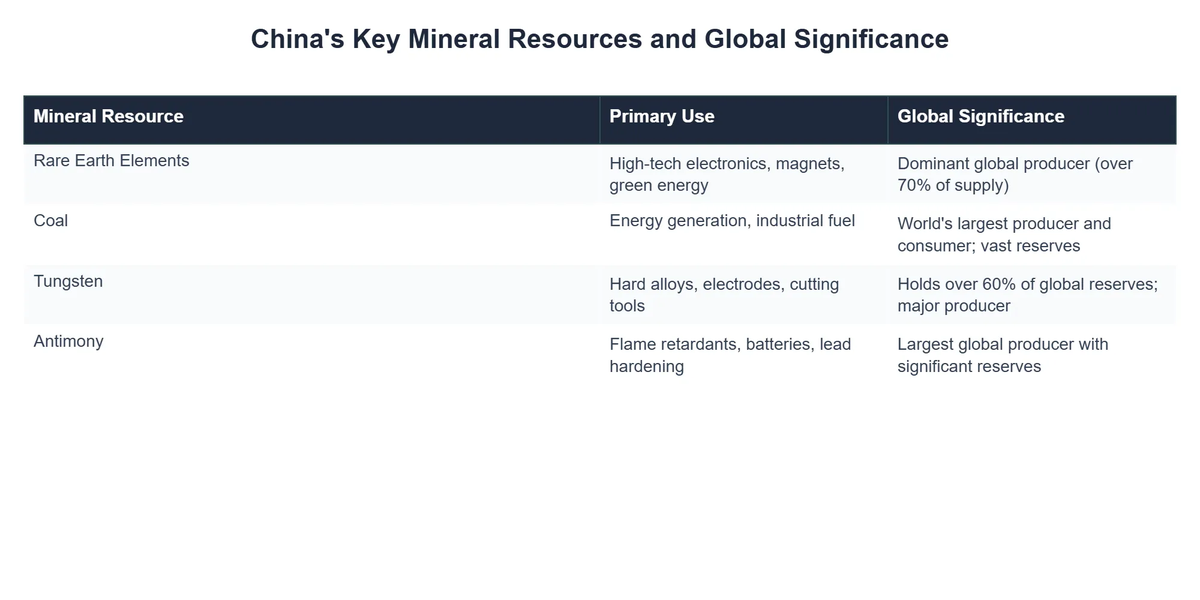
China is a global leader in the production and reserves of many critical minerals, a direct consequence of its complex and prolonged geological evolution. Its diverse geological settings have created prime conditions for the accumulation of vast economic deposits.
🔥 Coal and Hydrocarbons
China possesses some of the world’s largest coal reserves, primarily located in the north and northwest. These vast deposits were formed in ancient swamp environments during the Carboniferous and Permian periods. Significant oil and natural gas reserves are also found in various sedimentary basins across the country, including the Tarim, Ordos, and Sichuan Basins. For more on how these valuable resources form, explore Coal Geology: Formation, Resources, and the Future and Basin Geology: Formation and Resource Potential.
💎 Rare Earth Elements (REEs)
China dominates the global supply of Rare Earth Elements, essential for high-tech industries. These elements are concentrated in unique geological formations, particularly in the Baiyun Obo deposit, which is renowned for its vast REE and iron reserves.
⚒️ Base Metals and Iron Ore
The nation is rich in deposits of iron ore, copper, lead, zinc, and aluminum (bauxite). These metals are found in various geological settings, including magmatic, hydrothermal, and sedimentary deposits, distributed across different provinces. Advanced mineral exploration equipment is continuously employed to identify new reserves.
🌟 Other Strategic Minerals
Beyond these, China also holds significant reserves of gold, silver, tungsten, molybdenum, tin, and antimony, all critical for various industrial applications. The distribution and exploitation of these resources are often detailed in specialized publications and geological maps of China.

💧 Geothermal and Water Resources
Beyond traditional minerals, China’s geological activity also blesses it with substantial geothermal energy potential and critical groundwater resources.
♨️ Geothermal Potential
Due to its active tectonic setting, particularly along fault lines and in areas of recent volcanism, China has considerable geothermal energy potential. This clean energy source is increasingly being explored and utilized for power generation and heating.
🌊 Crucial Groundwater Systems
Groundwater is a vital resource for agriculture, industry, and domestic consumption, especially in arid and semi-arid regions. The major tectonic structures often influence the distribution and quality of these underground water reservoirs. The importance of these resources is highlighted in studies focusing on their value, such as Undervalued Groundwater Resources Over the Major Tectonic Features.
⚠️ Geological Hazards and Mitigation
While China’s geology provides abundant resources, it also presents significant challenges in the form of natural hazards, particularly in tectonically active regions.
tremors Earthquakes
Due to the ongoing collision of the Indian and Eurasian plates, China experiences frequent and often powerful earthquakes, especially in the western and southwestern regions (e.g., Sichuan, Yunnan, Xinjiang). Understanding fault lines and seismic activity is critical for infrastructure planning and disaster preparedness.
⛰️ Landslides and Floods
The steep topography, combined with heavy monsoon rains and seismic activity, makes many areas prone to landslides and mudslides. Additionally, major rivers originating from the Tibetan Plateau can cause devastating floods in downstream areas, necessitating extensive flood control measures.
🔬 Exploring China’s Geology: Tools and Resources
The study of China’s complex geology relies on a variety of scientific tools and resources, continuously advancing our understanding of this vast land.
- ✅ Geological Maps of China: These indispensable tools provide detailed insights into rock types, geological structures, and mineral occurrences, essential for both academic research and practical resource exploration.
- ✅ Advanced Mineral Exploration Equipment: From seismic surveys and remote sensing to drilling rigs and geochemical analysis tools, modern technology is crucial for discovering and assessing new mineral and energy deposits across China’s challenging terrains.
- ✅ Books on Asian Geology: For those seeking a deeper dive, numerous academic texts and specialized journals offer comprehensive overviews and detailed studies of China’s unique geological evolution and resource potential. These resources are invaluable for students, researchers, and industry professionals alike.
- ✅ Fieldwork and Remote Sensing: Geologists regularly conduct fieldwork to collect data and samples, complemented by satellite imagery and remote sensing technologies that provide broad-scale perspectives on geological features.
Recommended Video
Conclusion
China’s geology is a captivating narrative of ancient crustal evolution, monumental tectonic collisions, and an extraordinary endowment of natural resources. From the formation of vast cratons and mountain ranges to the deposition of critical minerals and energy reserves, the dynamic forces shaping the Earth have left an indelible mark on this expansive nation. While these geological processes contribute to immense wealth, they also bring significant challenges in the form of natural hazards.
Ongoing research, aided by sophisticated Geology.com: Your Ultimate Resource for Rocks and Minerals and continuous advancements in geological mapping and exploration, continues to unveil the secrets hidden beneath China’s surface. Understanding this intricate geological tapestry is not only an academic pursuit but a critical endeavor for sustainable development, resource management, and hazard mitigation in one of the world’s most geologically complex regions.
Frequently Asked Questions
What are the main geological features of China?
China’s geology is dominated by several ancient cratons (North China, Yangtze, Tarim) and younger mountain ranges like the Himalayas and Kunlun, formed by extensive tectonic activity.
How have tectonic forces influenced China’s landscape?
Plate collisions, especially the India-Eurasia collision, have created vast mountain ranges, high plateaus, and deep basins, leading to extreme topographical variations across China.
What kind of mineral resources are abundant in China?
China is exceptionally rich in coal, rare earth elements, iron ore, copper, gold, and bauxite, among many others, making it a global leader in mineral production.
Are there unique geological phenomena in China?
Yes, China is home to the Tibetan Plateau, the world’s highest and largest plateau, and active seismic zones due to ongoing plate movements, showcasing unique geological processes.