Tesla Bot (Optimus): Price, Capabilities, and Future
In the rapidly evolving landscape of robotics, one project has captured global attention: the Tesla Bot, known more formally as Optimus. Unveiled by Elon Musk, CEO of Tesla, this humanoid robot represents a bold step towards a future where intelligent machines seamlessly integrate into daily life, from industrial applications to potentially even household chores. But what exactly is Optimus, what can it do, how much might it cost, and what does its future hold?
💡 Key Takeaways
- Optimus aims for mass production, potentially lowering its price point significantly for widespread adoption.
- Its capabilities range from complex factory tasks to potential domestic assistance, leveraging advanced AI.
- The robot’s development signifies a major leap towards general-purpose humanoid AI and robotics.
- Ethical considerations and societal integration challenges are paramount as Optimus evolves.
“Optimus represents more than just a robot; it’s a profound step into a future where AI and physicality merge. The true challenge, and opportunity, lies in ensuring its integration elevates humanity ethically and responsibly.”
— Kira Chen, Futurist & AI Ethics Advocate
This comprehensive guide dives deep into the world of the Tesla Bot (Optimus), exploring its current capabilities, the ambitious vision behind its development, and the long-term implications for automation and society. Join us as we chart the course of tomorrow’s technology, examining the promises and challenges of Tesla’s foray into humanoid robotics.
In This Article
- → Tesla Bot (Optimus): Price, Capabilities, and Future
- — 💡 Key Takeaways
- → Understanding Tesla Bot (Optimus): What It Is
- — 💡 The Vision Behind Optimus
- — ⚙️ Initial Prototypes and Progress
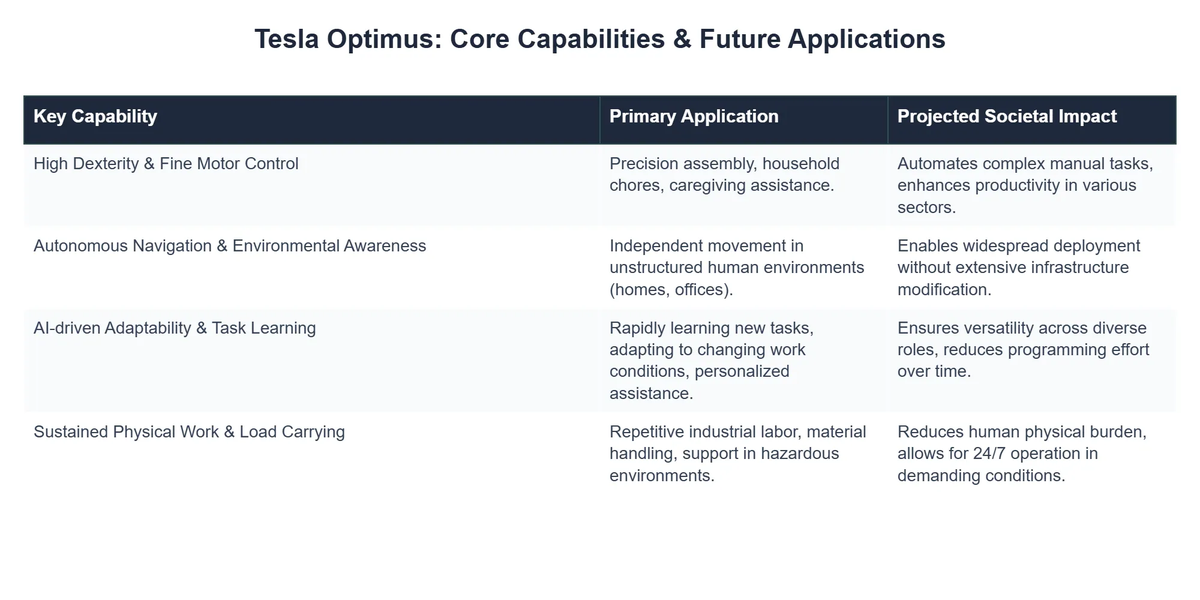
- → Current and Projected Capabilities of Optimus
- — 🦾 Core Design and Functionality
- — 🛠️ Demonstrated Abilities So Far
- — 🚀 Future Capability Roadmap
- → The Anticipated Price Tag: How Much Will an Optimus Tesla Cost?
- — 💸 Elon Musk’s Price Projections
- — 📈 Factors Influencing Tesla Bots Price
- → The Future of Tesla Bot: Beyond the Factory Floor
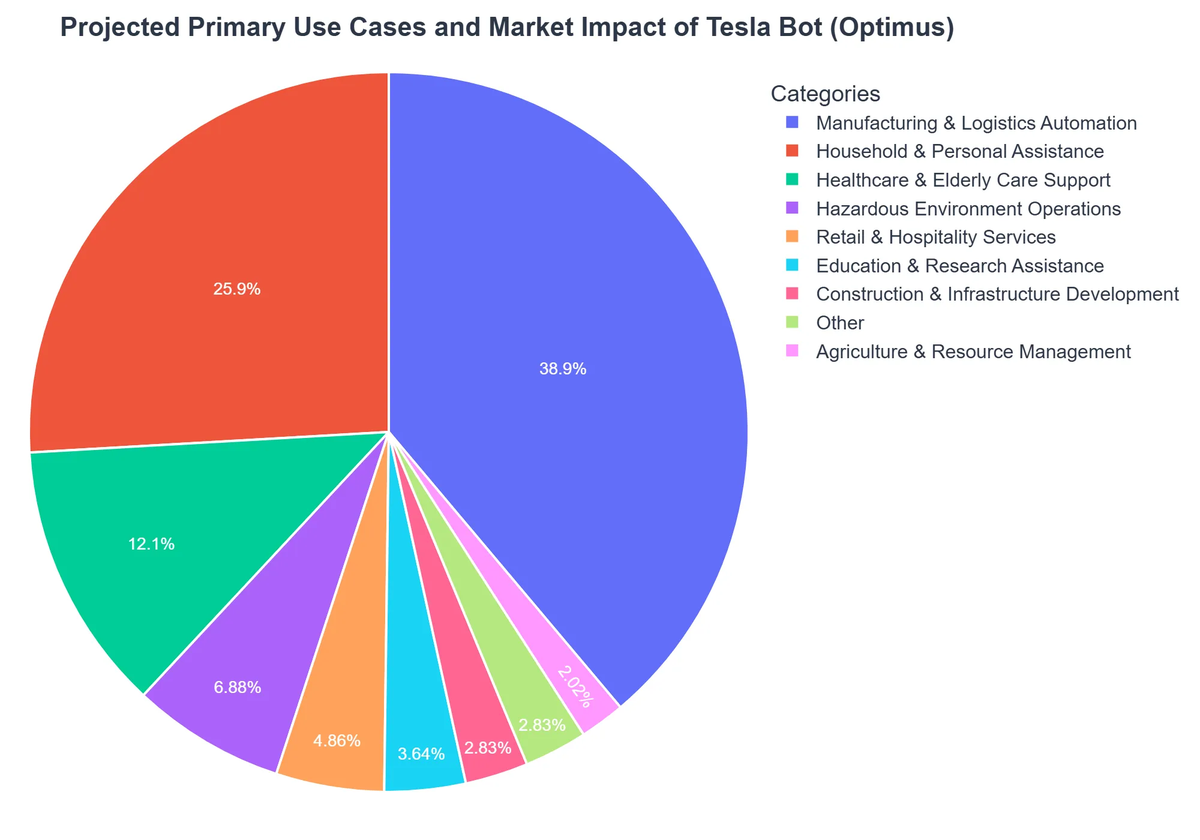
- — 🏭 Industrial and Manufacturing Applications
- — 🏡 Potential for Consumer and Home Use
- — 🌎 Societal Impact and Ethical Considerations
- → Challenges and Hurdles on the Road Ahead
- — ⚙️ Technical Complexities
- — 🗣️ Public Perception and Regulation
- → Conclusion
Understanding Tesla Bot (Optimus): What It Is

The Tesla Bot (Optimus) is a general-purpose humanoid robot being developed by Tesla Inc., a company primarily known for its electric vehicles and sustainable energy solutions. Announced at Tesla’s AI Day in 2021, Optimus is designed to perform repetitive, dangerous, or boring tasks that humans currently undertake.
💡 The Vision Behind Optimus
Elon Musk’s vision for Optimus extends beyond mere automation. He envisions a future where humanoid robots can augment human labor, address labor shortages, and ultimately contribute to a world of abundance. The underlying philosophy leverages Tesla’s extensive expertise in artificial intelligence (AI) and electric motor technology, refined through years of developing autonomous driving systems.
- ➡️ Humanoid Form Factor: Designed to navigate human-centric environments and use human-sized tools.
- ➡️ General Purpose: Unlike specialized industrial robots, Optimus aims to adapt to a wide array of tasks.
- ➡️ AI-Driven: Utilizes the same AI systems and neural networks developed for Tesla’s self-driving cars, adapting them for bipedal locomotion and dexterous manipulation.
⚙️ Initial Prototypes and Progress
Since its initial announcement, Tesla has showcased several iterations of the Optimus prototype. Early demonstrations focused on basic mobility and manipulation, emphasizing the rapid development progress. These events, typically Tesla AI Days, provide insights into the robot’s physical design and the company’s progress in developing the necessary AI and control systems.
For a detailed look at the evolution of Tesla’s humanoid robot, explore our article on Tesla Optimus Robot: Elon Musk’s Vision for Humanoid AI.
Current and Projected Capabilities of Optimus
While still in its developmental stages, the Optimus tesla has demonstrated an increasing range of capabilities, with ambitious projections for its future performance.
🦾 Core Design and Functionality
The design of the Tesla Bot (Optimus) emphasizes a balance of strength, agility, and human-like dexterity. It features:
- ✅ Advanced Actuators: Custom-designed electric actuators that provide high power density and smooth motion.
- ✅ Sensor Suite: Equipped with cameras (similar to those on Tesla vehicles), force sensors, and other inputs for environmental perception and interaction.
- ✅ Bipedal Locomotion: The ability to walk and maintain balance, crucial for navigating diverse environments.
🛠️ Demonstrated Abilities So Far
Public demonstrations have shown the tesla robot performing a variety of tasks, albeit often in controlled environments. These include:
- ➡️ Walking and balancing.
- ➡️ Picking up and moving objects.
- ➡️ Basic assembly tasks.
- ➡️ Navigating simple obstacles.
It’s important to note that these demonstrations represent milestones in a much longer developmental journey. The robot’s capabilities are continuously evolving as Tesla refines its hardware and AI.
🚀 Future Capability Roadmap
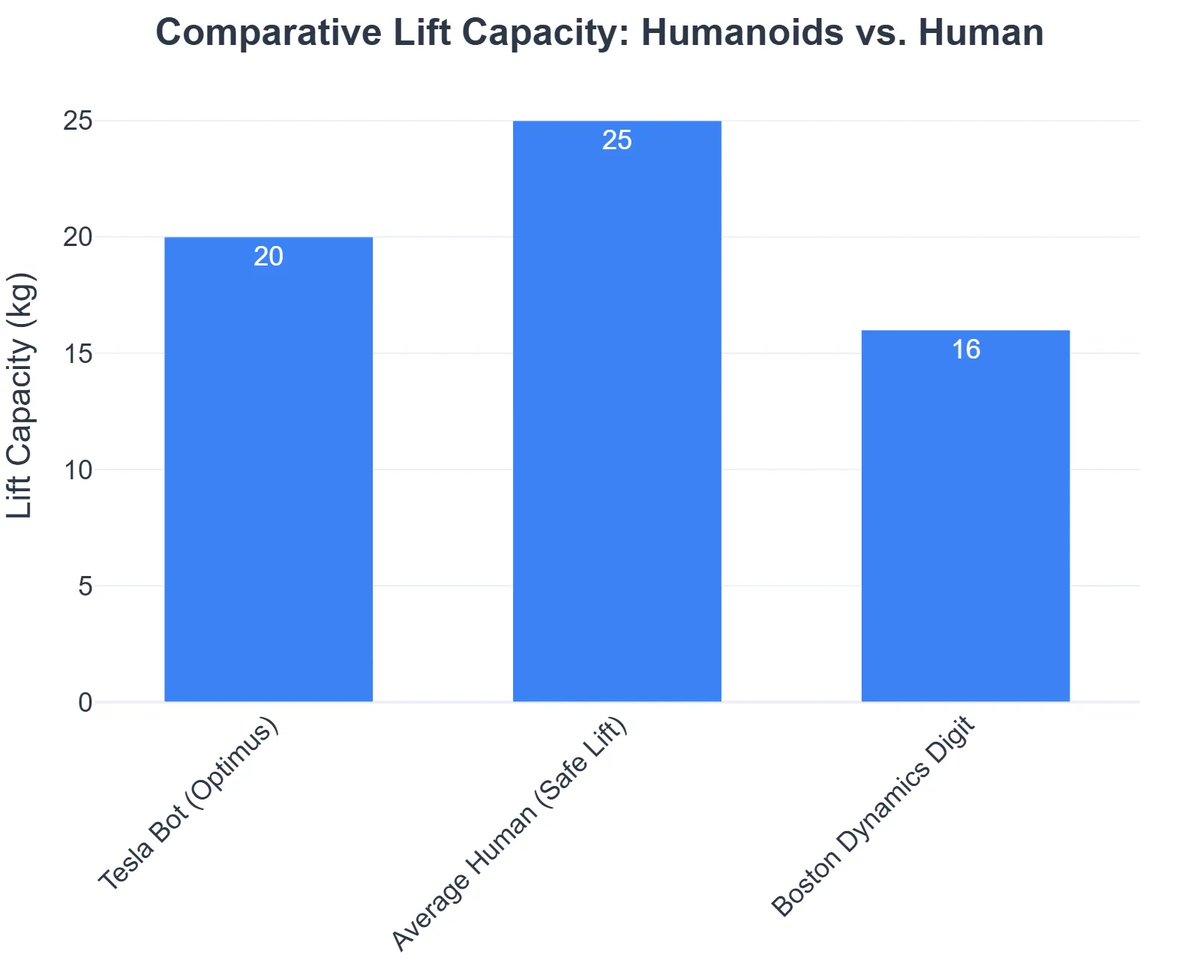
The long-term goal for Optimus is to achieve a level of general intelligence and dexterity that allows it to perform complex, unscripted tasks. This roadmap includes:
- 💡 Enhanced fine motor skills for delicate manipulation.
- 💡 Improved navigation in unstructured, dynamic environments.
- 💡 Advanced decision-making and problem-solving through sophisticated AI.
- 💡 Greater speed, strength, and endurance.
This vision aligns with the broader advancements in AI and robotics, promising a future where machines can handle diverse challenges. Learn more about how this vision ties into broader AI developments in our piece on Elon Musk Robots: Optimus, AI, and the Future of Automation.
The Anticipated Price Tag: How Much Will an Optimus Tesla Cost?
One of the most frequently asked questions about the Tesla Bot (Optimus) is its potential cost. While no official retail price has been announced, Elon Musk has offered significant hints regarding the target price point for the production version of the tesla robot cost.
💸 Elon Musk’s Price Projections
Musk has stated that he believes the Optimus robot will eventually cost “less than a car.” Specifically, he suggested a price target of around $20,000 in a 2022 earnings call. This ambitious price point is key to making the robot widely accessible and economically viable for a variety of applications.
According to a Reddit discussion about early projections, “Tesla’s Optimus robot will cost ‘less than a car’ in the future.” This reiterates Musk’s long-term vision for mass affordability.
“Tesla’s Optimus robot will cost ‘less than a car’ in the future.”
Achieving this price point would be a significant breakthrough in humanoid robotics, considering the typically high cost of advanced robotic systems like those from Boston Dynamics.
📈 Factors Influencing Tesla Bots Price
Several factors will determine the eventual tesla bots price:
- ✅ Mass Production: Tesla’s expertise in manufacturing at scale is crucial. High-volume production lines could significantly drive down unit costs, much like with electric vehicles.
- ✅ Component Costs: The price of sensors, actuators, batteries, and computing hardware will play a major role. Tesla’s vertical integration and in-house component development might provide an advantage.
- ✅ AI Development: The sophistication and autonomy of the AI system will influence its value, but the software development cost is amortized across all units.
- ✅ Market Demand: Widespread adoption would allow for further economies of scale, pushing prices down over time.
The goal is to make the Optimus robot an economically attractive alternative for tasks that are currently expensive, dangerous, or inefficient for humans.
The Future of Tesla Bot: Beyond the Factory Floor
The long-term vision for Tesla Bot (Optimus) extends far beyond manufacturing plants, promising a future where these robots could become ubiquitous, impacting various aspects of life and work.
Tesla Bot (Optimus): Advantages and Disadvantages
Pros
- ✔Potential to revolutionize labor, manufacturing, and daily life.
- ✔Aims for a significantly lower price point, increasing accessibility.
- ✔Designed as a general-purpose humanoid, adaptable to diverse tasks.
- ✔Leverages Tesla’s advanced AI and robotics expertise.
Cons
- ✖Current capabilities are limited compared to ambitious long-term goals.
- ✖Significant concerns regarding potential job displacement in various sectors.
- ✖Ethical and safety implications of widespread humanoid robot deployment.
- ✖Long development timeline with uncertain real-world availability and adoption.
🏭 Industrial and Manufacturing Applications
Initially, the most immediate application for Optimus is expected to be within Tesla’s own factories, performing tasks such as:
- ➡️ Moving parts and materials on assembly lines.
- ➡️ Performing quality control checks.
- ➡️ Assisting human workers with repetitive or ergonomically challenging tasks.
This internal deployment will serve as a crucial testing ground, allowing Tesla to refine Optimus’s capabilities in real-world, high-stakes environments before broader commercialization.
🏡 Potential for Consumer and Home Use
While a more distant prospect, Elon Musk has openly discussed the potential for Optimus to serve as a companion or helper in domestic settings. Imagine a tesla robot capable of:
- ✅ Doing laundry and washing dishes.
- ✅ Mowing the lawn or performing garden maintenance.
- ✅ Assisting the elderly or those with mobility challenges.
- ✅ Performing dangerous tasks, such as cleaning gutters or inspecting roofs.
This vision aligns with the broader theme of Future Perfect?: Charting the Course of Tomorrow’s Technology, where advanced robotics becomes an integral part of daily human existence.
🌎 Societal Impact and Ethical Considerations
The widespread deployment of advanced humanoid robots like Optimus will undoubtedly have profound societal implications. Discussions around job displacement, the ethics of AI, and robot-human interaction will become increasingly critical.
- 💡 Economic Shifts: Potential for increased productivity but also concerns about labor markets.
- 💡 Safety Protocols: Ensuring robots can operate safely alongside humans in diverse environments.
- 💡 Ethical AI Development: Designing robots with responsible AI that prioritizes human well-being and avoids bias.
Understanding these challenges is vital for shaping a beneficial future for humanity. For a broader perspective on the ethical considerations in AI, you might find our article on Timnit Gebru: A Voice for Ethical AI and Algorithmic Justice insightful.
Challenges and Hurdles on the Road Ahead
Despite the ambitious vision and progress, the development of a truly general-purpose humanoid robot like Optimus faces significant challenges.
⚙️ Technical Complexities
Creating a robot that can reliably perform a wide range of tasks in unstructured environments is immensely difficult. Key technical hurdles include:
- ➡️ Dexterous Manipulation: Replicating the nuanced hand-eye coordination and fine motor skills of humans is incredibly complex.
- ➡️ Robust Navigation: Dealing with unpredictable obstacles, slippery surfaces, and dynamic environments without failure.
- ➡️ Energy Efficiency: Designing a battery system that provides sufficient operating time without making the robot too heavy or cumbersome.
- ➡️ AI Generalization: Moving beyond specific trained tasks to truly understand and adapt to novel situations.
🗣️ Public Perception and Regulation
Beyond the technical aspects, the societal acceptance and regulatory framework for humanoid robots are still nascent. Public perception, often shaped by science fiction, can range from excitement to apprehension.
- ✅ Addressing fears of job displacement or “robot takeovers.”
- ✅ Developing clear legal and ethical guidelines for robot autonomy and accountability.
- ✅ Ensuring transparency in AI decision-making.
Overcoming these challenges will require not only technological breakthroughs but also thoughtful public discourse and proactive policy-making.
Recommended Video
Conclusion
The Tesla Bot (Optimus) represents one of the most ambitious and closely watched projects in modern robotics. While still in its early stages, the vision for a widely available, general-purpose humanoid robot costing “less than a car” has the potential to revolutionize industries and transform daily life. Tesla’s approach, leveraging its formidable AI and manufacturing prowess, positions Optimus as a significant contender in the race to bring advanced humanoid robots to the masses.
As the development continues, the world watches to see if Optimus can live up to its promise, navigating the complex technical, economic, and ethical landscapes to truly chart the course of tomorrow’s technology. Its success could redefine the future of work, leisure, and human-machine interaction, making the “Future Perfect?” not just a question, but a tangible reality for a new era of automation.
Frequently Asked Questions
What is Tesla Bot (Optimus)?
Tesla Bot, or Optimus, is a humanoid robot developed by Tesla Inc., designed for general-purpose, repetitive tasks in manufacturing and potentially domestic settings, aiming for mass production.
How much is Tesla Optimus expected to cost?
Elon Musk has indicated that the Tesla Optimus robot is projected to cost under $20,000, with the goal of making it affordable for widespread adoption, similar to a car.
What are Optimus’s primary capabilities?
Optimus is designed to perform a wide range of tasks, from material handling in factories and precise assembly work to potentially assisting with household chores, leveraging advanced AI for learning and adaptation to new environments.
When will Optimus be commercially available?
While prototypes have been demonstrated, a definitive timeline for Optimus’s commercial availability to the general public has not been firmly established, with development and refinement ongoing.