

Exploring Alternative Cosmological Models: Big Bounce and Big Crunch
In the vast realm of cosmology, our understanding of the universe’s origin, evolution, and ultimate fate is continuously evolving. While the Big Bang model currently stands as the prevailing paradigm, it doesn’t offer the only lens through which to view cosmic history. Scientists and theorists relentlessly explore alternative frameworks, seeking to resolve lingering puzzles and push the boundaries of our knowledge. Among the most compelling of these alternatives are the concepts of the Big Bounce and the Big Crunch, which propose vastly different endgames—and even beginnings—for the cosmos.
💡 Key Takeaways
- The Big Bounce proposes the universe undergoes cycles of expansion and contraction, avoiding a singular Big Bang.
- The Big Crunch theory suggests a hypothetical end-state where the universe collapses back on itself due to gravity.
- These alternative models explore the universe’s ultimate fate and its potential origins without a definitive start.
- They often involve a cyclical or oscillating universe, implying an eternal existence rather than a discrete beginning and end.
“The Big Bounce and Big Crunch hypotheses offer compelling narratives for a universe that breathes, expands, and contracts, challenging our linear perceptions of cosmic time and presenting a universe that might be eternally reborn.”
— Astrid Bellweather, Astrophysicist & Science Communicator
In This Article
- → Exploring Alternative Cosmological Models: Big Bounce and Big Crunch
- — 💡 Key Takeaways
- → The Standard Model’s Trajectory: From Big Bang to Big Freeze
- → The Big Crunch: A Universe Reversing Course
- — 🤔 What is the Big Crunch?
- — ⚙️ Key Mechanics of the Big Crunch
- — 💡 Implications for the Universe’s Fate
- → The Big Bounce: A Cyclical Universe Without a Beginning
- — 🌀 What is the Big Bounce?
- — ⚙️ Mechanics of a Bouncing Universe
- — 💡 Overcoming the Singularity
- → Big Bounce vs. Big Crunch: Key Distinctions and Similarities
- — ➡️ Initial Conditions and Origins
- — ➡️ Outcome and Cyclicity
- — ➡️ Observational Evidence and Constraints
- → Challenges and Evidence: Probing the Models
- — 🔭 Support for the Big Bounce
- — ⚠️ Challenges for the Big Crunch
- — 🌊 Gravitational Waves and the Early Universe
- → The Quest for an Alternative to Big Bang
- — 🌌 Addressing Singularities
- — 💡 The Enigma of Dark Energy
- → The Future of Cosmic Models: A Universe of Possibilities
The Standard Model’s Trajectory: From Big Bang to Big Freeze
To fully appreciate the significance of the Big Bounce and the Big Crunch, it’s crucial to first understand the standard cosmological model. The Big Bang theory posits that the universe began approximately 13.8 billion years ago from an extremely hot, dense state, often described as a singularity, and has been expanding and cooling ever since. This model is strongly supported by a wealth of observational evidence, including:
- ✅ The observed expansion of the universe (Hubble’s Law).
- ✅ The cosmic microwave background (CMB) radiation, a relic heat from the early universe.
- ✅ The abundance of light elements (hydrogen, helium, lithium) formed in the early universe.
- ✅ The formation and distribution of galaxies and large-scale cosmic structures.
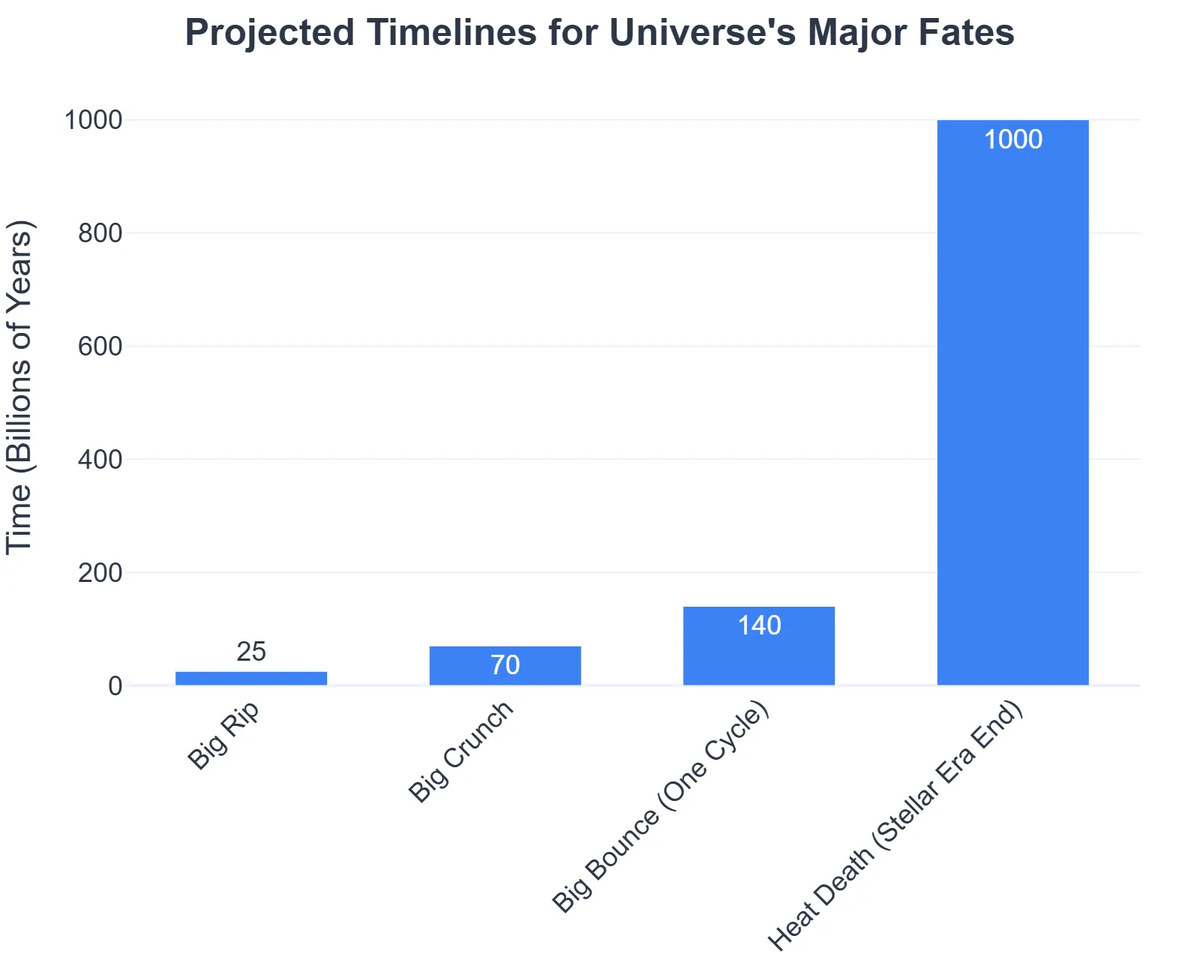
Under the standard model, the most likely ultimate fate of the universe, given the observed accelerated expansion driven by dark energy, is the “Big Freeze” or “Heat Death.” In this scenario, the universe continues to expand indefinitely, galaxies drift apart, stars exhaust their fuel, black holes evaporate, and the cosmos cools to a state of maximum entropy, with no usable energy left. This is a universe that ends not with a bang, but with an endless, cold whisper. However, the Big Bang model, despite its successes, does present theoretical challenges, particularly concerning the initial singularity and the nature of dark energy, paving the way for alternative theories like the ones we’ll explore.
The Big Crunch: A Universe Reversing Course
🤔 What is the Big Crunch?
The Big Crunch is a theoretical ultimate fate of the universe in which the expansion of the universe eventually reverses and the universe begins to contract. This model stands in direct opposition to the Big Freeze scenario, suggesting a cyclical or self-contained existence for the cosmos. For the Big Crunch to occur, the average density of matter and energy in the universe would need to be sufficiently high to overcome the outward momentum of the initial expansion.
⚙️ Key Mechanics of the Big Crunch
In the Big Crunch scenario, gravity would eventually dominate the universe’s expansion. Here’s a simplified breakdown of the process:
- ➡️ Deceleration: Initially, the universe’s expansion would slow down as the gravitational pull of all its matter and energy exerted its influence.
- ➡️ Contraction Begins: If the critical density is surpassed, the expansion would halt entirely, and then the universe would begin to shrink.
- ➡️ Increasing Density and Temperature: As the universe contracts, galaxies would draw closer, then merge. Stars and planets would collide. The temperature of the cosmic microwave background would dramatically increase.
- ➡️ Reaching a Singularity: The ultimate conclusion of the Big Crunch is a return to a state remarkably similar to the Big Bang singularity – a point of infinite density and temperature.
The primary factor determining whether a Big Crunch occurs is the universe’s density parameter (Ω). If Ω > 1, meaning the universe is “closed,” then a Big Crunch is possible. Current observations, however, suggest Ω is very close to 1, or perhaps slightly less, indicating a flat or open universe that would expand forever.
💡 Implications for the Universe’s Fate
The implications of a Big Crunch are profound. Instead of an infinite, cold death, the universe would experience a cataclysmic collapse. For any life existing at that distant future epoch, the end would be marked by unimaginable heat and compression. Some theories even suggest that this singular point could then trigger another Big Bang, leading to a cyclical universe – an idea closely related to the Big Bounce, which we’ll discuss next. For more on how the universe might end, read our comparison on Big Bounce vs. Big Freeze: The Universe’s Competing Fates.
The Big Bounce: A Cyclical Universe Without a Beginning
🌀 What is the Big Bounce?
The Big Bounce theory proposes an alternative to the Big Bang’s initial singularity, suggesting that the universe didn’t begin from nothing but rather emerged from the collapse of a previous universe. In this model, the Big Bang was not the absolute beginning of space and time, but a “bounce” point where a contracting universe reached a minimum size and then expanded again. It’s an endlessly recurring cycle of contraction and expansion, a truly cyclical universe.
⚙️ Mechanics of a Bouncing Universe
The Big Bounce model requires modifications to Einstein’s General Theory of Relativity, or the inclusion of exotic matter or energy forms, to prevent the formation of a singularity during the collapse. Here’s how it generally works:
- ✅ Previous Contraction: A preceding universe undergoes a period of contraction, much like the Big Crunch.
- ✅ The Bounce: As the contracting universe approaches a point of immense density, but crucially, before reaching a singularity, quantum gravitational effects, or other theoretical physics phenomena (e.g., negative energy density, emergent gravity), exert a repulsive force. This repulsion overcomes the gravitational attraction, causing the collapse to halt.
- ✅ New Expansion: Immediately after this “bounce,” the universe begins a new phase of expansion, which we observe as our current Big Bang.
- ✅ Perpetual Cycle: This cycle could repeat infinitely, with each “Big Bounce” giving rise to a new universe.
One of the primary motivations for the Big Bounce is to resolve the singularity problem inherent in the standard Big Bang model. A singularity represents a point where known physics breaks down, making it challenging to understand the universe’s true initial conditions. Bouncing models offer a way around this, suggesting a smooth transition through a finite minimum size. Recent studies, incorporating various gravity theories, continue to explore the viability of such scenarios. You can delve deeper into advanced models here: Comprehensive study of bouncing cosmological models in f(Q,T) gravity.
💡 Overcoming the Singularity
The concept of the Big Bounce offers an elegant solution to the singularity problem. Instead of an inexplicable point of infinite density, the universe simply undergoes a turnaround. This avoids the need for new physics at the very moment of creation, instead proposing that the physics of gravity and quantum mechanics interact in a way that prevents infinite compression. This approach resonates with various theories of quantum gravity that aim to smooth out the initial conditions of the universe. Some models, for instance, utilize alternative gravity theories or loop quantum gravity principles to facilitate this non-singular bounce. Further research on this topic can be found through resources like Cosmological bouncing solutions in f(T,B) gravity.
Big Bounce vs. Big Crunch: Key Distinctions and Similarities
While both the Big Bounce and the Big Crunch propose a universe that does not expand forever, their fundamental differences lie in their relationship to the beginning and the nature of the “collapse.”
➡️ Initial Conditions and Origins
- ✅ Big Crunch: Assumes an initial Big Bang, with the expansion eventually reversing due to overwhelming gravity. It’s an end-state for a universe that had a singular beginning.
- ✅ Big Bounce: Eliminates the Big Bang singularity as a true “beginning.” Instead, it suggests that the current expansion is merely a rebound from a prior contraction, implying an eternal cycle with no absolute start or end. It’s a cyclical process rather than a linear one.
➡️ Outcome and Cyclicity
- ✅ Big Crunch: Ends in a singularity, similar to the Big Bang. Whether this singularity then leads to a new Big Bang (thus becoming part of a Big Bounce scenario) is an extension, not an inherent part, of the “Big Crunch” definition itself.
- ✅ Big Bounce: Inherently implies cyclicity. The bounce is the mechanism by which one cosmic epoch transitions into the next, ensuring an infinite sequence of expanding and contracting universes. This addresses the question of what came before the Big Bang.
➡️ Observational Evidence and Constraints
Currently, direct observational evidence for either the Big Bounce or the Big Crunch is limited. The observed accelerating expansion of our universe, driven by dark energy, strongly disfavors a simple Big Crunch scenario, as this expansion works against gravity. However, this doesn’t entirely rule out more complex models where dark energy’s influence might change over vast cosmic timescales. The Big Bounce, on the other hand, might leave subtle imprints on the cosmic microwave background or gravitational waves that future instruments could detect, though these are highly speculative at present.
Understanding these different cosmic fates is part of the broader field of Cosmic Evolution: Understanding the Story of Everything, where scientists strive to piece together the universe’s full narrative.
Challenges and Evidence: Probing the Models
🔭 Support for the Big Bounce
While direct evidence for a Big Bounce remains elusive, theoretical developments continue to bolster its conceptual appeal:
- ✅ Singularity Avoidance: As mentioned, it resolves the problematic singularity of the Big Bang, offering a smoother, physically consistent transition.
- ✅ Inflation Alternative: Some bouncing models can naturally explain the large-scale homogeneity and flatness of the universe without needing a period of cosmic inflation, which is another area of active research.
- ✅ Quantum Gravity: Theories of quantum gravity, such as Loop Quantum Cosmology, provide mechanisms for the bounce to occur, suggesting that gravity becomes repulsive at extreme densities.
The quest for observational signatures often focuses on searching for deviations from standard predictions in the Cosmic Microwave Background (CMB) or primordial gravitational waves, which could carry echoes of a pre-bounce universe.
⚠️ Challenges for the Big Crunch
The primary challenge for the Big Crunch model is the overwhelming evidence for dark energy and the accelerating expansion of the universe. Current data suggests the universe is flat and will continue to expand indefinitely. For a Big Crunch to occur, either:
- ➡️ Dark Energy Disappears: Dark energy would need to weaken significantly or disappear entirely in the future.
- ➡️ Dark Energy Reverses: Even more speculatively, dark energy could somehow reverse its repulsive effect and become attractive, leading to a “Big Rip” followed by a “Big Crunch” or a direct reversal.
These scenarios would require radical shifts in our understanding of fundamental forces and cosmic constituents.
🌊 Gravitational Waves and the Early Universe
The study of gravitational waves offers a promising avenue for probing the very early universe and potentially distinguishing between these models. If a Big Bounce occurred, it might leave a characteristic imprint on the spectrum of primordial gravitational waves, distinct from those predicted by inflationary Big Bang models. Detecting and analyzing these faint ripples in spacetime could provide crucial data, pushing the boundaries of what we know about the universe’s true genesis. This area of research is pushing the boundaries of Cosmic Queries: Probing the Mysteries of the Universe.
Recommended Video
The Quest for an Alternative to Big Bang
The pursuit of alternative cosmological models is not an attempt to discredit the Big Bang, but rather to explore its boundaries and address its open questions. The Big Bang model, while incredibly successful, has certain aspects that remain theoretical puzzles. This is where models like the Big Bounce and the Big Crunch provide valuable theoretical frameworks.
🌌 Addressing Singularities
One of the most profound motivations for bouncing cosmologies is the elimination of the initial singularity. In physics, a singularity implies a breakdown of the laws of nature, where quantities become infinite. Avoiding this means our models can potentially describe the universe’s behavior through its entire history, even at the very earliest moments. This is a significant theoretical hurdle that alternatives seek to overcome.
💡 The Enigma of Dark Energy
The discovery of dark energy’s role in accelerating the universe’s expansion has profoundly shaped our understanding of its future. While it strongly disfavors a simple Big Crunch, it also presents its own set of mysteries. Some alternative models, including variations of bouncing cosmologies, attempt to incorporate or explain dark energy within their framework, sometimes even suggesting that dark energy itself could evolve in ways that allow for a future contraction or bounce. This complex interplay of forces and energy density is what defines the fate of the universe’s fate.
The exploration of such complex ideas, including the possibility of multiverses or preceding cosmic cycles, highlights the ever-evolving nature of scientific inquiry. For a deeper dive into another fascinating cyclical model, consider reading about Conformal Cyclic Cosmology: Is the Universe Born Again and Again?.
The Future of Cosmic Models: A Universe of Possibilities
The Big Bounce and Big Crunch models, while currently lacking definitive observational proof, represent vital theoretical explorations into the universe’s fundamental nature. They challenge us to think beyond a linear timeline and consider the possibility of a cyclical, perhaps even eternal, cosmos. As our instruments become more sophisticated and our theoretical understanding of quantum gravity deepens, we may one day gather the crucial evidence needed to confirm or refute these compelling alternatives. For now, they serve as powerful reminders of the profound mysteries that still lie at the heart of existence, continuously pushing the boundaries of what we know about the universe’s fate.
What is the Big Bounce theory?
The Big Bounce is a cosmological model where the universe undergoes an infinite series of expansions and contractions, with each ‘bounce’ occurring at a minimum size, avoiding a Big Bang singularity.
How does the Big Crunch differ from the Big Bounce?
The Big Crunch is a hypothetical end-state where the universe collapses back on itself due to gravity. The Big Bounce includes a Big Crunch-like phase, but it’s followed by a new expansion, making it a cyclical theory.
Are these theories supported by current evidence?
Currently, the standard Big Bang model with cosmic inflation is widely accepted. Big Bounce and Big Crunch are alternative theoretical models, with ongoing research and no direct observational evidence yet.
What is the main challenge for cyclical universe models?
One major challenge for cyclical models is accounting for the continuous increase in entropy with each cycle, and explaining the physics of how the universe could ‘bounce’ through an extremely dense state without breaking down.