Understanding Black Holes: A Comprehensive Guide to Cosmic Gravity Wells
In the vast expanse of the cosmos, few phenomena capture the imagination quite like a black hole. These enigmatic regions of spacetime are not merely empty voids, but incredibly dense objects where gravity’s pull is so immense that nothing—not even light—can escape. They represent the ultimate triumph of gravity, bending the fabric of the universe in ways that defy our everyday intuition.
💡 Key Takeaways
- Black holes are regions of spacetime where gravity is so strong that nothing, not even light, can escape.
- They form from the remnants of massive stars that collapse at the end of their life cycles.
- There are different types, including stellar-mass, supermassive, and potentially primordial black holes.
- The ‘event horizon’ is the point of no return around a black hole, beyond which escape is impossible.
“Understanding black holes isn’t just about cosmic giants; it’s about pushing the very limits of our comprehension of gravity and the universe’s most extreme phenomena.”
— Astrid Bellweather, Astrophysicist & Science Communicator
For anyone seeking to unravel the profound mysteries of the universe, comprehending what is a black hole is a fundamental step. This guide will delve deep into the mechanics, types, and implications of these cosmic behemoths, offering a clear and authoritative resource.
In This Article
- → Understanding Black Holes: A Comprehensive Guide to Cosmic Gravity Wells
- — 💡 Key Takeaways
- → 🌌 What Exactly is a Black Hole? Decoding the Cosmic Mystery
- — Event Horizon: The Point of No Return
- — The Singularity: Where Physics Breaks Down
- → 🔬 How Do Black Holes Form? The Lifecycle of Giants
- — Stellar-Mass Black Holes: The Remnants of Supernovae
- — Supermassive Black Holes: The Galactic Architects
- → 🔭 Types of Black Holes: A Cosmic Classification
- — Primordial Black Holes: Theoretical Relics of the Early Universe
- — Intermediate-Mass Black Holes (IMBHs): The Missing Link?
- → ⚡️ How Do We Detect Black Holes? The Invisible Behemoths
- — Accretion Disks and X-Ray Emissions
- — Gravitational Lensing: Bending Light
- — Gravitational Waves: Ripples in Spacetime
- → 🚀 What Happens If You Fall Into a Black Hole? A Journey Beyond Imagination
- — Spaghettification: The Ultimate Stretch
- — Time Dilation: A Warped Reality
- → ☢️ Do Black Holes Evaporate? The Enigma of Hawking Radiation
- — Quantum Mechanics and Particle-Antiparticle Pairs
- — Black Hole Evaporation: A Slow Demise
- → 🌌 Black Holes and the Universe: More Than Just Destroyers
- — Galaxy Formation and Evolution
- — Cosmic Recycling and Future Implications
🌌 What Exactly is a Black Hole? Decoding the Cosmic Mystery
At its core, a black hole is a region of spacetime exhibiting such strong gravitational effects that nothing—no particles or even electromagnetic radiation like light—can escape from inside it. The theory of general relativity predicts that a sufficiently compact mass can deform spacetime to form a black hole.
This extreme gravitational pull is a direct consequence of an immense amount of matter being compressed into an incredibly small space. Imagine taking something as massive as our Sun and squeezing it down to the size of a city – that’s the kind of density we’re talking about.
Event Horizon: The Point of No Return
The boundary of no return around a black hole is known as the event horizon. This isn’t a physical surface, but rather a theoretical boundary beyond which the escape velocity exceeds the speed of light. Any object or light crossing this boundary is inevitably pulled into the singularity.
- ✅ Beyond the event horizon, all paths lead inward, towards the singularity.
- ➡️ It’s the “point of no return” for anything, including light.
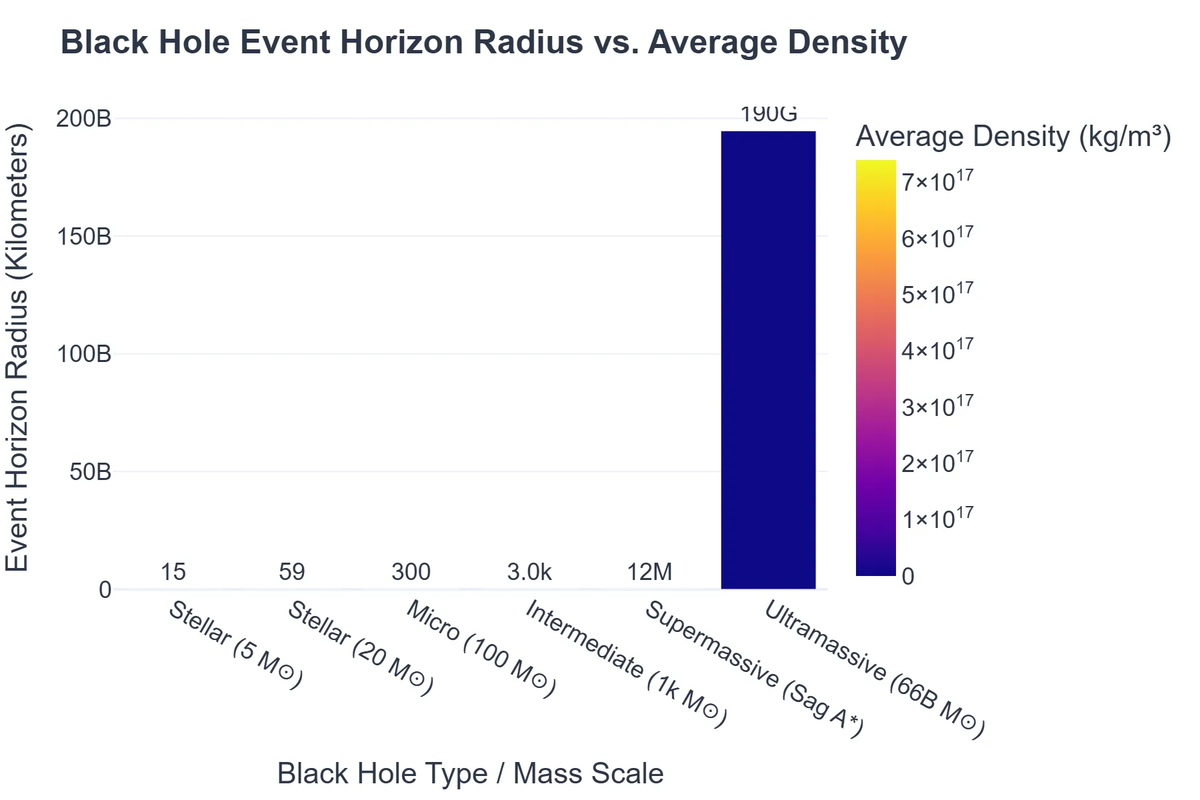
- 💡 The size of the event horizon is directly proportional to the black hole’s mass.
The Singularity: Where Physics Breaks Down
At the very center of a black hole lies the singularity, a point where matter is compressed to infinite density, and spacetime curvature becomes infinite. Here, the laws of physics as we currently understand them break down, making it one of the most mysterious aspects of these cosmic entities.

- ✅ A point of infinite density and zero volume.
- ➡️ Where the laws of general relativity no longer fully apply.
- 💡 It’s the ultimate destination for anything that crosses the event horizon.
🔬 How Do Black Holes Form? The Lifecycle of Giants
The formation of black holes is a fascinating journey rooted in the extreme physics of the universe. The most common pathway involves the catastrophic collapse of massive stars.
Stellar-Mass Black Holes: The Remnants of Supernovae
The vast majority of black holes we’ve detected are stellar-mass black holes. These form when a star, at least 20 times more massive than our Sun, exhausts its nuclear fuel. Without the outward pressure from fusion to counteract gravity, the star’s core collapses in on itself.
- ✅ Core collapses under immense gravity.
- ➡️ Triggers a supernova explosion, blowing off outer layers.
- 💡 The remaining core, if sufficiently massive, becomes a black hole.
This stellar collapse is one of the most violent events in the cosmos, briefly outshining entire galaxies. The remaining incredibly dense core is what we identify as a stellar black hole. For more details on these cosmic giants, read our guide on Black Holes: Unveiling the Mysteries – A Comprehensive Guide.
Supermassive Black Holes: The Galactic Architects
These are the titans of the black hole world, with masses ranging from millions to billions of times that of our Sun. They reside at the centers of nearly every large galaxy, including our own Milky Way, where Sagittarius A* (Sgr A*) lurks.
- ✅ Found at the center of most galaxies.
- ➡️ Their formation mechanisms are still debated.
- 💡 May grow by accreting gas, dust, and even other stars.
The exact process of their formation is still a hot topic among astrophysicists. Theories include direct collapse from massive gas clouds in the early universe, or the merger of smaller black holes over cosmic time scales. The link between supermassive black holes and galaxy evolution is profound; they are integral to the structure and development of galaxies.
🔭 Types of Black Holes: A Cosmic Classification
While the fundamental properties of all black holes are governed by gravity, their origins and scales lead to distinct classifications. Understanding these types of black holes helps us appreciate their diverse roles in the universe.
Black Holes: Insights and Complexities
Pros
- ✔Advances fundamental understanding of gravity and spacetime.
- ✔Offers insights into galaxy formation and cosmic evolution.
- ✔Drives cutting-edge research in astrophysics and theoretical physics.
- ✔Highlights the extreme and mysterious nature of the universe.
Cons
- ✖Concepts are highly abstract and counter-intuitive for many.
- ✖Direct observation and experimentation are extremely challenging.
- ✖Many theoretical aspects remain unconfirmed and speculative.
- ✖Can be conceptually daunting for non-experts to fully grasp.
Primordial Black Holes: Theoretical Relics of the Early Universe
These hypothetical black holes are thought to have formed not from collapsing stars, but from the extreme pressures and densities present in the very early universe, shortly after the Big Bang.
- ✅ Formed in the nascent universe.
- ➡️ Range in size from microscopic to thousands of solar masses.
- 💡 Their existence is still theoretical but could explain dark matter.
Intermediate-Mass Black Holes (IMBHs): The Missing Link?
These are the elusive middle child of the black hole family, with masses ranging from hundreds to hundreds of thousands of solar masses. Their existence is still being debated and actively searched for.
- ✅ Bridge the gap between stellar and supermassive black holes.
- ➡️ May form from runaway stellar collisions in dense star clusters.
- 💡 Their discovery would fill a critical gap in our understanding of black hole evolution.
⚡️ How Do We Detect Black Holes? The Invisible Behemoths
Since black holes don’t emit light, detecting them directly is impossible. However, their immense gravitational pull leaves unmistakable fingerprints on their surroundings.
Accretion Disks and X-Ray Emissions
When a black hole pulls in matter (gas, dust, or even stars), this material forms a swirling accretion disk around it. As particles in the disk rub against each other due to friction and intense gravity, they heat up to millions of degrees, emitting powerful X-rays.
- ✅ Matter forms a superheated disk.
- ➡️ Emits characteristic X-rays, detectable by telescopes.
- 💡 This is one of the most common ways to infer a black hole’s presence.
Gravitational Lensing: Bending Light
According to Einstein’s theory of general relativity, massive objects like black holes can bend the path of light. This phenomenon, called gravitational lensing, can distort or magnify the light from background objects, providing indirect evidence of a black hole’s presence.
- ✅ Warps spacetime, bending light around it.
- ➡️ Creates distorted images of background galaxies or stars.
- 💡 A powerful tool for detecting massive, unseen objects.
Gravitational Waves: Ripples in Spacetime
When massive objects like black holes accelerate or collide, they create ripples in the fabric of spacetime known as gravitational waves. These waves were directly detected for the first time in 2015 by the LIGO experiment, confirming a key prediction of general relativity and opening a new window into observing the universe.
- ✅ Generated by merging black holes or neutron stars.
- ➡️ Detected as tiny distortions in spacetime.
- 💡 Provides direct evidence of black hole mergers.
The detection of gravitational waves from merging black holes has revolutionized our understanding of a black hole system and the universe’s most violent events. For more on this, check out our piece on Ultimate Guide to Black Holes: A Comprehensive List.
🚀 What Happens If You Fall Into a Black Hole? A Journey Beyond Imagination
The concept of falling into a black hole is a staple of science fiction, but what would truly happen according to physics? It’s a journey that defies anything we experience on Earth.
Spaghettification: The Ultimate Stretch
As you approach a stellar-mass black hole, the gravitational pull on your feet (closer to the black hole) would be significantly stronger than on your head (further away). This differential in gravity would stretch your body like spaghetti, a process dramatically known as spaghettification.
- ✅ Caused by extreme tidal forces.
- ➡️ Your body would be stretched lengthwise and compressed sideways.
- 💡 More pronounced for smaller, stellar black holes.
Time Dilation: A Warped Reality
Near a black hole, time itself behaves strangely due to the intense gravity. An observer far away would see your clock ticking slower and slower as you approached the event horizon, eventually appearing to freeze as you cross it. For you, however, time would continue normally.
- ✅ Time appears to slow down for an outside observer.
- ➡️ Within the black hole, time and space swap roles.
- 💡 A powerful demonstration of Einstein’s general relativity.
For a detailed exploration of this mind-bending concept, refer to our comprehensive article on Entering a Black Hole: A Journey Beyond the Event Horizon.
☢️ Do Black Holes Evaporate? The Enigma of Hawking Radiation
For a long time, black holes were thought to be eternal, consuming everything without end. However, in the 1970s, Stephen Hawking proposed a revolutionary idea: black holes aren’t entirely black.
Quantum Mechanics and Particle-Antiparticle Pairs
According to quantum mechanics, empty space is not truly empty. Instead, pairs of “virtual” particles and antiparticles are constantly popping into existence and annihilating each other. Near the event horizon of a black hole, one particle from a pair might fall in while the other escapes.
- ✅ Virtual particle-antiparticle pairs emerge near the event horizon.
- ➡️ One particle falls in, the other escapes.
- 💡 The escaping particle carries away energy, causing the black hole to lose mass.
Black Hole Evaporation: A Slow Demise
The escaping particle effectively carries away energy from the black hole, meaning the black hole slowly loses mass and shrinks over an incredibly long period. This process is known as Hawking radiation.
- ✅ Black holes are not entirely “black” and can lose mass.
- ➡️ The rate of evaporation is inversely proportional to mass; smaller black holes evaporate faster.
- 💡 For stellar or supermassive black holes, this process takes far longer than the current age of the universe.
🌌 Black Holes and the Universe: More Than Just Destroyers
Far from being mere cosmic vacuum cleaners, black holes play a crucial and often constructive role in the evolution of galaxies and the universe as a whole.
Galaxy Formation and Evolution
Supermassive black holes at galactic centers are intricately linked to the growth and development of their host galaxies. They regulate star formation, influence gas distribution, and are considered key drivers of galactic evolution.
- ✅ Act as central anchors for galactic structures.
- ➡️ Their powerful jets and winds can influence star formation in their host galaxy.
- 💡 Co-evolution is a key concept: galaxies and their central black holes grow together.
Our ongoing journey through Cosmic Queries: Probing the Mysteries of the Universe continues to uncover the profound connections between black holes and the universe’s grand design.
Cosmic Recycling and Future Implications
While black holes are often seen as ultimate destroyers, they also play a role in cosmic recycling. Material that falls into them can eventually be re-emitted in powerful jets that enrich the intergalactic medium with elements, contributing to future star and galaxy formation.
Furthermore, studying black holes pushes the boundaries of physics, helping us understand quantum gravity, the nature of spacetime, and potentially unlocking secrets about the very beginning and end of our universe. For a non-expert’s guide on a black hole’s silhouette, you can find more information from Prof. Matt Strassler’s blog.
The mysteries surrounding black holes are far from fully unraveled, promising exciting discoveries as new observatories and theoretical frameworks emerge. For a comprehensive overview of black holes and their impact on the universe, consider this insightful guide from Smithsonian Magazine.
Recommended Video
What is a black hole?
A black hole is a region of spacetime where gravity is so intense that nothing—no particles or even electromagnetic radiation like light—can escape from it.
How do black holes form?
Most black holes are thought to form from the remnants of a large star that dies in a supernova explosion, leaving behind a super-dense core that collapses under its own gravity.
Can black holes ‘suck in’ everything in the universe?
No, black holes don’t ‘suck’ in the way a vacuum cleaner does. Their gravitational pull is only dominant at close range. If our Sun became a black hole, Earth would continue to orbit it safely at the same distance, albeit in darkness.
What is the ‘event horizon’?
The event horizon is the boundary around a black hole beyond which events cannot affect an outside observer. It’s often called the ‘point of no return’ because once something crosses it, it can never escape.