


On April 10, 2019, the world witnessed a scientific triumph: the unveiling of the first black hole image. This groundbreaking achievement offered humanity an unprecedented glimpse into the heart of a cosmic enigma, specifically the supermassive black hole at the center of the galaxy Messier 87, known as M87. Far from being a mere abstract concept, M87 became a tangible entity, its shadow cast against the glowing accretion disk of superheated gas.
💡 Key Takeaways
- The M87* image provided direct visual evidence of a black hole’s event horizon, confirming decades of theoretical predictions.
- The Event Horizon Telescope (EHT) utilized a global network of telescopes to create an Earth-sized virtual observatory.
- Decoding the image required advanced computational techniques and revealed a bright, ring-like structure around the black hole’s ‘shadow’.
- This monumental achievement opens new avenues for studying gravity and fundamental physics in extreme cosmic environments.
“The M87* image wasn’t just a picture; it was a testament to human ingenuity and our relentless quest to visualize the invisible, confirming Einstein’s theories in the universe’s most extreme laboratory.”
— Astrid Bellweather, Astrophysicist & Science Communicator
This monumental image wasn’t captured by a single telescope, but by a global network of observatories working in concert, forming a virtual Earth-sized telescope. This collaborative effort, known as the Event Horizon Telescope (EHT), revolutionized our understanding and ability to “see” these extreme objects. The M87* image served as a powerful validation of Einstein’s theory of general relativity in extreme gravitational environments and opened new frontiers in astrophysics.
The Target: Decoding M87*
In This Article
M87* is not just any black hole; it’s a supermassive black hole, estimated to be 6.5 billion times the mass of our Sun. Located approximately 55 million light-years away in the constellation Virgo, M87 is a giant elliptical galaxy, known for its active galactic nucleus and a powerful jet of energetic particles streaming from its core. This jet, spanning thousands of light-years, is believed to be powered by the very black hole at its center.
Choosing M87* as the primary target for the first imaging attempt was a strategic decision by the Event Horizon Telescope collaboration. Several factors made it an ideal candidate:
- ✅ Massive Size: Its enormous mass translates to a larger event horizon (the point of no return for light and matter), making its “shadow” in the sky appear larger and therefore easier to resolve from Earth.
- ✅ Relative Proximity: While 55 million light-years is vast, it’s one of the closest supermassive black holes with such an enormous apparent size.
- ✅ Active Jet: The presence of a prominent relativistic jet emanating from its core provides further evidence of an active black hole and allowed for studies relating the black hole’s properties to the jet’s formation.
- ✅ Less Obscuration: Unlike Sagittarius A* (Sgr A), the supermassive black hole at the center of our own Milky Way galaxy, M87 is observed with less intervening dust and gas, which can interfere with radio wave observations.
Understanding the properties of this cosmic giant was crucial to interpreting the captured data. The immense gravitational pull of M87* warps spacetime around it, bending light in predictable ways and creating the distinctive “shadow” observed.
The Event Horizon Telescope (EHT): A Global Eye on the Cosmos
⚙️ How the EHT Works Its Magic
Capturing the image of an object so distant and compact required an instrument of unprecedented resolution. The Event Horizon Telescope is not a single telescope but a distributed network of radio observatories scattered across the globe, including locations in Hawaii, Arizona, California, Mexico, Chile, Spain, and the South Pole.
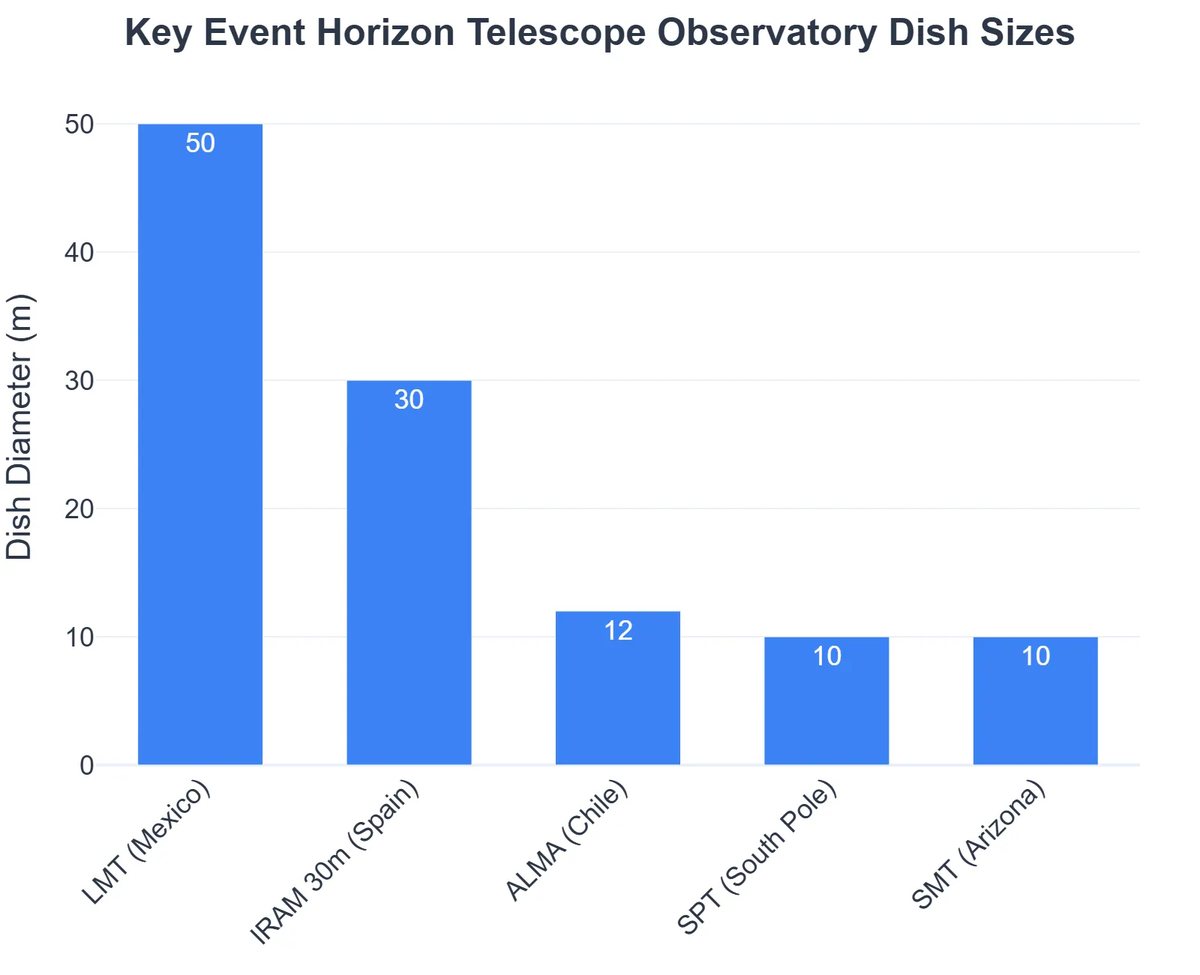
The core principle behind the EHT’s operation is Very Long Baseline Interferometry (VLBI). Here’s a simplified breakdown:
- ➡️ Simultaneous Observation: Each observatory precisely points its radio dish at M87* and collects radio waves emitted by the superheated gas orbiting the black hole. These observations occur simultaneously, timed with atomic clocks.
- ➡️ Data Collection: The data collected at each site is enormous – petabytes of raw information. This data is then recorded on specialized hard drives and physically transported to central processing facilities due to the sheer volume.
- ➡️ Interferometric Combination: At the processing centers, supercomputers correlate the data from all the different observatories. By combining the signals, astronomers effectively synthesize a virtual telescope as large as the distance between the farthest observatories. This enormous baseline provides the incredibly high angular resolution needed to resolve the black hole’s shadow. For a deeper look into the appearance of these cosmic entities, explore Black Hole Appearance: Understanding the Event Horizon.
- ➡️ Image Reconstruction: Because the EHT observes at radio wavelengths and the data is sparse, traditional “photography” is impossible. Instead, complex algorithms and computational techniques are used to reconstruct an image from the interference patterns. This process is akin to solving a giant puzzle, inferring the structure of the source from how its light waves interfere after traveling vast distances. The breakthrough in computational methods played a significant role in enabling this reconstruction. As EurekAlert notes, “Throughput computing enables astronomers to use AI to decode the Universe’s hidden secrets.” (Source).
This ingenious method allowed the EHT to achieve a resolution equivalent to discerning a donut on the surface of the Moon, a truly astonishing feat for astronomical observation.
What the M87* Image Reveals
The iconic image of M87* presented a bright, ring-like structure with a dark central region. This isn’t a direct “picture” of the black hole itself, as nothing, not even light, can escape beyond its event horizon. Instead, the image depicts the following:
- 💡 The Bright Ring: This glowing ring is superheated gas (plasma) orbiting the black hole at nearly the speed of light. As this gas spirals inwards, friction heats it to billions of degrees, causing it to emit radio waves that the EHT detected. The brightness variations within the ring are due to the Doppler effect: gas moving towards Earth appears brighter, while gas moving away appears dimmer.
- 💡 The Black Hole Shadow: The dark central region within the bright ring is the black hole’s “shadow.” This shadow is caused by the extreme gravity of the black hole bending light around itself, trapping photons that cross the event horizon, and creating a region from which no light can escape to the observer. It’s not the event horizon itself, but a slightly larger region, approximately 2.5 times the size of the event horizon.
This visual confirmation was a monumental moment for physics. It provided direct evidence of the existence of black hole shadows, a prediction of Einstein’s theory of general relativity. The size and shape of the shadow precisely matched predictions for a black hole of M87*’s estimated mass and spin, strongly validating Einstein’s theory under extreme conditions. For more details on the process, you can read “How the Event Horizon Telescope imaged an invisible black hole” on Astronomy.com (Source).
The Legacy and Future of Black Hole Imaging
The M87 black hole image represents a new era in astronomy, providing a unique laboratory for testing the fundamental laws of physics. Its impact reverberates across multiple scientific disciplines:
- ➡️ Validating General Relativity: The image provided the strongest evidence yet for the existence of black holes and the validity of Einstein’s theory in regimes of extreme gravity.
- ➡️ Understanding Black Hole Accretion: Observing the glowing ring allows scientists to study the dynamics of gas accretion onto a black hole, understanding how matter behaves just before it crosses the point of no return.
- ➡️ Jet Formation Mechanisms: By linking the black hole’s shadow to its powerful jet, researchers can gain insights into how these colossal cosmic accelerators are powered. For more on this, check out M87 Black Hole: First Image of a Cosmic Giant.
- ➡️ New Astronomical Capabilities: The success of the EHT paves the way for even more ambitious projects, potentially involving space-based interferometers for even higher resolution.
Since the M87* image, the EHT collaboration has also successfully imaged Sagittarius A* (Sgr A), the supermassive black hole at the center of our Milky Way galaxy, further expanding our observational capabilities. The story behind the naming of the first imaged black hole is also fascinating; learn more about Powehi: The Story Behind the First Black Hole Image. The quest to decode the universe’s ultimate mysteries continues, building on the foundation laid by the first extraordinary image of M87.
This monumental achievement underscores the power of international scientific collaboration and innovative technological development. It’s a testament to humanity’s enduring drive to understand the cosmos, pushing the boundaries of what is observable. Dive deeper into these fascinating topics with Cosmic Queries: Probing the Mysteries of the Universe.
Recommended Video
What exactly is M87*?
M87* is the supermassive black hole located at the center of the Messier 87 galaxy, approximately 55 million light-years away from Earth. It’s one of the largest known black holes, with a mass billions of times that of our Sun.
How was the first black hole image captured?
The image was captured by the Event Horizon Telescope (EHT), a global network of eight radio telescopes working together through a technique called Very Long Baseline Interferometry (VLBI). This created a virtual telescope the size of Earth, providing the necessary resolution.
What does the M87* image actually show?
The image shows a bright, asymmetric ring of light surrounding a central dark region. The bright ring is light from hot gas and plasma orbiting the black hole, bent and amplified by its immense gravity. The central dark region is the ‘black hole shadow’, which is roughly twice the size of the event horizon.