

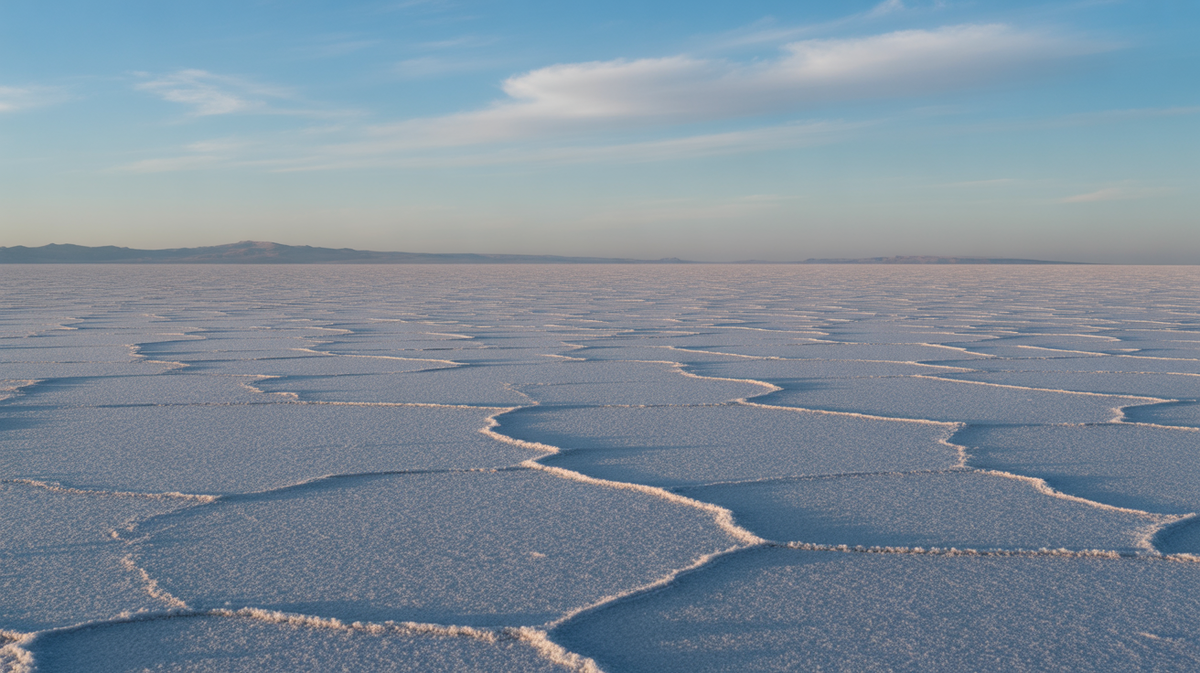
Unveiling the Atmospheric Boundary Layer (ABL)
In the intricate tapestry of Earth’s atmosphere, one of the most dynamic and critical regions is the atmospheric boundary layer (ABL). Often referred to as the planetary boundary layer (PBL), this is the lowest part of the troposphere, directly influenced by the Earth’s surface and responding to changes in surface forcing within an hour or less. It’s where the atmosphere “feels” the ground – experiencing friction, heating, cooling, and moisture exchange. Understanding the ABL is fundamental to comprehending many of the Earth’s Unseen Forces: The Hidden Dynamics of Our Planet that shape our daily lives.
💡 Key Takeaways
- Monin-Obukhov Similarity Theory (MOST) describes how atmospheric variables like wind and temperature behave within the lowest part of the atmosphere.
- MOST is fundamental for understanding energy and momentum transfer between the Earth’s surface and the atmosphere.
- It provides a framework for predicting micrometeorological conditions, vital for fields like agriculture, air quality, and weather forecasting.
- The theory simplifies the complex turbulent processes occurring within the atmospheric boundary layer, making them quantifiable.
“Monin-Obukhov Similarity Theory provides an elegant framework for dissecting the turbulent symphony of our lowest atmosphere, crucial for predicting everything from local air quality to global climate patterns.”
— Dr. Marcus Sterling, PhD, Planetary Geoscientist & Climatologist
The ABL is a hub of intense activity, responsible for:
- ✅ Vertical Transport: Facilitating the upward and downward movement of heat, moisture, momentum, and pollutants.
- ➡️ Weather Phenomena: Directly impacting local weather, from fog formation and thunderstorm initiation to wind patterns and temperature fluctuations.
- 💡 Air Quality: Governing the dispersion and concentration of aerosols and pollutants, affecting the air we breathe.
Its complex behavior, driven by turbulent processes, makes it a fascinating and challenging area of study in atmospheric science. For instance, processes within the ABL can significantly influence the development of Breathtaking Natural Phenomena: Explained like localized storms or unique cloud formations.
In This Article
The Cornerstone: Monin-Obukhov Similarity Theory (MOST) Explained
At the heart of understanding the complex physics within the ABL lies the Monin-Obukhov Similarity Theory (MOST). Developed independently by Alexander Monin and Andrey Obukhov in the 1950s, MOST provides a powerful framework for describing the mean vertical profiles of wind speed, temperature, and humidity within the surface layer of the atmospheric boundary layer.
This theory posits that under ideal conditions (flat, homogeneous terrain, and steady-state atmospheric conditions), the turbulent characteristics and mean profiles of various atmospheric variables within the surface layer can be scaled by a few key parameters. Essentially, it simplifies the incredibly complex nature of `turbulence theory` near the ground by identifying universal functions that describe these profiles. This theoretical approach has revolutionized `micrometeorology` and our ability to model near-surface atmospheric processes.
MOST is particularly vital because it allows scientists and engineers to predict how atmospheric variables change with height close to the Earth’s surface, which is crucial for a myriad of applications, from weather forecasting to pollutant dispersion modeling. For a deeper scientific dive into its application in wind flow, you can explore detailed research such as that on Monin-Obukhov similarity theory and its application to wind flow.
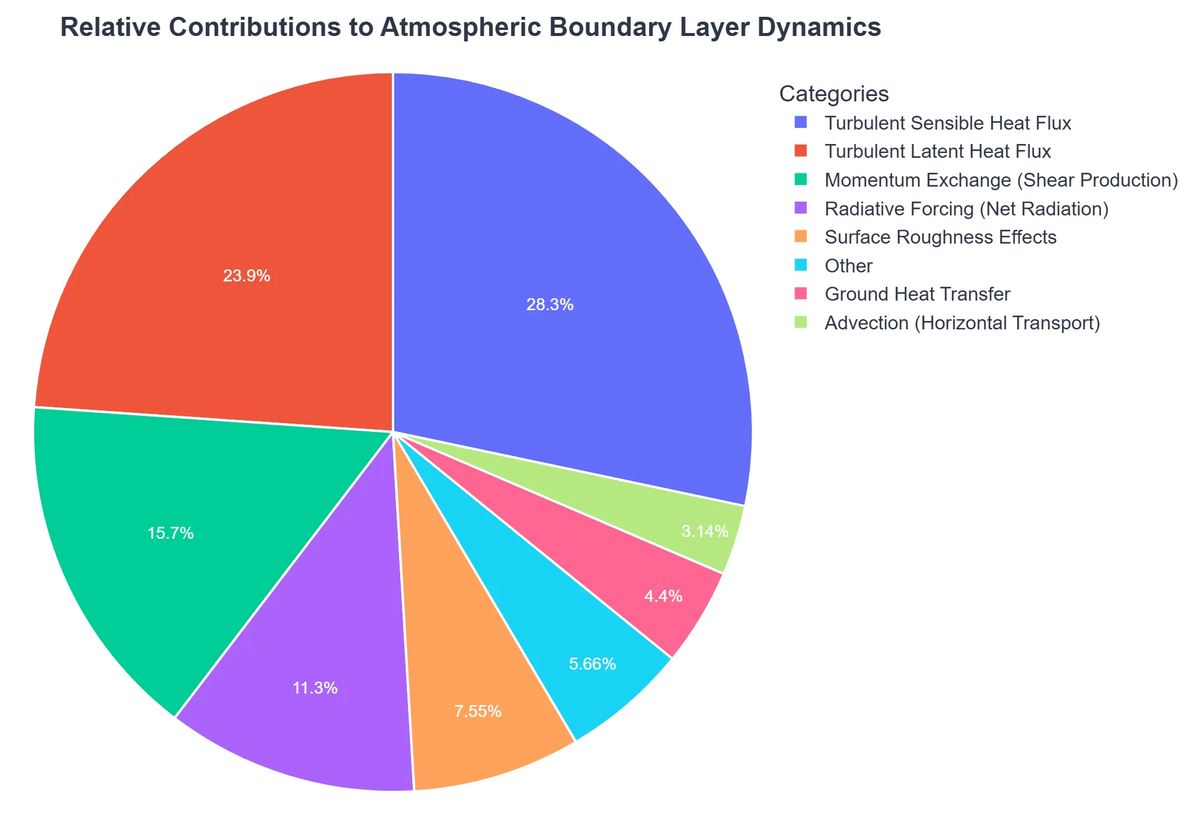
Key Parameters and the Obukhov Length
The efficacy of Monin-Obukhov Similarity Theory hinges on its ability to define and utilize a set of fundamental scaling parameters:
- 💨 Friction Velocity ($u_*$): This parameter represents the turbulent momentum exchange between the surface and the atmosphere. It’s essentially a measure of the vertical turbulent flux of momentum and directly relates to the wind shear near the surface.
- 🌡️ Scaling Temperature ($T_*$): Analogous to friction velocity, scaling temperature quantifies the turbulent heat exchange. It is derived from the surface heat flux and is crucial for describing temperature profiles.
- 💧 Scaling Humidity ($q_$): Similar to $u_$ and $T_*$, scaling humidity accounts for the turbulent moisture exchange, derived from the surface latent heat flux.
- ⚖️ Obukhov Length (L): Perhaps the most critical parameter in MOST, the Obukhov length is a characteristic length scale that describes the stability of the surface layer. It represents the height at which buoyancy (thermal effects) becomes as important as mechanical turbulence (wind shear) in generating turbulence.
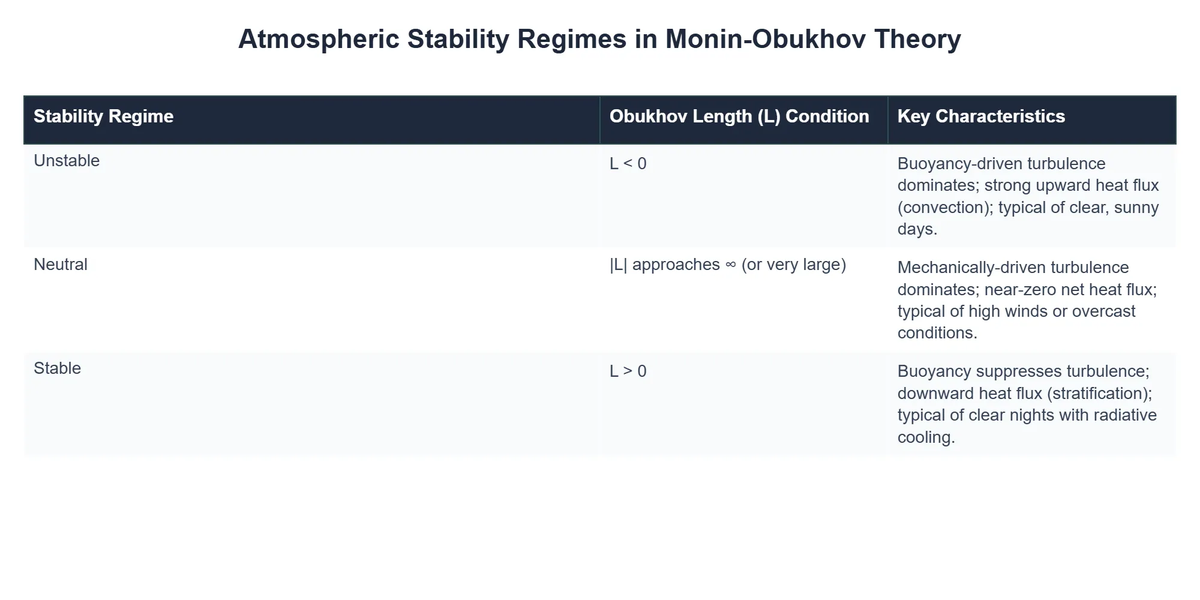
The sign of the Obukhov length tells us about the stability of the atmosphere:
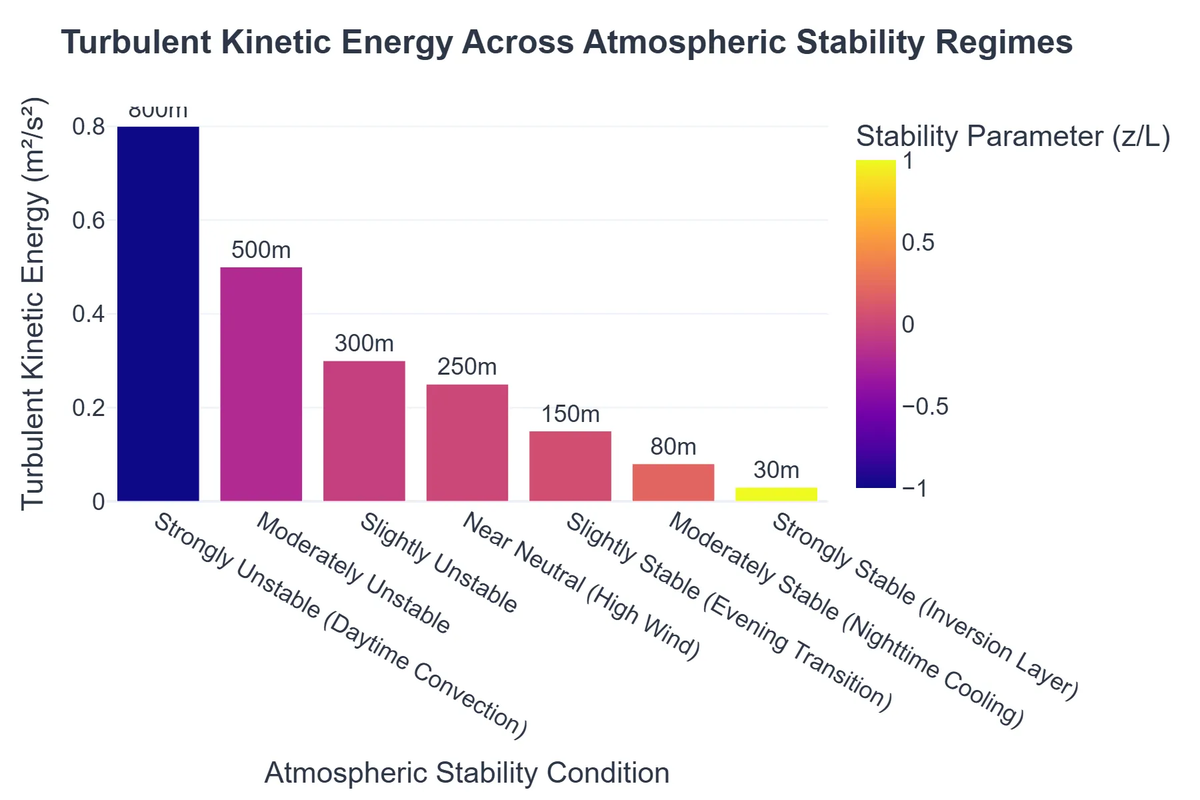
- Negative L (L < 0): Unstable Conditions. Occurs when the surface is warmer than the air above it (e.g., sunny day). Buoyancy-driven convection dominates, leading to vigorous vertical mixing.
- Positive L (L > 0): Stable Conditions. Occurs when the surface is cooler than the air above it (e.g., clear night). Turbulence is suppressed, leading to weaker mixing and often strong vertical gradients.
- L approaching infinity (L → ∞): Neutral Conditions. Occurs when there is no net heat exchange between the surface and the air (e.g., cloudy, windy conditions). Mechanical turbulence dominates, and temperature profiles are near-adiabatic.
These parameters allow us to create non-dimensional functions that universally describe how mean wind speed, temperature, and humidity vary with height, irrespective of specific site conditions, provided the underlying assumptions hold.
Monin-Obukhov Similarity Theory: Strengths and Limitations
Pros
- ✔Provides a fundamental framework for characterizing turbulence in the atmospheric surface layer.
- ✔Enables parameterization of surface fluxes (heat, momentum, moisture) in numerical weather and climate models.
- ✔Simplifies complex boundary layer processes into universal, measurable relationships.
- ✔Widely used for estimating profiles of wind, temperature, and humidity from limited observations.
Cons
- ✖Assumes horizontal homogeneity and steady-state conditions, which are often not met in real-world scenarios.
- ✖Applicability decreases significantly outside the surface layer (e.g., in the mixed layer) or under very stable/unstable conditions.
- ✖Relies on empirical universal functions, which can introduce uncertainties and site-specific variations.
- ✖Does not fully account for non-local transport or organized turbulent structures within the boundary layer.
Applications Across Atmospheric Science and Beyond
The influence of Monin-Obukhov Similarity Theory extends far beyond theoretical `atmospheric science` research, proving invaluable in a wide array of practical applications:
- 📈 Weather and Climate Modeling: MOST provides crucial parameterizations for representing surface-atmosphere interactions in numerical weather prediction (NWP) and climate models, improving the accuracy of forecasts, especially for near-surface variables.
- 🌬️ Wind Energy Assessment: Accurate characterization of wind profiles in the ABL is essential for siting wind farms and predicting power generation. MOST helps in extrapolating wind speeds from measurement heights to turbine hub heights.
- 🌿 Agricultural Meteorology: Understanding heat, moisture, and CO2 exchange between crops and the atmosphere is vital for irrigation scheduling, crop health monitoring, and modeling agricultural productivity.
- 🏭 Air Quality and Pollution Dispersion: MOST helps predict how pollutants released from industrial stacks or urban areas will disperse. The stability parameter (Obukhov length) directly influences how quickly pollutants mix vertically and horizontally.
- 🔬 Micrometeorological Research: It forms the basis for designing and interpreting field experiments that measure turbulent fluxes of momentum, heat, and mass at the Earth’s surface.
Just as we seek to understand complex fluid dynamics in the atmosphere, parallel efforts in areas like Physical Oceanography: Understanding Ocean Currents leverage similar principles to describe boundary layers and fluid motion in the marine environment.
Limitations and Modern Advancements
While exceptionally powerful, Monin-Obukhov Similarity Theory is built upon certain idealized assumptions that limit its direct applicability in all scenarios:
- ❌ Homogeneity and Flat Terrain: MOST assumes a horizontally homogeneous and flat surface. Its direct application becomes challenging over complex terrain, urban areas, forests, or coastlines, where flow is non-uniform.
- ❌ Stationarity: The theory assumes steady-state conditions, meaning atmospheric variables are not changing significantly with time. This assumption can be violated during rapid transitions, such as sunrise or sunset, or during frontal passages.
- ❌ The “Grey Zone”: In very unstable conditions (strong convection), the surface layer assumption, which is the basis of MOST, can break down as large eddies extend beyond the surface layer height.
Despite these limitations, MOST remains a foundational theory. Modern `atmospheric science` has seen significant advancements that build upon or extend MOST:
- ✅ Generalizations and Extensions: Researchers have developed extensions to MOST for more complex scenarios, including urban environments, heterogeneous surfaces, and non-stationary conditions. For example, recent work explores Monin–Obukhov Similarity and Local-Free-Convection Scaling under various conditions.
- ✅ Computational Fluid Dynamics (CFD) and Large Eddy Simulations (LES): Advanced numerical models are increasingly used to simulate turbulent flow in the ABL, providing detailed insights that complement and validate MOST, especially in complex geometries.
- ✅ New Measurement Technologies: The advent of advanced remote sensing technologies (e.g., lidars, radars) and improved in-situ sensors allows for more detailed and extensive measurements of the ABL, helping refine and test similarity theories.
The ongoing refinement and expansion of MOST continue to deepen our understanding of the `unseen forces` that govern our atmosphere, pushing the boundaries of `micrometeorology` and enabling more accurate environmental predictions.
Recommended Video
What is the Monin-Obukhov Similarity Theory?
It’s a foundational theory in micrometeorology that describes the mean profiles of wind, temperature, and humidity in the atmospheric surface layer, based on surface layer scaling parameters.
Why is the atmospheric boundary layer important?
The atmospheric boundary layer is the lowest part of the atmosphere, directly influenced by the Earth’s surface. It’s where most weather phenomena occur and where energy, moisture, and pollutants are exchanged.
How is MOST applied in real-world scenarios?
MOST is used in weather prediction models, climate simulations, air pollution dispersion modeling, agricultural meteorology, and to study surface-atmosphere interactions over various terrains.
What are the key parameters in Monin-Obukhov Similarity Theory?
Key parameters include friction velocity, sensible heat flux, and the Obukhov length, which is a critical scaling parameter characterizing the stability of the atmospheric surface layer.