

Understanding the Aurora Australis: The Southern Lights Explained
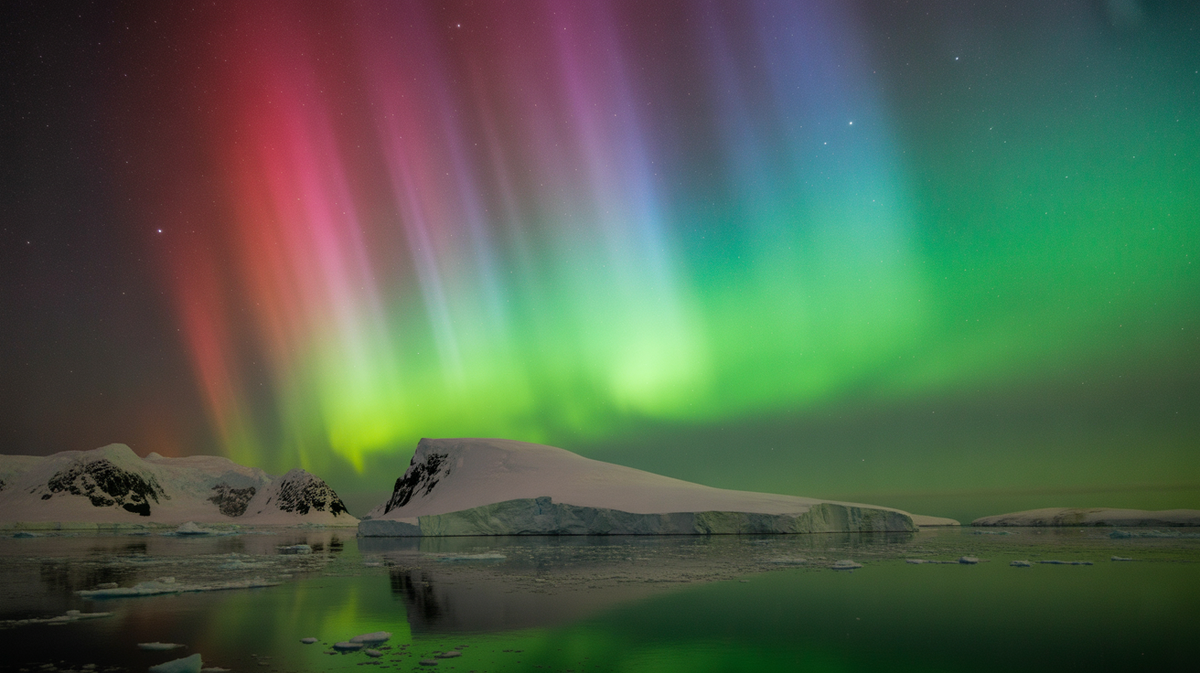
Often overshadowed by its northern counterpart, the aurora australis, or southern lights, is an equally spectacular celestial phenomenon that captivates observers in the Earth’s polar regions. This breathtaking display of natural light occurs when solar particles interact with our planet’s magnetic field and atmosphere, painting the night sky with vibrant hues of green, pink, and sometimes red or blue.
💡 Key Takeaways
- Aurora Australis is the Southern Hemisphere’s equivalent of the Aurora Borealis, caused by solar particles interacting with Earth’s magnetic field.
- Best viewed from high southern latitudes, including Antarctica, Tasmania, New Zealand, and southern Australia, away from light pollution.
- The intensity and visibility depend on solar activity (like solar flares and coronal mass ejections) and clear, dark skies.
- Understanding space weather forecasts is crucial for predicting the best opportunities to witness these magnificent light displays.
“The Aurora Australis is a breathtaking reminder of the intricate dance between our Sun’s powerful emissions and Earth’s protective magnetic shield, a true cosmic ballet.”
— Dr. Marcus Sterling, PhD, Planetary Geoscientist & Climatologist
For those fascinated by Earth’s unseen forces, understanding the aurora australis offers a profound insight into the intricate relationship between the Sun and our planet. It’s a vivid reminder of the dynamic energies constantly at play in our solar system, influencing everything from space weather to breathtaking atmospheric displays.
In This Article
⚙️ The Science Behind the Southern Lights
The mechanism behind the aurora australis is identical to that of the aurora borealis. It begins with the Sun emitting a constant stream of charged particles known as the solar wind. During solar flares or coronal mass ejections (CMEs), the Sun expels even larger bursts of these particles at incredible speeds.
When these charged particles (primarily electrons and protons) reach Earth, they encounter our planet’s powerful magnetosphere. This protective magnetic field acts like a shield, deflecting most of the solar wind. However, at the magnetic poles, the field lines converge, allowing some of these particles to penetrate the upper atmosphere.
- ✅ Excitation: As these high-energy particles collide with atoms and molecules of gases in Earth’s atmosphere (like oxygen and nitrogen) at altitudes of 80 to 600 kilometers, they transfer energy to them.
- 💡 Emission: The excited atmospheric gases then release this excess energy in the form of light photons, much like a neon sign. The specific color of the light depends on the type of gas atom and the altitude at which the collision occurs.
- ➡️ Green: Most common, produced by oxygen atoms at lower altitudes (around 100-200 km).
- ➡️ Red: Produced by oxygen atoms at higher altitudes (above 200 km).
- ➡️ Blue/Purple: Less common, produced by nitrogen molecules, often seen at the lower edges of the aurora.
The intensity and visibility of the southern lights are directly related to solar activity. Stronger solar winds and CMEs result in more frequent and spectacular displays, often extending further away from the magnetic pole.
When and Where to Witness the Aurora Australis
Unlike the northern lights, which are visible from high latitudes in the Northern Hemisphere (like Norway, Iceland, Canada), the aurora australis requires a journey to the Earth’s southernmost regions. Understanding the optimal conditions is key to a successful sighting.
Aurora Australis: The Southern Lights – Pros & Cons
Pros
- ✔A breathtaking and unique natural spectacle.
- ✔Offers an unforgettable viewing experience.
- ✔Provides incredible astrophotography opportunities.
- ✔Chance to visit pristine Southern Hemisphere landscapes.
Cons
- ✖Highly unpredictable and difficult to forecast.
- ✖Requires specific geographical location (high southern latitudes).
- ✖Dependent on clear, dark skies and minimal light pollution.
- ✖Often involves travel to remote, sometimes cold, locations.
Best Locations:
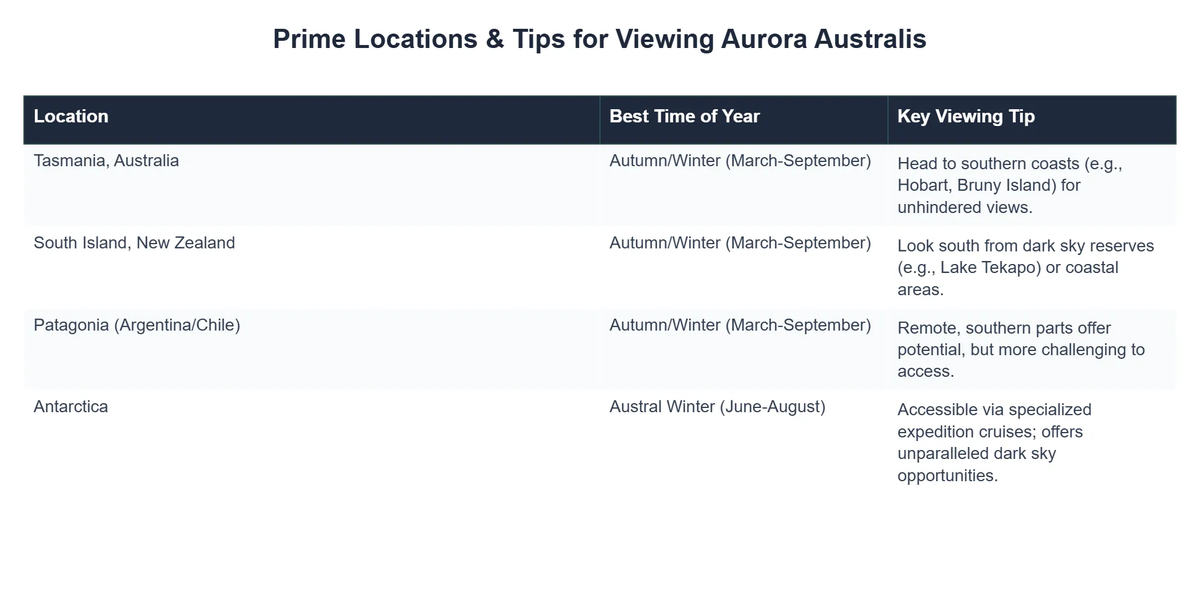
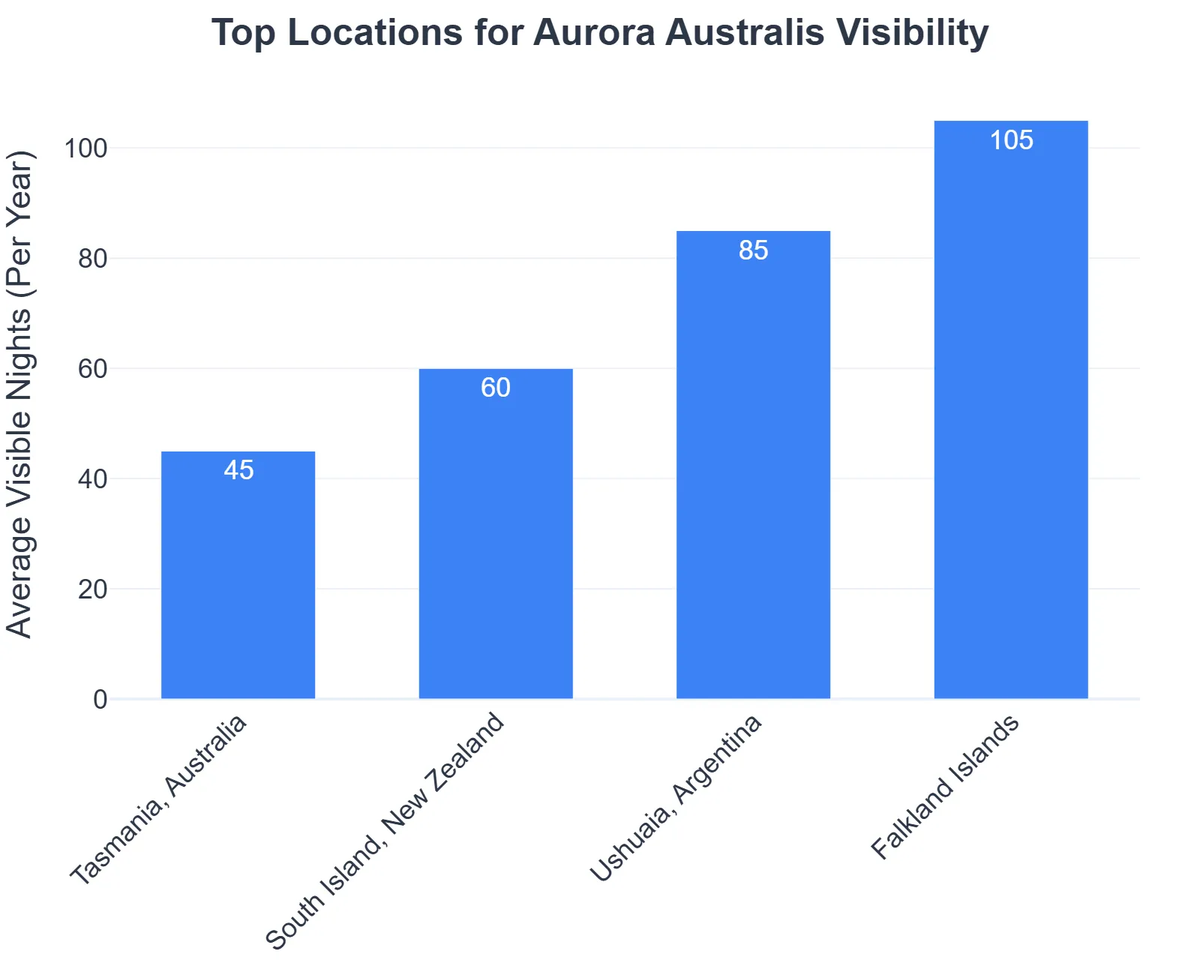
- 🇦🇶 Antarctica: The absolute best location, as it’s directly over the magnetic South Pole. However, accessibility is limited to scientific expeditions or specialized cruises.
- 🇦🇺 Tasmania, Australia: The southernmost state of Australia is a prime location. Dark sky parks and remote areas away from city lights offer excellent viewing opportunities. The University of Tasmania even provides specific insights into local viewing conditions, underscoring its relevance. (Source: University of Tasmania)
- 🇳🇿 South Island, New Zealand: Especially regions like Stewart Island, Queenstown, Tekapo, and the Catlins.
- 🇦🇷 Patagonia, Argentina & Chile: The southernmost tips of South America can occasionally offer glimpses, though less frequently than closer-to-pole locations.
- 🇿🇦 Falkland Islands & South Georgia Island: Remote islands in the South Atlantic offer strong possibilities.
Best Time:
- 📅 Season: The austral winter months (March to September) offer the longest periods of darkness, increasing the chances of seeing the aurora australis. June, July, and August are often considered peak months due to longer nights.
- 🌑 Time of Day: Typically between 10 PM and 3 AM local time, though displays can start earlier or last later during intense solar storms.
- ☀️ Solar Cycle: Auroral activity waxes and wanes with the Sun’s 11-year solar cycle. During solar maximum, when the Sun is most active, auroral displays are more frequent and intense. During solar minimum, they are less common.
- ☁️ Clear Skies: Regardless of location or time, clear, dark skies away from light pollution are essential for viewing. Check local weather forecasts for cloud cover.
Photography Tips for Capturing the Southern Lights
Capturing the ephemeral beauty of the southern lights requires some specific photographic techniques. While a smartphone might capture faint glows, a dedicated camera provides the best results.
- Equipment Essentials:
- ✅ DSLR or Mirrorless Camera: With manual mode capabilities.
- ✅ Wide-Angle Lens: Essential for capturing the vastness of the display (e.g., 14-24mm).
- ✅ Sturdy Tripod: Absolutely critical for long exposures.
- ✅ Remote Shutter Release: To avoid camera shake.
- ✅ Extra Batteries: Cold weather drains batteries quickly.
- ✅ Headlamp with Red Light Mode: To preserve night vision.
- Camera Settings:
- 💡 Manual Mode (M): Full control over settings.
- 💡 Aperture (f-stop): As wide as possible (lowest f-number, e.g., f/2.8 or f/4) to let in maximum light.
- 💡 ISO: Start at 1600-3200 and adjust based on brightness. Higher ISO increases noise but allows for shorter exposures.
- 💡 Shutter Speed: Start with 10-20 seconds. If the aurora is fast-moving, reduce the shutter speed to capture more detail without blurring. For fainter aurora, you might go up to 30 seconds.
- 💡 Focus: Set to manual focus and infinity. It’s often helpful to focus on a distant star before the light disappears.
- 💡 White Balance: Experiment with settings like “Tungsten” or “Fluorescent” for different color renditions, or shoot in RAW and adjust later.
- Composition Tips:
- ➡️ Include Foreground: Add interest by incorporating landmarks, trees, or reflections in water.
- ➡️ Shoot in RAW: This provides maximum flexibility for post-processing adjustments.
- ➡️ Dress Warmly: You’ll be out in the cold for extended periods.
Recommended Video
Differentiating the Auroras: Southern vs. Northern Lights
While the underlying physics for both the aurora australis and aurora borealis is identical, their locations and viewing experiences differ. For a more detailed comparison, you might find our article on Northern vs. Southern Lights: Aurora Borealis and Australis insightful. However, here’s a brief overview:
- 🌍 Location: The primary distinction is geographic. The aurora australis is seen in the Southern Hemisphere, concentrated around the magnetic South Pole. The aurora borealis is visible in the Northern Hemisphere, around the magnetic North Pole. Despite the common misconception of “aurora borealis south pole,” the correct term for the southern display is aurora australis.
- 🔭 Accessibility: The northern lights are generally more accessible to tourists due to a greater density of landmasses at high northern latitudes (e.g., Scandinavia, Canada, Alaska). The southern lights require travel to more remote locations, making them a rarer sight for most.
- 📅 Seasonal Timing: While both occur year-round, optimal viewing seasons are dictated by the darkest nights. For the Northern Hemisphere, this is typically September to March. For the Southern Hemisphere, it’s March to September.
Understanding these subtle differences enhances appreciation for Earth’s diverse atmospheric phenomena. For deeper scientific context on how these displays manifest, explore our resource on Aurora Borealis: Effects and Scientific Explanation. Whether it’s the aurora australis or its northern counterpart, both are magnificent manifestations of solar-terrestrial interaction, reminding us of the active nature of our solar system, a core theme within Earth’s Unseen Forces: The Hidden Dynamics of Our Planet. You can also explore our Northern Lights: A Guide to Aurora Borealis for comprehensive information on auroral displays in the Northern Hemisphere.
What causes the Aurora Australis?
The Aurora Australis is caused by charged particles from the Sun colliding with gases in Earth’s upper atmosphere, guided by the planet’s magnetic field. These collisions excite the gas atoms, causing them to emit light.
Where is the best place to see the Southern Lights?
The best places are high southern latitudes, such as Antarctica, Tasmania (Australia), South Island of New Zealand, and the southern parts of mainland Australia, particularly during periods of strong solar activity.
When is the best time to see the Aurora Australis?
While visible year-round during intense solar storms, the best viewing times are generally during the Southern Hemisphere’s winter months (March to September) due to longer, darker nights.
Is Aurora Australis the same as Aurora Borealis?
Yes, they are fundamentally the same phenomenon, differing only in their geographical location. Aurora Borealis occurs in the Northern Hemisphere (Northern Lights), and Aurora Australis occurs in the Southern Hemisphere (Southern Lights).