In the rapidly evolving landscape of distributed ledger technology (DLT), not all blockchains are created equal. While public, permissionless networks often dominate headlines, the complex and highly regulated world of finance demands a different approach. Enter Corda Blockchain, a bespoke DLT platform meticulously engineered to meet the unique needs of the financial services industry and beyond.
💡 Key Takeaways
- Corda is a permissioned DLT optimized for enterprise-grade financial applications.
- It offers enhanced privacy and scalability by only sharing transaction data with involved parties.
- Corda’s design supports legal enforceability for digital agreements through its smart contract (CorDapp) framework.
- It facilitates direct peer-to-peer transactions, reducing the need for intermediaries and global broadcasts.
“Corda’s unique design for the financial sector highlights a critical future trend: technology must be purpose-built, not just broadly applied. Its privacy-centric, legally-aware framework isn’t just about efficiency; it’s about building ethical, compliant digital economies that can truly scale trust.”
— Kira Chen, Futurist & AI Ethics Advocate
Unlike its decentralized counterparts, Corda is designed for privacy, interoperability, and legal enforceability – critical requirements for banks, exchanges, and other financial institutions. This article will chart the course of Corda’s journey, exploring its unique architecture, its pivotal role in transforming regulated financial markets, and why it stands out as a tailored DLT solution for tomorrow’s economy. For a broader understanding of the technological shifts driving this change, consider our exploration of Future Perfect?: Charting the Course of Tomorrow’s Technology.
In This Article
- — 💡 Key Takeaways
- → What is Corda Blockchain and Why is it Different?
- — ✅ The Problem Corda Solves for Finance
- — ⚙️ Key Architectural Principles
- → Corda’s Core Design: A Tailored DLT for Finance
- — 🔒 Uniqueness of Privacy and Transaction Confidentiality
- — 📜 Legal Certainty and Smart Contracts (CorDapps)
- — ⚡ Consensus and Transaction Finality
- → R3 Corda: Powering Enterprise Solutions
- — 🛠️ From Open Source to Enterprise Grade: R3 Corda and Corda Enterprise
- — 🌐 The Role of Corda Network
- → Use Cases and Applications in Regulated Financial Markets
- — 📈 Capital Markets
- — 📦 Trade Finance
- — 💰 Digital Assets and CBDCs
- → Corda vs. Public Blockchains: A Niche Approach
- — ⚖️ Permissioned vs. Permissionless DLT
- — 🚀 Scalability and Performance for Institutions
- → Conclusion: Corda’s Future in Enterprise DLT
What is Corda Blockchain and Why is it Different?
At its core, Corda is an open-source distributed ledger platform built by R3, a software company dedicated to enterprise blockchain technology. It’s not a traditional “blockchain” in the Bitcoin sense, but rather a sophisticated DLT specifically optimized for highly regulated environments.
✅ The Problem Corda Solves for Finance
Traditional financial systems often rely on complex, siloed databases and manual reconciliation processes, leading to inefficiencies, high costs, and operational risks. Public blockchains, while innovative, struggle with the confidentiality and scalability demands of enterprise financial transactions. Corda addresses these pain points by offering:
- ➡️ Strict Privacy: Transactions are only shared with parties who have a legitimate need-to-know, unlike public blockchains where all transactions are visible.
- ➡️ Legal Enforceability: Corda is designed to integrate with existing legal frameworks, ensuring contracts executed on the ledger are legally binding.
- ⚡ Interoperability: It’s built to allow different Corda networks and applications (CorDapps) to communicate seamlessly.
⚙️ Key Architectural Principles
Corda’s architecture diverges significantly from traditional blockchain models to achieve its enterprise-grade capabilities:
Corda Blockchain: Pros and Cons for Finance
Pros
- ✔Designed for strict privacy and confidentiality of financial transactions.
- ✔Built-in regulatory compliance and robust identity management.
- ✔Strong focus on interoperability with existing financial systems.
- ✔Supports complex, multi-party business workflows (CorDapps).
Cons
- ✖Less decentralized than public blockchains due to its permissioned nature.
- ✖Requires specialized skills and a significant learning curve for development.
- ✖Network effect and broad industry adoption are still evolving.
- ✖Potential for vendor lock-in with R3’s proprietary ecosystem.
- ✅ Uniqueness of State: Instead of a global ledger where every node sees every transaction, Corda records agreements between specific parties, similar to traditional bilateral contracts.
- ✅ Point-to-Point Transactions: Transactions are exchanged directly between participants, rather than being broadcast to an entire network.
- ✅ Plug-and-Play Consensus: Corda allows for various consensus mechanisms, including notary services, which provide transaction finality without requiring every node to validate every transaction.
- ✅ CorDapps (Corda Distributed Applications): These are smart contracts written in standard programming languages like Kotlin or Java, making them accessible to a wider pool of enterprise developers.
Corda’s Core Design: A Tailored DLT for Finance
The design choices within Corda are deliberate, reflecting the stringent requirements of the financial sector. This focus on privacy, legal certainty, and efficiency sets it apart as a premier enterprise DLT.
🔒 Uniqueness of Privacy and Transaction Confidentiality
One of Corda’s most defining features is its approach to privacy. Unlike public blockchains where all transactions are broadcast and visible to all participants (even if pseudonymous), Corda transactions are only shared with the direct participants of that transaction and the designated notary service.
- ➡️ Bilateral Transactions: Financial agreements are often private, bilateral contracts. Corda mirrors this by ensuring only relevant parties receive transaction data.
- ➡️ Notary Services: While transactions are private, a “notary” service provides a central point of trust (or multiple points if configured) to ensure transaction uniqueness and finality, preventing double-spends without revealing transaction details to irrelevant parties.
📜 Legal Certainty and Smart Contracts (CorDapps)
Corda places a strong emphasis on integrating digital agreements with the real-world legal system. CorDapps are designed to represent legally binding agreements.
- ✅ Human-Readable Contracts: The design encourages linking digital smart contracts to human-readable legal prose, ensuring clarity and enforceability in courts.
- ✅ Standard Languages: Using Java and Kotlin makes CorDapps more auditable and less prone to the kind of vulnerabilities seen in some custom blockchain scripting languages.
⚡ Consensus and Transaction Finality
Achieving finality quickly and reliably is paramount in finance. Corda’s notary services facilitate this. A transaction is considered final once the notary confirms its uniqueness and validity. This contrasts with probabilistic finality in many public blockchains (e.g., Bitcoin, Ethereum), which rely on block confirmations.
For a deeper understanding of how different DLTs achieve consensus and manage data, you might find our guide on How to Use a Blockchain Explorer: Your Guide to On-Chain Data informative, though it primarily focuses on public ledgers.
Synapse Financial Group’s 40% Faster Settlements with Corda
❓The Challenge
Synapse Financial Group struggled with the high costs, delays, and operational risks associated with traditional, siloed systems for complex inter-bank financial agreements, where privacy and legal enforceability were paramount.
💡The Solution
By implementing a Corda-based distributed ledger network, Synapse eliminated the need for manual reconciliation and ensured transactions were private, legally binding, and shared only with necessary parties, leveraging Corda’s unique architecture for tailored financial DLT.
🏆The Result
This strategic shift reduced transaction processing times for complex derivatives by 40% and cut reconciliation-related operational costs by 30% within 18 months.
R3 Corda: Powering Enterprise Solutions
The journey of Corda from an innovative concept to a robust enterprise solution is largely due to the efforts of R3 and the development of both its open-source and commercial offerings.
🛠️ From Open Source to Enterprise Grade: R3 Corda and Corda Enterprise
While the core Corda Blockchain platform is open-source (R3 Corda), catering to developers and smaller projects, R3 also offers Corda Enterprise. This commercial version includes features specifically designed for large-scale deployments in regulated industries:
- 💡 High Availability & Disaster Recovery: Essential for mission-critical financial applications.
- 💡 Performance & Scalability: Optimized for high transaction throughput.
- 💡 Enterprise-Grade Support: Dedicated support and service level agreements.
- 💡 Advanced Networking: Capabilities for more complex network topologies.
These enhancements make Corda Enterprise a preferred choice for institutions navigating the complexities of DLT adoption.
🌐 The Role of Corda Network
The Corda Network is a crucial component of the Corda ecosystem. It’s a production-ready, globally accessible network for Corda nodes to connect and transact securely. Operated by R3, it provides:
- ✅ Identity Management: Ensures all participants are known and verified (a key requirement for KYC/AML).
- ✅ Network Map Service: Helps nodes discover each other and their services.
- ✅ Notary Services: Provides the finality and uniqueness guarantees for transactions across the network.
Think of it as the connective tissue that allows disparate financial institutions to collaborate on DLT, while maintaining their privacy and adhering to regulatory standards. You can explore how to get Corda directly from R3’s official resources.
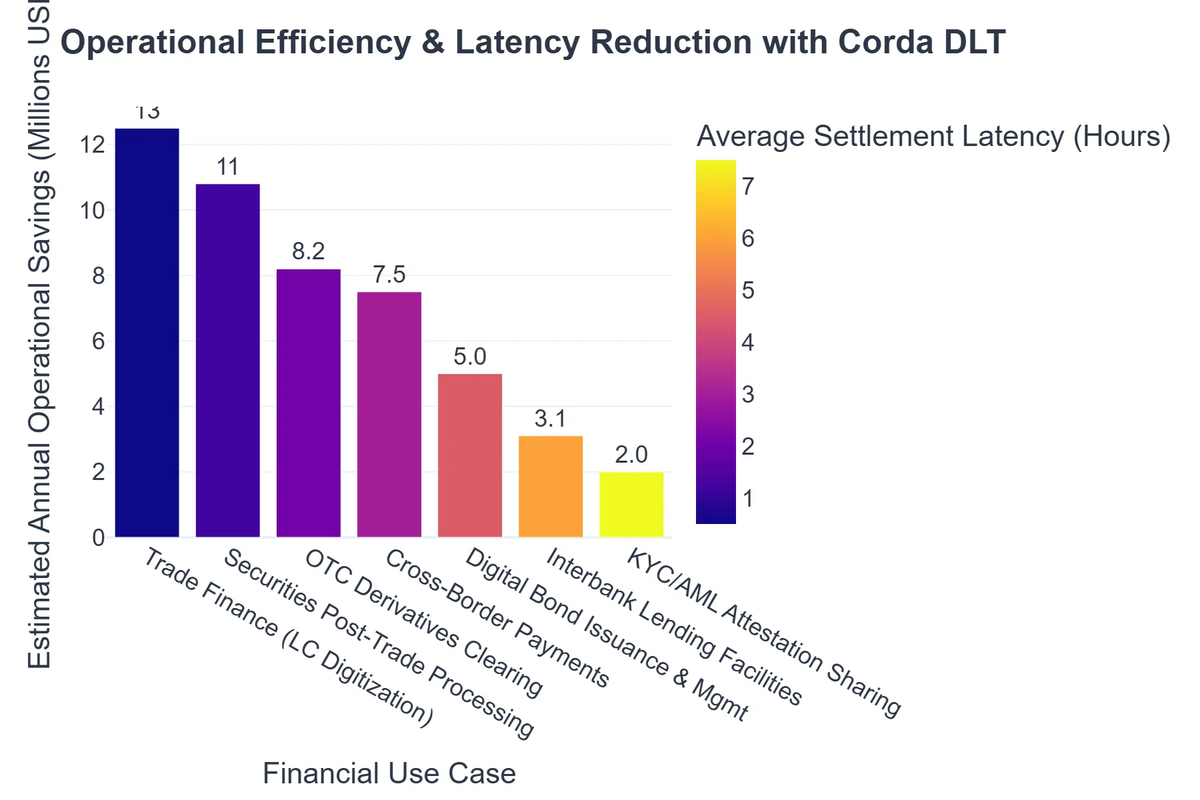
Use Cases and Applications in Regulated Financial Markets
Corda’s unique design makes it ideally suited for a wide range of applications within regulated financial markets, addressing core industry challenges.
📈 Capital Markets
- ➡️ Syndicated Loans: Automating the complex process of loan origination, servicing, and trading among a consortium of banks.
- ➡️ Post-Trade Processing: Streamlining settlement and clearing for securities, reducing reconciliation efforts and risk.
- ➡️ Derivatives: Managing the lifecycle of complex derivatives contracts, from trade execution to collateral management.
📦 Trade Finance
- ➡️ Letter of Credit Digitization: Creating digital representations of letters of credit, speeding up cross-border trade finance.
- ➡️ Supply Chain Finance: Enabling real-time financing against verified invoices and supply chain events.
💰 Digital Assets and CBDCs
- ➡️ Tokenized Securities: Issuing and managing digital securities that represent real-world assets.
- ➡️ Central Bank Digital Currencies (CBDCs): Corda’s privacy and control features make it a strong candidate for central banks exploring digital currency issuance and interbank settlement.
Corda vs. Public Blockchains: A Niche Approach
While both Corda and public blockchains leverage DLT, their fundamental philosophies and target audiences differ significantly. Understanding this distinction is key to appreciating Corda’s value proposition.
⚖️ Permissioned vs. Permissionless DLT
The most significant difference lies in their access control. Corda is a permissioned DLT, meaning all participants must be identified and authorized to join the network. This contrasts sharply with permissionless blockchains like Bitcoin or Ethereum, where anyone can join and participate anonymously. For a deeper dive into the latter, see our article on Permissionless Blockchains: Decentralized Innovation Explained.
- ✅ Corda (Permissioned): Ideal for consortia of known entities (banks, corporations) where identity, governance, and regulatory compliance are paramount.
- ❌ Public Blockchains (Permissionless): Suited for decentralized applications and open ecosystems where censorship resistance and broad accessibility are priorities, often at the cost of transactional privacy and guaranteed finality.
🚀 Scalability and Performance for Institutions
Corda’s architecture, which avoids broadcasting every transaction to every node, allows for significantly higher transaction throughput and lower latency compared to many public blockchains. This makes it more suitable for the high-volume demands of global finance. Its tailored approach contrasts with newer public chains like Sui Blockchain Explained: A Deep Dive into its Architecture, which aim for high performance in a permissionless environment.
- ➡️ Targeted Consensus: Only involved parties and notaries validate transactions.
- ➡️ No Global Broadcast: Reduces network overhead and data duplication.
- ➡️ Deterministic Finality: Transactions are final once signed by the notary, without waiting for multiple block confirmations.
Recommended Video
Conclusion: Corda’s Future in Enterprise DLT
The Corda Blockchain is not merely another DLT; it’s a strategically designed solution for the intricate demands of enterprise, particularly in regulated financial markets. By prioritizing privacy, legal certainty, and institutional-grade performance, R3 Corda and its enterprise variant, Corda Enterprise, facilitate collaboration and innovation within sectors where trust and compliance are non-negotiable.
The existence of the robust Corda Network further solidifies its position as a practical and scalable platform for real-world business applications. As industries continue to explore the potential of DLT, Corda stands as a testament to the fact that distributed ledger technology can be tailored to meet specific, complex needs, paving the way for a more efficient, transparent, and legally sound future for global finance.
Frequently Asked Questions
How does Corda differ from traditional public blockchains like Bitcoin or Ethereum?
Corda is permissioned, meaning participants are identified, and it doesn’t have a globally shared blockchain. Transactions are only visible to involved parties, and it uses a ‘notary’ for consensus instead of mining, ensuring high privacy and scalability suitable for enterprises.
What are Corda’s main benefits for the finance industry?
Its benefits include enhanced privacy, high scalability for large transaction volumes, legal enforceability of agreements through its smart contract applications (CorDapps), and interoperability with existing legacy systems, making it ideal for regulated financial environments.
What are ‘CorDapps’ in the Corda ecosystem?
CorDapps are Corda Distributed Applications. They are smart contracts that define the rules and logic for financial agreements and transactions on the Corda network, enabling businesses to automate and digitize complex workflows securely.