


Understanding Earth’s Deep Past: What is Geologic Time?
Delving into the Earth’s history requires a unique perspective on chronology—one that stretches far beyond human experience. This is where the concept of geologic time becomes fundamental. Unlike the days, months, and years that define our lives, geologic time measures intervals on a scale of millions and billions of years, allowing us to comprehend the immense duration over which our planet has formed, evolved, and changed.
💡 Key Takeaways
- Geologic time spans billions of years, divided into hierarchical units like eons, eras, and periods.
- Major divisions in the timescale are marked by significant geological events, climate shifts, or biological changes.
- Scientists piece together Earth’s history using methods such as radiometric dating, fossil records, and rock layer analysis.
- Understanding geologic time is crucial for comprehending Earth’s past climates, biodiversity evolution, and predicting future planetary changes.
“The geologic timescale isn’t merely a chronology; it’s a profound narrative of planetary evolution, where every epoch tells a complex story of climate, life, and tectonic dance.”
— Dr. Marcus Sterling, PhD, Planetary Geoscientist & Climatologist
It’s the framework that allows scientists to organize and understand the planet’s entire 4.54-billion-year story, from the formation of continents and oceans to the evolution and extinction of countless life forms. Without a grasp of this vast timescale, the slow, imperceptible forces that shape our world would remain a mystery. It helps us understand that seemingly sudden events, like massive volcanic eruptions or ice ages, are often the culmination of processes that unfold over eons.
In This Article
- → Understanding Earth’s Deep Past: What is Geologic Time?
- — 💡 Key Takeaways
- → The Geologic Timescale: Charting Epochs and Eras
- → Decoding Earth’s Age: Methods of Geologic Dating
- — ⚙️ Relative Dating: Understanding Sequential Order
- — ⏳ Absolute Dating: Pinpointing Numerical Ages
- → Why Geologic Time Matters: Unraveling Earth’s Unseen Forces
The Geologic Timescale: Charting Epochs and Eras
To make sense of such immense durations, geologists have developed the Geologic Timescale. This comprehensive system divides Earth’s history into hierarchical units, much like a calendar, but on a grander scale. These divisions are based on significant geological and biological events recorded in the Earth’s rock layers (strata), such as major glaciations, mass extinctions, and the emergence of new life forms.
The primary divisions of the Geologic Timescale, from longest to shortest, include:
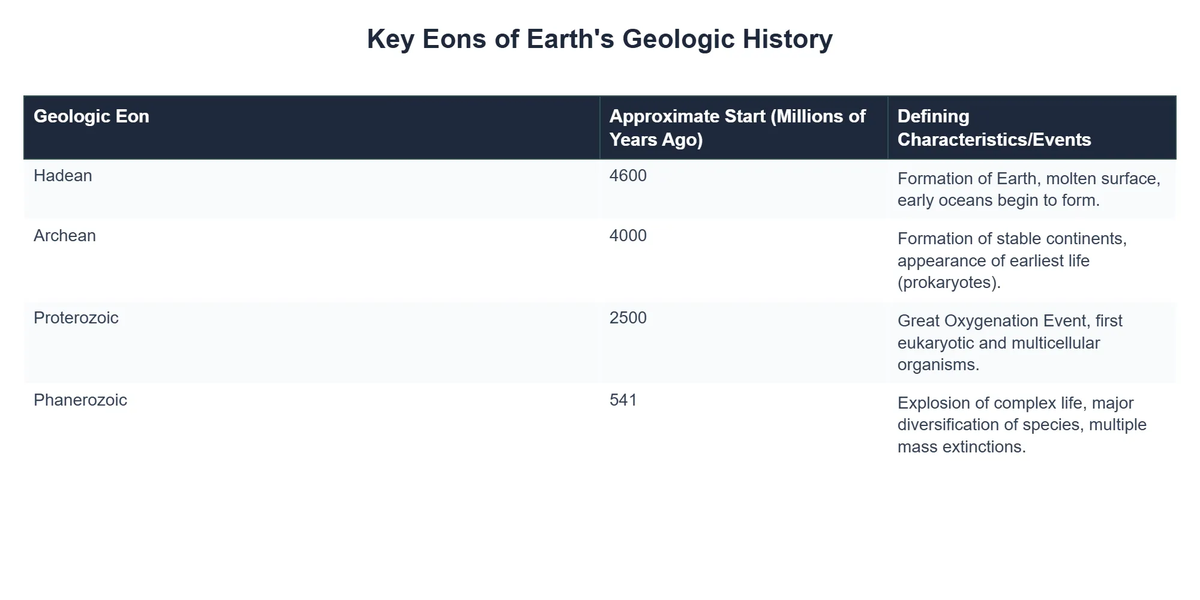
- ✅ Eons: The largest time units, spanning hundreds of millions to billions of years. Earth’s history is divided into four eons: the Hadean, Archean, Proterozoic, and Phanerozoic.
- ➡️ Eras: Subdivisions of eons, typically tens to hundreds of millions of years long. The Phanerozoic Eon, for example, is divided into the Paleozoic, Mesozoic, and Cenozoic Eras, famously associated with ancient life, dinosaurs, and mammals, respectively.
- 💡 Periods: Finer subdivisions of eras, often tens of millions of years. Famous periods include the Cambrian, Jurassic, and Quaternary.
- 🗓️ Epochs: Divisions of periods, typically millions of years in length. The Cenozoic Era, for instance, is well-defined by numerous epochs like the Paleocene, Eocene, Oligocene, Miocene, Pliocene, Pleistocene, and Holocene.
This timescale is not static; it’s continually refined as new data emerges from various scientific disciplines, reinforcing our understanding of Earth’s Unseen Forces: The Hidden Dynamics of Our Planet. For a detailed breakdown of these divisions, explore our article on Geologic Timescale: Earth’s Deep History Unveiled.
Decoding Earth’s Age: Methods of Geologic Dating
How do scientists assign specific dates to these vast spans of geologic time? They employ a combination of clever techniques, broadly categorized into two types: relative dating and absolute dating.
⚙️ Relative Dating: Understanding Sequential Order
Relative dating establishes the chronological order of events without determining their precise numerical age. It’s based on fundamental geological principles:
- ➡️ Principle of Superposition: In an undeformed sequence of sedimentary rocks, the oldest layers are at the bottom, and the youngest are at the top.
- ✅ Principle of Original Horizontality: Sedimentary layers are originally deposited horizontally. Any tilting or folding occurred after deposition.
- 💡 Principle of Cross-Cutting Relationships: A geological feature that cuts across another feature is younger than the feature it cuts. For example, a fault cutting through rock layers is younger than those layers.
- 🌟 Principle of Faunal Succession: Specific groups of fossils succeed one another in a definite and determinable order. This allows for correlation of rock strata across vast distances, even if the rock types differ.
These principles provide a framework for establishing the sequence of events and are crucial for understanding the geographic time evolution of regions.
Understanding Geologic Time: Pros and Cons
Pros
- ✔Provides a vital framework for Earth’s history and evolution.
- ✔Essential for understanding climate change and ecological shifts.
- ✔Guides the discovery of natural resources and energy deposits.
- ✔Enables precise dating and correlation of geological events.
Cons
- ✖Concepts of vast timescales can be difficult to fully grasp.
- ✖Relies on complex dating techniques and interpretations with inherent uncertainties.
- ✖The geological record is often incomplete, leading to knowledge gaps.
- ✖Requires specialized scientific expertise and interdisciplinary knowledge.
⏳ Absolute Dating: Pinpointing Numerical Ages
Absolute dating techniques provide numerical ages for rocks, minerals, and organic materials. The most common and powerful method is radiometric dating, which relies on the predictable decay of radioactive isotopes.
- ⚛️ Radiometric Dating: Unstable radioactive parent isotopes decay into stable daughter isotopes at a constant, measurable rate (known as the half-life). By measuring the ratio of parent to daughter isotopes in a sample, scientists can calculate the age of the material. Common methods include:
- Carbon-14 dating (for relatively young organic materials, up to about 50,000-60,000 years).
- Uranium-Lead dating (for very old rocks, often igneous, spanning millions to billions of years).
- Potassium-Argon dating (widely used for volcanic rocks, dating back millions to billions of years).
- 🌲 Dendrochronology (Tree-Ring Dating): For more recent geological events, the study of tree rings can provide precise annual dates.
- 🧊 Ice Core Dating: Layers in ice sheets can also be counted and analyzed for climatic data over hundreds of thousands of years.
These methods allow geologists to assign precise numerical ages, transforming the relative sequence into a concrete timeline. For more on how Earth’s dynamics are monitored, consider reading about USGS: Guardians of Earth’s Dynamics.
Why Geologic Time Matters: Unraveling Earth’s Unseen Forces
Understanding geologic time is not merely an academic exercise; it’s fundamental to comprehending many aspects of our planet and its future. It provides the essential context for studying phenomena that occur over vast timescales, influencing everything from resource exploration to climate change predictions.
- 🌍 Resource Formation: The formation of fossil fuels (coal, oil, natural gas), mineral deposits, and groundwater reservoirs are processes that take millions of years. Understanding the geologic time periods in which they formed is crucial for their discovery and sustainable extraction.
- 🌋 Plate Tectonics & Mountain Building: The slow, relentless movement of tectonic plates, leading to earthquakes, volcanoes, and the uplift of mountain ranges, is only appreciable over vast expanses of geologic time. These are core components of Earth’s Unseen Forces: The Hidden Dynamics of Our Planet.
- 🌱 Evolution & Biodiversity: Geologic time provides the backdrop for the evolution of life, the diversification of species, and the five major mass extinction events that have reshaped life on Earth.
- 🌡️ Climate Change & Paleoclimate: By studying past climates preserved in ice cores, sediments, and fossils across geologic time, scientists can understand natural climate variability, rates of change, and the long-term impacts of greenhouse gases, providing critical context for current and future climate challenges. The vastness of this `relativity time` helps scientists understand long-term weather patterns, contrasting with shorter-term phenomena like Weather Patterns: From Jet Streams to Extreme Events.
- 🏗️ Geologic Hazards: Understanding the frequency and scale of past events like major floods, volcanic eruptions, and seismic activity over geologic time helps assess future risks and inform infrastructure planning.
As scientists discuss the possibility of a new epoch, the Anthropocene, it highlights how human activities are leaving a permanent mark on Earth’s geology, demonstrating the profound and tangible impact that events, even recent ones, can have on `geographic time` and the geological record. This idea challenges our perception of `relativity time` when considering human impact versus natural geological processes. Learn more about how the Anthropocene is considered a new epoch of geological time by referring to this discussion on the topic: The Anthropocene: a new epoch of geological time? | Philosophical Transactions of the Royal Society A.
For more foundational information on the various ways we understand Earth’s past and present, consider this resource from OpenGeology: 7 Geologic Time – An Introduction to Geology.
Recommended Video
What are the main divisions of geologic time?
The main divisions of geologic time, from largest to smallest, are eons, eras, periods, epochs, and ages. Each division is characterized by unique geological and biological events.
How do scientists determine geologic time?
Scientists determine geologic time primarily through radiometric dating of rocks, which measures the decay of radioactive isotopes. They also use the fossil record and the study of rock layers (stratigraphy).
Why is understanding geologic time important?
Understanding geologic time provides critical context for Earth’s long-term climate cycles, the evolution of life, the formation of continents, and the history of major extinction events, aiding future predictions.
What is the current geologic epoch?
We are currently living in the Holocene Epoch, which began approximately 11,700 years ago after the last major ice age ended. Some scientists propose we’ve entered a new epoch called the Anthropocene due to human impact.