


What is the Hot Big Bang Theory?
The Hot Big Bang Theory stands as the prevailing cosmological model describing the early development of our universe. It’s a refinement and expansion of the general Big Bang theory, specifically emphasizing the universe’s extremely hot and dense initial state, followed by a period of rapid expansion and cooling.
💡 Key Takeaways
- The Hot Big Bang Theory describes the universe’s evolution from an extremely hot, dense initial state to its current form.
- Key evidence supporting the theory includes the universe’s expansion, the Cosmic Microwave Background (CMB) radiation, and the observed abundance of light elements.
- It explains the formation of cosmic structures and the distribution of matter on large scales, offering a consistent picture of our universe’s history.
- While widely accepted, the theory still has open questions regarding the very first moments and the nature of dark matter and dark energy.
“The Hot Big Bang Theory isn’t just a hypothesis; it’s the robust framework built on decades of observational evidence, painting an incredible picture of cosmic evolution from the very first moments.”
— Astrid Bellweather, Astrophysicist & Science Communicator
Unlike a simple explosion in pre-existing space, the Hot Big Bang describes the expansion of space itself, carrying matter and energy along with it. This model posits that the universe began as an incredibly hot, almost infinitely dense singularity, a state unlike anything we can observe today. As space expanded, this primordial soup cooled, allowing the fundamental forces and particles we know to emerge and coalesce.
This “hot” aspect is crucial because it accounts for the conditions necessary for the formation of light elements like hydrogen and helium, as well as the existence of the cosmic microwave background radiation (CMB) – two of the strongest pieces of evidence supporting the theory. To delve deeper into the overarching concept, explore our Big Bang Theory: A Comprehensive Guide to the Universe’s Origin.
The scientific consensus around this model is robust, built upon decades of observational data and theoretical breakthroughs. For a deeper look into the scientific perspective, consider this analysis on The Big Bang: A Scientific Perspective.
The Hot Big Bang Theory: Strengths and Open Questions
Pros
- ✔Supported by extensive observational evidence, including the Cosmic Microwave Background (CMB) and the universe’s expansion.
- ✔Provides a coherent and comprehensive framework for the universe’s evolution from a hot, dense state.
- ✔Successfully predicts the abundance of light elements and other key cosmological phenomena.
Cons
- ✖Does not explain the initial singularity or what might have preceded the Big Bang.
- ✖Requires additional theoretical concepts, such as cosmic inflation, to resolve fundamental issues like the horizon and flatness problems.
- ✖Relies on the existence of unobserved dark matter and dark energy to accurately fit current cosmological observations.
In This Article
- → What is the Hot Big Bang Theory?
- — 💡 Key Takeaways
- → The Cosmic Timeline: Key Epochs of the Early Universe
- — ⚛️ The Planck Epoch (0 to 10-43seconds)
- — ⚡ Grand Unification Epoch (10-43to 10-36seconds)
- — 🚀 Inflationary Epoch (10-36to 10-32seconds)
- — 🌡️ Electroweak Epoch (10-32to 10-12seconds)
- — 🔗 Quark Epoch (10-12to 10-6seconds)
- — 🧱 Hadron Epoch (10-6to 1 second)
- — 💫 Lepton Epoch (1 second to 3 minutes)
- — 🧪 Nucleosynthesis Epoch (3 minutes to 20 minutes)
- — 🌌 Recombination/Decoupling Epoch (380,000 years)
- → Pillars of Proof: Evidence Supporting the Hot Big Bang
- → Unpacking the “Hot”: Temperature, Density, and Phase Transitions
- → Challenges and Open Questions in the Hot Big Bang Model
The Cosmic Timeline: Key Epochs of the Early Universe
The Hot Big Bang Theory maps out a remarkable timeline of cosmic evolution, from fractions of a second after the initial singularity to the universe we observe today. Here’s a breakdown of the critical epochs:
⚛️ The Planck Epoch (0 to 10-43 seconds)
- ➡️ Conditions: Extremely hot (over 1032 K) and dense. All four fundamental forces (gravity, strong nuclear, weak nuclear, electromagnetic) are believed to have been unified into a single “superforce.”
- ✅ Challenges: Our current understanding of physics (General Relativity and Quantum Mechanics) breaks down here. A theory of quantum gravity is needed to describe this era.
⚡ Grand Unification Epoch (10-43 to 10-36 seconds)
- ➡️ Conditions: Temperature around 1029 K. Gravity separates from the other unified forces. The strong nuclear force is still unified with the electroweak force.
- 💡 Significance: Marks the potential onset of the inflationary period.
🚀 Inflationary Epoch (10-36 to 10-32 seconds)
- ➡️ Event: A period of extremely rapid, exponential expansion of space, driven by a hypothetical scalar field (inflaton field).
- ✅ Solved Problems: Addresses the flatness problem, horizon problem, and monopole problem of the standard Big Bang model.
- 💡 Impact: Stretched microscopic quantum fluctuations into the seeds of large-scale structure in the universe. Learn more about how the universe expanded in Big Bang Expansion: Understanding the Universe’s Growth.
🌡️ Electroweak Epoch (10-32 to 10-12 seconds)
- ➡️ Conditions: Temperature cools to 1015 K. The strong nuclear force separates. The electroweak force still exists (electromagnetic and weak forces are unified).
- ⚛️ Particle Formation: Quarks, leptons (electrons, neutrinos), and their antiparticles are abundant, constantly forming and annihilating.
🔗 Quark Epoch (10-12 to 10-6 seconds)
- ➡️ Conditions: Temperature below 1012 K. The electroweak force separates into the electromagnetic and weak nuclear forces. All four fundamental forces are now distinct.
- ⚛️ Plasma State: The universe is a dense, hot plasma of quarks, gluons, and other fundamental particles.
🧱 Hadron Epoch (10-6 to 1 second)
- ➡️ Conditions: Temperature drops to 1010 K. Quarks combine to form hadrons, such as protons and neutrons.
- 🔥 Annihilation: Most matter-antimatter pairs annihilate, leaving a slight excess of matter (explaining why the universe is predominantly matter).
💫 Lepton Epoch (1 second to 3 minutes)
- ➡️ Conditions: Temperature around 109 K. Hadrons are stable. Leptons (electrons, positrons, neutrinos) dominate the mass of the universe.
- 🔥 Electron-Positron Annihilation: Most electrons and positrons annihilate, leaving behind a small number of electrons.
🧪 Nucleosynthesis Epoch (3 minutes to 20 minutes)
- ➡️ Conditions: Temperature cools enough (to around 109 K) for atomic nuclei to form.
- ✅ Key Process: Protons and neutrons fuse to form the nuclei of light elements: primarily hydrogen (protons), helium-4, and trace amounts of deuterium and lithium. This abundance precisely matches astronomical observations, a key piece of evidence for the Hot Big Bang.
🌌 Recombination/Decoupling Epoch (380,000 years)
- ➡️ Conditions: Temperature drops to approximately 3,000 K. Electrons can now combine with nuclei to form stable, neutral atoms (primarily hydrogen and helium).
- 💡 Transparency: The universe becomes transparent to light for the first time, as photons are no longer constantly scattered by free electrons. These “first light” photons are what we observe today as the Cosmic Microwave Background (CMB).
Pillars of Proof: Evidence Supporting the Hot Big Bang
The strength of the Hot Big Bang Theory lies in its ability to explain a wide range of observed phenomena. Here are the primary lines of evidence:
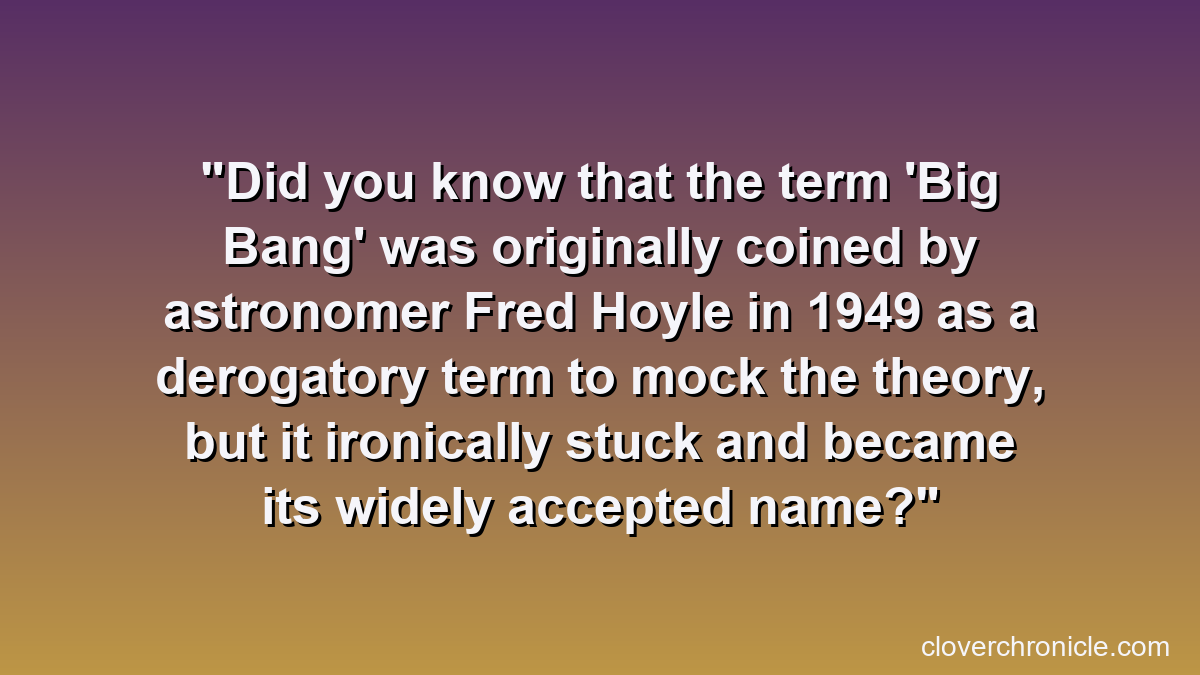
- ✅ Expansion of the Universe (Hubble’s Law): Observations by Edwin Hubble in the late 1920s showed that galaxies are moving away from us, and the farther away they are, the faster they are receding. This uniform expansion, with space itself stretching, is a cornerstone of the Big Bang model. Georges Lemaître, often called The Father of the Big Bang Theory, was instrumental in proposing this expanding universe concept even before Hubble’s definitive observations.
- ✅ Cosmic Microwave Background (CMB) Radiation: Discovered accidentally by Arno Penzias and Robert Wilson in 1964, the CMB is isotropic background radiation detected from all directions in space. It’s interpreted as the residual heat from the Hot Big Bang, specifically the “afterglow” from the Recombination Epoch when the universe became transparent. Its nearly uniform temperature and subtle fluctuations are precisely what the Hot Big Bang predicts.
- ✅ Abundance of Light Elements: The theory accurately predicts the observed cosmic abundances of light elements like hydrogen (~75%), helium-4 (~24%), deuterium, and lithium. These elements were formed during the Nucleosynthesis Epoch, when the universe was hot enough for nuclear fusion but cooled rapidly enough to prevent heavier elements from forming in significant quantities.
- ✅ Large-Scale Structure of the Universe: The Hot Big Bang, particularly with the addition of inflation, explains the formation of galaxies, galaxy clusters, and superclusters. The tiny temperature fluctuations in the CMB are the primordial seeds from which these large structures grew through gravitational collapse over billions of years.
Unpacking the “Hot”: Temperature, Density, and Phase Transitions
The “hot” in Hot Big Bang Theory isn’t just a descriptor; it’s the engine of cosmic evolution. Imagine a universe crammed into an incredibly small volume, far smaller than an atom, and superheated to temperatures that defy human comprehension. This extreme energy density is what allowed for the fundamental transformations that shaped reality.
In the earliest moments, the universe was so hot that matter as we know it couldn’t exist. Instead, energy and particles were interchangeable, governed by Einstein’s famous E=mc2. As the universe expanded, its temperature and density plummeted, triggering a series of crucial phase transitions:
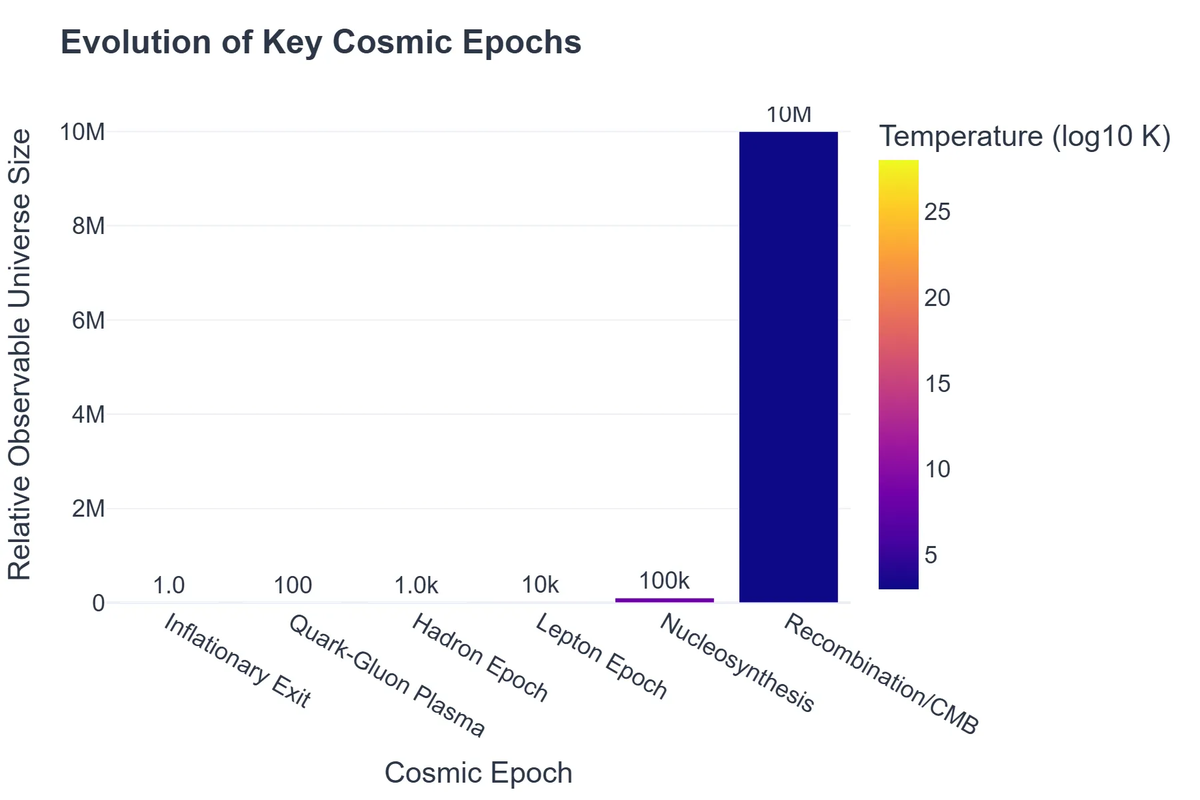
- 💡 Fundamental Forces Separate: From a unified superforce, gravity first peeled off, followed by the strong nuclear force, and finally the weak nuclear and electromagnetic forces. Each separation marked a fundamental shift in how matter and energy interacted.
- ⚛️ Quark-Gluon Plasma: Before particles like protons and neutrons could form, the universe was a scorching soup of quarks and gluons, constantly interacting. This state is known as a quark-gluon plasma. As the universe cooled, these quarks became confined by the strong force, binding together to form the first stable hadrons.
- 🌡️ Matter-Antimatter Annihilation: At extremely high temperatures, matter and antimatter particles (like electrons and positrons) were constantly created and annihilated in pairs. As the universe cooled, the rate of creation dropped, leading to a massive annihilation event. Crucially, a tiny, inexplicable asymmetry (about one extra matter particle for every billion matter-antimatter pairs) meant that a small amount of matter survived, forming everything we see today.
- 🌊 Neutral Atom Formation: The final major “hot” phase transition occurred during recombination. Before this, free electrons scattered photons, making the universe opaque. Once the temperature dropped sufficiently, electrons combined with nuclei to form neutral atoms, allowing light to travel freely – the source of the CMB.
These sequential transitions, driven by the cooling of the initially hot universe, explain the emergence of the fundamental particles, forces, and structures that comprise our cosmos. For a broader look at cosmic conundrums, you might find this discussion on Cosmic Conundrums insightful. This continuous unfolding of properties from an initial hot, dense state is a core tenet of our understanding of Cosmic Queries: Probing the Mysteries of the Universe.
Challenges and Open Questions in the Hot Big Bang Model
While the Hot Big Bang Theory is incredibly successful, it’s not without its challenges and areas of active research. These open questions represent frontiers of cosmological inquiry:
- ❓ The Initial Singularity: The model extrapolates back to an infinitely dense, hot point. However, current physics cannot fully describe this singularity. What was “before” the Big Bang? Or is it a meaningless question within our current understanding of spacetime?
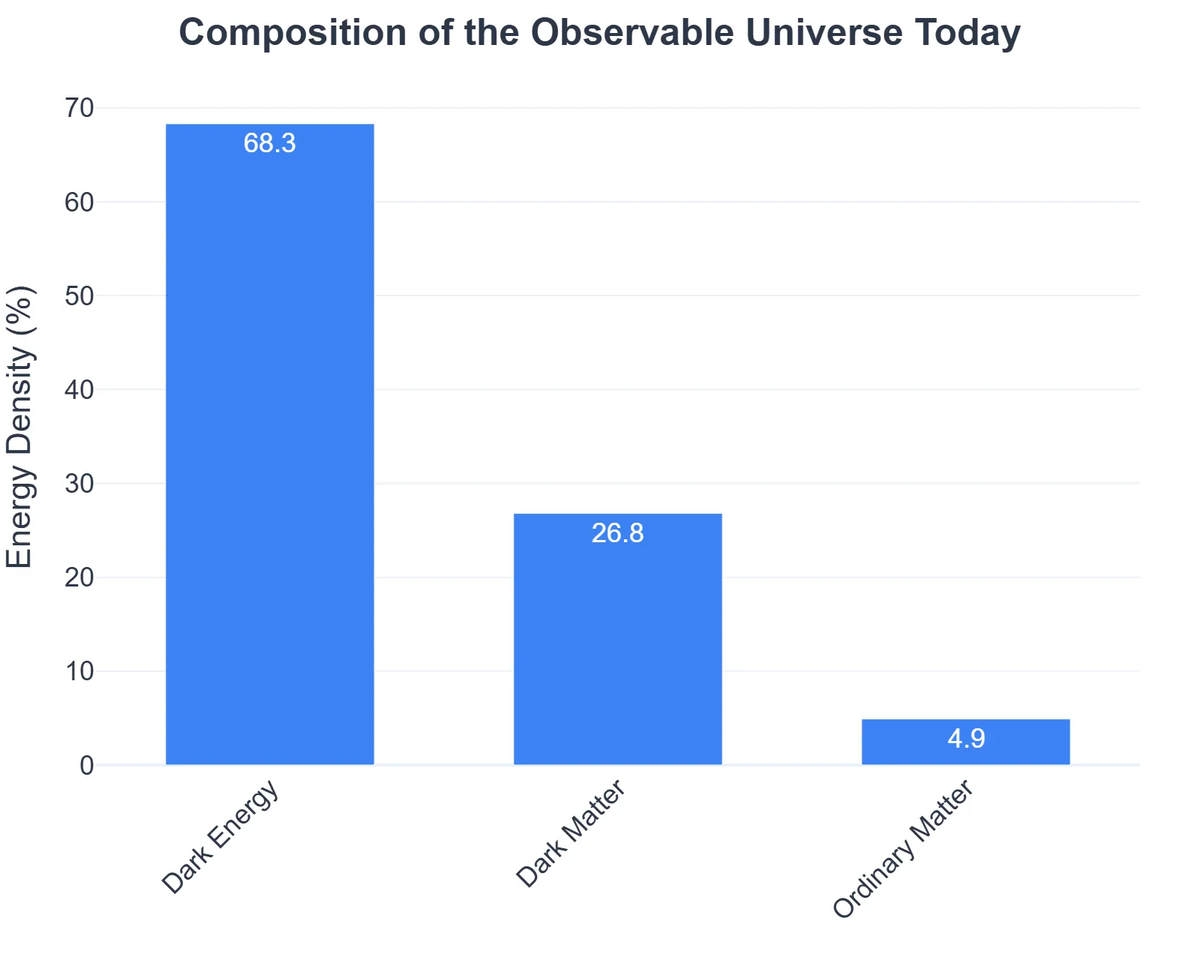
- ❓ Nature of Dark Matter: Observations of galactic rotation curves and galaxy clusters strongly suggest the presence of an invisible substance that interacts gravitationally but not with light. This “dark matter” makes up about 27% of the universe’s mass-energy budget, but its nature remains unknown.
- ❓ Nature of Dark Energy: Even more mysterious is “dark energy,” which is thought to be responsible for the accelerating expansion of the universe. It constitutes about 68% of the universe’s mass-energy and is a dominant force on cosmic scales, yet its properties are largely unknown.
- ❓ The Flatness Problem: The universe appears to be remarkably flat (meaning its geometry is Euclidean). Without inflation, the Hot Big Bang model requires an incredibly precise initial density to achieve this flatness, a fine-tuning problem. Inflation elegantly solves this by stretching any initial curvature to near-flatness.
- ❓ The Horizon Problem: The CMB is remarkably uniform across the sky, even in regions that, according to standard Big Bang expansion, should never have been in causal contact. How did they reach thermal equilibrium? Inflation solves this by positing that these regions were once causally connected before rapid expansion stretched them beyond our current observable horizon.
- ❓ The Monopole Problem: Grand Unified Theories predict the existence of magnetic monopoles (isolated north or south poles). If they were produced in the early universe, they should be abundant, but none have ever been observed. Inflation predicts that any monopoles produced would have been diluted to undetectable levels.
Recommended Video
What is the Hot Big Bang Theory?
The Hot Big Bang Theory is the prevailing cosmological model describing the universe’s evolution from a extremely hot, dense, and rapidly expanding state approximately 13.8 billion years ago.
What is the primary evidence supporting the Big Bang?
Primary evidence includes the observed expansion of the universe (Hubble’s Law), the Cosmic Microwave Background (CMB) radiation, and the measured abundance of light elements like hydrogen and helium.
Does the Hot Big Bang explain the absolute origin of everything?
No, it describes the evolution of the universe *after* an initial singularity, but it doesn’t fully explain what caused the singularity or what existed ‘before’ it. That remains an active area of research.
How does ‘Hot’ in Hot Big Bang Theory relate to the universe?
The ‘Hot’ refers to the extremely high temperatures of the early universe. This initial heat was crucial for the formation of light elements and for imprinting the Cosmic Microwave Background radiation we observe today.