For centuries, humanity has sought to understand the fundamental laws governing our universe. From the grand cosmic dance of galaxies to the perplexing behavior of subatomic particles, physics has provided remarkably accurate frameworks. Yet, two of the most successful theories, General Relativity and Quantum Mechanics, stand in stark contrast, describing vastly different realms of existence. The challenge of reconciling these titans forms the core of one of the greatest quests in modern science: the search for a unified theory of everything.
💡 Key Takeaways
- General Relativity describes gravity for large-scale structures, while quantum mechanics governs the subatomic world.
- These two highly successful theories are incompatible at extreme conditions, like black holes or the Big Bang.
- The quest for a ‘Theory of Everything’ aims to unify these forces, with candidates like String Theory and Loop Quantum Gravity.
- A unified theory could unlock deeper insights into the universe’s origins and fundamental nature.
“The true elegance of the cosmos will only reveal itself when we finally understand how the dance of stars and the flutter of a quantum particle are orchestrated by a single, underlying rhythm. It’s the ultimate cosmic mystery novel, and we’re just turning the first few pages.”
— Astrid Bellweather, Astrophysicist & Science Fiction Consultant
This article delves into the profound complexities of gravity and quantum mechanics, exploring why they clash and the leading theories attempting to bridge this chasm. Join us as we probe the very fabric of reality, seeking to understand the universe at its most fundamental level.
In This Article
- — 💡 Key Takeaways
- → The Two Pillars: General Relativity and Quantum Mechanics Explained
- — 🌌 General Relativity: The Fabric of Spacetime
- — 🔬 Quantum Mechanics: The Realm of the Very Small
- → The Fundamental Conflict: Why Gravity Doesn’t Fit Quantum Mechanics
- — 🚫 Differences in Fundamental Assumptions
- — ⚠️ The Problem of Gravitons and Renormalization
- — 🤯 The Planck Scale: Where Theories Break Down
- → The Quest for Quantum Gravity: Motivations and Challenges
- — ✨ Unifying All Forces
- — ⚫ Understanding Black Holes and the Big Bang
- — 🔭 Experimental Verification Challenges
- → Leading Theories of Quantum Gravity
- — 💫 String Theory: Vibrating Strings and Extra Dimensions
- — 🌀 Loop Quantum Gravity: Quantized Spacetime
- — ⚛️ Other Approaches
- → Implications of a Unified Theory
- — 🧠 A Deeper Understanding of Reality
- — 🔭 Resolving Cosmic Mysteries
- → Conclusion
The Two Pillars: General Relativity and Quantum Mechanics Explained
Before we explore the conflict, it’s essential to understand the separate domains and incredible successes of these two foundational theories.
🌌 General Relativity: The Fabric of Spacetime
Developed by Albert Einstein in the early 20th century, General Relativity revolutionized our understanding of gravity. Instead of a force acting at a distance, Einstein proposed that gravity is a manifestation of the curvature of spacetime, caused by mass and energy. Massive objects, like planets and stars, warp the spacetime around them, and this curvature dictates how other objects (and even light) move. This elegant theory perfectly describes gravity on large scales, from the orbits of planets to the expansion of the universe and the behavior of black holes.
- ✅ Describes Large Scales: Governs planets, stars, galaxies, and the cosmos.
- ✅ Gravity as Spacetime Curvature: Mass and energy warp the fabric of spacetime.
- ✅ Predictive Power: Successfully predicted phenomena like gravitational lensing, the existence of black holes, and gravitational waves.
Einstein himself dedicated much of his later life to the quest for a unified field theory, aiming to merge gravity with electromagnetism, a precursor to the modern challenge. For more on this historical pursuit, you can read about Einstein’s quest for a unified theory.
🔬 Quantum Mechanics: The Realm of the Very Small
Emerging in the same era, Quantum Mechanics (QM) describes the universe at the microscopic level – the world of atoms, electrons, photons, and other elementary particles. It’s a world where energy comes in discrete packets (quanta), particles can behave as waves, and uncertainty is a fundamental aspect of reality. QM successfully describes three of the four fundamental forces: the strong nuclear force, the weak nuclear force, and electromagnetism. These forces are mediated by specific particles, like photons for electromagnetism, gluons for the strong force, and W and Z bosons for the weak force.
- ➡️ Describes Small Scales: Governs atoms, subatomic particles, and their interactions.
- ➡️ Quantized Energy: Energy exists in discrete packets.
- ➡️ Probabilistic Nature: Predicts probabilities, not certainties, of outcomes.
To dive deeper into the fascinating world of quantum mechanics and its relationship with other grand theories, explore our article on Quantum Mechanics & String Theory: Beyond the Standard Model.
The Fundamental Conflict: Why Gravity Doesn’t Fit Quantum Mechanics
The problem arises when physicists attempt to describe gravity in quantum mechanics terms. General Relativity works beautifully for large, heavy objects, while quantum mechanics excels at the tiny, energetic world. But what happens when gravity becomes incredibly strong at minuscule scales, such as inside a black hole or at the very beginning of the universe (the Big Bang singularity)? This is where the theories break down.
🚫 Differences in Fundamental Assumptions
General Relativity assumes a smooth, continuous spacetime. Quantum Mechanics, however, introduces inherent “graininess” and uncertainty. When you try to quantize gravity, spacetime itself would have to fluctuate wildly at extremely small scales, becoming “foamy” or “fuzzy,” which directly contradicts the smooth fabric assumed by General Relativity.
⚠️ The Problem of Gravitons and Renormalization
In quantum field theory, forces are mediated by particles. If gravity were quantized like the other forces, it would be mediated by a hypothetical particle called the “graviton.” The mathematical attempts to describe gravitons within the framework of quantum field theory lead to infinities that cannot be removed through a process called “renormalization,” which works for other forces. This makes a quantum theory of gravity non-predictive and unworkable with current methods.
🤯 The Planck Scale: Where Theories Break Down
The Planck scale (a tiny length of 10-35 meters and an immense energy of 1019 GeV) is where the effects of quantum gravity are expected to become significant. At this scale, the quantum fluctuations of spacetime are so extreme that both General Relativity and Quantum Mechanics, in their current forms, cease to be valid descriptions of reality. This is the theoretical boundary that a theory of quantum gravity must address.
The Quest for Quantum Gravity: Motivations and Challenges
The pursuit of a theory of quantum gravity isn’t just an academic exercise; it’s essential for a complete understanding of the universe.
✨ Unifying All Forces
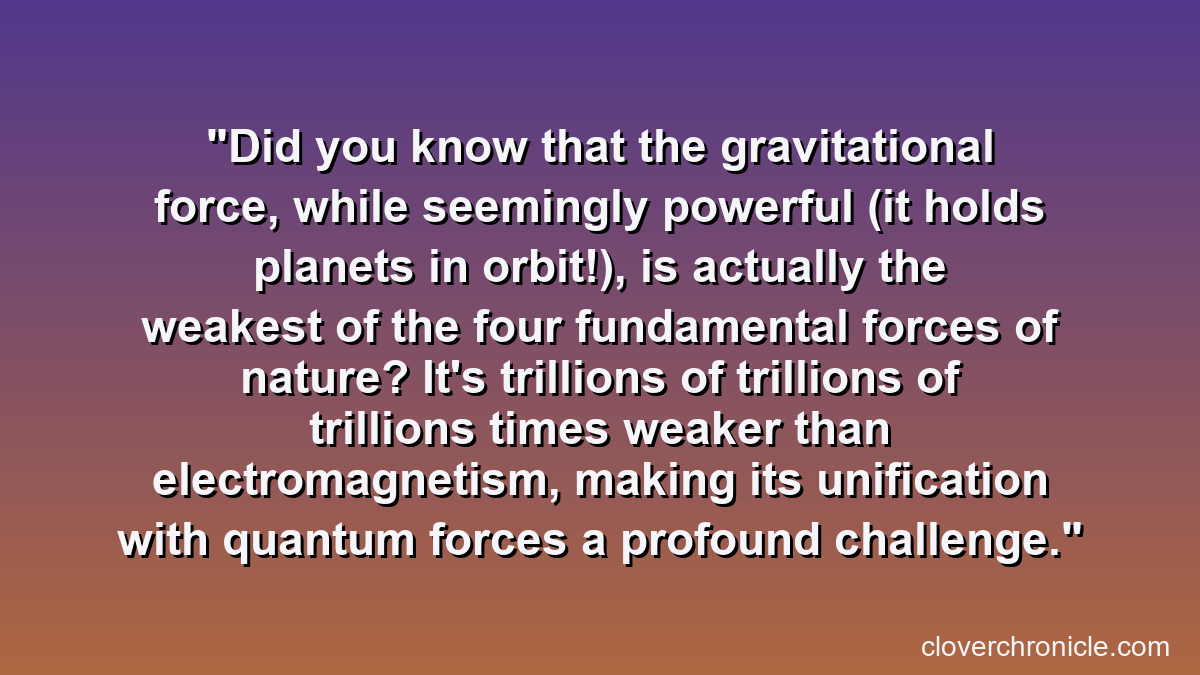
A unified theory would bring together all four fundamental forces of nature (strong, weak, electromagnetic, and gravitational) under a single, consistent mathematical framework. This would represent the pinnacle of scientific understanding, revealing a deeper, more elegant simplicity in the laws of the cosmos.
⚫ Understanding Black Holes and the Big Bang
Regions of extreme gravity, like the singularities at the heart of black holes and the initial moments of the Big Bang, are precisely where quantum gravity effects would dominate. A successful theory of quantum gravity could resolve paradoxes like the information loss problem in black holes and provide insights into what truly happened at the birth of our universe.
🔭 Experimental Verification Challenges
One of the biggest hurdles is the incredibly small scale at which quantum gravitational effects become apparent. The energies required to probe the Planck scale are far beyond the capabilities of current or foreseeable particle accelerators. This means that direct experimental verification of quantum gravity theories is exceedingly difficult, relying more on theoretical consistency and potential indirect astrophysical observations.
Leading Theories of Quantum Gravity
Despite the challenges, several promising theoretical frameworks are vying to be the unified theory. Each offers a unique perspective on how to bridge the gap between General Relativity and Quantum Mechanics.
💫 String Theory: Vibrating Strings and Extra Dimensions
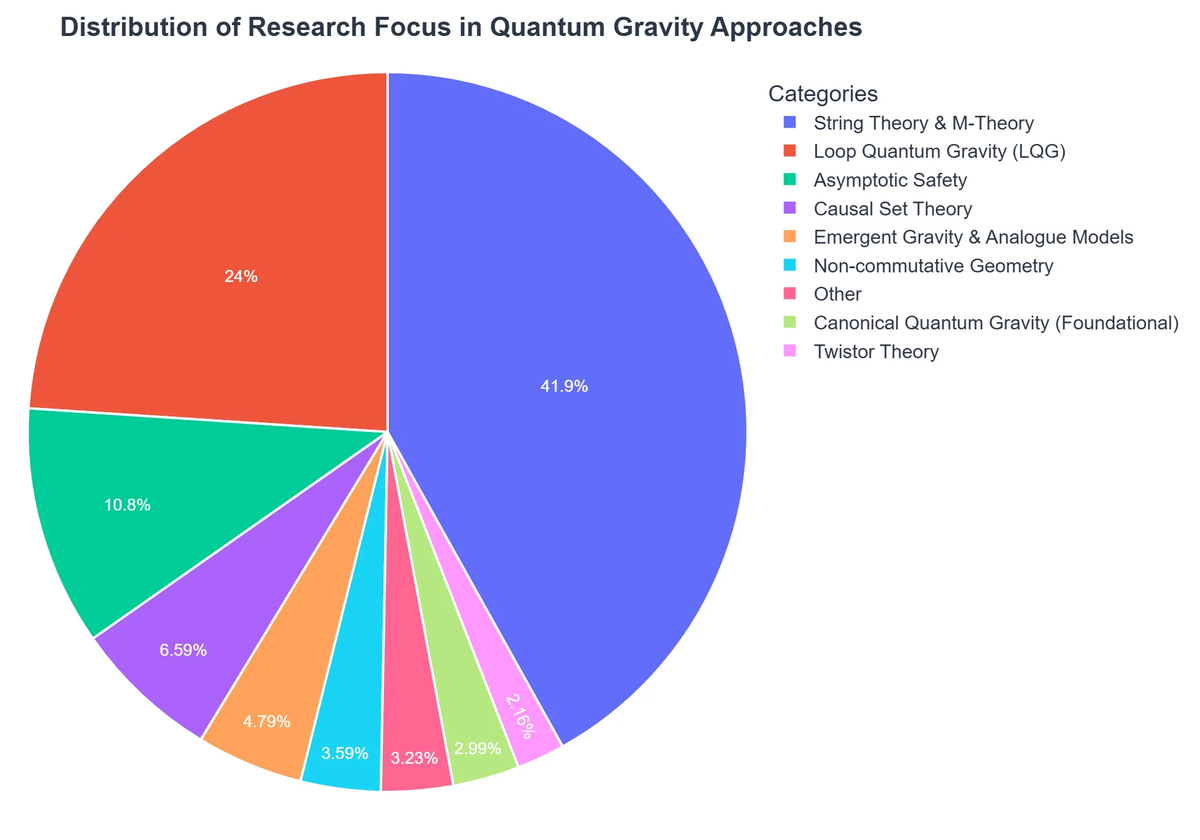
Perhaps the most well-known candidate, String Theory, proposes that the fundamental constituents of the universe are not point-like particles but tiny, one-dimensional vibrating strings. Different vibrational modes of these strings correspond to different particles, including the graviton. A key feature of String Theory is its requirement for extra spatial dimensions (typically 10 or 11 in total), which are compactified or “curled up” to be imperceptible at macroscopic scales. While elegant, String Theory faces challenges, including the existence of a vast “landscape” of possible universes and the difficulty of experimental verification. To learn more about this, check out our piece on Quantum Mechanics and Relativity: Bridging the Divide.
- 💡 Fundamental Units: Not particles, but vibrating strings.
- 💡 Extra Dimensions: Requires more than three spatial dimensions.
- 💡 Promises Graviton: Naturally includes a quantum of gravity.
For a critical perspective, some physicists highlight problems with String Theory in quantum gravity.
🌀 Loop Quantum Gravity: Quantized Spacetime
Loop Quantum Gravity (LQG) takes a different approach. Instead of unifying forces by introducing new fundamental objects, LQG attempts to quantize spacetime itself. It suggests that spacetime is not continuous but is made up of discrete “loops” or “atoms” of space, woven into a network called a spin network. These loops define the geometry of space at the Planck scale. LQG does not require extra dimensions and offers a background-independent formulation of quantum gravity, meaning it doesn’t assume a pre-existing spacetime background. However, it still faces challenges, particularly in demonstrating how classical General Relativity emerges from its quantum description and predicting experimental signatures.
- ➡️ Quantizes Spacetime: Space itself is granular, not continuous.
- ➡️ Spin Networks: Fundamental structure of spacetime.
- ➡️ Background Independent: Does not rely on a fixed spacetime.
For more on supergravity, an extension of General Relativity that incorporates supersymmetry, which is often considered in the context of unified theories, you can refer to the EBSCO Research Starters article on Supergravity.
⚛️ Other Approaches
Beyond String Theory and Loop Quantum Gravity, other theories offer alternative paths toward quantum gravity:
- Causal Set Theory: Proposes that spacetime is fundamentally discrete, formed by a collection of points with causal relationships, rather than a continuous manifold.
- Non-Commutative Geometry: Explores the idea that spacetime coordinates might not commute at the Planck scale, leading to a “fuzzy” or “non-local” geometry.
- Asymptotic Safety: Suggests that quantum gravity could be a viable quantum field theory if its infinities cancel out at high energies due to a “fixed point.”
Implications of a Unified Theory
The successful development of a theory of quantum gravity would have profound implications for our understanding of the cosmos and our place within it, echoing the spirit of inquiry central to Cosmic Queries: Probing the Mysteries of the Universe.
🧠 A Deeper Understanding of Reality
A unified theory would reveal the deep connections between all the forces and particles in the universe, providing a more coherent and elegant description of reality at its most fundamental level. It would allow physicists to truly understand the very nature of space, time, matter, and energy.
🔭 Resolving Cosmic Mysteries
It could unlock answers to some of the universe’s most enduring puzzles: What existed before the Big Bang? What happens inside a black hole? What is the true nature of dark matter and dark energy? A quantum theory of gravity is crucial for unraveling these cosmic enigmas.
Recommended Video
Conclusion
The quest for a unified theory of gravity and quantum mechanics represents the Everest of modern physics. It’s a monumental challenge that forces us to rethink our most fundamental assumptions about space, time, and matter. While a definitive answer remains elusive, the ongoing pursuit has already led to remarkable theoretical breakthroughs and deepened our appreciation for the intricate beauty and complexity of the universe.
As physicists continue to explore the frontiers of knowledge, combining mathematical rigor with imaginative leaps, the dream of a single, coherent theory that describes all of reality moves closer to fruition, promising to unlock secrets that will redefine our understanding of existence itself.
Frequently Asked Questions
Why are General Relativity and Quantum Mechanics incompatible?
General Relativity is a classical, deterministic theory describing gravity as spacetime curvature, while quantum mechanics is probabilistic and describes forces via particle exchanges, making them difficult to reconcile at quantum scales.
What is a ‘unified theory’ or ‘Theory of Everything’?
A unified theory aims to describe all fundamental forces of nature (gravity, electromagnetism, strong, and weak nuclear forces) as different manifestations of a single force, offering a complete understanding of the universe.
What are some leading candidates for a unified theory?
Leading candidates include String Theory, which posits that fundamental particles are tiny vibrating strings, and Loop Quantum Gravity, which attempts to quantize spacetime itself.