
The universe is vast, and within its boundless expanse, the question of whether life exists beyond Earth continues to captivate humanity. Among the most promising candidates for harboring extraterrestrial life in our own solar system is Europa, one of Jupiter’s intriguing moons. With its vast, hidden ocean, Europa has become a focal point for astrobiological exploration, leading to one of NASA’s most ambitious endeavors: the Europa Clipper Mission.
💡 Key Takeaways
- Europa Clipper aims to investigate Europa’s subsurface ocean for habitability.
- The mission will use advanced instruments to study the moon’s ice shell, ocean, and composition.
- Discoveries from Europa Clipper could revolutionize our understanding of life beyond Earth.
- The mission represents a critical step in astrobiological research in the outer solar system.
“The Europa Clipper isn’t just probing for water; it’s lifting the veil on one of the solar system’s most tantalizing mysteries. It’s the closest we’ve come to knowing if the whispers of life echo on worlds beyond our own, transforming science fiction into palpable possibility.”
— Astrid Bellweather, Astrophysicist & Science Fiction Consultant
This comprehensive article delves into why Europa holds such immense scientific interest, the groundbreaking objectives of the mission, and how this intrepid spacecraft aims to unravel the mysteries beneath the moon’s icy shell, bringing us closer to answering the profound question: Are we alone?
In This Article
- — 💡 Key Takeaways
- → Why Europa? The Allure of an Ocean World
- — ✅ Ingredients for Life
- — 💡 Europa’s Subsurface Ocean
- → The Europa Clipper Mission: A Deep Dive into Design and Objectives
- — 🔭 Mission Goals
- — 🔬 Advanced Instrument Payload
- → Journey to Jupiter’s Icy Moon: The Path Ahead
- — 🚀 Launch and Trajectory
- — ➡️ Orbital Strategy
- → What Will Europa Clipper Search For? Signs of Life
- — 🧪 Biosignatures and Habitability
- — 🧊 Beyond the Ocean: Surface Features
- → The Broader Context: Europa Clipper’s Place in Cosmic Exploration
- — 🪐 Building on Past Missions
- — 🌌 Implications for Astrobiology
- → Conclusion
Why Europa? The Allure of an Ocean World
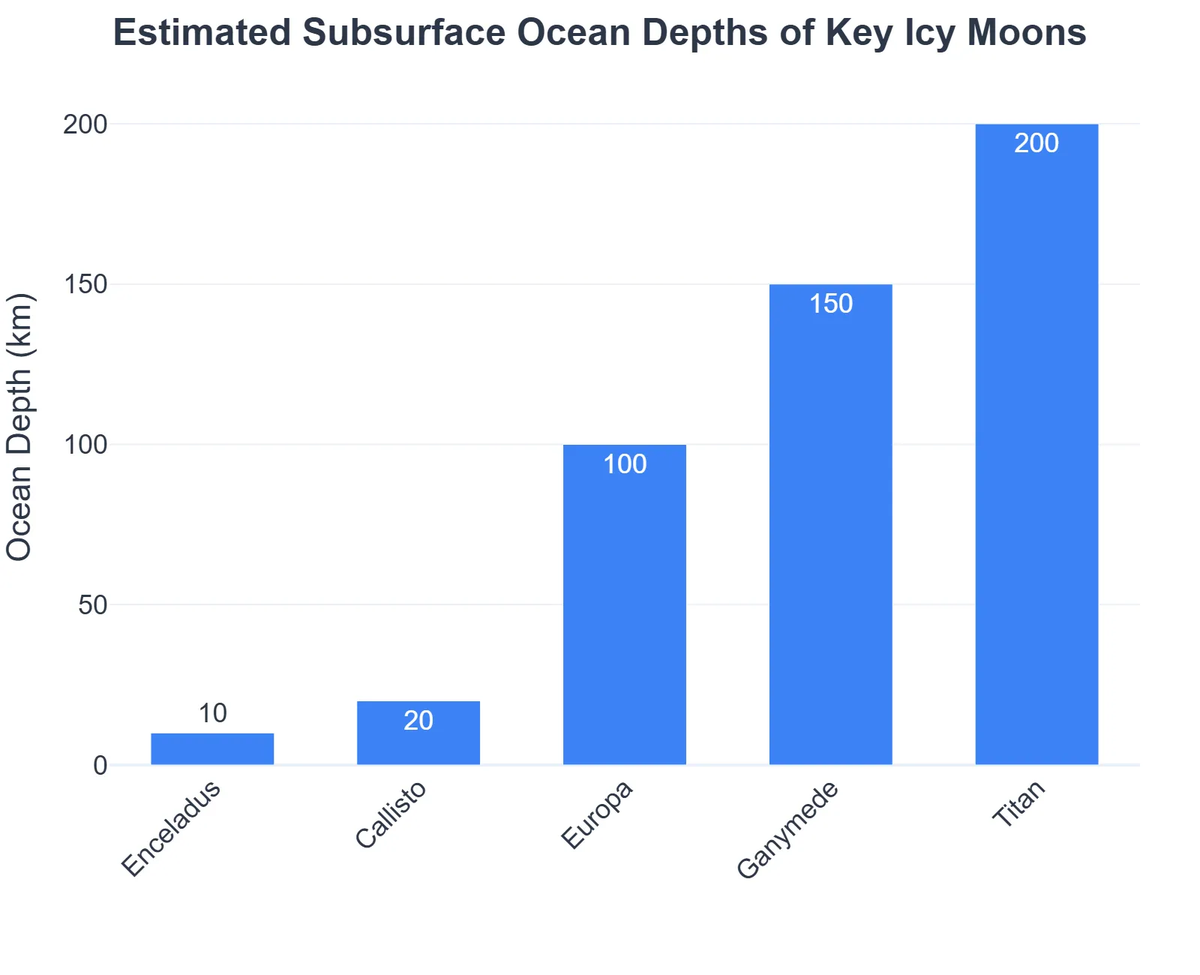
Europa, slightly smaller than Earth’s Moon, is more than just another celestial body. Decades of observations, notably from the Galileo mission to Jupiter, have provided compelling evidence that Europa harbors a vast, salty ocean beneath its icy crust – an ocean that could contain more than twice the volume of all of Earth’s oceans combined.
✅ Ingredients for Life
Scientists believe that three key ingredients are essential for life as we know it:
- ➡️ Liquid Water: Europa’s subsurface ocean provides this in abundance.
- ➡️ Essential Chemical Elements: Europa is believed to possess the necessary elements, such as carbon, hydrogen, nitrogen, oxygen, phosphorus, and sulfur, which are the building blocks of life.
- ➡️ Energy Source: While sunlight doesn’t penetrate the ice, scientists hypothesize that hydrothermal vents on Europa’s seafloor, similar to those found on Earth, could provide chemical energy for life, independent of the sun. As explored in Europa Mission: Quest for Life on Jupiter’s Moon, this energy source is critical.
The presence of these ingredients makes Europa an prime target in the search for habitable environments beyond Earth. For more detailed information on the ingredients for life on Europa, refer to NASA’s Europa Clipper website.
💡 Europa’s Subsurface Ocean
Evidence for Europa’s ocean comes from various sources:
- ✅ Magnetic field measurements by the Galileo spacecraft suggested a conductive layer beneath the surface, consistent with a salty ocean.
- ✅ Gravitational data indicated a differentiation of Europa’s interior into distinct layers, including a liquid water layer.
- ✅ Images of Europa’s surface reveal features like “chaos terrains” and cracks that resemble patterns formed by ice drifting over a liquid ocean.
- ✅ Geysers or plumes erupting from the moon’s south polar region have been observed by the Hubble Space Telescope, hinting at direct access to the ocean.
The Europa Clipper Mission: A Deep Dive into Design and Objectives
NASA’s Europa Clipper is a groundbreaking mission designed specifically to investigate Europa’s habitability. Unlike previous missions that conducted flybys, Europa Clipper will perform nearly 50 close flybys of the moon, gathering unprecedented data.
🔭 Mission Goals
The primary objectives of the Europa Clipper mission are:
-
Confirm the Ocean: Confirm the existence of Europa’s subsurface ocean and characterize its size, depth, and salinity.
Estimated Subsurface Ocean Depths of Key Icy Moons -
Assess Habitability: Investigate the ocean’s composition to determine if it possesses the necessary chemical ingredients for life.
-
Search for Biosignatures: Identify potential biosignatures (evidence of past or present life), particularly by analyzing material ejected from plumes.
-
Characterize Ice Shell: Understand the structure and thickness of the ice shell and potential interactions between the ocean and the surface.
This mission represents a critical step in our understanding of the potential for life within the Cosmic Queries: Probing the Mysteries of the Universe.
🔬 Advanced Instrument Payload
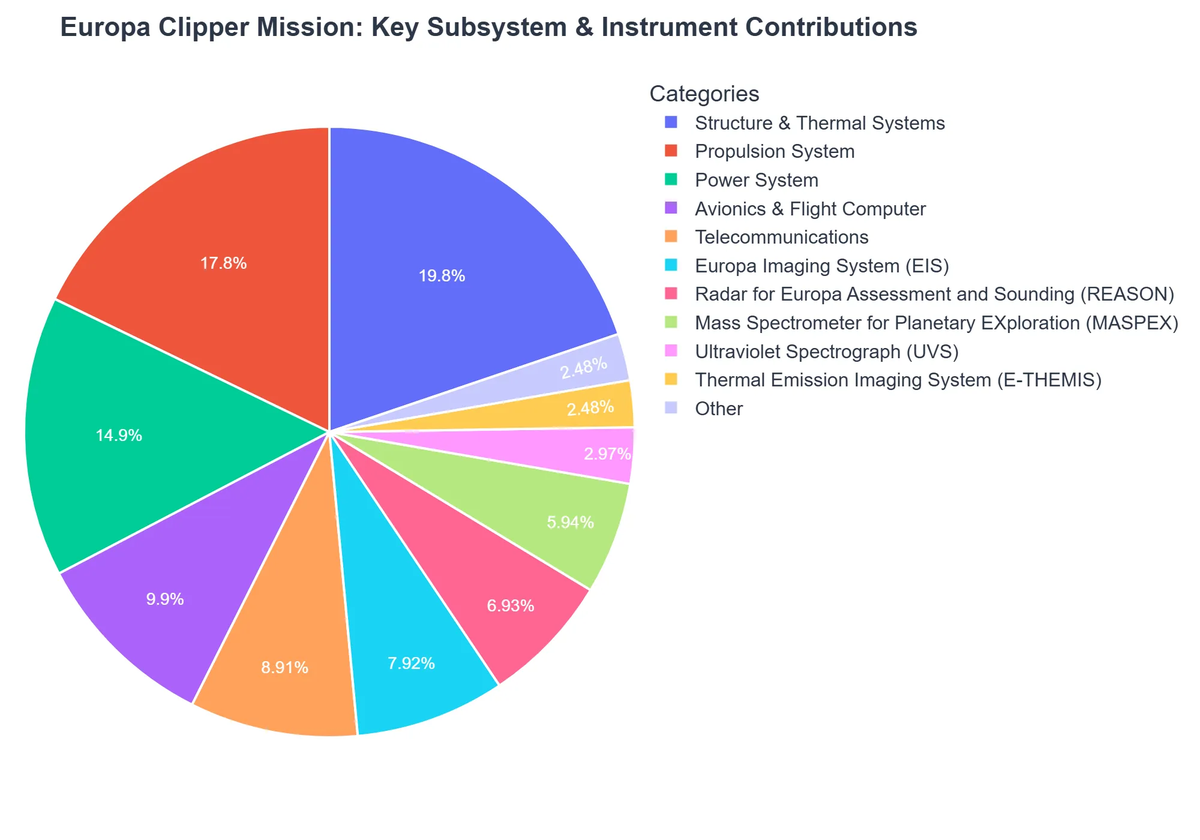
To achieve its ambitious goals, the Europa Clipper carries a sophisticated suite of nine scientific instruments:
- ✅ Europa Imaging System (EIS): High-resolution cameras to map Europa’s surface and search for plume activity.
- ✅ Europa Ultraviolet Spectrograph (EUV): To detect and analyze faint emissions from potential plumes.
- ✅ Mapping Imaging Spectrometer for Europa (MISE): To map the distribution of organic materials, salts, and other compounds on the surface.
- ✅ Radar for Europa Assessment and Sounding: Ocean to Near-surface (REASON): Ice-penetrating radar to study the ice shell structure and locate the ocean.
- ✅ Europa Clipper Magnetometer (ECM): To measure Europa’s magnetic field and help characterize the ocean’s properties.
- ✅ Plasma Instrument for Magnetic Sounding (PIMS): To analyze the plasma around Europa and its interaction with Jupiter’s strong magnetic field.
- ✅ Energetic Ion and Fast Neutral Atom Spectrometer (EIS): To study the particles orbiting Europa.
- ✅ Mass Spectrometer for Planetary Exploration/Europa (MASPEX): To analyze the composition of Europa’s exosphere and any material ejected from plumes.
- ✅ Thermal Emission Imaging System (E-THEMIS): To map Europa’s surface temperatures and identify active hot spots.
This comprehensive set of tools will allow scientists to conduct an unparalleled investigation into Europa’s secrets.
Journey to Jupiter’s Icy Moon: The Path Ahead
The journey to Europa is long and complex, requiring precise navigation and advanced propulsion.
🚀 Launch and Trajectory
The Europa Clipper mission is currently slated for launch in October 2024. It will embark on a multi-year journey, utilizing gravity assists from other planets (likely Mars and Earth) to gain the necessary speed and trajectory to reach Jupiter.
➡️ Orbital Strategy
Upon arrival in the Jupiter system, Europa Clipper will not orbit Europa directly. Instead, it will orbit Jupiter, making close flybys of Europa on highly elliptical trajectories. This strategy is crucial for several reasons:
- ✅ Radiation Protection: Jupiter’s intense radiation belts are extremely hazardous to spacecraft. By orbiting Jupiter and performing quick flybys, the Clipper minimizes its exposure to the harshest radiation.
- ✅ Global Coverage: The multiple flybys at varying altitudes and angles will allow the mission to achieve near-global coverage of Europa’s surface.
- ✅ Flexible Operations: This approach provides flexibility for mission planning and scientific observations.
The insights gained will complement previous studies from missions like the Juno Probe: Unlocking Jupiter’s Deepest Secrets, providing a fuller picture of the Jovian system.
What Will Europa Clipper Search For? Signs of Life
The ultimate goal of the Europa Clipper Mission is not to find life directly, but to determine if Europa has the potential to harbor life and, if so, to search for indirect evidence or “biosignatures.”
🧪 Biosignatures and Habitability
A biosignature is any substance – such as an element, isotope, or molecule – or phenomenon that provides scientific evidence of past or present life. On Europa, the Clipper will look for:
- ✅ Organic Molecules: Complex carbon-based molecules that are often associated with biological processes.
- ✅ Chemical Disequilibrium: Unbalanced chemical reactions that could be indicative of metabolic activity.
- ✅ Patterns in Ice and Plumes: Unique distributions or concentrations of elements that might be linked to biological activity.
Even if the mission doesn’t definitively detect life, confirming the presence of a habitable environment would be a monumental discovery, profoundly reshaping our understanding of where life might emerge in the cosmos.
🧊 Beyond the Ocean: Surface Features
While the ocean is the main draw, Europa Clipper will also meticulously study the moon’s fascinating surface, which acts as a window into its interior. This includes:
- ✅ Analyzing the composition of surface materials, including salts and possible organic compounds.
- ✅ Mapping geological features to understand tectonic processes and the interaction between the ice shell and the ocean.
- ✅ Investigating potential cryovolcanic activity and active plumes, which could bring subsurface material to the surface for direct sampling.
The Broader Context: Europa Clipper’s Place in Cosmic Exploration
The Europa Clipper Mission is not an isolated endeavor but a crucial link in a long chain of planetary exploration that seeks to understand our solar system and the potential for life beyond Earth.
🪐 Building on Past Missions
This mission builds directly on the pioneering work of previous probes. The Galileo Mission to Jupiter: Unraveling Jovian Mysteries provided the initial, compelling evidence for Europa’s subsurface ocean, laying the foundation for Clipper’s focused investigation. Other missions to Jupiter’s moons, like the upcoming JUICE mission by the European Space Agency, will further complement Clipper’s findings, especially regarding Ganymede and Callisto.
🌌 Implications for Astrobiology
If Europa Clipper confirms that Europa is indeed habitable or even finds signs of life, the implications for astrobiology and humanity’s place in the universe would be profound. It would indicate that liquid water and the ingredients for life are not unique to Earth and might be common throughout the cosmos, boosting the likelihood of life existing on exoplanets like Gliese 581 c: Habitable Zone Exoplanet. This mission will push the boundaries of our knowledge, inspiring future generations of scientists and explorers.
Recommended Video
Conclusion
The Europa Clipper Mission stands as a testament to human ingenuity and our insatiable curiosity about the universe. By embarking on this ambitious quest to Jupiter’s icy moon, NASA is taking a monumental step in the search for life beyond Earth. The data collected by Clipper will not only unveil the secrets of Europa’s ocean but also provide invaluable insights into the conditions necessary for life to emerge, forever changing our perspective on our unique planet and the vast cosmos it inhabits. The anticipation surrounding this mission is immense, as it promises to deliver groundbreaking discoveries that could redefine our understanding of life itself.
Frequently Asked Questions
When is the Europa Clipper expected to launch?
The Europa Clipper mission is currently targeted for launch in October 2024.
What instruments will Europa Clipper use to study Europa?
It will carry a sophisticated suite of instruments, including cameras, spectrometers, a magnetometer, and radar, to analyze the moon’s ice, ocean, and potential plumes.
Why is Europa considered a prime target in the search for life?
Europa is believed to harbor a vast liquid water ocean beneath its icy crust, interacting with a rocky core, which provides the necessary ingredients and energy for life as we know it.