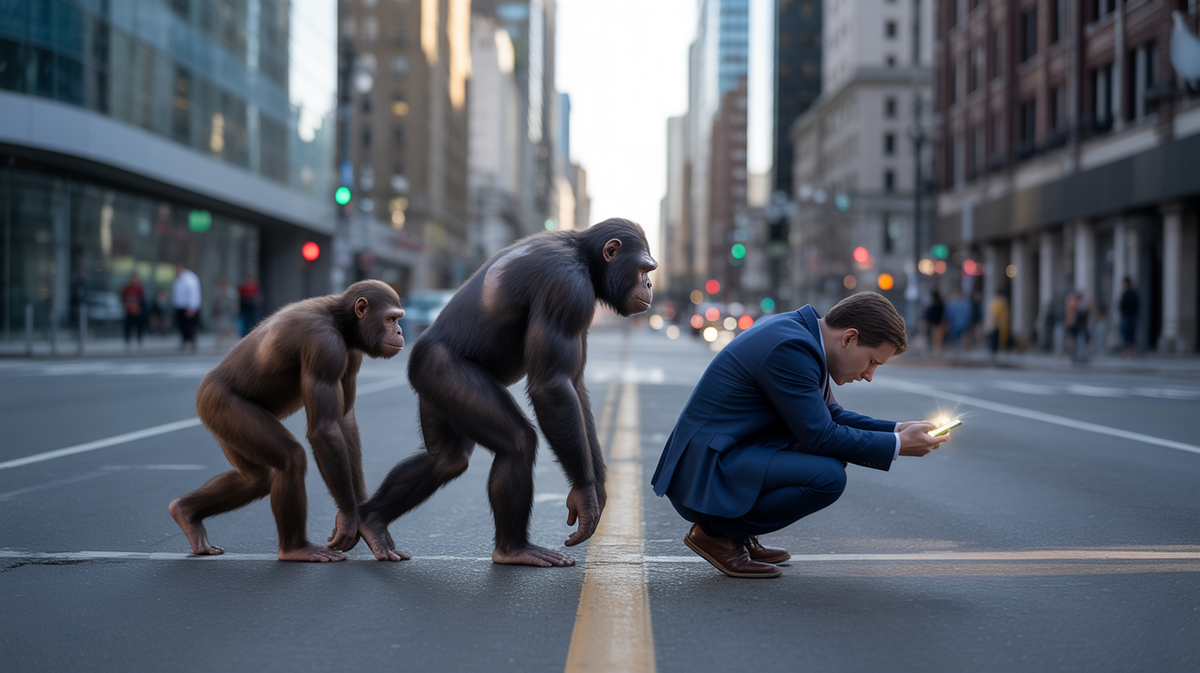
Understanding the Evolutionary Leap: Debunking the “Monkey to Human” Myth
One of the most persistent misconceptions about evolution is the idea that humans evolved directly from monkey to human. This simplistic view often conjures images of an ape slowly straightening up into a modern human, which isn’t quite how it works. In reality, the theory of evolution proposes that humans and modern monkeys (and apes) share a common ancestor.
💡 Key Takeaways
- Human evolution is a continuous, non-linear process, driven by natural selection, genetic mutations, and environmental factors.
- The concept of ‘from monkey to human’ simplifies a complex shared ancestry, with humans and modern apes evolving from a common ancestor.
- Speculation about evolving ‘back again’ highlights the dynamic nature of evolution, where future adaptations could lead to unexpected biological shifts.
- Technological advancements and cultural influences are now significant factors shaping the trajectory of human biological and social evolution.
“Evolution isn’t a linear march of progress, but a dynamic, branching tree. While humans are a distinct branch, the interplay of genetics and environment means our future evolutionary trajectory is far from static, perhaps even cyclical.”
— Julian Aris, PhD, Geneticist & Evolutionary Biologist
This common ancestor lived millions of years ago, and from it, different lineages diverged, leading to the diverse primate species we see today, including ourselves. It’s a branching tree, not a linear ladder. To truly grasp the scope of The Code of Life: Decoding Genetics, Evolution, and Existence, it’s essential to understand this fundamental principle of shared ancestry rather than direct descent.
In This Article
- → Understanding the Evolutionary Leap: Debunking the “Monkey to Human” Myth
- — 💡 Key Takeaways
- → The Hominin Journey: Key Milestones in Our Evolution
- → Parallel Paths: Why Monkeys Still Exist
- → Can We Evolve “Back” to a Monkey? Dispelling Common Misconceptions
- → The Future of Human Evolution: What’s Next?
The Hominin Journey: Key Milestones in Our Evolution
Our journey from that common primate ancestor to modern humans involves a remarkable series of adaptations and developments over millions of years. This lineage, known as hominins, began diverging from other apes roughly 6 to 7 million years ago in Africa. Key milestones that differentiate our branch include:

- ✅ Bipedalism: Walking upright on two legs was one of the earliest and most significant adaptations. It freed up our hands for carrying, tool-making, and communication.
- ➡️ Brain Expansion: Over time, there was a significant increase in brain size and complexity, particularly in the prefrontal cortex, which is associated with planning, problem-solving, and language.
- 💡 Tool Use: The development and sophisticated use of tools, starting with simple stone tools, marked a critical phase in our ancestors’ ability to manipulate their environment and access new food sources.
- 🦴 Dental Changes: Shifts in diet, from largely fruit-based to more omnivorous, are reflected in changes in tooth size and jaw structure.
- 🗣️ Language Development: While hard to pinpoint, the capacity for complex language and symbolic thought is a hallmark of human evolution, enabling advanced social structures and knowledge transfer.
For a more detailed exploration of our lineage, refer to our comprehensive guide on Human Evolution: A Comprehensive Guide. These adaptations weren’t isolated events but occurred in a complex interplay with environmental pressures and opportunities, highlighting the dynamic nature of human and monkey evolution from a shared root.
Parallel Paths: Why Monkeys Still Exist
The persistence of monkeys and apes alongside humans is a cornerstone of evolutionary understanding, not a contradiction. The premise that “if humans evolved from monkeys, there should be no monkeys left” is flawed because it misunderstands the branching nature of evolution.
Consider it like a family tree: you didn’t evolve from your cousin; you both share a grandparent. Similarly, humans and modern monkeys are like cousins, sharing a distant common ancestor (the “grandparent”). Different descendant branches adapted to different environments and lifestyles, leading to the incredible diversity we see today. As ABC Science explains, our ancestors shared a common ancestor with apes, but those ancestral species are now extinct, having evolved into different modern lineages. If evolution is real why are there still monkeys?

Key points to remember:
- 🌳 Branching Evolution: Evolution is not a linear progression but a complex tree of life with many branches diverging from common ancestors.
- 🌍 Ecological Niches: Different primate species adapted to different ecological niches, allowing them to coexist rather than one replacing the other.
- ⏳ Ongoing Evolution: Monkeys and apes are also continuing to evolve in their own ways, constantly adapting to their changing environments. This ongoing process of Animal Evolution: Diverse Paths of Adaptation and Change is a testament to life’s adaptability.
Can We Evolve “Back” to a Monkey? Dispelling Common Misconceptions
The idea of “evolving back” to a monkey, or any prior state, fundamentally misunderstands how evolution works. Evolution is not a reversible process, nor does it have a predetermined direction or goal. It’s driven by natural selection acting on random genetic mutations, favoring traits that enhance survival and reproduction in a given environment.
Here’s why human to monkey evolution isn’t possible:
Human Evolution: Tracing Our Ancestry and Debunking Myths
Pros
- ✔Provides a robust scientific explanation for human biological development and origins.
- ✔Unifies biology by illustrating shared ancestry among all life forms and the mechanisms of biodiversity.
- ✔Essential for understanding genetics, disease patterns, and anthropological studies.
- ✔Promotes critical thinking by challenging linear views of progress and highlighting ongoing adaptation.
Cons
- ✖Often misunderstood as a linear progression *from* modern apes rather than from a shared ancestor.
- ✖Can face significant cultural, religious, or political opposition due to perceived conflicts with beliefs.
- ✖The idea of ‘going back’ (‘and Back Again?’) is a common misconception; evolution is not reversible or a ladder.
- ✖Requires nuanced understanding to avoid oversimplification or deterministic views of human behavior.
- 🚫 Irreversibility: Once a species evolves a certain set of traits and loses others, it’s highly unlikely to perfectly re-evolve the exact genetic makeup and characteristics of an ancestor. Lost genetic information is rarely recovered.
- 🎯 No Predetermined Path: Evolution doesn’t aim for a specific outcome or “reversion.” It’s a continuous process of adaptation to current environmental pressures. The pressures that shaped our ancestors into hominins are different from those acting on us today.
- 💡 New Solutions: If environmental pressures were to change drastically, species would adapt in new ways, not by reverting to old ones. As discussed in online forums, the concept of “returning to monke” is a simplification that ignores the complex, forward-moving nature of evolution. Is it possible to Return to Monke?
Evolution builds upon existing structures and genetic material, leading to novel adaptations, not repeats of the past. Our physical and cognitive traits are a result of millions of years of unique evolutionary paths.
The Future of Human Evolution: What’s Next?
While the notion of evolution from monkey to human is a simplification of our shared lineage, it raises compelling questions about our future. Human evolution hasn’t stopped; it’s an ongoing process, though perhaps slower or less obvious due to cultural and technological advancements. What might future human evolution look like?
- ⚙️ Cultural and Technological Impact: Our ability to modify our environment, develop medicine, and create technology significantly alters the selective pressures that historically drove evolution. For instance, reliance on glasses reduces the pressure for perfect natural vision. Our Culture and Evolution: Shaping Human Societies are deeply intertwined.
- 🧬 Genetic Drift and Gene Flow: Global travel and increased intermixing of populations lead to greater gene flow, potentially reducing regional genetic differences.
- 🦠 Pathogen Co-evolution: Our immune systems continue to co-evolve with new pathogens, a constant arms race against diseases.
- 🧠 Cognitive and Social Evolution: While physical changes might be subtle, shifts in cognitive abilities, social structures, and even empathy could be ongoing, though harder to measure.
It’s important to remember that significant evolutionary changes occur over vast timescales, often imperceptible within a single human lifetime. While we won’t be sprouting tails or swinging through trees again, our species will undoubtedly continue to adapt, shaped by a complex interplay of biology, culture, and environment.

Recommended Video
Are humans still evolving?
Yes, human evolution is an ongoing process. While perhaps less obvious on short timescales, genetic adaptations to diet, disease resistance, and environmental changes continue to occur across populations.
What does ‘from monkey to human’ actually mean?
This phrase refers to the shared ancestry between humans and other primates. Humans did not evolve directly ‘from’ modern monkeys, but rather both share a common ancestor that lived millions of years ago, from which different lineages diverged.
What factors drive human evolution today?
Beyond traditional natural selection, modern human evolution is influenced by factors like global migration patterns, changes in diet and lifestyle, medical advancements, and even cultural practices, all of which can alter selective pressures.
Could humans ‘de-evolve’ or evolve ‘back again’?
Evolution is not a reversible ladder. While ‘de-evolution’ isn’t a scientific concept, populations can adapt to new environments in ways that might resemble traits of distant ancestors if those traits become advantageous again. However, it’s not a return to a previous form but a new adaptation.