


Black holes are among the most enigmatic and awe-inspiring objects in the cosmos. Their immense gravitational pull, so strong that nothing, not even light, can escape, has long led to the popular belief that they are truly eternal black hole entities, unchanging and permanent fixtures in the universe. However, modern theoretical physics, particularly the groundbreaking work of Stephen Hawking, presents a far more nuanced picture. These cosmic behemoths, while incredibly long-lived, are not immortal. In fact, they are slowly, imperceptibly, evaporating.
💡 Key Takeaways
- Black holes are not eternal; they slowly lose mass over time due to a phenomenon called Hawking radiation.
- Hawking radiation is a theoretical process where black holes emit thermal radiation due to quantum effects near their event horizon.
- The evaporation process is incredibly slow for stellar and supermassive black holes, taking trillions of years or even longer than the current age of the universe.
- Smaller black holes evaporate faster, potentially ending in a violent burst of energy.
“The idea that black holes aren’t forever changes everything we thought we knew about cosmic permanence. It’s a humbling reminder that even the most formidable forces in the universe are subject to the inexorable march of quantum mechanics.”
— Astrid Bellweather, Astrophysicist & Science Fiction Consultant
In this comprehensive guide, we’ll delve into the fascinating concept of black hole evaporation, explore the mechanisms behind it, and discuss what it means for the ultimate fate of the universe. Prepare to challenge your perceptions of eternity in the cosmos as we unravel the true lifespan of these cosmic giants.
For a deeper dive into the vastness of space, consider exploring more on Cosmic Queries: Probing the Mysteries of the Universe.
In This Article
- — 💡 Key Takeaways
- → The Traditional View: Black Holes as “Eternal” Entities
- — 🌌 Gravitational Collapse and the Event Horizon
- — ⚫ The Singularity: A Point of No Return
- → Stephen Hawking’s Revolutionary Idea: Black Hole Evaporation
- — ⚛️ Quantum Effects at the Event Horizon
- — 💡 The Birth of Hawking Radiation
- → How Hawking Radiation Works: A Closer Look
- — 💫 Virtual Particle Pairs
- — 📉 Energy Loss and Mass Decrease
- → The Lifespan of a Black Hole: It’s All About Mass
- — 🌟 Stellar-Mass vs. Supermassive Black Holes
- — ⏳ The Incredibly Long Timescales
- → The Final Moments: A Cataclysmic Burst
- — 💥 Mini Black Holes and Accelerated Evaporation
- → Implications and Unanswered Questions
- — 🤔 The Information Paradox
- — ✨ Remnants of Evaporation
- → Conclusion: Black Holes Are Not Eternal After All
The Traditional View: Black Holes as “Eternal” Entities
For decades after their theoretical prediction, black holes were considered the ultimate cosmic prisons. Once something crossed their event horizon, it was thought to be gone forever, contributing its mass and energy to the black hole, making it larger and, seemingly, more enduring. This perspective solidified the idea of black holes as permanent, unyielding structures.
🌌 Gravitational Collapse and the Event Horizon
Black holes are typically formed from the remnants of massive stars that undergo gravitational collapse. When a star exhausts its nuclear fuel, its core can no longer withstand the crushing force of its own gravity. If the core’s mass exceeds a certain limit (the Tolman-Oppenheimer-Volkoff limit), it collapses inward indefinitely, forming a singularity—a point of infinite density.
- ✅ Event Horizon: The boundary around a black hole beyond which nothing can escape. It’s not a physical surface but a boundary in spacetime.
- ✅ One-Way Journey: Anything crossing the event horizon is inexorably drawn towards the singularity.
To learn more about the profound implications of crossing this boundary, read our article on Entering a Black Hole: A Journey Beyond the Event Horizon.
⚫ The Singularity: A Point of No Return
At the heart of every non-rotating black hole lies a singularity, a point where the laws of physics as we understand them break down. All the mass of the collapsed star is compressed into an infinitesimally small volume, creating an unimaginably strong gravitational field. This extreme environment reinforces the notion of an unyielding, permanent object.
Stephen Hawking’s Revolutionary Idea: Black Hole Evaporation
In the 1970s, Stephen Hawking introduced a radical concept that challenged the prevailing view of black holes as truly eternal. His work, combining general relativity with quantum mechanics, suggested that black holes are not perfectly “black” but instead emit a faint glow of particles, causing them to slowly lose mass and eventually evaporate. This phenomenon is known as Hawking radiation.
⚛️ Quantum Effects at the Event Horizon
Hawking’s theory hinges on the principles of quantum mechanics, particularly the idea of “virtual particles” constantly popping into and out of existence in empty space. These particle-antiparticle pairs are usually created and annihilated almost instantly, without violating the law of energy conservation.
💡 The Birth of Hawking Radiation
Near the intense gravitational field of a black hole’s event horizon, a unique situation arises. When a virtual particle-antiparticle pair appears, one particle might fall into the black hole, while its partner escapes to infinity. The particle that escapes carries away positive energy from the black hole, while the particle that falls in carries away negative energy (relative to the outside observer). This effectively means the black hole is losing mass and energy.
How Hawking Radiation Works: A Closer Look
Understanding Hawking radiation requires grappling with some counterintuitive quantum phenomena, but the core idea is elegantly simple: black holes aren’t perfectly isolated systems.
💫 Virtual Particle Pairs
Quantum field theory dictates that even in seemingly empty space, there’s a constant fluctuation of energy, leading to the spontaneous creation and annihilation of virtual particles. These pairs consist of a particle and its corresponding antiparticle (e.g., an electron and a positron).
- ➡️ Vacuum Fluctuations: Space is never truly empty; it’s teeming with these ephemeral particles.
- ➡️ Energy Debt: These virtual particles exist only for a fleeting moment, “borrowing” energy from the vacuum, which must be repaid immediately through annihilation.
📉 Energy Loss and Mass Decrease
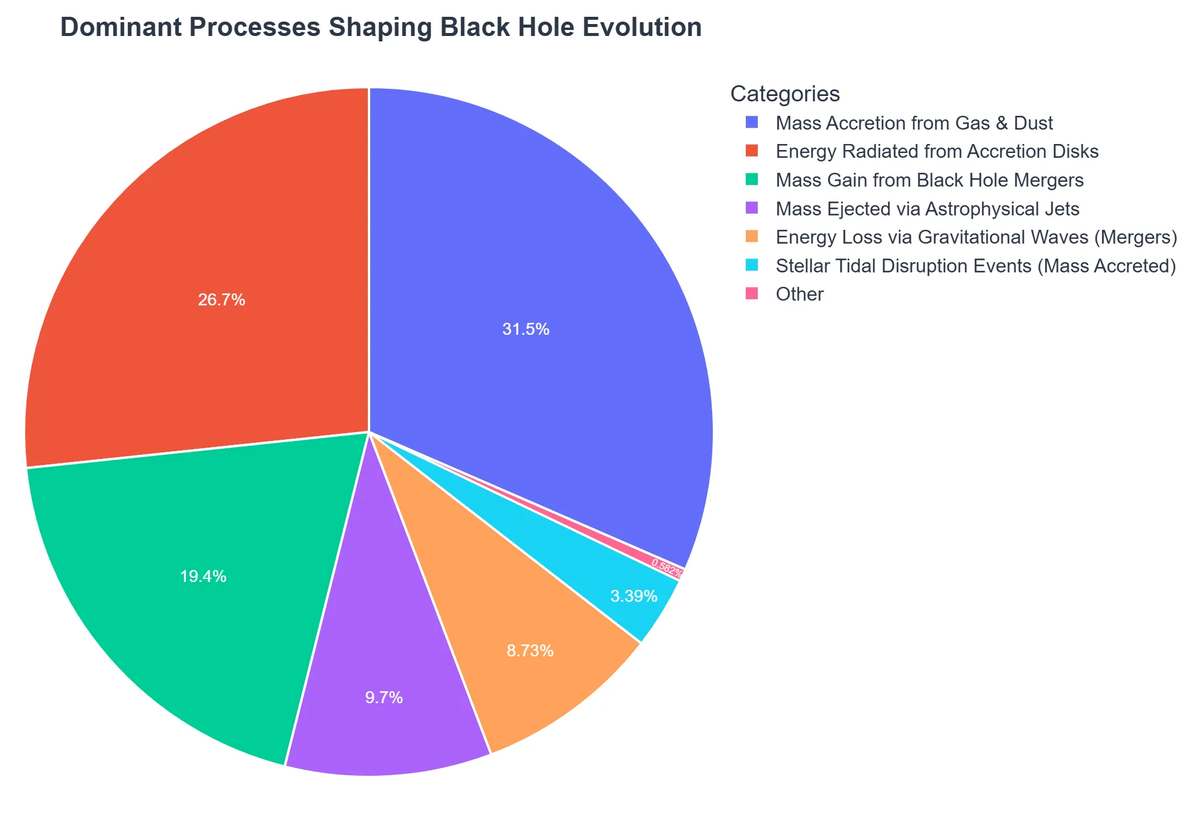
At the event horizon, the immense gravity separates these virtual pairs before they can annihilate. One particle (or antiparticle) falls into the black hole, while its partner escapes as Hawking radiation. Because the escaping particle carries positive energy away from the black hole, the black hole itself must lose an equivalent amount of mass (E=mc²). This continuous process leads to black hole evaporation.
- ✅ Smaller, Hotter: Counter-intuitively, smaller black holes evaporate faster and emit more radiation because their event horizons have a greater curvature and stronger tidal forces.
- ✅ Slow Process: For typical astrophysical black holes, this process is incredibly slow.
The Lifespan of a Black Hole: It’s All About Mass
The rate of Hawking radiation is inversely proportional to the black hole’s mass. This means the more massive a black hole is, the colder it is and the slower it evaporates. Conversely, smaller black holes are “hotter” and evaporate much more quickly.
🌟 Stellar-Mass vs. Supermassive Black Holes
Consider the difference in evaporation rates:
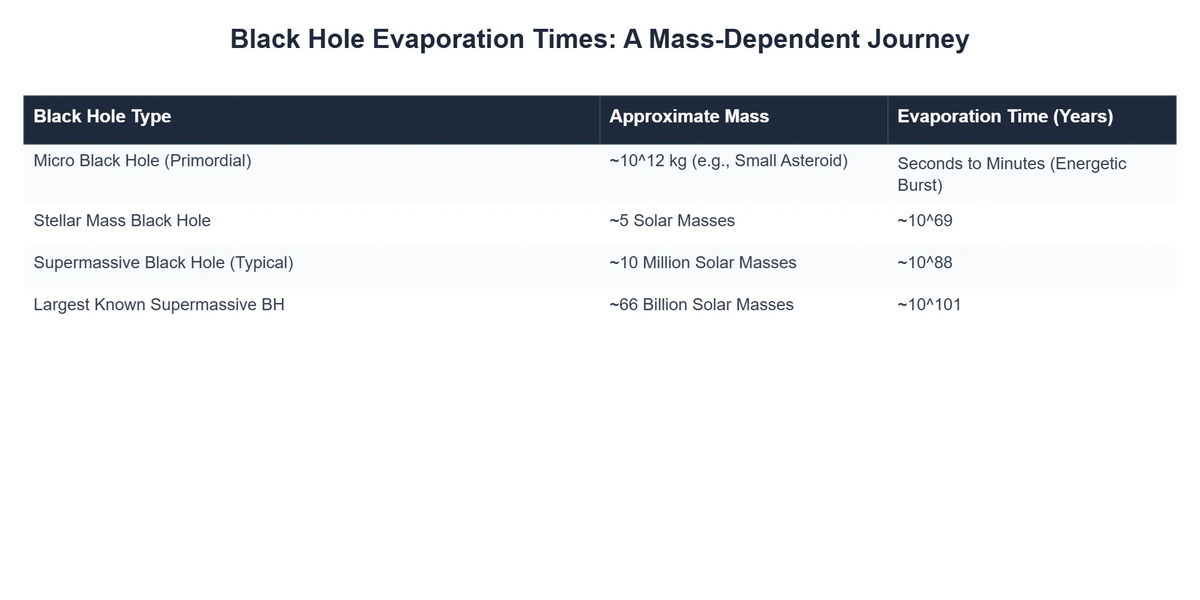
- ✅ Stellar-Mass Black Holes: A black hole with the mass of our Sun (about 2 x 10^30 kg) would take roughly 10^67 years to completely evaporate. This is vastly longer than the current age of the universe (approximately 13.8 billion years, or 1.38 x 10^10 years).
- ✅ Supermassive Black Holes: These giants, found at the centers of galaxies and millions to billions of times the mass of the Sun, would take an unfathomable 10^100 years or more to evaporate. For context, the number of atoms in the observable universe is estimated to be around 10^80.
To understand how these cosmic giants grow, read about Black Hole Eating: How Black Holes Consume Stars and Gas.
⏳ The Incredibly Long Timescales
These timescales are so vast they are difficult to comprehend. They extend far beyond the expected lifespan of stars, galaxies, or even the universe as we know it. In the very distant future, after all stars have died and galaxies have dispersed, black holes are predicted to be the last remaining large structures in the universe, slowly shrinking until they finally vanish.
The Final Moments: A Cataclysmic Burst
While the initial stages of black hole evaporation are agonizingly slow, the process accelerates as the black hole loses mass. As it shrinks, its temperature increases, and it radiates more intensely.
💥 Mini Black Holes and Accelerated Evaporation
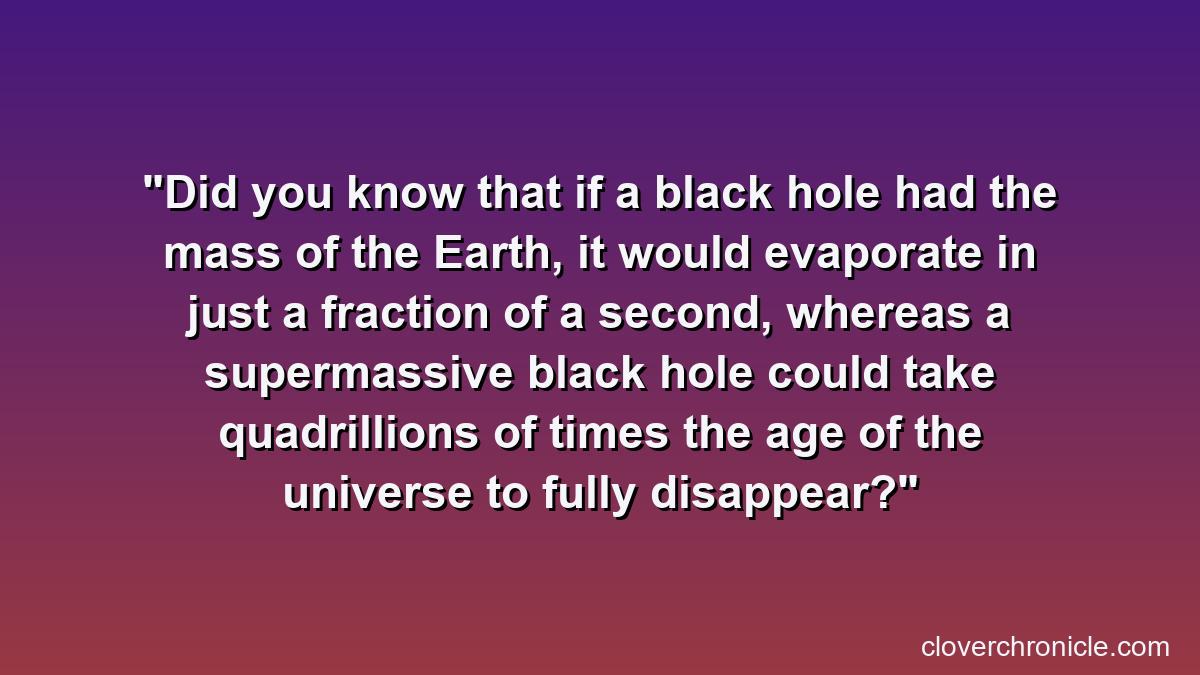
The smaller a black hole becomes, the faster it loses mass. In its final moments, a black hole the size of a mountain (with a mass of around 10^12 kg) would evaporate in just a few seconds, releasing an immense burst of gamma rays and other high-energy particles, equivalent to millions of megatons of TNT. This violent end is theoretically how primordial micro black holes (if they exist) would have met their demise shortly after the Big Bang.
Recommended Video
Implications and Unanswered Questions
The concept of black hole evaporation has profound implications for our understanding of the universe and its ultimate fate, while also posing new theoretical challenges.
🤔 The Information Paradox
One of the most vexing questions arising from Hawking radiation is the “information paradox.” According to quantum mechanics, information cannot be truly destroyed. However, if a black hole evaporates and simply vanishes, what happens to the information about all the matter that fell into it? Does it simply disappear? This conflict between general relativity and quantum mechanics remains a major unsolved problem in physics, though recent progress with “Page curves” and “quantum extremal surfaces” offers tantalizing clues.
✨ Remnants of Evaporation
While the prevailing theory suggests complete evaporation, some speculative theories propose that black holes might not entirely vanish. Instead, they might leave behind a tiny, stable remnant, a “Planck-mass relic,” which would be a new fundamental particle or object. However, there is currently no observational evidence for such remnants.
Conclusion: Black Holes Are Not Eternal After All
The journey into understanding the true nature of black holes takes us to the very edge of our knowledge, where general relativity meets quantum mechanics. Far from being eternal, immutable cosmic vacuums, black holes are dynamic entities that, over unimaginable timescales, are destined to fade away through the process of Hawking radiation. This slow but inevitable evaporation means that even the most powerful objects in the universe have a finite black hole lifespan. While the vast majority of black holes will outlive the current age of the universe by unfathomable eons, their eventual demise highlights the transient nature of all things, even those that appear to be everlasting.
The mysteries surrounding black holes continue to drive cutting-edge research, pushing the boundaries of physics and offering new insights into the fundamental laws governing our cosmos. The ultimate fate of these cosmic giants remains a key focus in our ongoing quest to fully comprehend the universe.
Frequently Asked Questions
What is Hawking radiation?
Hawking radiation is a theoretical thermal radiation emitted by black holes due to quantum effects at the event horizon, causing them to slowly lose mass and energy.
Do all black holes evaporate?
Yes, in theory, all black holes are predicted to evaporate over vast timescales, though the process is incredibly slow for larger black holes.
How long does it take for a black hole to evaporate?
The evaporation time depends on the black hole’s mass; a solar-mass black hole would take quadrillions of years, far longer than the universe’s current age.
What happens when a black hole completely evaporates?
Upon complete evaporation, a black hole would theoretically vanish, potentially ending in a final burst of high-energy particles as its last remnants disappear.