Life’s Genesis: How Did Life Begin on Earth?
The question of how life originated on Earth is one of the most profound and enduring mysteries in science. It delves into the very core of our existence, seeking to understand the intricate journey from a lifeless planet to one teeming with biodiversity. This complex field, known as abiogenesis, explores the natural process by which life arises from non-living matter. Unlike evolution, which explains how life diversifies once it exists, abiogenesis addresses the monumental leap from chemistry to biology. For millennia, various cultures and philosophies have offered their explanations for the creation of life, but modern scientific inquiry seeks answers grounded in physics, chemistry, and geology, piecing together a plausible narrative of Earth’s earliest days.
💡 Key Takeaways
- Life emerged from non-living matter through a process known as abiogenesis.
- Leading scientific theories propose life began in environments like the primordial soup or deep-sea hydrothermal vents.
- The formation of self-replicating molecules, such as RNA, was a critical step in the emergence of life.
- Early Earth’s unique atmospheric and geological conditions were essential for the chemical reactions that led to life.
“Understanding life’s genesis is like reverse-engineering the universe’s most intricate initial conditions; it reveals the incredible biochemical potential inherent in our cosmos.”
— Julian Aris, Evolutionary Biologist & Geneticist
In This Article
- → Life’s Genesis: How Did Life Begin on Earth?
- — 💡 Key Takeaways
- → The Primordial Earth: A Cradle for Life?
- — The Early Atmosphere and Oceans
- — Energy Sources: Lightning, UV, and Hydrothermal Vents
- → The Building Blocks: From Simple Molecules to Complex Polymers
- — Amino Acids and Nucleotides: The Monomers
- — Polymerization on Early Earth
- → The RNA World Hypothesis: A Self-Replicating Beginning
- → Protocells and Compartmentalization: Enclosing Life
- — The Emergence of Membranes
- — Early Self-Organization
- → The Emergence of Metabolism: The Engine of Life
- — From Geochemistry to Biochemistry
- → Early Life on Land and the Evolution of Complexity
- → Modern Perspectives and Ongoing Research
- → Conclusion
Understanding life’s genesis requires a multidisciplinary approach, drawing insights from geology, astronomy, chemistry, and biology. It’s a grand scientific challenge that continues to inspire groundbreaking research and debate. This article will explore the prevailing scientific hypotheses, the experimental evidence, and the tantalizing questions that remain in our quest to decode life’s primordial beginnings.
The Primordial Earth: A Cradle for Life?
To comprehend how life could have begun, we must first understand the conditions on early Earth, roughly 4 to 3.8 billion years ago. This period, known as the Hadean Eon, was vastly different from our planet today. It was a tumultuous environment, often described as a “hellish” landscape, yet it provided the raw materials and energy necessary for chemical evolution.
The Early Atmosphere and Oceans
The early atmosphere was anoxic, meaning it lacked significant free oxygen. Instead, it was likely composed primarily of volcanic gases such as water vapor, carbon dioxide, nitrogen, and smaller amounts of hydrogen sulfide, methane, and ammonia. This reducing atmosphere was crucial, as oxygen, being highly reactive, would have quickly destroyed nascent organic molecules. As the planet cooled, water vapor condensed, leading to the formation of vast, warm oceans, which would become the crucible for early chemical reactions.
Energy Sources: Lightning, UV, and Hydrothermal Vents
The early Earth was a cauldron of energy. Intense ultraviolet (UV) radiation from the sun, unrestricted by an ozone layer (which requires oxygen), permeated the surface. Volcanic activity was rampant, and frequent lightning storms crisscrossed the skies. Perhaps most importantly, deep-sea hydrothermal vents, spewing superheated, mineral-rich water from Earth’s crust, offered stable, chemically active environments shielded from harsh surface conditions. These diverse energy sources provided the activation energy needed to drive the synthesis of complex organic molecules from simpler inorganic precursors.
The Building Blocks: From Simple Molecules to Complex Polymers
The first step in abiogenesis involves the formation of organic molecules – the fundamental building blocks of life – from inorganic compounds. This concept is central to the Oparin-Haldane hypothesis, which proposed a primordial soup rich in organic substances.
Amino Acids and Nucleotides: The Monomers
In 1952, the Miller-Urey experiment famously demonstrated that amino acids, the monomers of proteins, could form spontaneously under simulated early Earth conditions (a reducing atmosphere, water, and electrical discharges). Subsequent experiments have shown that other essential organic molecules, including nucleotides (the building blocks of DNA and RNA), sugars, and fatty acids, can also arise under various plausible primordial conditions, including those near deep-sea vents. This laid the foundation for understanding how life’s fundamental components could have self-assembled.
Polymerization on Early Earth
The next challenge was how these simple monomers could link together to form complex polymers like proteins and nucleic acids without the aid of enzymes (which didn’t exist yet). Scientists have proposed several mechanisms. Clay minerals, with their charged surfaces, could have acted as catalysts, attracting and concentrating monomers, facilitating their polymerization. Evaporation-condensation cycles on shorelines or within porous rock matrices could also have concentrated solutions, promoting the formation of longer chains. The formation of these complex molecules marked a significant step toward the emergence of self-replicating systems.
The RNA World Hypothesis: A Self-Replicating Beginning
One of the most compelling theories regarding early life’s mechanism for information storage and catalysis is the RNA World Hypothesis. This proposes that RNA, not DNA or proteins, was the primary genetic and catalytic material of early life. RNA molecules, known as ribozymes, can store genetic information (like DNA) and also catalyze biochemical reactions (like proteins).
The dual functionality of RNA made it an ideal candidate for early life. In a world without complex enzymes, ribozymes could have facilitated their own replication and the synthesis of other essential molecules. This overcomes the “chicken-or-egg” problem: which came first, DNA (for information) or proteins (for function)? The RNA world suggests RNA could do both. This period likely involved a transition where RNA-based systems gradually gave way to the more stable DNA for genetic storage and more efficient proteins for catalytic functions. Understanding the intricate processes like DNA replication today gives us insights into how such complex machinery might have evolved from simpler RNA-based mechanisms. Furthermore, studying the unique characteristics and surprising longevity, or the code of life embedded within cellular components like the life span of mitochondria, offers compelling evidence for ancient endosymbiotic events and the deep history of self-replicating elements within cells.
Protocells and Compartmentalization: Enclosing Life
For life to truly begin, these complex molecules and self-replicating systems needed to be contained within a boundary, creating an internal environment distinct from their surroundings. This led to the concept of protocells – primitive membrane-bound vesicles that could concentrate molecules, facilitate reactions, and provide a stable internal milieu.
The Emergence of Membranes
Fatty acids, which can spontaneously form vesicles or micelles in water, are believed to have played a crucial role in forming these early membranes. These lipid bilayers could encapsulate the RNA molecules and other early biomolecules, allowing for localized chemical reactions and preventing their diffusion into the environment. Such compartments were essential for the development of distinct cellular identities and for maintaining the integrity of emerging metabolic pathways.
Early Self-Organization
Protocells would have exhibited rudimentary forms of self-organization and growth. As they incorporated more lipids and molecules, they could grow and divide, simple precursors to cellular reproduction. This compartmentalization was a critical step, marking the transition from a collection of interacting molecules to discrete entities capable of evolving through natural selection. The ability to form such vesicles has been demonstrated in laboratory settings under conditions mimicking early Earth.
The Emergence of Metabolism: The Engine of Life
Beyond self-replication and compartmentalization, early life needed a way to acquire and convert energy to sustain its processes. This led to the emergence of rudimentary metabolic pathways.

From Geochemistry to Biochemistry
Initially, early protocells might have utilized readily available chemical energy sources from their environment, such as inorganic compounds found near hydrothermal vents. These simple chemical reactions, driven by geological forces, would have been the precursors to the complex metabolic networks we see in all living organisms today. Over time, selective pressures would have favored protocells that could more efficiently harness energy and synthesize their own building blocks, leading to the evolution of increasingly sophisticated biochemical pathways.
The co-evolution of self-replicating systems and metabolic networks is a complex challenge in abiogenesis research. It’s often debated which came first: a metabolism-first approach (where chemical cycles preceded self-replication) or a replication-first approach (as in the RNA world). Current understanding suggests a synergistic relationship, with both aspects developing in tandem within the confines of early protocells. This early metabolic prowess laid the groundwork for the incredible diversity of life we see today, from the simplest bacteria to the intricate organisms that allowed for the subsequent advent of life on land.
Early Life on Land and the Evolution of Complexity
While life likely originated in the oceans, the colonization of land represented a monumental evolutionary leap. For billions of years, Earth’s terrestrial environments were barren. The transition from aquatic to terrestrial life required significant adaptations to cope with desiccation, UV radiation, temperature fluctuations, and nutrient availability.
The earliest evidence of microbial life on land dates back perhaps 3.2 billion years, but the significant widespread colonization by complex, macroscopic organisms occurred much later. The journey of life from the primordial soup to diverse ecosystems, including the eventual emergence of extremophiles, highlights life’s incredible adaptability. The concept of “life on land” itself, particularly the development of complex terrestrial ecosystems, marks a pivotal chapter in Earth’s biological history. While specifying an exact count like ’15 life on land’ is not scientifically established as a specific milestone, the general shift of life from water to land, potentially involving key evolutionary innovations in around 1.5 billion years ago, was a slow, multi-stage process, requiring the development of protective layers, mechanisms for water retention, and specialized structures for reproduction and nutrient acquisition in a dry environment. This expansion of the biosphere onto land fundamentally reshaped Earth’s geology and atmosphere, paving the way for the complex terrestrial biomes we inhabit today. The Theory of Evolution provides the framework for understanding this gradual diversification and adaptation over geological timescales.
Modern Perspectives and Ongoing Research
The quest for life’s genesis is an active and dynamic field, with new discoveries constantly refining our understanding. Scientists are exploring multiple avenues:
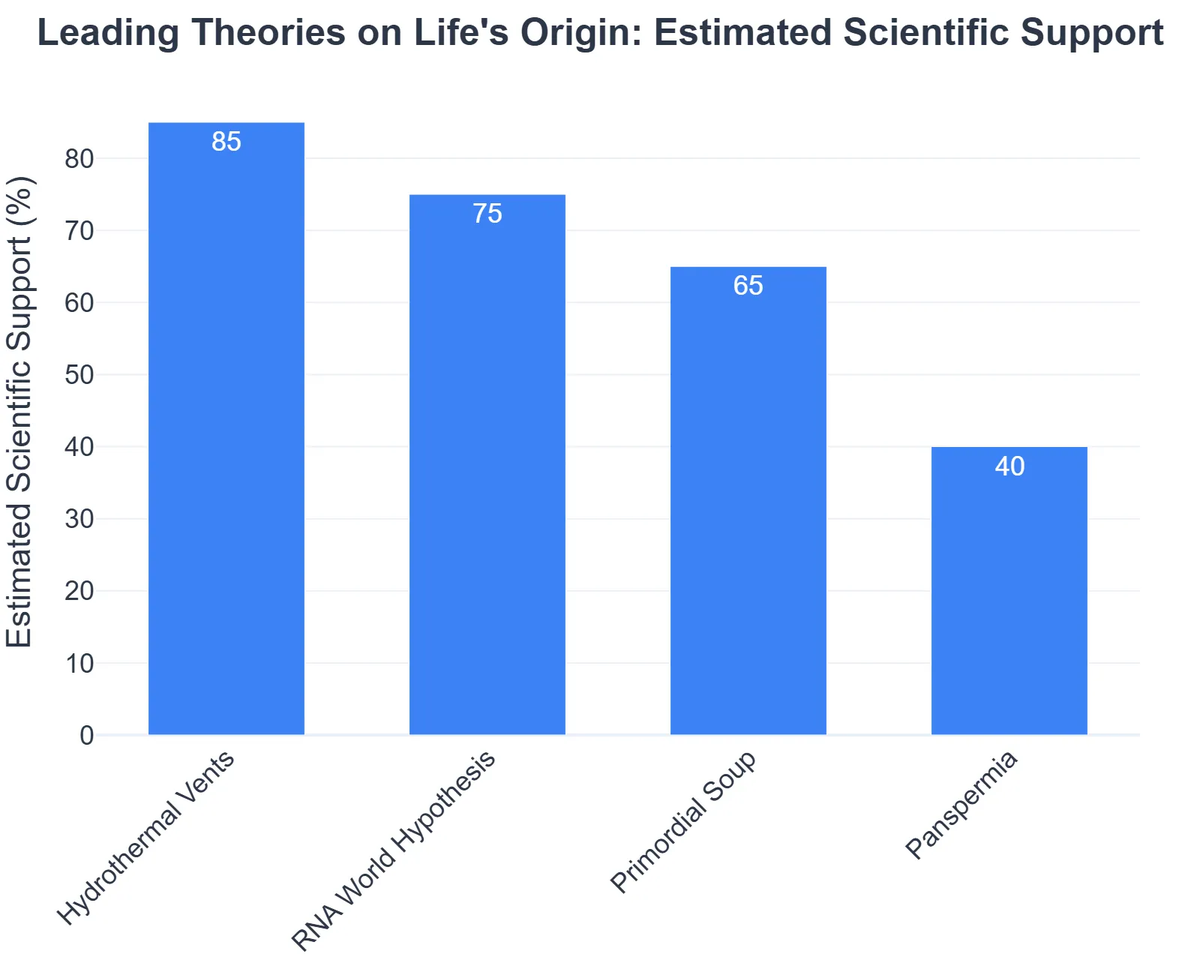
- Deep-Sea Hydrothermal Vents: Many researchers now favor alkaline hydrothermal vents as plausible sites for life’s origin. These vents provide a continuous supply of chemical energy (redox gradients), stable temperatures, and mineral surfaces that can catalyze organic reactions and form natural micro-compartments.
- Panspermia Hypothesis: While not an explanation for the ultimate origin of life, panspermia suggests that life (or its building blocks) might have originated elsewhere in the universe and was transported to Earth via meteorites or comets. This moves the “where did life begin?” question off Earth but doesn’t answer the fundamental “how.”
- Astrobiology and Extraterrestrial Life: The search for life on other planets and moons within our solar system (e.g., Mars, Europa, Titan) provides critical context. If life is discovered independently elsewhere, it would suggest that abiogenesis might be a common cosmic phenomenon, not unique to Earth. The very existence of life, in all its forms and impressive capabilities (such as the remarkable longevity exemplified by the Japanese life span, reflecting complex biological advancements), reinforces the scientific drive to understand its fundamental origins on Earth and potentially beyond.
- Laboratory Synthesis and Protocell Models: Ongoing experiments continue to push the boundaries of what can be spontaneously formed under early Earth conditions, from more complex polymers to self-replicating protocells with rudimentary metabolic capabilities. This experimental approach provides tangible evidence for the plausibility of abiogenesis. For a broader overview, Wikipedia’s entry on Abiogenesis offers a comprehensive summary of the current scientific consensus.
]
Recommended Video
Conclusion
The journey to understand life’s genesis is far from complete, yet significant progress has been made in unraveling this profound mystery. From the fiery crucible of early Earth and the spontaneous formation of organic molecules to the emergence of self-replicating RNA and membrane-bound protocells, each step in the abiogenesis narrative builds upon the principles of chemistry and physics. While no single, definitive answer has been universally accepted, the prevailing scientific consensus points towards a gradual, natural progression from inorganic matter to the earliest forms of life.
The scientific pursuit of life’s origins continues to be one of humanity’s most ambitious endeavors, pushing the boundaries of our knowledge and inspiring new generations of researchers. It reminds us of the extraordinary power of natural processes and the intricate beauty of the universe that allowed for the miraculous emergence of life on our pale blue dot.
Frequently Asked Questions
What is abiogenesis?
Abiogenesis is the natural process by which life arises from non-living matter, such as simple organic compounds, under specific environmental conditions.
What was the ‘primordial soup’ hypothesis?
The primordial soup hypothesis suggests that early Earth’s oceans contained a rich mixture of organic molecules, formed from atmospheric gases and energy, which then combined to create the first life forms.
Could life have originated outside of Earth?
Yes, the panspermia hypothesis proposes that life, or its building blocks, could have originated elsewhere in the universe and been transported to Earth, perhaps via meteorites or comets.
What role did early Earth’s atmosphere play?
Early Earth’s atmosphere, believed to be rich in methane, ammonia, water vapor, and hydrogen, but lacking free oxygen, provided the reducing conditions necessary for the spontaneous formation of complex organic molecules.