

Papua New Guinea Biodiversity: An Ecological Treasure
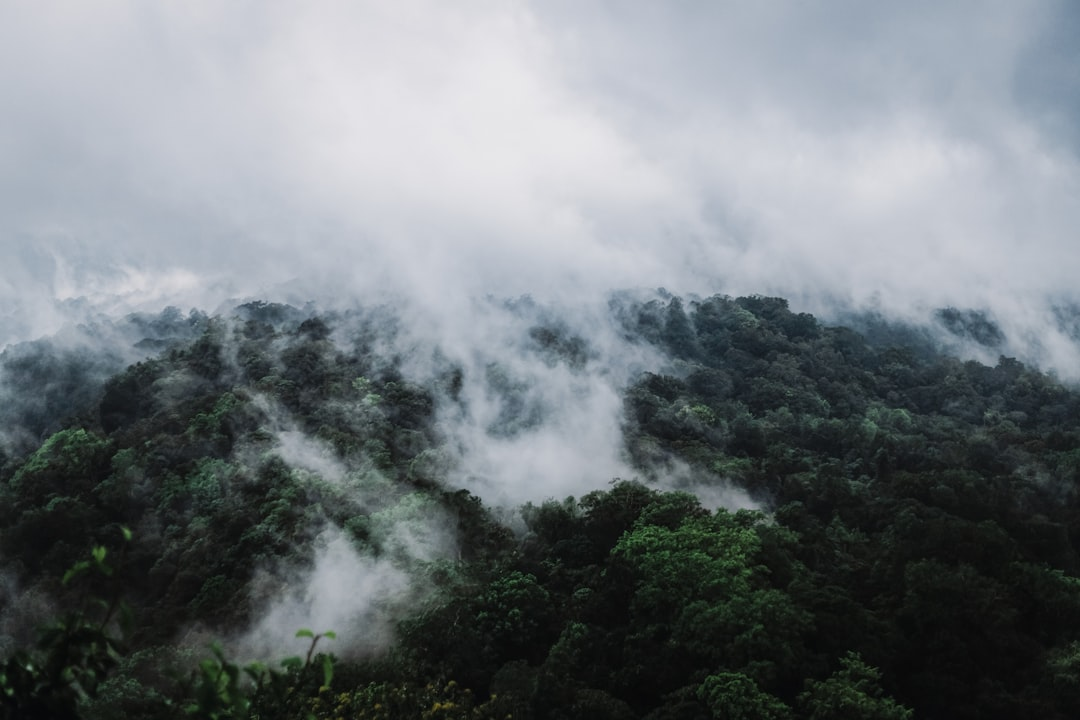
Nestled in the southwestern Pacific Ocean, Papua New Guinea (PNG) stands as a beacon of unparalleled natural wealth. Often described as one of the world’s last great wildernesses, its unique geographical position and diverse landscapes have fostered an extraordinary concentration of life, making Papua New Guinea biodiversity a global marvel. This nation, spanning tropical rainforests, high mountain ranges, vast wetlands, and vibrant coral reefs, is a living laboratory of evolution, home to an immense variety of species, many of which are found nowhere else on Earth.
💡 Key Takeaways
- Papua New Guinea is one of the world’s most biodiverse regions, home to an exceptionally high percentage of unique species.
- Its diverse ecosystems, from dense rainforests to vibrant coral reefs, support unparalleled ecological complexity.
- Conservation efforts in PNG are crucial for global biodiversity, facing challenges like deforestation and climate change.
- Indigenous knowledge plays a significant role in protecting these ecological treasures.
“Papua New Guinea’s geophysical formations have created isolated niches, fostering an unparalleled evolutionary kaleidoscope. It’s a living laboratory, vital for understanding planetary resilience and the impact of climate dynamics on unique ecosystems.”
— Marcus Sterling, Geophysical Explorer & Climate Dynamics Analyst
Understanding PNG’s ecological significance is crucial for global conservation efforts. Its ecosystems play a vital role in regulating the planet’s climate and supporting countless species, including humanity. This comprehensive guide delves into the depths of PNG’s natural heritage, exploring its unique ecosystems, iconic species, the threats it faces, and the crucial initiatives underway to protect this invaluable natural legacy. For a broader perspective on the planet’s intricate natural systems, consider exploring Earth’s Unseen Forces: The Hidden Dynamics of Our Planet.
In This Article
- → Papua New Guinea Biodiversity: An Ecological Treasure
- — 💡 Key Takeaways
- → Why PNG is a Biodiversity Hotspot
- — 🌍 Geographical Isolation and Unique Landscapes
- — 💧 High Rainfall and Climatic Stability
- → Iconic Flora and Fauna of Papua New Guinea
- — 🦜 Birds of Paradise: Jewel of the Forests
- — 🦘 Unique Mammals and Reptiles
- — 🌿 Botanical Wonders
- → Marine Biodiversity: A Submerged Paradise
- — 🐠 Coral Reefs and Their Inhabitants
- → Threats to Papua New Guinea Biodiversity
- — deforestation-and-habitat-loss”>🌲 Deforestation and Habitat Loss
- — 🌡️ Climate Change Impacts
- — 🎣 Overexploitation and Illegal Wildlife Trade
- → Conservation Efforts and the Path Forward
- — 🤝 Community-Based Conservation
- — 🏞️ Establishment of Protected Areas
- — 🔬 Research and Monitoring
- — 🌱 Sustainable Resource Management
- → The Role of Cultural Biodiversity in PNG
- — ancestral-knowledge-for-conservation”>📚 Ancestral Knowledge for Conservation
- — art-and-nature-intertwined”>🎨 Art and Nature Intertwined
- → Looking Ahead: A Sustainable Future for PNG’s Ecosystems
Why PNG is a Biodiversity Hotspot
The incredible species richness of Papua New Guinea is not accidental; it is the product of millions of years of geological activity, climatic variations, and geographical isolation. These factors have converged to create an environment ripe for speciation and the proliferation of unique life forms.
🌍 Geographical Isolation and Unique Landscapes
- Island Arc Formation: PNG is part of a complex island arc system, which has led to significant isolation for many terrestrial species, fostering endemism.
- Rugged Topography: The country’s interior is dominated by the formidable central cordillera, including peaks like Mount Wilhelm. These mountains create diverse microclimates and act as natural barriers, promoting the evolution of distinct species in different valleys and altitudinal zones.
- Diverse Ecosystems: From vast lowland rainforests and montane cloud forests to sprawling savanna grasslands, extensive wetlands, and dynamic coastal mangroves, PNG offers an incredible array of habitats.
💧 High Rainfall and Climatic Stability
Consistent high rainfall throughout much of the year, coupled with relatively stable tropical temperatures, provides ideal conditions for lush vegetation growth and supports complex food webs. This climatic stability has allowed ecosystems to flourish without major disruptions over geological timescales.
Iconic Flora and Fauna of Papua New Guinea
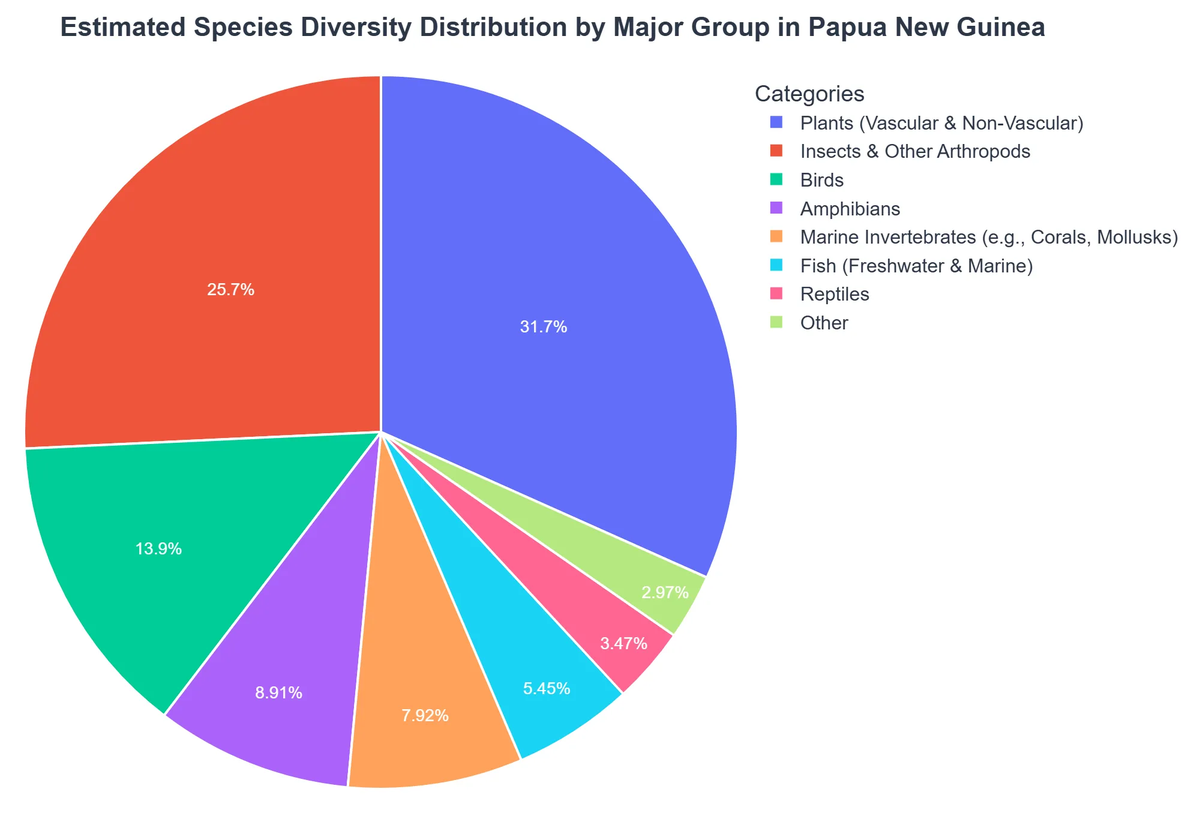
The sheer volume of unique life in PNG is staggering. It’s a land where scientific expeditions continue to uncover species previously unknown to science, reinforcing its status as an ecological frontier. For instance, a “lost” volcano region once revealed an astounding number of new species in a short period (Mongabay News).
🦜 Birds of Paradise: Jewel of the Forests
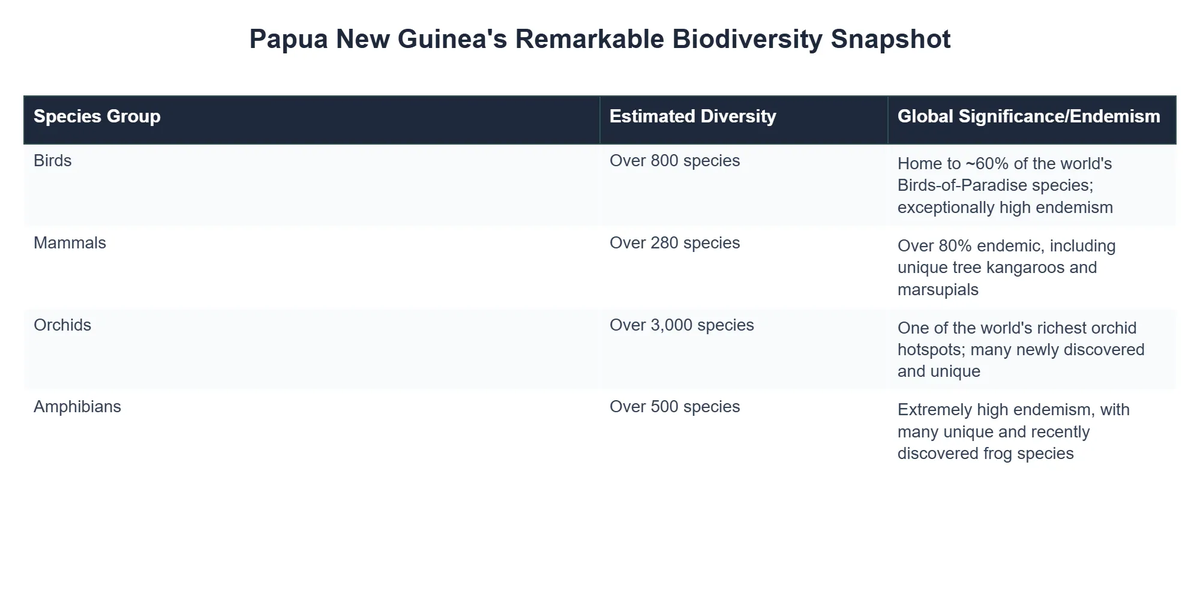
Perhaps the most iconic symbols of PNG’s avian richness are the Birds of Paradise. Of the 42 known species, 38 are found in PNG, showcasing spectacular plumage and elaborate courtship displays that are unparalleled in the bird world. They are a testament to the evolutionary processes at play in the region’s dense forests.
🦘 Unique Mammals and Reptiles
- ✅ Tree Kangaroos: Unlike their ground-dwelling Australian cousins, PNG’s tree kangaroos are adapted for arboreal life, with strong limbs and long tails for balance. Several endemic species exist, each uniquely adapted to their specific forest habitats.
- ✅ Echidnas and Cassowaries: The country is home to long-beaked echidnas, ancient monotremes, and the magnificent cassowary, a large, flightless bird vital for seed dispersal in the rainforest.
- ✅ Frogs and Lizards: PNG boasts an incredible diversity of amphibians and reptiles, with new species regularly being discovered, particularly in remote highland areas.
🌿 Botanical Wonders
The plant life is equally diverse. PNG’s forests contain thousands of species of orchids, rhododendrons, and carnivorous plants, many of which are endemic. The country’s rich flora supports the complex ecosystems, providing food and habitat for its equally diverse fauna.
Marine Biodiversity: A Submerged Paradise
Beyond its terrestrial wonders, Papua New Guinea is also a critical part of the Coral Triangle, often referred to as the “Amazon of the Seas.” This region encompasses the highest marine biodiversity on Earth.
🐠 Coral Reefs and Their Inhabitants
- ➡️ Species Hotspot: PNG’s waters are home to over 600 species of reef-building corals and more than 3,000 species of reef fish. This incredible density of life makes it a prime location for marine research and eco-tourism.
- ➡️ Marine Mammals and Reptiles: Dugongs, various species of whales and dolphins, and six of the world’s seven species of sea turtles navigate these rich waters.
- ➡️ Global Significance: The health of PNG’s coral reefs is crucial not only for local communities that depend on them but also for the global marine ecosystem. Protecting these areas is a cornerstone of Aquatic Biodiversity: Life Beneath the Waves efforts worldwide.
Threats to Papua New Guinea Biodiversity
Despite its rich natural endowment, Papua New Guinea’s biodiversity faces significant and escalating threats, largely driven by human activities. These challenges jeopardize the long-term health of its ecosystems and the livelihoods of its people.
deforestation-and-habitat-loss”>🌲 Deforestation and Habitat Loss
Large-scale logging, often illegal or unsustainable, is a primary driver of habitat destruction. The conversion of forests for agriculture (especially palm oil), mining operations, and infrastructure development further fragments and degrades vital habitats. This unchecked loss directly impacts species, pushing many towards endangerment, a common theme explored in Decreased Biodiversity: Causes and Consequences.
🌡️ Climate Change Impacts
PNG is highly vulnerable to the effects of climate change. Rising sea levels threaten coastal ecosystems and low-lying islands, while increased frequency and intensity of extreme weather events (droughts, floods) disrupt terrestrial and marine ecosystems. Ocean acidification and rising sea temperatures pose a direct threat to the country’s precious coral reefs.
🎣 Overexploitation and Illegal Wildlife Trade
Unsustainable fishing practices, including destructive methods, deplete marine stocks. On land, hunting pressure for bushmeat and the illegal trade of protected species (such as Birds of Paradise, tree kangaroos, and various reptiles) contribute significantly to species decline.
Conservation Efforts and the Path Forward
Recognizing the immense value of its natural heritage, various national and international efforts are underway to protect Papua New Guinea’s biodiversity. These initiatives range from establishing protected areas to empowering local communities.
🤝 Community-Based Conservation
Given that much of PNG’s land is under customary ownership, involving local communities is paramount. Many successful conservation projects focus on empowering traditional landowners to manage and protect their resources sustainably. This includes promoting sustainable livelihoods that reduce pressure on natural ecosystems, often linking to the broader concept of Biodiversity Warriors: Protecting Our Planet.
- 💡 Integrated Land Use Planning: Supporting communities in developing land-use plans that balance development with conservation.
- 💡 Eco-tourism Initiatives: Developing sustainable tourism that provides economic benefits to local communities while incentivizing the preservation of natural habitats and wildlife.
🏞️ Establishment of Protected Areas
While still relatively low compared to its landmass, PNG has several designated protected areas, national parks, and wildlife management areas. Expanding and effectively managing these areas is critical for safeguarding key habitats and corridors for wildlife.
🔬 Research and Monitoring
Ongoing scientific research is vital for understanding PNG’s biodiversity, identifying new species, and monitoring population trends. This information is crucial for informed conservation policy and adaptive management strategies.
🌱 Sustainable Resource Management
Promoting sustainable forestry practices, responsible mining, and improved agricultural techniques are essential to mitigate the impact of industries on natural ecosystems. Innovation in sustainable practices, like those discussed by the FAO, can offer solutions (FAO News).
The Role of Cultural Biodiversity in PNG
Papua New Guinea is not only biologically diverse but also one of the most culturally diverse nations on Earth, with over 800 indigenous languages. This deep cultural tapestry is intimately linked with its natural environment.
Papua New Guinea’s Biodiversity: Strengths and Challenges
Pros
- ✔Globally significant biodiversity hotspot with high endemism rates.
- ✔Exceptional range of diverse ecosystems, from coral reefs to montane forests.
- ✔Integral to the livelihoods and cultural heritage of local communities.
- ✔Vast potential for new scientific discoveries and medical breakthroughs.
Cons
- ✖Severe threats from deforestation, logging, and unsustainable resource extraction.
- ✖Vulnerability to impacts of climate change, including sea-level rise and extreme weather.
- ✖Challenges in effective governance, law enforcement, and conservation funding.
- ✖Increasing pressure from illegal wildlife trade and human population growth.
ancestral-knowledge-for-conservation”>📚 Ancestral Knowledge for Conservation
Many indigenous communities possess extensive traditional ecological knowledge (TEK) about their local environments, including sustainable resource management practices, medicinal plants, and wildlife behavior. Integrating this knowledge with modern conservation science offers a powerful approach to protecting biodiversity, a topic often explored when discussing Cultural Biodiversity: Preserving Human Heritage.
art-and-nature-intertwined”>🎨 Art and Nature Intertwined
The rich artistic traditions of PNG, from intricate carvings to vibrant bilums, often draw inspiration directly from the natural world, reflecting the deep spiritual and practical connection between people and their environment.
Recommended Video
Looking Ahead: A Sustainable Future for PNG’s Ecosystems
The future of Papua New Guinea’s extraordinary biodiversity hinges on a concerted and collaborative effort. It requires a balance between national development aspirations and the imperative to protect its irreplaceable natural assets.
Key strategies for moving forward include:
- ✅ Strengthening Governance: Enhancing legal frameworks and enforcing regulations against illegal logging, mining, and wildlife trade.
- ✅ Investing in Sustainable Livelihoods: Providing viable alternatives to destructive practices for local communities.
- ✅ Promoting Environmental Education: Raising awareness among all citizens about the value of biodiversity and the importance of conservation.
- ✅ International Cooperation: Securing continued international support for conservation programs, climate change adaptation, and capacity building.
Papua New Guinea’s unique position as a global biodiversity hotspot presents both a profound responsibility and an incredible opportunity. By prioritizing the protection of its natural heritage, PNG can continue to thrive as an ecological treasure, offering invaluable lessons for global conservation and sustainable development.
Frequently Asked Questions
Why is Papua New Guinea considered a biodiversity hotspot?
PNG’s extreme geographical isolation, rugged terrain, and diverse climates have led to the evolution of a vast number of unique and endemic species not found anywhere else.
What are some iconic species found in PNG?
PNG is home to diverse species like birds-of-paradise, tree kangaroos, unique butterfly species, and a myriad of marine life in its coral reefs.
What threats does PNG’s biodiversity face?
Major threats include deforestation, unsustainable resource extraction, habitat loss due to agriculture and mining, and the impacts of climate change.
How can PNG’s biodiversity be protected?
Protection efforts focus on establishing protected areas, promoting sustainable livelihoods, combating illegal logging, and supporting community-led conservation initiatives.