


Mars has always captivated humanity, a rusty beacon in our night sky hinting at untold secrets. Among the most profound of these secrets is the potential for life, past or present. Spearheading this monumental quest is NASA’s Perseverance rover, a marvel of engineering designed specifically to seek out signs of ancient microbial life on the Red Planet. Its mission is not just about discovery; it’s about setting the stage for future human exploration and fundamentally reshaping our understanding of life beyond Earth.
💡 Key Takeaways
- The Perseverance rover is actively searching for signs of ancient microbial life in Mars’ Jezero Crater.
- It collects and caches rock and regolith samples for a future Mars Sample Return mission to Earth.
- The rover uses advanced instruments to analyze Martian geology and chemistry, including its groundbreaking PIXL and SHERLOC tools.
- Discoveries from Perseverance could revolutionize our understanding of the potential for life beyond Earth and inform future human missions.
“The Perseverance mission isn’t just about finding fossils; it’s about rewriting our cosmic origin story. It bridges the gap between scientific discovery and the very human longing to know if we are truly alone, making the impossible feel just within reach.”
— Astrid Bellweather, Astrophysicist & Science Fiction Consultant
In the realm of Cosmic Queries: Probing the Mysteries of the Universe, the search for extraterrestrial life stands as one of the most compelling frontiers. The Mars 2020 mission, with its advanced rover, represents a giant leap in this pursuit. This article will delve into the critical role of the Perseverance rover on Mars, its sophisticated instruments, and its groundbreaking efforts to uncover definitive evidence of ancient life.
In This Article
- — 💡 Key Takeaways
- → The Perseverance Rover: A New Era of Mars Exploration
- — 🎯 Mission Objectives: Why Ancient Life?
- — 🛠️ Key Technologies: How Perseverance Hunts
- → The Jezero Crater: A Prime Target for Astrobiology
- — 💧 Geological Context and Water Evidence
- → Groundbreaking Discoveries & Early Findings
- — 🪨 Rock and Soil Samples: Paving the Way for Return
- — 🌬️ Atmospheric Insights with MOXIE
- → The Search for Biosignatures: What Are We Looking For?
- — 🧪 Organic Molecules and Stromatolites
- → The Future of the Mission & Mars Sample Return
- — 🤝 Collaboration and Next Steps
The Perseverance Rover: A New Era of Mars Exploration
Launched in July 2020, the Perseverance rover embarked on a meticulously planned journey, culminating in a dramatic and successful Perseverance landing on Mars in February 2021. This mission builds upon decades of Martian exploration, leveraging lessons learned from its predecessors like Curiosity, Spirit, and Opportunity.
🎯 Mission Objectives: Why Ancient Life?
The primary objectives of the Perseverance mission are ambitious and scientifically rigorous:
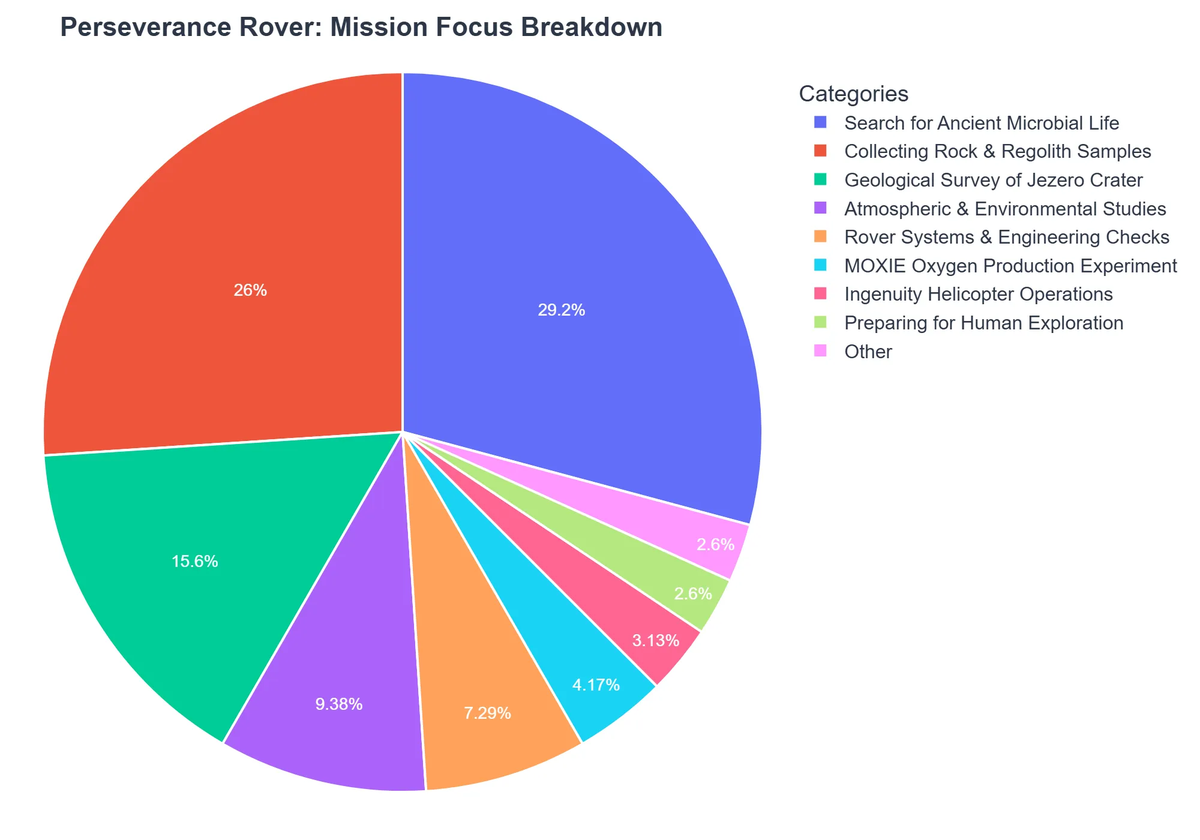
- ✅ Astrobiology: Search for signs of ancient microbial life. This involves identifying environments on Mars that could have supported life in the past, and then searching for actual biosignatures within those environments.
- 🔬 Geology: Characterize the planet’s geology and past climate, providing crucial context for the habitability assessment.
- 🧪 Sample Caching: Collect carefully selected rock and regolith (broken rock and dust) samples for potential return to Earth. This is a first-of-its-kind endeavor.
- 🚀 Preparation for Human Exploration: Test technologies for future human missions, including the production of oxygen from the Martian atmosphere.
For more insights into the broader context of robotic exploration, explore our feature on Mars Rovers: Epic Journeys of NASA’s Perseverance, Spirit, and Opportunity.
🛠️ Key Technologies: How Perseverance Hunts
The Perseverance rover Mars mission is equipped with an array of cutting-edge scientific instruments, each designed to contribute to the astrobiology goals:
- Mastcam-Z: An advanced camera system with zoom capability to image the landscape, analyze minerals, and provide stereo images.
- SuperCam: Analyzes the chemistry and mineralogy of rocks and soil from a distance, and detects the presence of organic compounds.
- PIXL (Planetary Instrument for X-ray Lithochemistry): An X-ray fluorescence spectrometer that maps the elemental composition of Martian surface materials, with fine-scale imaging.
- SHERLOC (Scanning Habitable Environments with Raman & Luminescence for Organics & Chemicals): Utilizes a Raman spectrometer, a fluorescence spectrometer, and a high-resolution imager to search for organic molecules and minerals indicative of past water environments.
- WATSON: A camera for close-up imaging of rock and soil textures.
- MEDA (Mars Environmental Dynamics Analyzer): Measures atmospheric conditions like wind, temperature, humidity, and dust.
- RIMFAX (Radar Imager for Mars’ Subsurface Experiment): The first ground-penetrating radar on Mars, capable of imaging the subsurface geology.
These instruments, working in concert, allow Perseverance to analyze the Martian surface and subsurface with unprecedented detail, specifically looking for biosignatures.
The Jezero Crater: A Prime Target for Astrobiology
The selection of Jezero Crater as the landing site was a crucial decision, driven by strong scientific evidence suggesting it was once home to an ancient river delta. This makes it an ideal location for the perseverance rover to search for signs of past life.
Perseverance Rover Mission: Pros and Cons
Pros
- ✔Potential for groundbreaking discovery of ancient Martian life.
- ✔Collection of pristine rock and soil samples for future Earth return.
- ✔Tests key technologies vital for future human missions to Mars.
- ✔Enhances understanding of Mars’ geological and atmospheric history.
Cons
- ✖Enormous financial cost of development and operation.
- ✖High risk inherent in complex space missions, including potential for failure.
- ✖Sample return is a multi-decade, multi-mission endeavor with no guaranteed success.
- ✖No guarantee of finding definitive evidence of past life.
💧 Geological Context and Water Evidence
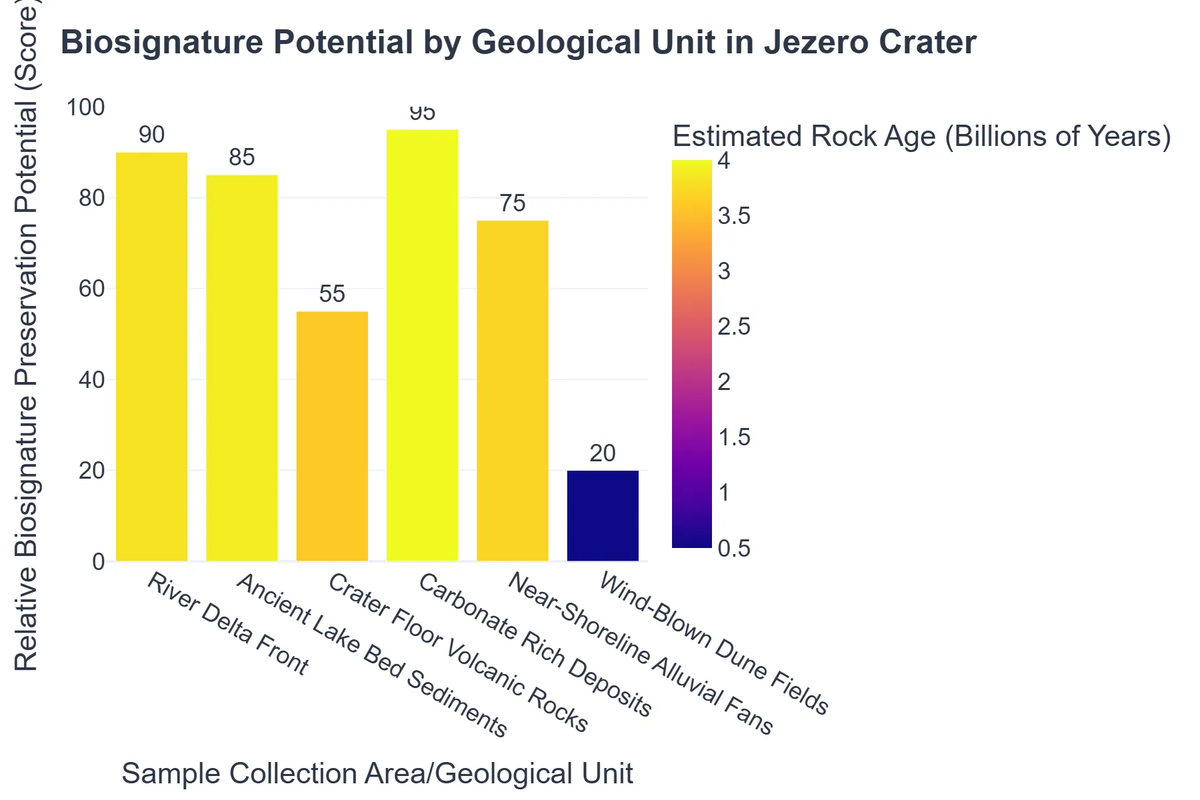
Jezero Crater, a 28-mile-wide (45-kilometer-wide) impact basin, features clear geological evidence of a past river and lake system. Scientists believe that billions of years ago, water flowed into the crater, forming a lake and depositing sediments that could have preserved organic molecules and potential biosignatures. The rover has already provided significant data about the crater’s geology. For example, the rover’s findings indicate the presence of igneous rocks, suggesting volcanic activity, and sedimentary structures, reinforcing the past water activity in the region. You can learn more about these fascinating findings by checking out Perseverance Rover: Exploring Mars’ Latest Discoveries.
Groundbreaking Discoveries & Early Findings
Since its arrival, the Perseverance rover on Mars has been relentlessly exploring Jezero Crater, yielding a wealth of data and making significant strides in its mission.
🪨 Rock and Soil Samples: Paving the Way for Return
One of the most ambitious aspects of the mission is the collection and caching of Martian rock and regolith samples. Perseverance is equipped with a sophisticated drilling system to extract core samples, which are then sealed in titanium tubes. As of late 2023, the rover has successfully collected numerous samples, strategically chosen from areas believed to be rich in potential biosignatures or evidence of past habitable environments. These samples are critical for the proposed Mars Sample Return mission, a joint effort with the European Space Agency (ESA), which aims to bring these precious materials to Earth for in-depth analysis in terrestrial laboratories. This marks the first time such samples have been systematically collected for return from another planet. NASA details its ongoing search for life in these samples, underscoring their immense scientific value.
🌬️ Atmospheric Insights with MOXIE
Beyond the search for ancient life, Perseverance also carries the Mars Oxygen In-Situ Resource Utilization Experiment (MOXIE). MOXIE has successfully demonstrated the ability to produce oxygen from the carbon dioxide-rich Martian atmosphere. This groundbreaking technology is a vital step toward enabling future human missions to Mars, as it could provide breathable air and propellant for rockets. This innovative experiment signifies the rover’s dual role: scientific discovery and preparing for humanity’s deep-space future.

The Search for Biosignatures: What Are We Looking For?
The term “biosignature” refers to any substance, object, or pattern whose origin requires a biological agent. On Mars, this search is complex and requires meticulous analysis.
🧪 Organic Molecules and Stromatolites
Perseverance is specifically looking for:
- ➡️ Organic Molecules: These are carbon-containing compounds that are fundamental building blocks of life. While they can be formed by non-biological processes, their presence in certain patterns or alongside specific minerals could indicate biological origins.
- ➡️ Microfossils: Evidence of ancient microscopic life, such as fossilized microbial mats (like stromatolites on Earth).
- ➡️ Isotopic Fractionation: Variations in the ratios of certain isotopes (different forms of an element) that can be indicative of biological processes.
- ➡️ Minerals formed by life: Certain minerals are precipitated or altered by microbial activity.
The rover’s SHERLOC instrument, in particular, is designed to perform fine-scale detection and mapping of organic molecules and minerals. Early results from the rover’s drilling operations and instrument analyses have revealed the presence of organic molecules in some rock samples within Jezero Crater. While the detection of organic molecules alone does not confirm life (as they can be created through geological processes), their presence, coupled with specific mineral associations (like sulfates and carbonates), is a compelling signpost for past habitable conditions and warrants further investigation back on Earth.
For a comprehensive look at another groundbreaking mission, read about the Curiosity Mars Rover: Exploring the Red Planet and its contributions to our understanding of Mars’s habitability.

Recommended Video
The Future of the Mission & Mars Sample Return
The Perseverance rover’s cost reflects the immense scientific and technological investment in understanding Mars’s past habitability and preparing for future human missions. Its work is far from over.
🤝 Collaboration and Next Steps
The success of the Perseverance mission is paving the way for the ambitious Mars Sample Return campaign. This multi-mission endeavor, spearheaded by NASA and ESA, involves a lander and ascent vehicle that will pick up the samples cached by Perseverance and launch them into Mars orbit. A subsequent orbiter will then rendezvous with the sample container and bring it back to Earth for unparalleled analysis in highly specialized laboratories. This global collaboration represents the next frontier in astrobiology, offering the best chance yet to definitively answer the question: Did life ever exist on Mars? The implications of such a discovery would be profound, influencing everything from space policy to philosophical considerations about our place in the universe. JPL NASA’s news highlights how Perseverance has begun the hunt for these signs of life.
The Perseverance mission embodies humanity’s enduring curiosity and relentless pursuit of knowledge. By meticulously exploring Jezero Crater, collecting invaluable samples, and testing technologies for future human endeavors, the Perseverance rover is not just searching for ancient life; it’s laying the foundation for a new era of cosmic discovery.
Frequently Asked Questions
What is the primary goal of the Perseverance rover?
The main goal of the Perseverance rover is to seek signs of ancient microbial life on Mars, particularly in the Jezero Crater, and to collect rock and soil samples for potential return to Earth.
Where is Perseverance exploring on Mars?
Perseverance is exploring the Jezero Crater, a location believed to have once been a lake and river delta billions of years ago, making it an ideal spot to look for biosignatures.
How will the samples collected by Perseverance return to Earth?
NASA and the European Space Agency (ESA) are collaborating on a future Mars Sample Return campaign, which involves subsequent missions to retrieve the cached samples and bring them back to Earth for in-depth analysis.
What unique instruments does Perseverance carry?
Beyond its core scientific instruments, Perseverance carries the Ingenuity helicopter, which demonstrated the first powered flight on another planet, and a MOXIE instrument, which successfully generated oxygen from the Martian atmosphere.