In the vast cosmic tapestry, few phenomena captivate the imagination and challenge our understanding of physics quite like black holes. These enigmatic regions of spacetime, where gravity is so intense that nothing—not even light—can escape, owe their theoretical foundation almost entirely to one man: Albert Einstein and his revolutionary theory of relativity.
💡 Key Takeaways
- Einstein’s General Relativity predicted the existence of black holes before they were directly observed.
- His theories revolutionized our understanding of gravity, spacetime, and the universe’s structure.
- Gravitational waves, a key prediction of relativity, confirmed the violent mergers of black holes.
- The study of black holes continues to be a frontier for testing and expanding Einstein’s legacy.
“Einstein’s equations aren’t just abstract math; they’re a blueprint for the universe’s most extreme phenomena. Black holes aren’t merely cosmic curiosities; they’re the ultimate proving ground for the elegant, brutal beauty of relativity.”
— Astrid Bellweather, Astrophysicist & Science Fiction Consultant
While Einstein himself initially harbored doubts about the physical reality of these cosmic behemoths, his equations undeniably laid the groundwork for their discovery and subsequent understanding. This article delves into the profound connection between Einstein’s groundbreaking work and the gravitational singularities we now call black holes, exploring how his cosmic legacy continues to shape our perception of the universe.
In This Article
- — 💡 Key Takeaways
- → The Unshakable Foundation: Einstein’s General Theory of Relativity
- — 🌌 Gravity as Spacetime Curvature
- — 🔭 Predictions Beyond Newton
- → From Theory to Cosmic Enigma: The Birth of the Black Hole Concept
- — ✨ Karl Schwarzschild’s Breakthrough
- — ⚫ The Schwarzschild Radius: Defining the Event Horizon
- → Einstein’s Complex Relationship with Black Holes
- — 🤔 Initial Skepticism: Why He Doubted Their Physical Existence
- — ⏳ The Slow Acceptance: How Evidence and Further Theoretical Work Shifted Views
- → Proving the Unseen: Gravitational Waves and Black Hole Mergers
- — 🌊 A Century-Old Prediction Confirmed: LIGO’s Achievement
- — 💥 Cosmic Collisions: Understanding the Detection of Black Holes
- → Black Holes Today: A Cornerstone of Modern Astrophysics
- — 分类深渊: Types of Black Holes
- — 💫 Their Role in the Universe: Galaxy Formation, Quasars
- → The Enduring Legacy of Albert Einstein’s Theories
- — 🌐 Beyond Black Holes: Contributions to Cosmology and Physics
- — 🚀 Future Frontiers: Quantum Gravity, Wormholes, and Continued Research
- → Conclusion
The Unshakable Foundation: Einstein’s General Theory of Relativity
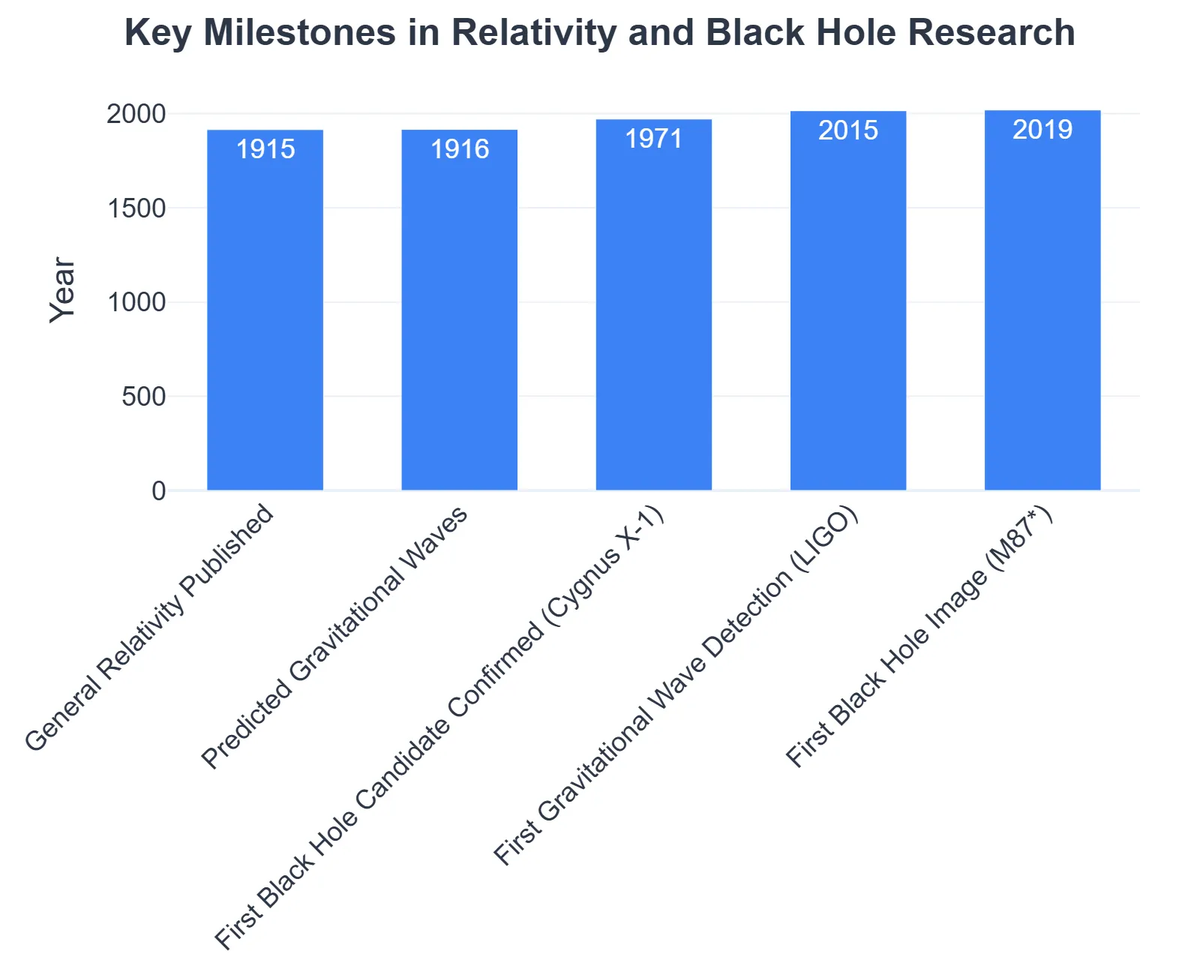
At the heart of our understanding of black holes lies Einstein’s General Theory of Relativity (GR), published in 1915. This theory redefined gravity not as a force acting between masses, but as a curvature of spacetime caused by mass and energy.
🌌 Gravity as Spacetime Curvature
Before Einstein, Isaac Newton described gravity as an instantaneous force pulling objects together. Einstein, however, offered a far more nuanced and elegant picture:
- ✅ Mass and Energy Distort Spacetime: Imagine a bowling ball placed on a stretched rubber sheet; it creates a dip. Similarly, massive objects like stars and planets warp the fabric of spacetime around them.
- ✅ Objects Follow the Curvature: Other objects, like planets orbiting a star, simply follow the curves in spacetime created by the more massive object. This is what we perceive as gravity.
- ✅ Unification of Space and Time: GR famously combined space and time into a single, four-dimensional continuum known as spacetime.
🔭 Predictions Beyond Newton
General Relativity made several bold predictions that differed from Newtonian physics, and their subsequent confirmation cemented Einstein’s theory as the leading description of gravity:
- ➡️ Bending of Light: GR predicted that light from distant stars would bend as it passed close to massive objects like the Sun, a phenomenon famously observed during a solar eclipse in 1919.
- ➡️ Precession of Mercury’s Orbit: It accurately explained the anomalous precession of Mercury’s orbit, a long-standing puzzle in astronomy.
- ➡️ Gravitational Redshift: The theory predicted that light escaping a strong gravitational field would be stretched to longer, redder wavelengths.
These early successes provided compelling evidence for the validity of Einstein’s revolutionary ideas, even as some of their more extreme implications remained theoretical.
From Theory to Cosmic Enigma: The Birth of the Black Hole Concept
Ironically, the very first theoretical glimpse of what we now call a black hole came almost immediately after Einstein published his theory, from a physicist studying its implications.
✨ Karl Schwarzschild’s Breakthrough
Just weeks after Einstein published GR, German physicist Karl Schwarzschild found an exact solution to Einstein’s field equations for the gravitational field of a single, non-rotating, spherically symmetric mass. His solution described a region around a sufficiently compact mass where spacetime is so severely warped that even light cannot escape.
- 💡 The “Dark Star” Precedent: The idea of objects so dense that light cannot escape had been mused upon by John Michell and Pierre-Simon Laplace in the late 18th century, but Schwarzschild’s solution provided a rigorous mathematical framework within GR.
- 💡 A Point of No Return: Schwarzschild’s solution identified a critical boundary, now known as the event horizon. Crossing this boundary means irreversible collapse towards the singularity.
⚫ The Schwarzschild Radius: Defining the Event Horizon
The Schwarzschild radius is the specific distance from the center of a mass where, if all the mass were compressed within that sphere, the escape velocity would equal the speed of light. Any object, including light, that crosses this boundary is trapped. It’s the “point of no return” that defines a non-rotating black hole.
For more on these fascinating objects, explore our comprehensive guide, Black Holes Explained: A Comprehensive Guide to Gravitational Mysteries.
Einstein’s Complex Relationship with Black Holes
Despite his equations paving the way, Albert Einstein himself was initially skeptical about the physical existence of black holes. His doubts were rooted in a fundamental understanding of physics at the time.
🤔 Initial Skepticism: Why He Doubted Their Physical Existence
Einstein found the concept of a singularity—a point of infinite density—troubling. He believed that some unknown physical process would prevent matter from collapsing indefinitely to such a point. He published a paper in 1939 titled “On a Stationary System with Spherical Symmetry Consisting of Many Gravitating Masses,” arguing that such objects could not form in nature.
- ➡️ The “Naked Singularity” Problem: Einstein, and many others, were wary of singularities that weren’t “clothed” by an event horizon.
- ➡️ Physical Implausibility: He thought the extreme conditions required for collapse were unlikely to be met in a natural stellar evolution process.
His focus was on stable solutions to his equations, and he often dismissed the more exotic solutions as mere mathematical curiosities rather than physical realities. For a broader view of his cosmological insights, see our article on Einstein and the Big Bang: His Actual View.
⏳ The Slow Acceptance: How Evidence and Further Theoretical Work Shifted Views
It took decades of further theoretical work and, eventually, observational evidence for the scientific community—and posthumously, Einstein’s legacy—to fully embrace black holes. Key figures like J. Robert Oppenheimer, David Finkelstein, and John Wheeler (who coined the term “black hole”) made significant contributions.
Einstein’s Legacy: Relativity and Black Holes
Pros
- ✔Theoretical prediction of black holes through General Relativity.
- ✔Provided the foundational framework for modern astrophysics and cosmology.
- ✔Paved the way for understanding extreme gravitational phenomena.
- ✔Validated through subsequent observational evidence, like gravitational waves.
Cons
- ✖Einstein’s initial reluctance to fully accept black hole implications.
- ✖General Relativity’s breakdown at singularities within black holes.
- ✖Challenges in reconciling the theory with quantum mechanics (e.g., information paradox).
- ✖Does not fully describe phenomena at the quantum scale near singularities.
- ✅ Stellar Collapse Models: Work in the 1930s and beyond, especially by Oppenheimer and his students, showed that massive stars could indeed collapse under their own gravity at the end of their lives, leading to the formation of a singularity.
- ✅ Observational Evidence: The discovery of X-ray sources like Cygnus X-1 in the 1970s provided strong circumstantial evidence for stellar-mass black holes. Later, observations of galactic centers strongly suggested the presence of supermassive black holes.
Today, black holes are no longer theoretical curiosities but integral components of our cosmic landscape, a testament to the enduring power of Einstein’s equations, even when he doubted their most extreme interpretations.
Proving the Unseen: Gravitational Waves and Black Hole Mergers
Perhaps the most compelling proof of black hole einstein‘s theoretical predictions came a century after General Relativity was formulated, with the direct detection of gravitational waves.
🌊 A Century-Old Prediction Confirmed: LIGO’s Achievement
Gravitational waves—ripples in spacetime caused by accelerating massive objects—were another key prediction of Einstein’s General Relativity. While incredibly difficult to detect, their existence was finally confirmed in 2015 by the Laser Interferometer Gravitational-Wave Observatory (LIGO).
- 🏆 First Direct Detection: On February 11, 2016, the LIGO Scientific Collaboration announced the direct detection of gravitational waves from the merger of two stellar-mass black holes, an event designated GW150914. This monumental discovery opened a new window onto the universe. (Source: LIGO)
- 🏆 Confirming Einstein’s Insight: This detection not only validated Einstein’s prediction of gravitational waves but also provided the most direct evidence yet for the existence of black holes and their violent interactions.
💥 Cosmic Collisions: Understanding the Detection of Black Holes
LIGO and its sister observatory Virgo have since detected numerous gravitational wave events, predominantly from merging black holes and neutron stars. These detections provide unprecedented insights into the properties and distribution of black holes across the universe.
- 🔭 Masses and Spins: By analyzing the waveform of the gravitational waves, scientists can deduce the masses, spins, and orbital parameters of the merging black holes.
- 🔭 Black Hole Population: These observations are building a catalog of black holes, revealing their prevalence and how they interact in binaries.
- 🔭 Extreme Gravity Labs: Black hole mergers are the most energetic events in the universe, occurring in regions of extreme gravity where spacetime is severely distorted, providing unique laboratories for testing GR under the most stringent conditions.
To learn more about the longevity of these cosmic structures, check out our article: Are Black Holes Eternal?: Lifespan and Evaporation.
Black Holes Today: A Cornerstone of Modern Astrophysics
Far from being theoretical oddities, black holes are now recognized as fundamental components of the cosmos, playing crucial roles in galaxy evolution and high-energy phenomena.
分类深渊: Types of Black Holes
Astronomers categorize black holes primarily by their mass:

- ⭐ Stellar-Mass Black Holes: Formed from the collapse of massive stars (typically 3 to tens of solar masses). These are the most common type of black hole detected by gravitational wave observatories.
- 🌌 Supermassive Black Holes (SMBHs): Residing at the centers of nearly all large galaxies, including our own Milky Way, these giants range from millions to billions of solar masses. Their influence on galaxy dynamics is profound. For more, see Galactic Black Holes: Understanding Galaxy Centers.
- ❓ Intermediate-Mass Black Holes (IMBHs): A rarer and still-debated category, these fall between stellar and supermassive black holes (hundreds to thousands of solar masses). Their formation mechanisms are a current area of research.
💫 Their Role in the Universe: Galaxy Formation, Quasars
Black holes are not merely passive gravitational sinks; they are active participants in cosmic processes:
- 🔭 Galaxy Evolution: Supermassive black holes at galactic centers are intricately linked to the growth and evolution of their host galaxies. Feedback from SMBHs can regulate star formation within a galaxy.
- 🔭 Quasars and Active Galactic Nuclei (AGN): When SMBHs actively accrete matter, they can power some of the most luminous objects in the universe—quasars and other AGNs—by converting gravitational energy into intense radiation.
- 🔭 Cosmic Recycling: While black holes consume matter, they also play a role in recycling cosmic material through powerful jets and outflows, influencing the interstellar medium.
The Enduring Legacy of Albert Einstein’s Theories
The journey from Einstein’s initial conception of General Relativity to our current understanding of black holes is a testament to the power of theoretical physics and the persistent pursuit of observational evidence. His legacy extends far beyond black holes.
🌐 Beyond Black Holes: Contributions to Cosmology and Physics
Einstein’s contributions transformed our understanding of the universe. His theories laid the foundation for modern cosmology, explaining the expansion of the universe and the Cosmic Microwave Background radiation. He profoundly impacted quantum mechanics, even though he was famously uncomfortable with some of its implications. His work continues to inspire new generations of physicists.
For more on the breadth of his influence, you can explore this resource: Princeton University – Einstein’s Legacy.
🚀 Future Frontiers: Quantum Gravity, Wormholes, and Continued Research
While General Relativity excels at describing gravity on large scales, it breaks down at the singularity within a black hole, where quantum effects are expected to become dominant. This challenge fuels the quest for a theory of quantum gravity, a unified theory that combines GR with quantum mechanics.
- 🔍 Wormholes: Although purely hypothetical, wormholes are another exotic solution to Einstein’s equations, suggesting theoretical “tunnels” through spacetime.
- 🔍 Information Paradox: Stephen Hawking’s work on black hole evaporation introduced the “information paradox,” a major puzzle that combines aspects of GR and quantum mechanics.
- 🔍 Next-Generation Observatories: Future gravitational wave detectors and space telescopes will continue to probe black holes with unprecedented precision, offering even deeper insights into these cosmic enigmas and the fabric of spacetime itself.
The universe continues to surprise us, and the tools we use to understand it are often direct descendants of Einstein’s pioneering vision.
Recommended Video
Conclusion
The story of Einstein and black holes is one of profound theoretical insight, initial skepticism, and ultimate vindication through relentless scientific inquiry. Einstein’s General Theory of Relativity provided the mathematical framework that predicted the existence of black holes, even if he didn’t fully embrace their reality during his lifetime. From the elegant equations describing spacetime curvature to the dramatic detection of merging black holes through gravitational waves, his cosmic legacy is undeniably vast and continues to unfold.
As we continue to probe the universe’s greatest mysteries, from the enigmatic nature of dark matter to the fundamental forces that govern everything, we stand on the shoulders of giants like Albert Einstein. His theories remain the bedrock of modern astrophysics, constantly guiding our exploration of the cosmos and inspiring new questions about the ultimate nature of reality. Dive deeper into the cosmos with Cosmic Queries: Probing the Mysteries of the Universe.
Frequently Asked Questions
How did Einstein’s theory predict black holes?
His General Theory of Relativity describes how mass and energy warp spacetime, leading to regions where gravity is so strong that nothing, not even light, can escape – the definition of a black hole.
What is the connection between black holes and gravitational waves?
The merger of black holes is one of the most powerful events in the universe, producing ripples in spacetime known as gravitational waves, which were predicted by Einstein and later detected.
What is the event horizon?
The event horizon is the boundary around a black hole beyond which events cannot affect an outside observer. It’s the point of no return where the escape velocity exceeds the speed of light.