


In the vast and complex narrative of Earth’s changing climate, few figures have become as central and influential as Michael Mann scientist. A distinguished American climatologist and geophysicist, Mann is renowned for his pioneering work in paleoclimate reconstruction. His name is inextricably linked with one of the most iconic and debated graphs in climate science: the “Hockey Stick” graph. This visual representation profoundly reshaped our understanding of global temperature trends over the past millennium, illustrating a dramatic and unprecedented warming in recent centuries.
💡 Key Takeaways
- The ‘Hockey Stick’ graph illustrates a sharp, unprecedented global warming trend in the 20th century.
- It became a central and highly influential piece of evidence supporting human-caused climate change.
- Michael Mann’s work faced intense scrutiny and personal attacks from climate change deniers.
- The core methodology and findings of the graph have been repeatedly validated by subsequent independent scientific research.
“The ‘Hockey Stick’ graph wasn’t just data visualization; it was a seismic shift, fundamentally reshaping how we perceive the speed and magnitude of recent warming against millennia of natural variability. Its power lies in its stark clarity.”
— Marcus Sterling, Geophysical Explorer & Climate Dynamics Analyst
As a leading climate scientist, Mann’s research has provided critical evidence supporting the consensus on human-induced climate change. This article will delve into his background, the groundbreaking methodology behind the Hockey Stick, the intense scrutiny it faced, and his ongoing role in the crucial global dialogue about our planet’s future.
In This Article
- — 💡 Key Takeaways
- → Who is Michael Mann? A Leading Voice in Climate Science
- — 📚 Early Career and Academic Foundation
- — 🔬 Contributions to Paleoclimatology
- → Unpacking the “Hockey Stick” Graph: What it Shows
- — 📊 The Original Research (MBH98/99)
- — 📈 Interpreting the Data: Temperature Trends
- — 🛠️ Methodologies Behind the Reconstruction
- → The Controversy and Scrutiny Surrounding the Graph
- — ⚔️ Challenges and Debates
- — ✅ Independent Verifications and Reaffirmations
- — 🛡️ Scientific Integrity and the Science of Climate Change
- → Michael Mann’s Ongoing Role in the Climate Change Dialogue
- — 📢 Advocacy and Public Engagement
- — 🗣️ Countering Misinformation and Climate Change Skepticism
- → Broader Context: Other Influential Climate Scientists
- — 🌌 James Hansen Scientist: A Pioneer in Climate Awareness
- — 🤝 The Collaborative Nature of Climate Research
- → Conclusion: Michael Mann’s Enduring Legacy
Who is Michael Mann? A Leading Voice in Climate Science
Dr. Michael E. Mann stands as a towering figure in contemporary climate science. His career has been marked by rigorous research, a commitment to scientific integrity, and an unwavering dedication to communicating complex findings to the public. He currently serves as a Distinguished Professor of Atmospheric Science at Penn State University and is also the director of the Penn State Earth System Science Center.
📚 Early Career and Academic Foundation
- ✅ Born in 1965, Michael Mann’s academic journey began with a strong foundation in applied mathematics and physics.
- ➡️ He earned his A.B. in Applied Mathematics and Physics from the University of California, Berkeley, and went on to receive an M.S. in Physics, an M.Phil. in Geophysics, and a Ph.D. in Geophysics from Yale University.
- 💡 This multidisciplinary background equipped him with the analytical tools necessary to tackle the intricate challenges of paleoclimatology – the study of past climates.
🔬 Contributions to Paleoclimatology
Mann’s most significant contributions lie in his work reconstructing past climate conditions using various proxy data sources such as tree rings, ice cores, and coral. This field, paleoclimatology, is crucial for providing context to current warming trends, allowing scientists to differentiate between natural climate variability and anthropogenic (human-caused) influences. His early research laid the groundwork for statistical methods used to synthesize disparate proxy records into coherent global temperature reconstructions.
Unpacking the “Hockey Stick” Graph: What it Shows
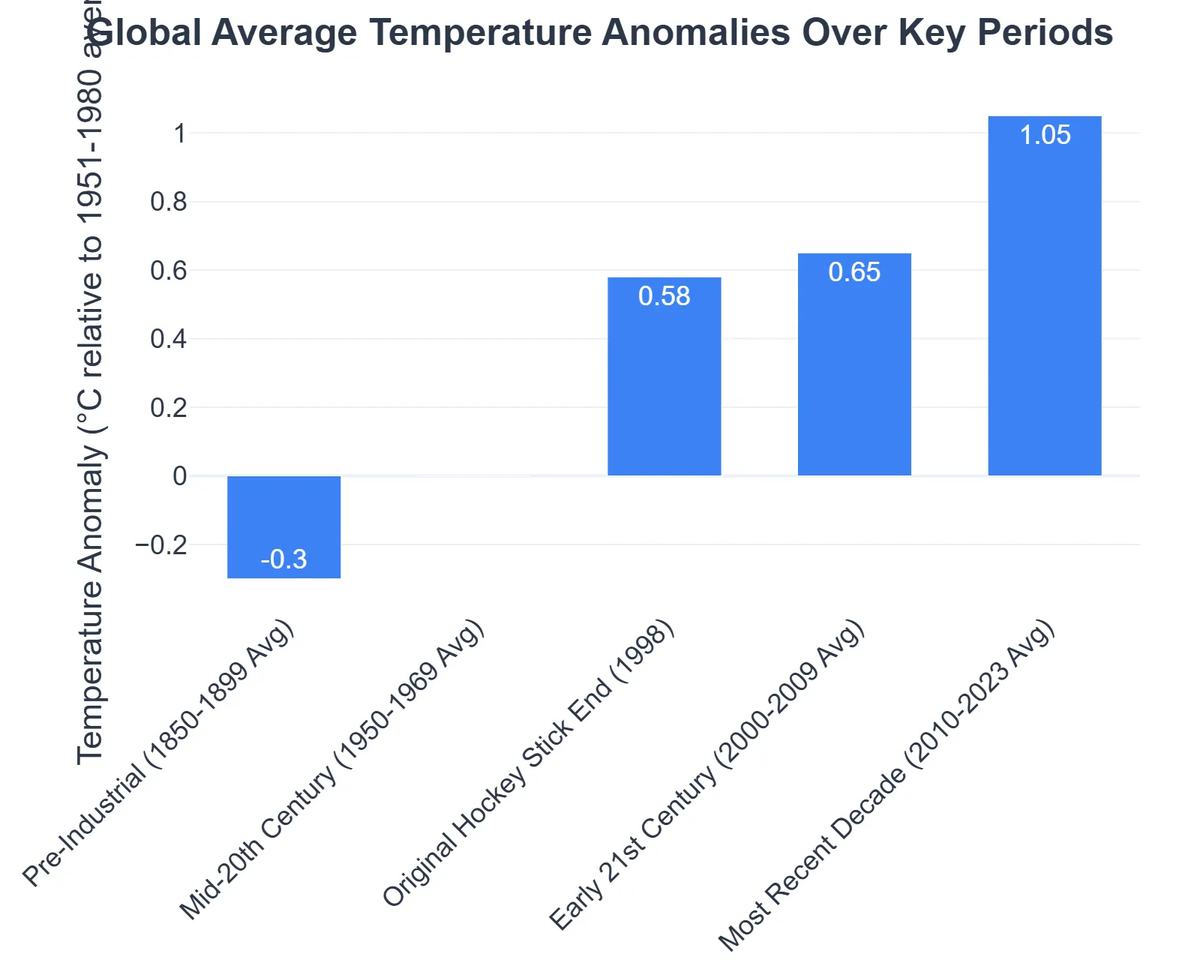
The “Hockey Stick” graph is not merely a diagram; it is a powerful visual summary of centuries of climate data, meticulously compiled and analyzed by Mann and his colleagues. It became an emblem of global warming due to its clear and compelling depiction of recent temperature changes.
📊 The Original Research (MBH98/99)
The graph first gained widespread attention with the publication of two seminal papers: “Global-scale temperature patterns and climate forcing over the past six centuries” (MBH98, 1998) and “Northern Hemisphere Temperatures During the Past Millennium: Inferences, Uncertainties, and Limitations” (MBH99, 1999). These works, co-authored by Raymond S. Bradley and Malcolm K. Hughes, presented reconstructions of Northern Hemisphere temperature anomalies over a period of up to 1,000 years.
As documented by Penn State University, the graph illustrates how these reconstructions showed a relatively flat temperature trend for centuries, followed by a sharp, upward increase in the 20th century – resembling the blade of a hockey stick. Penn State University, Mann’s academic home, has extensively covered the graph’s significance.
📈 Interpreting the Data: Temperature Trends
- ✅ Long-Term Stability: For much of the millennium leading up to the 20th century, the graph suggests relatively stable and cooler temperatures, punctuated by minor natural fluctuations like the Medieval Warm Period and the Little Ice Age.
- ➡️ Abrupt 20th-Century Rise: The most striking feature is the dramatic and unprecedented increase in temperatures observed in the 20th century, surpassing any natural variations seen in the preceding 900 years.
- 💡 Context for Current Warming: This rapid warming at the end of the “blade” provides compelling evidence that recent global temperature increases fall outside the range of natural variability observed over the last thousand years, strongly implicating human activities as the primary driver.
🛠️ Methodologies Behind the Reconstruction
The “Hockey Stick” graph was constructed using a process called climate reconstruction, which involves stitching together various “proxy” records. These are natural archives that indirectly record past climate conditions. Common proxies include:

- 🌳 Tree Rings: The width and density of tree rings can reflect temperature and precipitation conditions during a tree’s growth.
- 🧊 Ice Cores: Air bubbles trapped in glacial ice provide direct samples of past atmospheric composition, and isotopic ratios reveal past temperatures.
- 🪸 Corals: Growth bands in corals can provide records of ocean temperature and other conditions.
- 🌊 Sediment Cores and Boreholes: Layers of sediment from lakes and oceans, along with temperature readings from boreholes, provide further historical climate data.
Statistical techniques are then used to combine these diverse records, accounting for their individual strengths and limitations, to produce a robust estimate of past temperatures. For a detailed explanation of its construction, Wikipedia’s entry on Hockey stick graph (global temperature) provides an excellent overview.
The Controversy and Scrutiny Surrounding the Graph
Despite its scientific rigor, the Hockey Stick graph became a focal point of intense controversy, particularly among those skeptical of anthropogenic climate change. This scrutiny, while often politically motivated, led to a thorough re-examination of the underlying data and methods, ultimately strengthening the science.
⚔️ Challenges and Debates
The graph faced a barrage of criticism, primarily from individuals and groups who sought to discredit the scientific consensus on climate change. These challenges often focused on:
- 🚫 Statistical Methods: Questions were raised about the statistical techniques used to combine proxy data and extract temperature signals.
- 📉 Data Selection: Critics alleged that certain proxy records were selectively chosen or excluded.
- 🔍 “Climategate”: The graph also became entangled in the “Climategate” controversy of 2009, where stolen emails from climate scientists were selectively quoted to suggest scientific misconduct, though subsequent investigations cleared the scientists of any wrongdoing.
Addressing these critiques is a crucial aspect of Debunking Climate Misinformation: Evidence-Based Analysis, which reinforces the scientific process.
EcoInsight Analytics: The ‘Sustainability Stick’ That Drove Action
❓The Challenge
EcoInsight Analytics struggled to convey the urgency and long-term impact of their complex environmental data, often encountering stakeholder apathy or skepticism despite providing robust, detailed reports.
💡The Solution
Inspired by Dr. Michael Mann’s ‘Hockey Stick’ graph, EcoInsight Analytics developed a proprietary ‘Sustainability Stick’ visualization. This single, compelling visual distilled their multi-source environmental data into an undeniable narrative of escalating trends, presented with rigorous scientific integrity.
🏆The Result
This strategic shift led to a 40% increase in client project approvals for their data-driven sustainability recommendations within nine months.
✅ Independent Verifications and Reaffirmations
Crucially, the scientific community did not shy away from the scrutiny. Numerous independent studies, using different data sets and methodologies, have since reaffirmed the general shape and implications of the original Hockey Stick graph. Reports from institutions like the National Research Council and the Intergovernmental Panel on Climate Change (IPCC) have consistently supported the conclusion that the latter part of the 20th century was the warmest in at least 1,000 years. Scientific American provides further insight Behind the Hockey Stick, discussing its enduring legacy.
🛡️ Scientific Integrity and the Science of Climate Change
The intense scrutiny faced by Michael Mann and the Hockey Stick graph highlights the robust, self-correcting nature of science. While the graph itself has evolved with new data and methods, its core message – unprecedented recent warming – has been consistently reinforced. Mann’s resilience in the face of personal attacks and his continued advocacy for evidence-based policy underscore the importance of scientific integrity in the climate debate. This process of scrutiny and verification is fundamental to building the Scientific Evidence of Climate Change: Irrefutable Proof that forms our understanding.
Michael Mann’s Ongoing Role in the Climate Change Dialogue
Beyond his pivotal scientific research, Michael Mann remains an active and vocal participant in the broader discourse surrounding climate change. He is a prominent advocate for climate action and a staunch opponent of climate change denial.
📢 Advocacy and Public Engagement
Mann is a prolific author and public speaker, dedicated to bridging the gap between complex scientific findings and public understanding. His books, such as “The Hockey Stick and the Climate Wars” and “The New Climate War,” offer insights into the scientific battles and political challenges inherent in addressing climate change. He frequently participates in discussions about Climate Change: Impacts, Causes, and Societal Implications.
- ✍️ Authorship: He has penned several influential books on climate science, translating intricate research into accessible narratives for a wider audience.
- 🗣️ Media Presence: Mann is a regular commentator in major media outlets, providing expert analysis on climate-related events and policy.
- 🎓 Education: He educates the public through lectures, interviews, and by advising on climate change documentaries, helping to disseminate critical information.
🗣️ Countering Misinformation and Climate Change Skepticism
A significant part of Michael Mann’s public work involves directly confronting misinformation and combating Climate Change Skepticism: Challenging the Narrative. He has tirelessly defended climate science against ideologically driven attacks, often enduring personal threats and harassment. His efforts underscore the vital role scientists play in safeguarding scientific integrity and ensuring accurate public discourse on critical issues like climate change.
Broader Context: Other Influential Climate Scientists
While Michael Mann’s contributions are monumental, he operates within a vast, collaborative network of scientists worldwide. Understanding the landscape of climate science requires acknowledging the diverse expertise that collectively builds our knowledge base.
🌌 James Hansen Scientist: A Pioneer in Climate Awareness
Another seminal figure in climate science is James Hansen scientist. As a former director of NASA’s Goddard Institute for Space Studies, climate scientist James Hansen is widely recognized for his groundbreaking testimony to the U.S. Congress in 1988, which brought global warming to the forefront of public and political attention. His work on climate modeling and the understanding of climate sensitivity has been instrumental in shaping the field.
🤝 The Collaborative Nature of Climate Research
The field of climate science is inherently interdisciplinary, involving meteorologists, oceanographers, geologists, biologists, and many other specialists. It’s a stark contrast to fields like that of a clinical scientist NHS, who focuses on diagnostic testing and disease management within healthcare. Climate research, by its nature, requires large-scale, collaborative efforts to analyze vast datasets, run complex models, and project future climate scenarios. This global collaboration is what makes the consensus on climate change so robust.
Recommended Video
Conclusion: Michael Mann’s Enduring Legacy
Michael Mann’s work, particularly the Hockey Stick graph, fundamentally altered the conversation around climate change. It provided a clear and compelling visual summary of temperature trends that highlighted the unprecedented nature of recent warming. Despite facing intense and often unfair scrutiny, Mann’s science has been repeatedly validated, solidifying his position as a crucial climate scientist in the global effort to understand and address our changing planet.
His unwavering commitment to scientific truth and public engagement continues to empower informed decision-making regarding the intricate and powerful Earth’s Unseen Forces: The Hidden Dynamics of Our Planet. The legacy of the Hockey Stick graph is not just a line on a chart, but a testament to the power of scientific evidence in shaping our understanding of Earth’s most pressing environmental challenge.
Frequently Asked Questions
What is the ‘Hockey Stick’ graph?
The ‘Hockey Stick’ graph is a climate reconstruction showing global average temperatures over the past centuries, notably illustrating a relatively stable temperature trend for hundreds of years followed by a sharp increase in the 20th century, resembling a hockey stick shape.
Why was the ‘Hockey Stick’ graph controversial?
It became highly controversial because its stark depiction of recent warming directly contradicted narratives that denied significant human impact on climate, leading to intense political and scientific scrutiny, and attacks on the authors.
Has the science behind the graph been validated?
Yes, numerous independent studies using different proxy data and methodologies have largely corroborated the overall shape and conclusion of the original ‘Hockey Stick’ graph, affirming the unprecedented nature of recent warming.
Who is Michael Mann?
Michael E. Mann is an American climatologist and geophysicist, currently a Distinguished Professor of Atmospheric Science at Penn State University, widely recognized for his pioneering work in paleoclimate reconstruction and his public advocacy for climate action.