


The Event Horizon: Defining the Boundary of No Return
In the vast, enigmatic expanse of the cosmos, few phenomena capture our imagination quite like black holes. These cosmic behemoths represent regions of spacetime where gravity is so intense that nothing—not even light—can escape. At the heart of understanding these incredible objects lies a crucial concept: the event horizon.
💡 Key Takeaways
- The event horizon is the boundary around a black hole beyond which nothing, not even light, can escape.
- It represents the point of no return, where gravity’s pull becomes insurmountable.
- Understanding the event horizon is crucial for comprehending the most extreme phenomena in the universe.
- Observations related to event horizons, like those by the Event Horizon Telescope, provide critical tests for Einstein’s theory of general relativity.
“The event horizon isn’t a physical surface, but a profound boundary in spacetime where the fabric of reality itself warps so intensely that escape becomes utterly impossible. It’s the universe’s ultimate cosmic one-way street.”
— Astrid Bellweather, Astrophysicist & Science Communicator
In This Article
- → The Event Horizon: Defining the Boundary of No Return
- — 💡 Key Takeaways
- → The Physics Beyond the Edge: Why Nothing Escapes
- — 🌌 Spacetime Distortion and Light Cones
- → What Happens at the Event Horizon? Time Dilation and Spaghettification
- — ⏳ Time Dilation: A Cosmic Illusion
- — 🍝 Spaghettification: The Tidal Force Effect
- → Types of Black Holes and Their Event Horizons
- → Unanswered Questions and Future Exploration
The event horizon is not a physical barrier or a surface you can touch. Instead, it’s a boundary in spacetime, a point of no return. Once anything, be it a particle of dust, a photon of light, or an entire star, crosses this invisible threshold, it is irrevocably committed to falling towards the black hole’s central singularity. It marks the ‘edge’ of a black hole, the point at which the escape velocity exceeds the speed of light.
The Physics Beyond the Edge: Why Nothing Escapes
To truly grasp the implications of the event horizon, we must delve into the realm of Einstein’s theory of general relativity. This groundbreaking theory posits that massive objects warp the fabric of spacetime around them. A black hole, being an object of immense mass concentrated into an incredibly small volume, warps spacetime to an extreme degree.
🌌 Spacetime Distortion and Light Cones
- ✅ Light Cones: In normal spacetime, your future light cone (the path all possible light rays emanating from you could take) always points forward in time, allowing light to travel away from you in any direction.
- ➡️ Beyond the Horizon: As you approach a black hole, the spacetime curvature becomes so severe that the light cones begin to tilt. At the event horizon, they tilt so much that all future paths, including those of light, point inward towards the black hole’s singularity.
- 💡 No Escape: This means that even if a light ray were emitted outwards at the event horizon, the warping of spacetime would ensure its path ultimately leads inward, making escape impossible. This is why black holes are “black”—no light can escape to reach our eyes.
This extreme gravitational pull is the fundamental reason for the event horizon’s existence. It’s the point where the pull becomes so strong that the velocity required to escape exceeds the universal speed limit, the speed of light.
What Happens at the Event Horizon? Time Dilation and Spaghettification
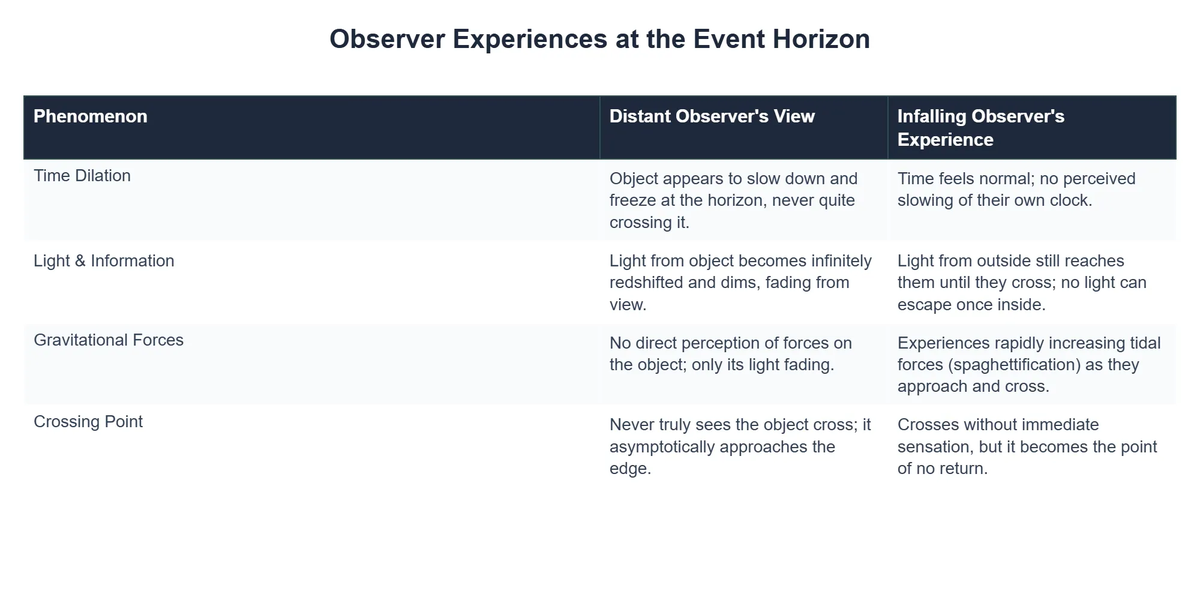
While the event horizon is a point of no return, the actual experience of crossing it depends heavily on the black hole’s size. For smaller, stellar-mass black holes, the journey can be quite dramatic, while for supermassive black holes, it might be surprisingly smooth, at least initially.
⏳ Time Dilation: A Cosmic Illusion
One of the most mind-bending effects predicted by general relativity near an event horizon is time dilation. For an outside observer, time appears to slow down drastically for anything approaching the black hole. An object falling towards the black hole would appear to hover and freeze at the event horizon, becoming infinitely red-shifted (its light stretching to longer, lower-energy wavelengths) before vanishing from sight. This phenomenon is critical to understanding the Black Hole Appearance: Understanding the Event Horizon.
🍝 Spaghettification: The Tidal Force Effect
As an object approaches a black hole, the gravitational pull on the part of the object closer to the black hole is significantly stronger than on the part further away. This differential gravitational force creates an extreme stretching effect known as spaghettification. Imagine being stretched like a noodle until you are just a stream of atoms.
- ✅ Stellar Black Holes: For black holes formed from collapsed stars, the tidal forces at the event horizon are immense. Spaghettification would occur long before you even reached the horizon, tearing you apart.
- ➡️ Supermassive Black Holes: Counterintuitively, for supermassive black holes (millions to billions of times the sun’s mass), the event horizon is much larger, and the gravitational gradient across a person’s body at the horizon is much weaker. You could cross the event horizon of a supermassive black hole without immediately feeling spaghettification. However, once inside, the journey to the singularity is inevitable, and spaghettification would eventually occur closer to the singularity itself. To learn more about this journey, explore Entering a Black Hole: A Journey Beyond the Event Horizon.
For more detailed information on black hole anatomy, NASA provides an excellent resource: Black Hole Anatomy.
Exploring the Event Horizon: Benefits and Challenges
Pros
- ✔Tests the limits of General Relativity and quantum mechanics.
- ✔Offers profound insights into the nature of gravity and spacetime.
- ✔Potential for revolutionary discoveries about the universe’s fundamental laws.
- ✔Drives advancements in theoretical astrophysics and observational technology.
Cons
- ✖Physical exploration is currently impossible and fatal.
- ✖Poses the theoretical ‘information paradox’ challenge.
- ✖Direct observation is hindered by extreme gravitational lensing and distortion.
- ✖Requires highly complex and often unverified theoretical frameworks.
Types of Black Holes and Their Event Horizons
Black holes come in various sizes, each with its own scale of event horizon:
- ✅ Stellar Black Holes: Formed from the collapse of massive stars, their event horizons are typically tens of kilometers in diameter.
- ➡️ Intermediate-Mass Black Holes (IMBHs): Hypothesized to exist, with masses between stellar and supermassive black holes. Their event horizons would be proportionally larger.
- 💡 Supermassive Black Holes (SMBHs): Found at the centers of most galaxies (including our own Milky Way), these have event horizons that can be millions to billions of kilometers across, large enough to encompass entire solar systems.
- 🌠 Primordial Black Holes: Theoretical black holes formed in the early universe, possibly as small as an atom, with microscopic event horizons.
Understanding these different types is crucial to comprehending the full spectrum of Black Holes Explained: A Comprehensive Guide to Gravitational Mysteries. The size of the event horizon is directly proportional to the black hole’s mass – the more massive the black hole, the larger its event horizon.
Unanswered Questions and Future Exploration
Despite significant progress in our understanding, the event horizon remains a frontier of theoretical physics. Questions persist regarding the ultimate fate of information that crosses the horizon (the “information paradox”) and the nature of the singularity itself.
Theoretical concepts like Hawking radiation suggest that black holes are not entirely black but slowly evaporate over vast cosmic timescales, emitting radiation from just outside the event horizon. This phenomenon highlights the intricate interplay between gravity, quantum mechanics, and thermodynamics at this extreme boundary.
The study of event horizons continues to push the boundaries of physics, offering insights not only into black holes but also into the fundamental nature of gravity, spacetime, and the universe itself. These explorations are part of a broader journey into Cosmic Queries: Probing the Mysteries of the Universe.
Researchers are continuously exploring extreme physics around black holes, including accretion disk dynamics at the event horizon. You can find more on this at Extreme Physics Around Black Holes.
Recommended Video
What exactly is an event horizon?
The event horizon is the boundary around a black hole beyond which the gravitational pull is so strong that no particles or electromagnetic radiation (like light) can escape from it.
Can we see an event horizon?
No, you cannot directly ‘see’ the event horizon itself because no light escapes it. However, we can observe its effects on surrounding matter and detect its ‘shadow’ against a luminous background, as seen with images from the Event Horizon Telescope.
What happens if an object crosses the event horizon?
Once an object crosses the event horizon, it’s irretrievably pulled towards the black hole’s singularity. From an external observer’s perspective, the object would appear to slow down and freeze at the horizon due to extreme time dilation, never quite disappearing.
Is the event horizon a solid surface?
No, the event horizon is not a physical surface. It’s a conceptual boundary in spacetime where the escape velocity equals the speed of light, making escape impossible.