


In a world increasingly driven by digital transformation, certain technologies emerge as true game-changers, reshaping industries from their core. Among these, blockchain technology stands out, promising unprecedented levels of security, transparency, and efficiency. Far from being confined to cryptocurrencies, its revolutionary potential is now being harnessed across diverse sectors, with healthcare and cybersecurity emerging as two of the most impactful frontiers.
💡 Key Takeaways
- Blockchain enhances patient data security and privacy in healthcare through secure, auditable records.
- Its immutable nature significantly bolsters cybersecurity defenses against fraud and data breaches.
- Decentralized systems reduce single points of failure, improving resilience in critical infrastructure.
- The technology fosters transparency and trust across various digital applications.
“Blockchain isn’t just about cryptocurrency; it’s a foundational shift towards a trustless, transparent digital future. Its integration into healthcare and cybersecurity could redefine data ownership and protect our most vulnerable information, but we must navigate the ethical implications carefully to ensure equitable access and prevent new forms of digital exclusion.”
— Kira Chen, Futurist & AI Ethics Advocate
This article delves deep into the multifaceted applications of blockchain, exploring how this distributed ledger technology is not just optimizing existing processes but fundamentally redefining trust, data management, and operational resilience within the critical domains of healthcare and cybersecurity. Join us as we chart the course of tomorrow’s technology, understanding how blockchain is poised to revolutionize these vital industries.
In This Article
- — 💡 Key Takeaways
- → The Foundation: Understanding Blockchain Technology
- — What is Blockchain?
- — Key Characteristics
- — How Blockchain Works
- → Blockchain’s Transformative Power in Healthcare
- — Enhancing Data Security and Interoperability
- — Streamlining Supply Chains and Drug Traceability
- — Revolutionizing Claims Management and Billing
- — Facilitating Research and Clinical Trials
- → Fortifying Defenses: Blockchain in Cybersecurity
- — Decentralized Identity and Access Management (IAM)
- — Enhancing Data Integrity and Protection
- — Securing IoT Devices and Networks
- — Combating Cyber Threats with Immutable Logs
- → Challenges and Future Outlook
- — Overcoming Hurdles
- — The Road Ahead for Blockchain Applications
- → Conclusion
The Foundation: Understanding Blockchain Technology
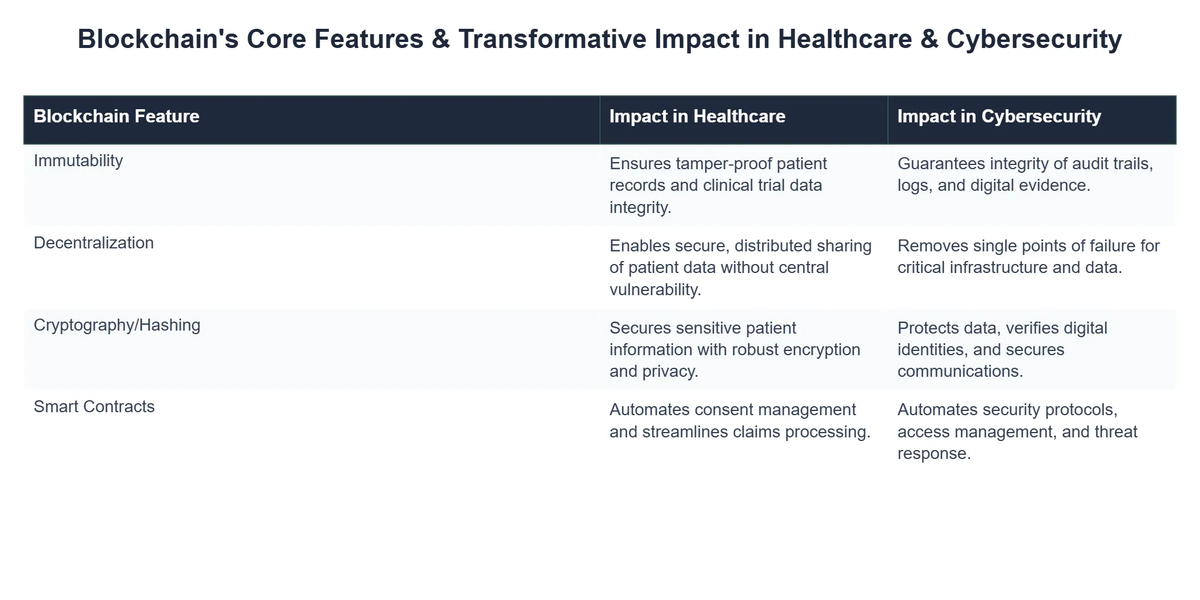
At its heart, blockchain is a decentralized, distributed ledger that records transactions across many computers, ensuring data integrity and immutability. Each ‘block’ contains a timestamped set of transactions and a cryptographic hash of the previous block, creating an unbreakable chain. This structure is what lends blockchain its inherent security and transparency.
What is Blockchain?
- ✅ Decentralized Ledger: Unlike traditional centralized databases, blockchain operates without a central authority, distributing copies of the ledger across a network of participants.
- 🔐 Cryptographic Security: Transactions are cryptographically secured and linked, making them tamper-proof.
- 🌐 Consensus Mechanisms: All participants must validate and agree on new transactions before they are added to the chain, maintaining integrity.
Key Characteristics
- ➡️ Immutability: Once a transaction is recorded, it cannot be altered or deleted, creating an unchangeable audit trail.
- ➡️ Transparency: While identities can be pseudonymous, all transactions on the public ledger are visible to network participants.
- ➡️ Security: The distributed nature and cryptographic principles make blockchain highly resistant to fraud and cyberattacks.
- ➡️ Efficiency: Eliminates intermediaries, streamlining processes and reducing transaction times.
How Blockchain Works
When a transaction occurs, it is grouped into a block with other transactions. This block is then verified by network participants (nodes) using consensus algorithms. Once verified, it is added to the existing chain of blocks, creating a permanent, transparent record. Different Blockchain Architectures: Exploring Different Types exist, from public to private and consortium blockchains, each suited for specific applications.
Blockchain’s Transformative Power in Healthcare

The healthcare sector, burdened by data silos, privacy concerns, and supply chain complexities, finds a powerful ally in blockchain healthcare solutions. Its ability to create secure, interoperable, and immutable records offers solutions to some of the industry’s most pressing challenges.
Enhancing Data Security and Interoperability
Patient data is highly sensitive and often fragmented across various healthcare providers, leading to inefficiencies and security vulnerabilities. Blockchain offers a robust framework for managing Electronic Health Records (EHRs) and Electronic Medical Records (EMRs).
- 🔒 Secure Patient Records: By encrypting and decentralizing patient data, blockchain minimizes the risk of data breaches and unauthorized access. Solutions like those offered by IBM Blockchain for Healthcare focus on creating secure, permissioned data exchanges.
- 🤝 Seamless Interoperability: Patients can grant specific healthcare providers access to their comprehensive medical history, fostering better coordinated care and reducing redundant tests.
- 审计 Auditable Access: Every access to a patient record is immutably logged on the blockchain, providing a transparent audit trail for compliance and accountability.
Streamlining Supply Chains and Drug Traceability
The pharmaceutical supply chain is susceptible to counterfeiting, diversion, and inefficiencies. Blockchain provides an end-to-end verifiable record, enhancing patient safety and operational integrity.
- 💊 Counterfeit Prevention: Tracking drugs from manufacturing to patient delivery, blockchain ensures authenticity. Companies like MediLedger are leveraging blockchain to secure the pharmaceutical supply chain, complying with regulations like the Drug Supply Chain Security Act (DSCSA).
- 📊 Transparency and Traceability: All participants in the supply chain – manufacturers, distributors, pharmacies – can record and verify product movements, improving accountability. For an in-depth look at how this works, consider exploring VeChain: Revolutionizing Supply Chains with Blockchain.
- 📉 Waste Reduction: Better visibility helps manage inventory, reduce spoilage, and optimize logistics.
Revolutionizing Claims Management and Billing
Healthcare billing and insurance claims are often complex, prone to errors, and vulnerable to fraud. Blockchain, especially through smart contracts, can automate and secure these processes.
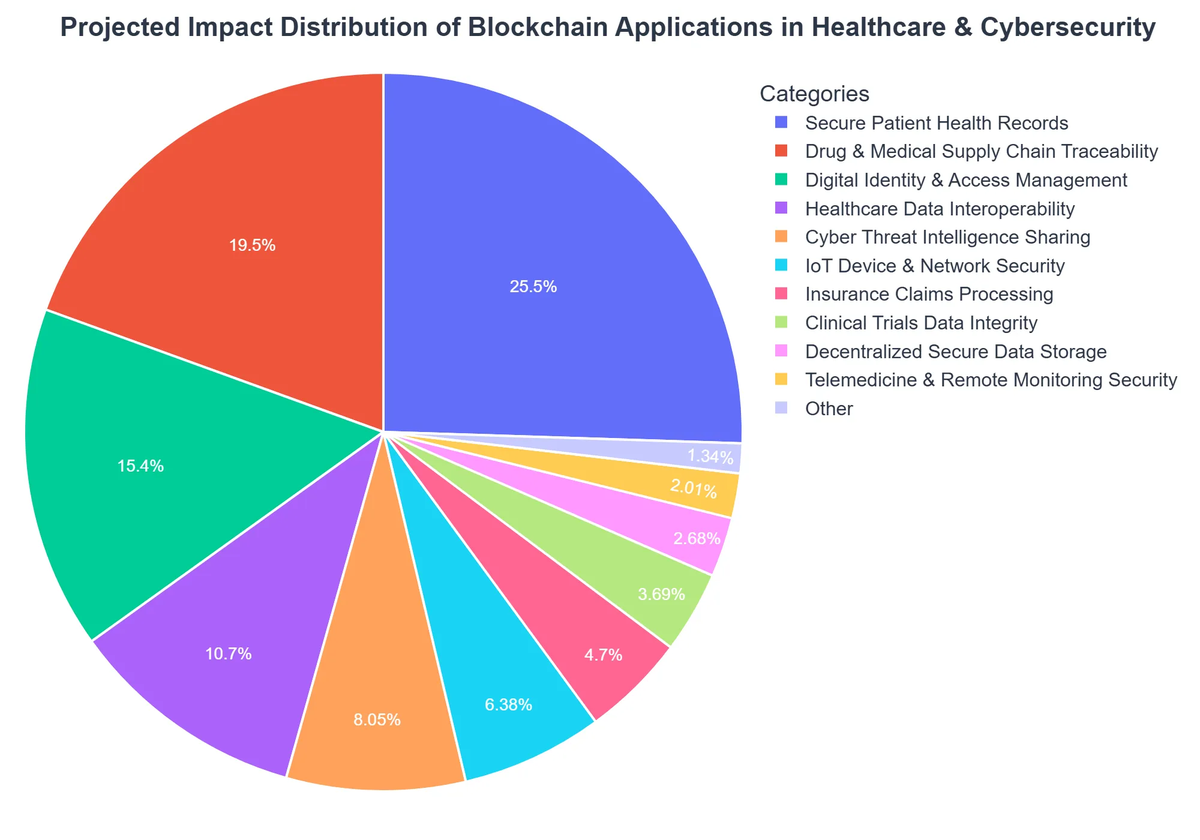
- ✅ Automated Claims Processing: Smart contracts can automatically verify and process claims when predefined conditions are met, speeding up payments and reducing administrative overhead.
- ⚖️ Fraud Reduction: The immutable nature of blockchain records makes it harder to submit fraudulent claims or duplicate payments.
- 💡 Enhanced Patient Experience: Transparent billing processes lead to fewer disputes and greater trust. Platforms like Solve.Care are building blockchain-powered ecosystems to streamline healthcare administration and improve access.
Facilitating Research and Clinical Trials
Clinical trials often face challenges related to data integrity, patient recruitment, and consent management. Blockchain offers solutions to enhance the reliability and efficiency of medical research.
- 🔬 Secure Data Sharing: Researchers can securely share anonymized or consent-based patient data for studies, accelerating drug discovery.
- Consent Management: Patients can control who accesses their data for research purposes, with every consent and withdrawal immutably recorded.
- ✍️ Data Integrity: Ensures the authenticity and immutability of trial data, preventing manipulation and enhancing the credibility of research findings. According to a study published in ScienceDirect, blockchain technology can significantly improve data management in healthcare. Read more about blockchain applications in healthcare here.
Fortifying Defenses: Blockchain in Cybersecurity
Cybersecurity faces an uphill battle against ever-evolving threats. Blockchain cybersecurity solutions offer a new paradigm for data protection, identity management, and network security by leveraging decentralization and cryptographic strength.
Decentralized Identity and Access Management (IAM)
Traditional IAM systems are centralized, making them attractive targets for cybercriminals. Blockchain enables self-sovereign identity, where users control their own digital identities.
- 👤 Self-Sovereign Identity (SSI): Users manage their own identity data, only sharing necessary credentials on a need-to-know basis, reducing the risk of large-scale data breaches.
- 🔑 Stronger Authentication: Eliminates reliance on central servers for authentication, making phishing and identity theft more difficult.
- 🔐 Tamper-Proof Credentials: Digital identities and credentials recorded on a blockchain are immutable and verifiable.
Enhancing Data Integrity and Protection
Blockchain’s core principle of immutability is a significant asset in protecting data from manipulation and ensuring its veracity.
Blockchain in Healthcare & Cybersecurity: Pros and Cons
Pros
- ✔Enhanced data security and integrity through immutable ledgers.
- ✔Improved interoperability and secure sharing of sensitive information.
- ✔Strengthened cybersecurity measures and decentralized identity management.
- ✔Increased transparency and auditability of records and transactions.
Cons
- ✖Significant scalability and performance limitations for large-scale adoption.
- ✖High implementation costs and technical complexity for integration.
- ✖Regulatory and compliance challenges, particularly concerning data privacy and the ‘right to be forgotten’.
- ✖Lack of standardized protocols and skilled professionals for widespread deployment.
- 🛡️ Immutable Audit Trails: Every change, access, or transaction on a system can be logged on a blockchain, creating an unalterable record for forensic analysis and compliance.
- 🚫 Data Tampering Prevention: Because blockchain records are cryptographically linked, any attempt to alter past data would break the chain, making tampering immediately detectable.
- ☁️ Secure Cloud Storage: Decentralized storage solutions built on blockchain can distribute data fragments across multiple nodes, enhancing resilience against attacks. Enterprise solutions like Microsoft Azure Blockchain and offerings from ConsenSys provide frameworks for building secure, permissioned blockchain networks for data management.
Securing IoT Devices and Networks
The proliferation of IoT devices introduces numerous security vulnerabilities. Blockchain can provide a decentralized security layer for these vast networks.
- 🔗 Device Identity and Authentication: Each IoT device can have a unique, unchangeable identity on a blockchain, preventing unauthorized devices from joining the network.
- ↔️ Secure Communication: Facilitates secure, peer-to-peer communication between IoT devices without a centralized server, reducing points of failure.
- ⚙️ Decentralized Management: Automates device updates and patches through smart contracts, enhancing overall network security and manageability.
Combating Cyber Threats with Immutable Logs
The transparency and immutability of blockchain logs can be critical in detecting and responding to cyberattacks.
- 🚨 Enhanced Threat Detection: Security event logs can be stored on a blockchain, preventing attackers from covering their tracks and enabling faster detection of anomalies.
- 🔎 Forensic Analysis: Immutable logs provide a reliable source of truth for post-incident investigations, improving the accuracy of forensic analysis.
- 🚫 Distributed Denial of Service (DDoS) Protection: Decentralized DNS systems built on blockchain can make it harder for attackers to launch DDoS attacks by disrupting centralized name servers. While blockchain has immense potential, awareness of cyber threats targeting blockchain itself is crucial. The World Economic Forum highlights the need to understand these threats for successful adoption. Learn more about blockchain’s cyber threats here.
Challenges and Future Outlook
Despite its vast potential, the widespread adoption of blockchain applications in healthcare and cybersecurity faces several hurdles. However, ongoing innovation promises to address these challenges, paving the way for a more secure and efficient future.
Overcoming Hurdles
- 📏 Scalability: Public blockchains often struggle with transaction throughput, a critical factor for large-scale enterprise applications. Solutions like sharding and layer-2 protocols are being developed.
- ⚖️ Regulatory Clarity: The evolving regulatory landscape for blockchain technology can be a barrier to widespread adoption, especially in highly regulated sectors like healthcare.
- 🤝 Interoperability: Ensuring different blockchain networks can communicate and share data seamlessly is essential for a truly integrated future.
- ⚡ Energy Consumption: Some consensus mechanisms, like Proof-of-Work, are energy-intensive, raising environmental concerns. More sustainable alternatives are emerging.
The Road Ahead for Blockchain Applications
The trajectory of blockchain suggests continued growth and integration with other emerging technologies. We can expect to see more sophisticated blockchain applications that leverage AI for predictive analytics on blockchain data, IoT for real-time secure data feeds, and even AR/VR for immersive, secure data visualization.
- 💡 Industry-Specific Consortia: More industry groups will form to establish standards and develop permissioned blockchain solutions tailored to their unique needs.
- 🌍 Global Collaboration: Increased international cooperation will foster cross-border data sharing and identity management solutions.
- 📈 Hybrid Architectures: A blend of centralized and decentralized systems may emerge as a practical approach for enterprise adoption, balancing efficiency with security.
As we continue to chart the course of Future Perfect?: Charting the Course of Tomorrow’s Technology, blockchain’s role in creating a more secure, transparent, and equitable digital world will undoubtedly expand.
Recommended Video
Conclusion
The blockchain revolution is well underway, extending its transformative reach far beyond finance. In healthcare, it promises to untangle complex data silos, fortify supply chains against counterfeiting, and streamline administrative burdens, ultimately leading to safer, more efficient patient care. In cybersecurity, blockchain offers a fundamental shift from centralized vulnerabilities to decentralized resilience, empowering stronger identity management, immutable data integrity, and enhanced protection against an ever-growing array of threats.
While challenges remain, the strategic integration of blockchain technology by industry leaders like IBM, Microsoft, ConsenSys, MediLedger, and Solve.Care underscores its undeniable value proposition. As the digital landscape continues to evolve, blockchain will be a cornerstone in building the secure, trustworthy, and interconnected systems vital for the future of both healthcare and cybersecurity.
Frequently Asked Questions
How does blockchain improve data security in healthcare?
Blockchain enhances healthcare data security by creating an immutable, tamper-proof record of patient information, ensuring data integrity and enabling secure sharing while maintaining privacy.
What cybersecurity threats can blockchain mitigate?
Blockchain can mitigate threats like data breaches, identity theft, and ransomware by providing decentralized authentication, secure transaction logging, and robust integrity checks that make data manipulation extremely difficult.
Is blockchain scalable for widespread healthcare adoption?
While scalability remains a challenge, ongoing advancements in blockchain technology, such as sharding and layer-2 solutions, are addressing these issues, making widespread adoption in healthcare increasingly feasible.
Can blockchain eliminate the need for traditional cybersecurity measures?
No, blockchain complements traditional cybersecurity measures by adding layers of trust and immutability. It doesn’t replace firewalls, intrusion detection systems, or secure coding practices, but enhances overall resilience.