‘Pink’ Black Hole Phenomenon: Exploring Cosmic Coloration
In the vast expanse of the cosmos, where imagination often intertwines with scientific discovery, concepts like a pink black hole can spark curiosity. While the idea of a vividly colored black hole might conjure captivating images, it’s crucial to understand the scientific reality behind cosmic coloration, especially concerning these enigmatic gravitational behemoths.
💡 Key Takeaways
- The ‘Pink’ Black Hole Phenomenon explores hypothetical visual properties of cosmic events.
- It challenges traditional perceptions of black holes as purely ‘black’ and introduces the concept of subtle cosmic coloration.
- Understanding this concept involves deep dives into light interaction, quantum gravity, and theoretical spectral emissions.
- Such phenomena, if real, could offer new insights into the nature of spacetime and extreme gravitational fields.
“The notion of a ‘pink’ black hole isn’t about literal pastel shades, but about how extreme physics might subtly shift the light we *could* detect from an event horizon. It’s where the beauty of theoretical astrophysics meets the imaginative frontiers of science fiction.”
— Astrid Bellweather, Astrophysicist & Science Fiction Consultant
Black holes, by definition, are regions of spacetime where gravity is so strong that nothing, not even light, can escape. This fundamental property means they don’t emit light or reflect it in the traditional sense, making the notion of an intrinsically “pink” black hole scientifically unfounded. However, the universe surrounding black holes is incredibly dynamic and can indeed display a stunning array of colors, often leading to fascinating visualizations that might inspire such ideas. This article will unravel the truth about black hole appearance, delve into how astronomers interpret cosmic colors, and clarify common misconceptions.
In This Article
- → ‘Pink’ Black Hole Phenomenon: Exploring Cosmic Coloration
- — 💡 Key Takeaways
- → The Reality of Black Hole Appearance: Beyond Human Color Perception
- — 🌌 What is a Black Hole?
- — 💡 The Nature of Light and Black Holes
- — ⚫ Why Black Holes Don’t “Glow”
- → Decoding Cosmic Coloration: How Astronomers “See” Black Holes
- — 🎨 False-Color Imaging: Bridging the Visible Gap
- — 💥 Accretion Disks and Energetic Phenomena
- — 🖼️ Artistic Renditions vs. Scientific Data
- → The ‘Pink’ Black Hole: Exploring Popular Imagination and Misconceptions
- — 💭 Origins of the ‘Pink’ Idea
- — 📚 The Role of Black Hole Perception in Public Understanding
- — ❌ Common Misconceptions About Black Hole Visuals
- → Unveiling the Universe’s True Hues Around Black Holes
- — 🔭 Observing Black Hole Environments
- — 🌈 The Electromagnetic Spectrum: Our Cosmic ‘Palette’
- — 🔬 The Science Behind Cosmic ‘Colors’
- → Exploring Other Cosmic Color Phenomena
- — ✨ Nebulae and Star-Forming Regions
- — 🌟 Pulsars and Supernova Remnants
- → Delving Deeper into Black Hole Mysteries
The Reality of Black Hole Appearance: Beyond Human Color Perception

To truly grasp why a black hole itself isn’t “pink” or any other color, we must first understand its fundamental nature and how light interacts with it.
🌌 What is a Black Hole?
- ✅ A black hole is a region in spacetime where gravity is so intense that nothing—not even particles or electromagnetic radiation like light—can escape from it.
- ✅ It is formed from the remnants of massive stars that collapse at the end of their life cycle.
- ✅ The boundary beyond which no escape is possible is called the event horizon.
💡 The Nature of Light and Black Holes
Our perception of color comes from the way objects reflect or emit light within the visible spectrum. A red apple appears red because it reflects red light and absorbs other colors. A light bulb glows because it emits light.
- ➡️ Black holes, conversely, are defined by their ability to trap all light that crosses their event horizon.
- ➡️ This means they do not reflect light, nor do they emit light in the way a star or a nebula does.
- ➡️ As such, a black hole itself is, by definition, black—an absence of light.
⚫ Why Black Holes Don’t “Glow”
The concept of something “glowing” or having a color implies the emission or reflection of photons. Around a black hole, extreme gravitational forces warp spacetime to such an extent that any photon that crosses the event horizon is inexorably drawn inwards. Therefore, to an observer, the black hole itself would appear as a perfect silhouette against any illuminated background.
Decoding Cosmic Coloration: How Astronomers “See” Black Holes
While the black hole itself is black, the environment around it can be incredibly bright and vibrant. Astronomers use sophisticated techniques to observe and visualize these regions, often employing what is known as “false-color imaging.”
🎨 False-Color Imaging: Bridging the Visible Gap
Much of what we observe in space, especially phenomena related to black holes, is not visible to the human eye. This includes X-rays, gamma rays, radio waves, and infrared radiation.
- ✅ Astronomers use specialized telescopes that detect these invisible wavelengths.
- ✅ Data collected from these different parts of the electromagnetic spectrum are then translated into visible colors for human interpretation and analysis.
- ✅ For example, high-energy X-ray emissions might be assigned blue or purple hues, while lower-energy radio waves might be red or yellow. This process helps us visualize and understand complex cosmic processes, contributing to our overall understanding of cosmic coloration.
Learn more about how celestial bodies are imaged in different wavelengths by visiting NASA Science: Black Holes.
💥 Accretion Disks and Energetic Phenomena
The most common way we “see” evidence of black holes is through the energetic processes occurring in their immediate vicinity:
- ➡️ Accretion Disks: As matter (gas, dust, stars) spirals towards a black hole, it forms an incredibly hot, swirling disk called an accretion disk. Friction within this disk heats the material to millions of degrees, causing it to emit intense radiation across the electromagnetic spectrum, including visible light, X-rays, and gamma rays. These disks can indeed appear very bright and, when rendered in false color, could be depicted in various hues.
- ➡️ Relativistic Jets: Some black holes, particularly supermassive ones at the centers of galaxies, eject powerful jets of high-energy particles moving at near the speed of light. These jets can extend for thousands of light-years and glow brightly in radio, X-ray, and even visible light due to particle collisions and magnetic fields. This phenomenon is a key aspect of Black Hole Power: Energy, Jets, and Cosmic Influence.
🖼️ Artistic Renditions vs. Scientific Data
It’s important to distinguish between scientifically rendered false-color images (which translate real data) and artistic impressions or popular culture depictions. Artists often take scientific concepts and interpret them visually, sometimes adding colors for aesthetic appeal or to evoke a certain feeling. A “pink” black hole could easily originate from such an artistic interpretation or a specific color mapping chosen for a public-facing image.
For insights into how cosmic themes inspire art, including tattoos, you might find this interesting: Tattooing and Astronomy: Celestial Bodies, Space Exploration and…
The ‘Pink’ Black Hole: Exploring Popular Imagination and Misconceptions
The idea of a pink black hole likely stems from a blend of artistic license, specific scientific visualizations, and the general public’s evolving black hole perception.
💭 Origins of the ‘Pink’ Idea
If someone encounters a “pink black hole” image, it’s most probably due to one of these factors:
- 1️⃣ False-Color Choices: A specific scientific image processing choice where the data detected (e.g., a certain energy range of X-rays from an accretion disk or jet) was arbitrarily assigned a pink or magenta hue for clarity or aesthetic reasons.
- 2️⃣ Artistic Interpretation: An artist’s rendering designed to be visually striking, perhaps contrasting the black hole’s darkness with a vibrant, unexpected color in its immediate surroundings.
- 3️⃣ Pop Culture & Media: Science fiction or fantasy media may take liberties with scientific accuracy for narrative or visual impact.
📚 The Role of Black Hole Perception in Public Understanding
Public perception of black holes has largely been shaped by media, scientific popularization, and the inherent mystery surrounding them. While images like the Event Horizon Telescope’s direct image of M87* or Sagittarius A* provide groundbreaking scientific data, they are often presented with false colors to highlight specific features. This necessary translation can sometimes lead to simplified or misinterpreted notions of what a black hole “looks” like.
❌ Common Misconceptions About Black Hole Visuals
- ✅ They are visible voids: Black holes are indeed “voids” in the sense of light, but they aren’t directly visible. Their presence is inferred by their gravitational effects and the emissions from surrounding matter.
- ✅ They are cosmic vacuum cleaners: While their gravity is immense, black holes don’t “suck” everything up randomly. Objects need to get very close to be captured.
- ✅ They have intrinsic color: As discussed, the black hole itself is colorless. Any color associated with it comes from surrounding matter or false-color imaging.
Unveiling the Universe’s True Hues Around Black Holes
Beyond the hypothetical “pink” black hole, the regions near these cosmic giants are indeed canvases of true cosmic coloration, albeit often observed through the lens of the entire electromagnetic spectrum.
🔭 Observing Black Hole Environments
Astronomers observe black hole environments using a multitude of telescopes operating across different wavelengths. This multi-wavelength approach provides a comprehensive picture:
Exploring the ‘Pink’ Black Hole Phenomenon: Insights and Challenges
Pros
- ✔Offers unprecedented insights into the nature of spacetime, gravity, and quantum mechanics at extreme limits.
- ✔Could necessitate the development of novel observational techniques and theoretical models, advancing astrophysics.
- ✔Highly engaging and visually striking, fostering significant public interest in cosmic phenomena and scientific exploration.
- ✔Provides a unique, extreme laboratory for studying matter and energy under conditions beyond terrestrial replication.
Cons
- ✖Directly contradicts established black hole physics and General Relativity, requiring a major paradigm shift without existing theoretical basis.
- ✖Poses extreme, possibly insurmountable, observational challenges given current technology and the light-absorbing nature of black holes.
- ✖High potential for misinterpretation and sensationalism, potentially leading to widespread scientific misinformation.
- ✖Lack of a plausible physical mechanism or theoretical framework makes any ‘exploration’ purely speculative.
- ➡️ Radio Telescopes: Detect radio waves from jets and cool gas.
- ➡️ Optical Telescopes: Capture visible light from stars, accretion disks, and background galaxies.
- ➡️ X-ray and Gamma-ray Telescopes: Reveal superheated gas, stellar flares, and high-energy phenomena close to the event horizon. For example, the dramatic feeding event of SWIFT J1644+57: Witnessing a Black Hole’s Stellar Meal was primarily observed in X-rays.
🌈 The Electromagnetic Spectrum: Our Cosmic ‘Palette’
The universe communicates in more colors than our eyes can see. The electromagnetic spectrum ranges from long radio waves to short gamma rays. Each wavelength tells a different story about the temperature, composition, and motion of cosmic objects. What we perceive as “color” in space is often a mapping of these different energies into a visual spectrum.
🔬 The Science Behind Cosmic ‘Colors’
The actual “colors” we observe in space, like the vibrant reds of nebulae or the blues of young star clusters, arise from specific physical processes:
- ✅ Emission: Hot gases emit light at specific wavelengths, creating unique “fingerprints” (emission lines) that tell us about their chemical composition and temperature.
- ✅ Absorption: Cooler gases absorb light at specific wavelengths, creating dark lines in a spectrum, revealing what elements are present.
- ✅ Scattering: Dust and gas can scatter light, like how Earth’s atmosphere scatters blue light, making the sky blue.
Exploring Other Cosmic Color Phenomena
While the focus here is on the pink black hole and surrounding cosmic coloration, it’s worth noting the true visual splendor of the cosmos, which manifests in genuinely colorful phenomena that aren’t misconceptions.
✨ Nebulae and Star-Forming Regions
These are often the most visually stunning objects in space. Different gases glow in distinct colors when energized by nearby stars:
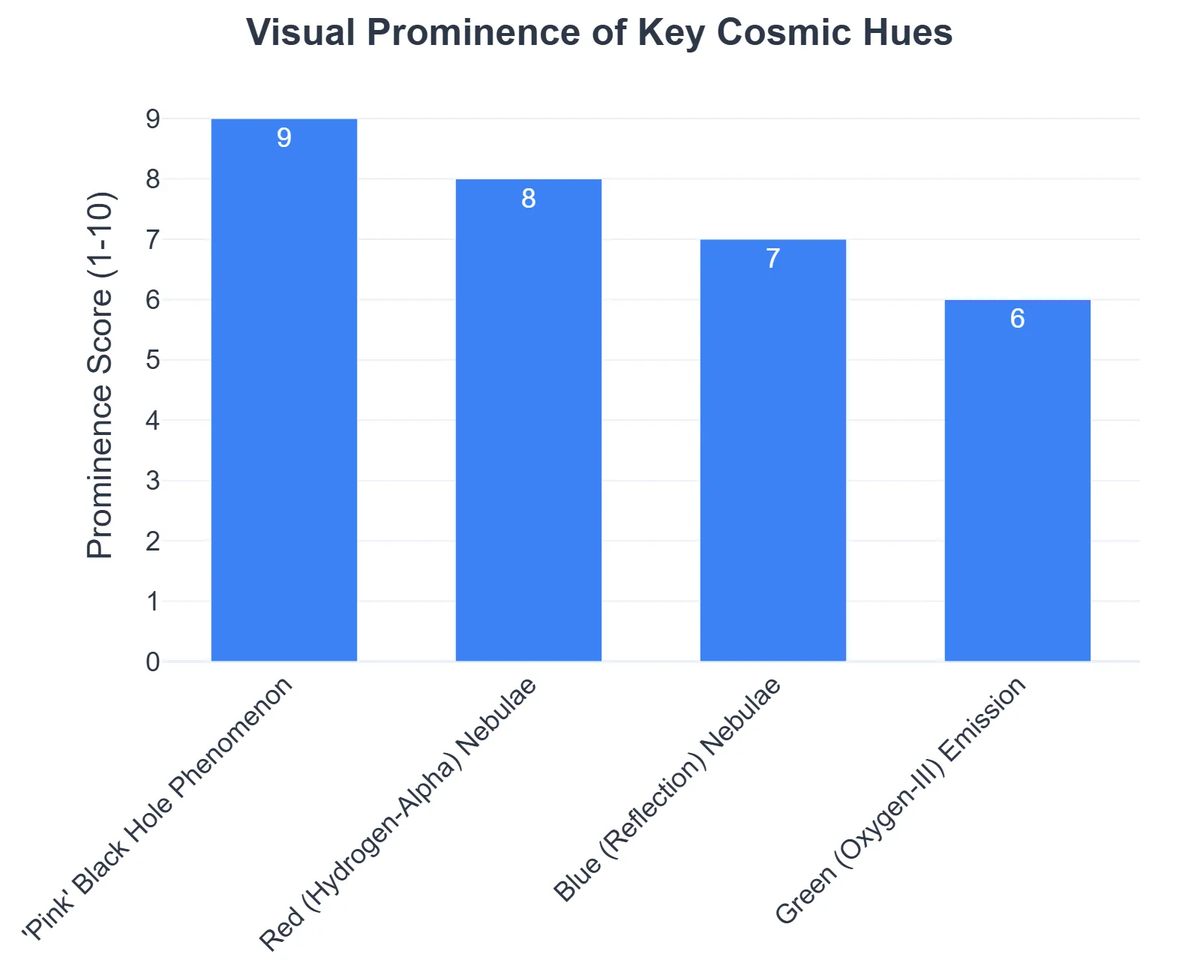
- ✅ Hydrogen often glows red (H-alpha emission).
- ✅ Oxygen glows blue-green.
- ✅ Sulfur can appear yellow or orange.
- ✅ Dust clouds can scatter blue light, giving rise to reflection nebulae.
🌟 Pulsars and Supernova Remnants
The aftermath of stellar explosions can also paint the cosmos with dramatic hues. Supernova remnants, like the Crab Nebula, are expanding shells of gas and dust energized by the shockwave and often by a rapidly spinning neutron star (pulsar) at their core. These too display incredible coloration based on their composition and energy levels.
Delving Deeper into Black Hole Mysteries
Understanding black holes goes far beyond their visual representation. It involves probing the fundamental laws of physics and the very fabric of spacetime.
For those fascinated by the theoretical aspects, consider topics like the Griff Black Hole: A Theoretical Frontier, which explores advanced concepts. The dance of Binary Black Holes: A Cosmic Dance also offers incredible insights into gravitational wave astronomy. To explore the broader context of these cosmic wonders, delve into our comprehensive guide on Cosmic Queries: Probing the Mysteries of the Universe.
Recommended Video
While the captivating image of a “pink” black hole might exist in art or popular culture, the true science reveals a universe far more nuanced and astonishing. Black holes themselves remain uncolored voids, yet their powerful gravitational pull orchestrates breathtaking displays of light and energy in their surroundings. It’s in the vibrant dance of accretion disks, the fiery emissions of jets, and the intricate processing of multi-wavelength data that we truly uncover the universe’s spectacular and scientifically accurate cosmic coloration. Our evolving black hole perception is critical to appreciating the genuine marvels of the cosmos.
Frequently Asked Questions
What is the ‘Pink’ Black Hole Phenomenon?
It’s a theoretical concept exploring how extreme gravitational effects or exotic matter near a black hole could cause a subtle, unusual coloration, rather than it appearing purely black.
Are ‘pink’ black holes real?
Currently, the ‘Pink’ Black Hole Phenomenon is a theoretical concept, not an observed astronomical fact. It’s a thought experiment within advanced astrophysics.
How could a black hole appear colored?
The coloration would stem from the interaction of light or exotic particles under immense gravitational stress, leading to unique spectral emissions or light bending effects that subtly shift observed wavelengths.
What does this phenomenon tell us about the universe?
It pushes the boundaries of our understanding of light, gravity, and quantum mechanics, suggesting new ways to detect and characterize phenomena near event horizons.