
Higgs Boson: Understanding the God Particle Theory
Dive deep into the universe’s most elusive fundamental particle and the field that gives everything mass.
💡 Key Takeaways
- The Higgs Boson is a fundamental particle associated with the Higgs field, which gives mass to other elementary particles.
- Its existence was theorized by Peter Higgs and others in the 1960s, a crucial component of the Standard Model of particle physics.
- Discovered in 2012 at CERN’s Large Hadron Collider, confirming a long-standing prediction in physics.
- The ‘God Particle’ nickname reflects its perceived importance in understanding the fundamental properties of matter and the universe.
“The Higgs Boson isn’t just a particle; it’s the cosmic background noise that makes the universe cohere. Without the Higgs field, matter as we know it simply wouldn’t exist, turning the grand story of the cosmos into a formless void. It’s the ultimate ‘why’ behind ‘what is.’”
— Astrid Bellweather, Astrophysicist & Science Fiction Consultant
In the vast expanse of the cosmos, where mysteries abound and fundamental forces dictate the very fabric of reality, one particle stands out as a cornerstone of our understanding: the Higgs boson. Often sensationalized as the “God Particle,” its discovery was a monumental achievement in modern physics, confirming a crucial piece of the Standard Model and revolutionizing our comprehension of mass.
This comprehensive guide will unravel the enigma of the Higgs boson, explaining its origins, its mechanism for imbuing mass, and why its existence is so vital to the universe as we know it. We’ll explore the monumental scientific journey that led to its detection and peer into the profound implications it holds for future discoveries in particle physics and beyond. For a broader exploration of the cosmos, consider delving into our pillar page on Cosmic Queries: Probing the Mysteries of the Universe.
In This Article
- → Higgs Boson: Understanding the God Particle Theory
- — 💡 Key Takeaways
- → What Exactly is the Higgs Boson?
- — ⚛️ The Standard Model of Particle Physics
- — 🌌 The Higgs Field Explained
- → Why “The God Particle”? Understanding the Nickname
- — 🤔 A Misleading Moniker
- → How Does the Higgs Boson Give Mass? (Mechanism of Mass)
- — 🍬 The “Taffy” Analogy
- — ⚡ Connecting to Particle’s Kinetic Behavior
- → The Hunt for the Higgs: A Scientific Saga
- — 🔬 The Large Hadron Collider (LHC)
- — 🏆 The Historic Discovery
- → Implications and Future of Higgs Boson Research
- — 🚀 Beyond the Standard Model
- — ❓ Unanswered Questions
- → Conclusion
What Exactly is the Higgs Boson?

At its core, the Higgs boson is an elementary particle in the Standard Model of particle physics. It’s not a building block of matter like quarks or electrons; instead, it’s a quantum excitation of the Higgs field, an omnipresent energy field that permeates all of space.
⚛️ The Standard Model of Particle Physics
The Standard Model is our most successful theory describing the fundamental particles and forces that govern the universe. It accounts for three of the four fundamental forces—the strong, weak, and electromagnetic forces—and classifies all known elementary particles. However, before the Higgs boson’s discovery, the Standard Model faced a critical challenge: it couldn’t explain why some particles have mass while others, like photons, do not.
🌌 The Higgs Field Explained
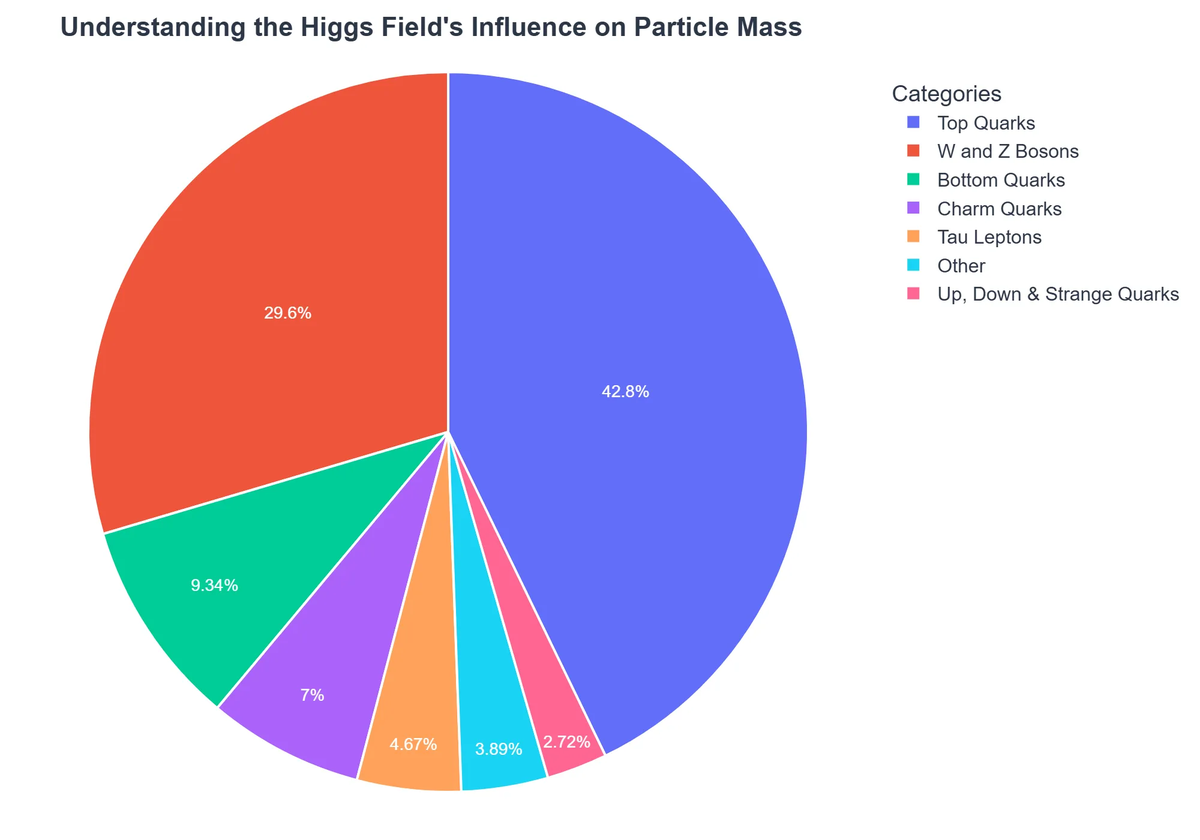
Imagine the Higgs field as a universal ocean of molasses or a dense crowd at a party. Particles moving through this field interact with it to varying degrees:
- ✅ Particles that interact strongly with the Higgs field experience more “resistance” and acquire more mass.
- ➡️ Particles that interact weakly acquire less mass.
- 💡 Particles that don’t interact at all (like photons) remain massless, traveling at the speed of light.
The Higgs boson itself is a ripple or excitation in this field, much like a wave on the surface of water. Its existence confirms the presence and mechanism of the Higgs field.
Why “The God Particle”? Understanding the Nickname
The moniker “God Particle” is largely a media invention and a source of contention among many physicists, including Peter Higgs himself, who disliked the term.
🤔 A Misleading Moniker
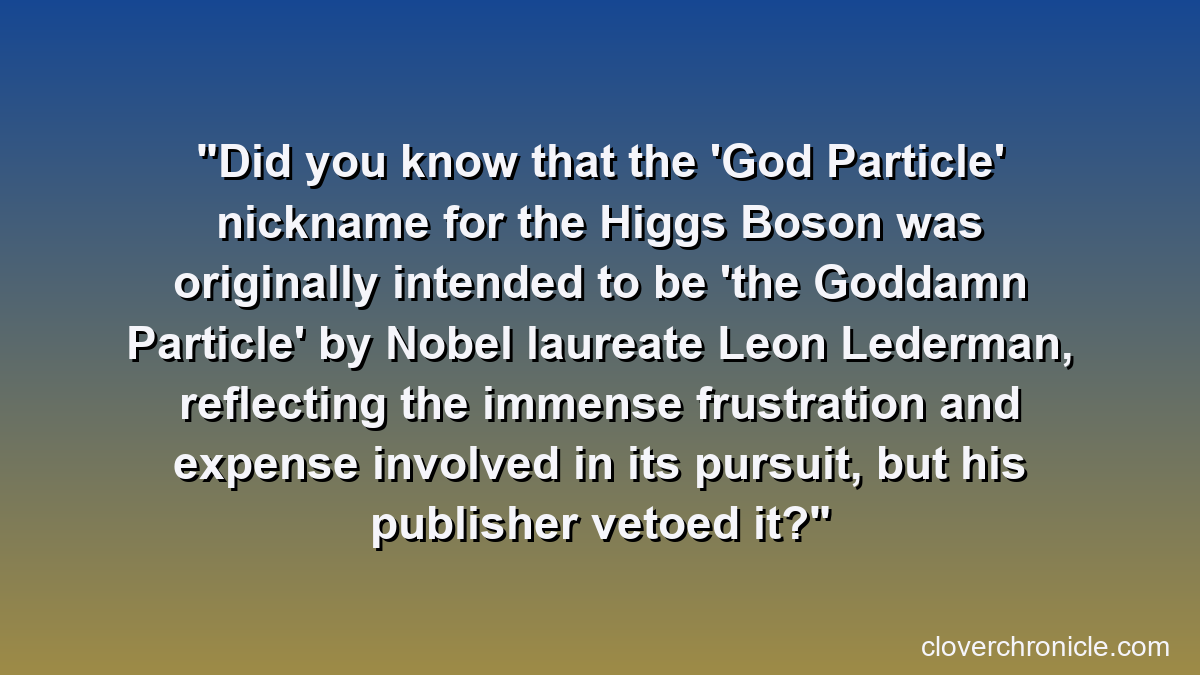
The nickname originated from the title of Nobel laureate Leon Lederman’s 1993 book, “The God Particle: If the Universe Is the Answer, What Is the Question?” Lederman originally wanted to call it “The Goddamn Particle” due to its elusive nature and the enormous cost and effort required to find it. However, his editor reportedly shortened it to “The God Particle.”
While catchy, the term often leads to misconceptions, implying a divine connection or a particle that creates everything. In reality, it simply explains how particles acquire mass, a critical piece of the cosmic puzzle, but not the ultimate creator. As Professor Matt Strassler highlights, Peter Higgs himself expressed discomfort with the term, preferring a more scientific description of its role (Strassler, 2024).
How Does the Higgs Boson Give Mass? (Mechanism of Mass)
The Higgs mechanism is a fundamental process by which elementary particles acquire mass. It’s not about the Higgs boson “giving” mass in the sense of a physical exchange, but rather through interaction with the pervasive Higgs field.
🍬 The “Taffy” Analogy
A common analogy to understand the Higgs mechanism involves a room full of people (the Higgs field) and a famous person (a particle). When a celebrity enters the room, people flock to them, slowing them down and making it harder for them to move quickly. This “resistance” to motion is analogous to acquiring mass. The more people who flock to them, the slower they move, hence more “mass.”
- ✅ Photons, which are massless, would pass through the room unnoticed, like someone completely ignored by the crowd.
- ➡️ Heavy particles, like top quarks, would attract a large crowd, moving sluggishly and acquiring significant mass.
⚡ Connecting to Particle’s Kinetic Behavior
While the term “kinetic particle theory” often refers to the behavior of gases and liquids based on the motion of their constituent particles, the Higgs mechanism fundamentally influences the kinetic properties of all elementary particles. Mass is inertia – the resistance of an object to changes in its state of motion. When particles acquire mass through their interaction with the Higgs field, it directly impacts their kinetic energy, momentum, and how they respond to forces. A heavier particle, due to its increased interaction with the Higgs field, has greater inertia, requiring more force to accelerate it to a certain speed or to change its direction. This inherent resistance, rooted in the Higgs mechanism, dictates their observed kinetic behavior within the universe.
The Hunt for the Higgs: A Scientific Saga
The existence of the Higgs boson was first theorized in 1964 by Peter Higgs and independently by others. For decades, it remained a theoretical necessity, the missing piece of the Standard Model.
🔬 The Large Hadron Collider (LHC)
The monumental task of finding the Higgs boson required an instrument of unprecedented power: the Large Hadron Collider (LHC) at CERN, located near Geneva, Switzerland. The LHC is the world’s largest and most powerful particle accelerator, designed to smash protons together at nearly the speed of light, recreating conditions similar to those just after the Big Bang.
These collisions produce cascades of new particles, which physicists then analyze to look for signatures of elusive particles like the Higgs boson. The scale of the experiment is immense, involving thousands of scientists and engineers from around the globe.
🏆 The Historic Discovery
On July 4, 2012, after decades of searching and meticulous data analysis, scientists at CERN’s ATLAS and CMS experiments announced they had independently observed a new particle consistent with the properties of the Higgs boson. This discovery was a triumph of human ingenuity and international collaboration, confirming a fundamental aspect of reality. This moment marked a new era in particle physics, providing concrete evidence for the mechanism that gives elementary particles their mass (CERN).
Implications and Future of Higgs Boson Research
The discovery of the Higgs boson was not the end of a chapter, but the beginning of a new one. It opened up new avenues for research and deepened our understanding of the universe.
🚀 Beyond the Standard Model
While the Higgs boson confirmed the Standard Model, it also highlighted its limitations. The Standard Model doesn’t account for gravity, dark matter, or dark energy. The Higgs boson’s properties, particularly its mass, are also puzzling and could hint at new physics beyond the Standard Model. Future experiments at the LHC and next-generation colliders will continue to precisely measure the Higgs boson’s properties, looking for deviations that could indicate the presence of new particles or forces.
For instance, understanding how particles acquire mass is crucial for theories describing phenomena like the Big Bang Expansion: Understanding the Universe’s Growth and the very early universe.
❓ Unanswered Questions
Despite the discovery, many questions remain:
- ✅ Is the observed Higgs boson the only one, or are there other types of Higgs bosons?
- ➡️ How does the Higgs field interact with dark matter?
- 💡 Could the Higgs boson play a role in the stability of the vacuum of the universe?
These questions drive ongoing research and the pursuit of even more powerful accelerators. The Higgs boson provides a unique window into these mysteries, and understanding its deeper nature could unlock secrets of the cosmos that we can currently only theorize, such as how particles can exist in multiple states simultaneously as explored in Quantum Superpositions: How Particles Exist in Two Places at Once. You can read more about the Higgs boson’s significance at Space.com.
Recommended Video
Frequently Asked Questions
What is the Higgs Boson?
The Higgs Boson is an elementary particle in the Standard Model of particle physics, representing the quantum excitation of the Higgs field. It plays a crucial role in giving other fundamental particles, like electrons and quarks, their mass.
Why is it nicknamed the ‘God Particle’?
The nickname ‘God Particle’ was popularized by Nobel laureate Leon Lederman’s book, ‘The God Particle: If the Universe Is the Answer, What Is the Question?’ It refers to the particle’s fundamental importance in creating mass, and the difficulty and expense involved in its discovery.
How was the Higgs Boson discovered?
The Higgs Boson was discovered in 2012 at CERN’s Large Hadron Collider (LHC) by both the ATLAS and CMS experiments. Scientists observed subtle statistical excesses in their data that were consistent with the decay patterns expected from a Higgs Boson.
What is the Higgs field?
The Higgs field is a pervasive energy field that exists throughout the universe. Particles interact with this field as they move through it; the more they interact, the more mass they acquire, similar to how a person moving through treacle experiences resistance.