

In the ambitious arena of private spaceflight, few endeavors capture the world’s attention quite like the development of crewed capsules. Among them, the Boeing Starliner has emerged as a focal point, designed to ferry astronauts to and from the International Space Station (ISS) as part of NASA’s Commercial Crew Program. This initiative aims to restore domestic human launch capabilities, diversifying access to low-Earth orbit and fostering a competitive space industry. However, the path for the Starliner has been fraught with significant challenges, prompting crucial analyses of its mission failures and casting a long shadow over its future in `space exploration`.
💡 Key Takeaways
- Understanding the root causes of Starliner’s past mission anomalies is crucial for its path to certification.
- The Starliner’s success is vital for diversifying NASA’s human spaceflight capabilities beyond SpaceX.
- Future missions will test critical systems and procedures, directly impacting Starliner’s operational viability.
- Lessons learned from Starliner’s development are shaping the future of commercial space vehicle design and testing.
“The Starliner’s evolution highlights humanity’s persistent drive to push boundaries, even when technology falters. Its future isn’t just about successful launches; it’s about refining the symbiotic relationship between human ambition and AI-driven system reliability in the cosmos.”
— Kira Chen, Futurist & AI Ethics Advocate
This article delves deep into the journey of the Boeing Starliner capsule, examining the technical setbacks and operational hurdles that have delayed its progress. We’ll explore the implications of these issues for both Boeing and NASA, and consider what lies ahead for a program critical to America’s independent access to space.
In This Article
- — 💡 Key Takeaways
- → The Starliner’s Genesis: A New Era of Commercial Crew Transport
- — Purpose and Promise: NASA’s Commercial Crew Program
- — Design and Key Features of theBoeing Starliner capsule
- → Analyzing Key Mission Failures and Delays
- — The Orbital Flight Test (OFT-1) Anomalies: The First `Boeing Starliner 1` Attempt
- — The Uncrewed Flight Test 2 (OFT-2) Successes and Remaining Hurdles
- — Crewed Flight Test (CFT) Challenges
- → Impact on Boeing and NASA’s Space Exploration Goals
- — Financial and Reputational Costs for Boeing
- — Implications for NASA’s Commercial Crew Program and ISS Resupply
- — The Role of Independent Oversight
- → The Road Ahead: Corrective Actions and Future Prospects
- — Engineering Solutions and Rigorous Testing
- — Restoring Confidence in theBoeing Starliner capsule
- — Competing in the Commercial Space Race
- → Why Starliner’s Success Matters forSpace Exploration
- — Diversifying Access to Space
- — Fostering Innovation and Competition
- — Paving the Way for Deeper Space Missions
- → Conclusion
The Starliner’s Genesis: A New Era of Commercial Crew Transport
NASA’s Commercial Crew Program was born from a strategic need to end reliance on Russian Soyuz rockets for astronaut transport following the retirement of the Space Shuttle. By partnering with private industry, NASA sought to spur innovation, reduce costs, and ensure redundant access to the ISS. Boeing, with its long history in aerospace, was one of two companies selected (alongside SpaceX) to develop a next-generation crew transportation system.
Purpose and Promise: NASA’s Commercial Crew Program
- ✅ Restoring U.S. Launch Capability: The primary goal was to bring human spaceflight launches back to American soil.
- ✅ Commercial Partnership Model: Shifting from a traditional “cost-plus” government contract to a fixed-price service model, incentivizing efficiency and innovation.
- ✅ Ensuring Redundancy: Having at least two independent crew transportation systems to the ISS enhances safety and mission assurance.
Design and Key Features of the Boeing Starliner capsule
The CST-100 Starliner, where CST stands for Crew Space Transportation, and 100 refers to the Kármán line (the internationally recognized boundary of space at 100 km altitude), is a reusable spacecraft designed to accommodate up to seven passengers, or a mix of crew and cargo. Its features include:
- ➡️ Automatic Docking: Capable of fully autonomous docking with the ISS, reducing astronaut workload.
- ➡️ Airbag Landing System: Designed to land on solid ground in the U.S. Southwest (primarily White Sands Missile Range, New Mexico), using airbags to cushion the impact after parachute deployment, enabling quicker reuse. This differs significantly from SpaceX’s water landings.
- ➡️ Reusability: The capsule is intended to be reusable for up to 10 missions, offering long-term cost efficiency.
Analyzing Key Mission Failures and Delays
The journey of the Starliner has been marked by a series of high-profile issues, leading to significant delays and cost overruns. Understanding these `boeing starliner failure` points is crucial to appreciating the complexities of human spaceflight development.
The Orbital Flight Test (OFT-1) Anomalies: The First `Boeing Starliner 1` Attempt
In December 2019, the uncrewed Orbital Flight Test (OFT-1) was intended to prove the Starliner’s capabilities. However, a software error led to a critical “Mission Elapsed Time (MET)” anomaly shortly after launch. The spacecraft’s internal clock was set incorrectly, causing it to believe it was at a different point in its mission than it actually was. This prevented a planned orbital insertion burn and resulted in excessive fuel consumption.
- 💡 MET Anomaly: The primary software glitch that caused the spacecraft to use too much fuel, precluding a rendezvous with the ISS.
- 💡 Communication Glitches: Related issues also impacted command and telemetry, although ground controllers were eventually able to regain control and bring the capsule back for a safe `boeing starliner landing`.
- 💡 Valve Software Issue: A separate software bug, discovered post-flight, could have led to a catastrophic service module jettison during deorbit if not fixed.
The Uncrewed Flight Test 2 (OFT-2) Successes and Remaining Hurdles
Following a comprehensive review and significant software rewrites, OFT-2 was launched in May 2022. While largely successful in reaching the ISS and demonstrating key capabilities, new issues arose:
- ➡️ Propulsion System Anomaly: Several oxidizer isolation valves failed to open during pre-launch checks, causing further delays and extensive investigations.
- ➡️ Successful Docking and `Boeing Starliner Return`: Despite the valve issues, the mission successfully docked with the ISS and executed a flawless `boeing starliner landing` in New Mexico, demonstrating the capsule’s fundamental flight dynamics.
Crewed Flight Test (CFT) Challenges
The Crewed Flight Test (CFT), carrying two NASA astronauts, Butch Wilmore and Suni Williams, faced several postponements. These delays were primarily due to new issues discovered during final readiness checks, highlighting the extreme scrutiny required for human-rated spacecraft.
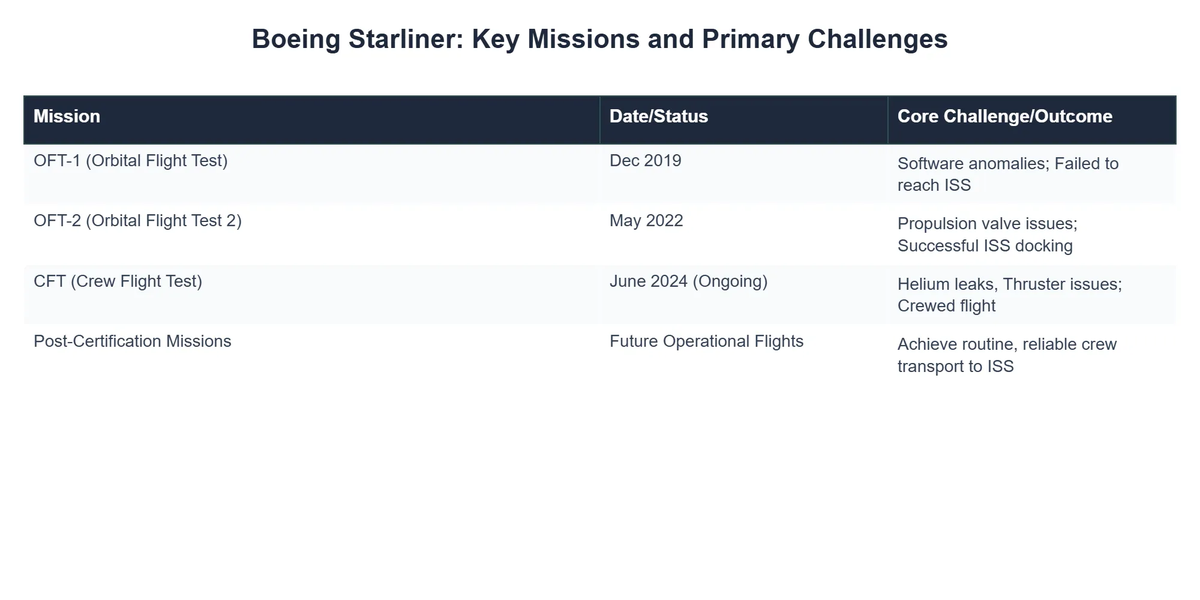
- ⚠️ Helium Leaks: Multiple helium leaks were detected in the service module, prompting detailed analysis and repairs. Helium is used to pressurize the propulsion system.
- ⚠️ Parachute Line Strength: Concerns about the strength of the parachute lines prompted additional verification.
- ⚠️ Tape on Wiring: Discovery of flammable P-cord tape on wiring inside the capsule led to removal and replacement, adding to delays.
These challenges underscore the iterative and often frustrating nature of pioneering complex aerospace technology. For a broader look at how unforeseen challenges shape technological advancement, consider exploring Future Innovations: Exploring Promising Technologies.
Impact on Boeing and NASA’s Space Exploration Goals
The repeated delays and technical setbacks have had significant ramifications for both the aerospace giant Boeing and NASA’s strategic objectives for `space exploration`.
Financial and Reputational Costs for Boeing
Boeing has incurred substantial financial losses due to the Starliner program, reportedly exceeding $1.5 billion in charges and provisions. These costs reflect the extensive redesigns, additional testing, and prolonged development period. The delays have also damaged Boeing’s reputation in the human spaceflight sector, particularly when compared to the faster and seemingly smoother development of SpaceX’s Crew Dragon.
NPR reported on the hard questions Boeing faces regarding Starliner and its future, indicating the pressure from various stakeholders. (Source: NPR)
Implications for NASA’s Commercial Crew Program and ISS Resupply
While SpaceX’s Crew Dragon has largely filled the void, the delays with the Starliner mean NASA has lost the desired redundancy and flexibility for crew transport. This impacts mission scheduling and contingency planning for the ISS, which relies on consistent crew rotation for scientific research and maintenance.
The Role of Independent Oversight
NASA’s Aerospace Safety Advisory Panel (ASAP) has played a crucial role in scrutinizing the Starliner program, providing independent assessments of its safety and technical readiness. Their reports have consistently highlighted concerns, pushing for thorough verification and validation processes before crewed flights. This rigorous oversight is vital for ensuring astronaut safety, a paramount concern in all space missions. Phys.org provides insights into such watchdog reports. (Source: Phys.org)
The Road Ahead: Corrective Actions and Future Prospects
Despite the setbacks, Boeing and NASA remain committed to getting the Starliner flying reliably. The lessons learned from the `boeing starliner failure` points are invaluable, shaping future design and testing protocols.
Engineering Solutions and Rigorous Testing
- ⚙️ Software Reworks: Extensive re-evaluation and rewriting of flight software, particularly after OFT-1, have been critical.
- ⚙️ Hardware Modifications: Addressing issues like valve reliability and parachute system robustness through redesigns and enhanced testing.
- ⚙️ Comprehensive Reviews: NASA and Boeing have implemented numerous joint reviews, technical interchange meetings, and independent assessments to ensure all issues are thoroughly vetted and resolved.
Restoring Confidence in the Boeing Starliner capsule
Success on the CFT will be paramount to restoring confidence among NASA officials, astronauts, and the public. A clean, safe, and efficient mission, including a perfect `boeing starliner landing`, is essential. The rigorous pre-flight checks and the transparency of addressing issues are part of this confidence-building process. Given the complex systems involved in space travel, ensuring data integrity and robust system communication, much like Brain Machine Interface: Exploring the Future of Mind Control for human-computer interaction, is crucial for mission success.
Competing in the Commercial Space Race
While SpaceX has taken a leading role, the Starliner’s success is not just about Boeing; it’s about the broader vision of a robust and competitive U.S. commercial space industry. Two independent crew transportation systems offer resilience and foster innovation through healthy competition, pushing the boundaries of what’s possible in space.
Why Starliner’s Success Matters for Space Exploration
The narrative of the Starliner is more than just a corporate saga; it’s a testament to the inherent challenges and immense rewards of pushing humanity’s boundaries in space. Its eventual success, or continued struggles, will have implications for the future of crewed orbital flight.
Diversifying Access to Space
Relying on a single provider for crew transport presents risks. A successful Starliner program ensures multiple pathways to the ISS, enhancing mission flexibility, crew rotation schedules, and overall safety margins.
Fostering Innovation and Competition
The competitive environment created by NASA’s Commercial Crew Program has undeniably driven innovation, leading to more cost-effective and advanced solutions for space travel. Starliner’s perseverance, despite its difficulties, continues to contribute to this ecosystem.
Paving the Way for Deeper Space Missions
The technologies and operational experience gained from developing and operating capsules like Starliner and Crew Dragon are foundational. They inform future designs for vehicles that will take humans to the Moon (e.g., Artemis program) and eventually to Mars. The lessons learned from Starliner’s challenges will directly contribute to making these more ambitious journeys safer and more reliable. This continuous evolution of human capabilities is a core theme in Future Perfect?: Charting the Course of Tomorrow’s Technology, where we explore the frontiers of innovation.
Recommended Video
Conclusion
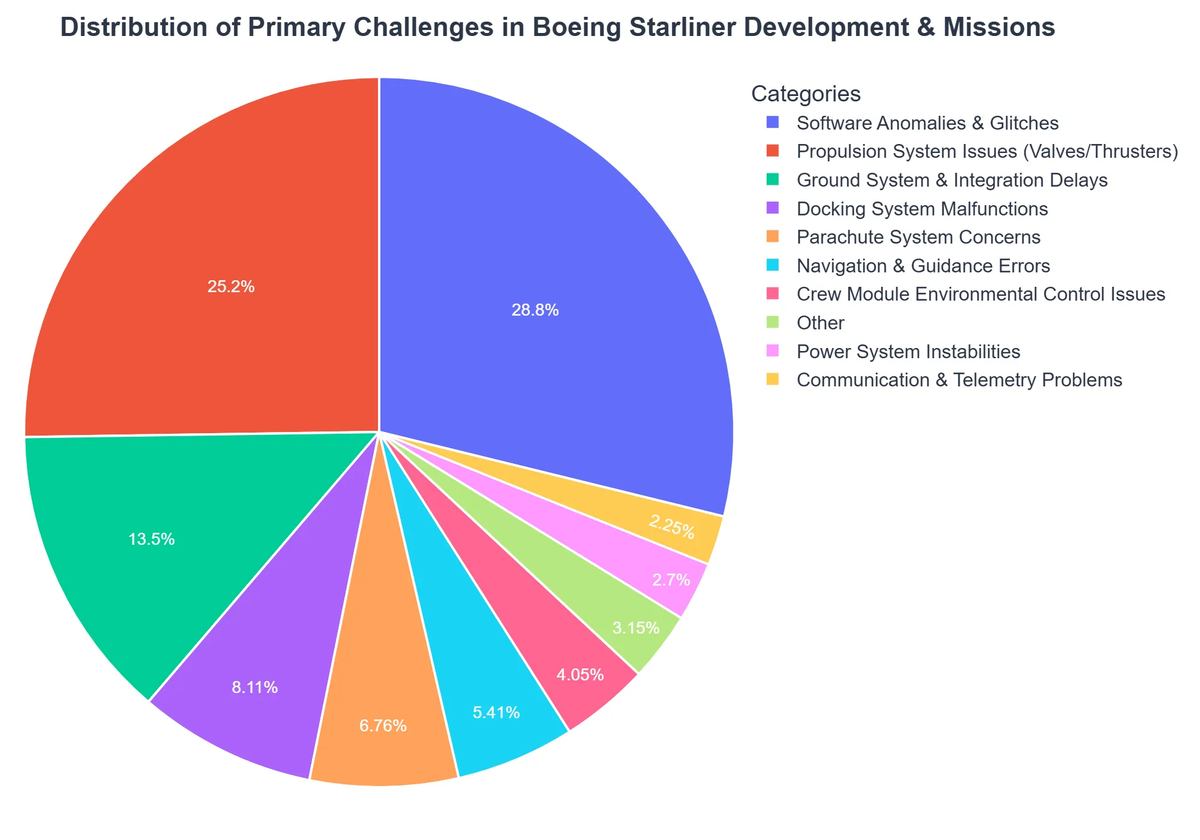
The journey of the Boeing Starliner has been a stark reminder of the immense complexities and unforgiving nature of spaceflight. From software glitches in its initial uncrewed flight to helium leaks and parachute concerns on its crewed test, the path has been arduous. Yet, each `boeing starliner failure` has provided invaluable lessons, driving rigorous corrective actions and enhancing safety protocols that will benefit all future `space exploration` endeavors.
While the delays have been costly and challenging for Boeing, the successful completion of the Starliner’s missions remains crucial for NASA’s vision of diversified, reliable access to space. As the world watches its progress, the Starliner stands as a symbol of perseverance in the face of engineering challenges, reminding us that the future of space exploration is built not just on grand ambitions, but on meticulous problem-solving and an unwavering commitment to safety.
Frequently Asked Questions
What are the primary challenges Starliner faced?
Starliner has encountered issues ranging from software glitches and valve malfunctions to propulsion system anomalies and helium leaks, significantly delaying its operational readiness.
How does Starliner compare to SpaceX’s Crew Dragon?
While both are designed for crew transport to the ISS, Starliner uses a parachute and airbag landing system, unlike Crew Dragon’s splashdown. They also have different abort systems and capsule designs.
What is the significance of Starliner for NASA?
Starliner provides NASA with a second independent crew transport system, reducing reliance on a single provider and ensuring redundancy for ISS resupply and crew rotation missions.
When is Starliner expected to begin routine crew missions?
Following the successful completion and analysis of its Crew Flight Test (CFT) and any subsequent certification requirements, routine missions are projected to begin, though no definitive timeline is set.