

Human Consciousness: Exploring the Mind’s Deepest Mystery
Welcome to the frontier of human understanding. Few topics are as profoundly perplexing and captivating as human consciousness. It’s the very fabric of our subjective experience, the “what it’s like to be” us. From the simplest sensation to the most complex thought, consciousness is the mysterious orchestrator of our inner world. But what precisely is it? How does it arise from the intricate dance of neurons? And what does it mean for our place in the universe?
💡 Key Takeaways
- Consciousness is a complex phenomenon debated across scientific and philosophical disciplines.
- Neuroscience explores brain regions and neural correlates associated with conscious experience.
- Philosophical theories range from dualism to materialism, offering diverse perspectives on the mind’s nature.
- Understanding consciousness is crucial for advances in AI, mental health, and our self-perception.
“Consciousness isn’t merely a byproduct of brain activity; it’s the fundamental lens through which we experience existence, constantly shaping our reality and perception.”
— Eleanor Vance, Neuroscience Communicator & Cognitive Psychologist
In this comprehensive guide, we’ll delve into the multifaceted nature of human consciousness, exploring its scientific underpinnings, philosophical implications, and the ongoing quest to unravel its secrets. This journey is central to understanding The Human Enigma: Unlocking the Secrets of Our Body and Mind, as consciousness is arguably the ultimate secret within us.
In This Article
- → Human Consciousness: Exploring the Mind’s Deepest Mystery
- — 💡 Key Takeaways
- → What is Human Consciousness? Defining the Enigma
- — 💡 The Elusive Definition of Human Consciousness Meaning
- — 🌌 Subjectivity and Qualia
- — 🌀 Different States of Consciousness
- → The Neurobiological Basis of Consciousness
- — 🧠 Brain Regions and Neural Correlates
- — 🔬 Theories: Integrated Information Theory (IIT) & Global Workspace Theory (GWT)
- → Human and Animal Consciousness: A Comparative Look
- — 🐾 Defining Animal Consciousness and Human Consciousness
- — 🌍 Similarities and Differences in Awareness
- — ⚖️ Ethical Implications
- → The Role of Human Consciousness in Human Values and Experience
- — 👤 Self-Awareness and Identity
- — 🤝 Morality, Empathy, and Decision-Making
- — 🧘♀️ Consciousness and Well-being
- → Philosophical Perspectives on Consciousness
- — 🔗 Dualism vs. Monism
- — ❓ The Hard Problem of Consciousness
- → Future Directions in Consciousness Research
- — 🤖 AI, Machine Consciousness, and the Future
- — 🌟 The Ongoing Quest to Understand the Mind’s Deepest Mystery
- → Conclusion
What is Human Consciousness? Defining the Enigma

Attempting to define human consciousness is akin to trying to grasp smoke. It’s universally experienced yet incredibly difficult to pin down with a precise, universally agreed-upon scientific definition. Most agree it encompasses awareness of internal and external existence.
💡 The Elusive Definition of Human Consciousness Meaning
At its core, the definition of human consciousness refers to our subjective awareness of ourselves and our environment. It’s the state of being awake and aware of one’s surroundings, thoughts, and feelings. However, this simple definition quickly branches into profound complexities:
- ✅ Awareness: The capacity to perceive and feel. This includes sensory awareness (seeing, hearing, touching), emotional awareness (feeling joy, sorrow), and self-awareness (recognizing oneself as a distinct entity).
- ➡️ Subjectivity: Consciousness is inherently personal. My experience of the color red is unique to me, even if we both agree it’s “red.” This ‘what it’s like’ quality is known as qualia.
- 🧠 Cognition: It involves mental processes like thought, reasoning, memory, and perception.
🌌 Subjectivity and Qualia
The concept of qualia is central to discussions about consciousness. These are the individual instances of subjective, conscious experience – the specific taste of chocolate, the ache of a headache, the vividness of a dream. How these subjective experiences arise from objective physical processes in the brain remains one of the “hard problems” of consciousness.
🌀 Different States of Consciousness
Consciousness isn’t a single, fixed state. We move through various states throughout our lives and even within a single day. These include:
- 😴 Waking Consciousness: Our normal state of alert awareness.
- 🛌 Sleep States: Including dream states (REM sleep) and non-dream states, where awareness is significantly altered or diminished.
- 🧘 Altered States: Induced by meditation, hypnosis, psychoactive substances, or extreme emotional/physical conditions. These states can offer unique insights into the mind’s flexibility.
For a deeper dive into these variations, explore our article on Psychological Consciousness: Theories & States of Mind.
The Neurobiological Basis of Consciousness
While consciousness is elusive, scientists are making significant strides in understanding its neural correlates – the specific brain activities that correspond to conscious experience. This is where neuroscience meets philosophy.
🧠 Brain Regions and Neural Correlates
No single “consciousness center” has been identified in the brain. Instead, it’s thought to emerge from complex interactions across various brain networks. Key areas implicated include:
- Thalamus: Acts as a relay station for sensory information.
- Cerebral Cortex: Especially the prefrontal cortex for higher-order cognitive functions, and parietal lobes for spatial awareness.
- Reticular Activating System (RAS): Located in the brainstem, crucial for arousal and wakefulness.
Researchers, including Cognitive Scientists: Unraveling the Human Mind, use advanced imaging techniques (fMRI, EEG) to observe brain activity during conscious experiences, identifying patterns that seem to correlate with different aspects of awareness.
🔬 Theories: Integrated Information Theory (IIT) & Global Workspace Theory (GWT)
Two prominent scientific theories attempt to explain how consciousness arises:
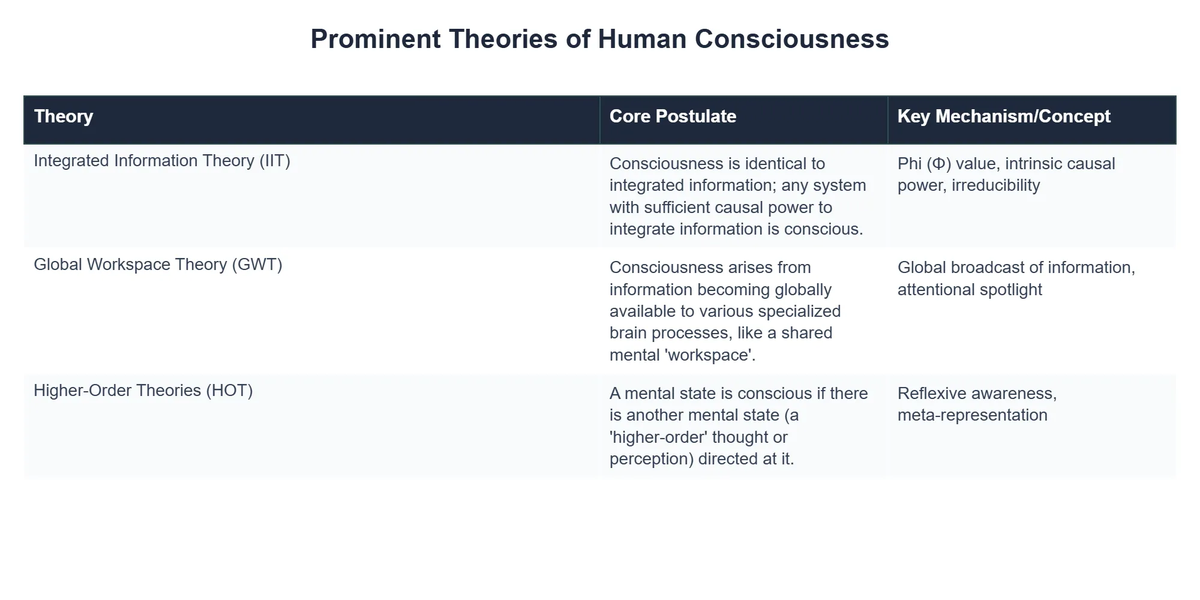
- Integrated Information Theory (IIT): Proposed by Giulio Tononi, IIT suggests that consciousness is a measure of integrated information. A system is conscious to the extent that it has a large repertoire of states, and these states are highly integrated and differentiated. It posits that consciousness is an intrinsic property of physical systems that meet certain criteria, potentially even extending beyond biological brains.
- Global Workspace Theory (GWT): Developed by Bernard Baars, GWT suggests that consciousness acts like a “global workspace” or “bulletin board” in the brain. Information from various specialized unconscious processors (sensory input, memories, emotions) is broadcast to this workspace, making it available to other parts of the brain, thus entering consciousness.
These theories, while distinct, both highlight the importance of complexity, integration, and communication within neural networks. For more on the neuroscience perspective, New Scientist offers an excellent Neuroscience course: The mystery of consciousness explained.
Human and Animal Consciousness: A Comparative Look
The question of animal and human consciousness is fascinating and ethically charged. Do animals experience consciousness in a way similar to humans? While we can’t definitively know what it “feels like” to be a bat or a dolphin, scientific evidence suggests varying degrees of awareness across the animal kingdom.
🐾 Defining Animal Consciousness and Human Consciousness
While human consciousness and animal consciousness share foundational elements like the ability to sense and react to stimuli, distinct differences emerge. Humans possess:
- ✅ Sophisticated Self-Awareness: The ability to recognize oneself in a mirror (passed by great apes, dolphins, elephants) is one indicator, but human self-reflection goes much deeper, involving introspection and contemplation of one’s own existence and future.
- 🗣️ Complex Language: While animals communicate, human language allows for abstract thought, sharing complex ideas, and building cumulative culture.
- 🕰️ Temporal Awareness: Humans can extensively plan for the future and reflect on the distant past, a capacity less evident in most animal species.
🌍 Similarities and Differences in Awareness
Research indicates that many animals exhibit forms of consciousness, including sentience (the ability to feel sensations) and phenomenal consciousness (subjective experience). Birds, mammals, and even some octopuses demonstrate complex behaviors suggesting awareness, problem-solving, and emotional responses.
However, the nuanced differences in cognitive abilities, particularly those linked to advanced frontal lobe development, suggest a spectrum of consciousness rather than an all-or-nothing phenomenon. Understanding the evolutionary links between different species, as discussed in Humans and Apes: Tracing the Evolutionary Link, helps contextualize these differences.
⚖️ Ethical Implications
The recognition of consciousness in animals has profound ethical implications, influencing debates on animal welfare, rights, and how we interact with other species. If animals experience pain, pleasure, and some form of subjective reality, our responsibilities towards them are significantly amplified.
The Role of Human Consciousness in Human Values and Experience
Beyond scientific inquiry, human consciousness in human values forms the bedrock of our societies, cultures, and individual identities. It is the canvas upon which our lives unfold.
👤 Self-Awareness and Identity
Consciousness allows for self-awareness – the ability to perceive oneself as a distinct individual with a personal history, unique thoughts, and feelings. This forms the basis of our identity, self-esteem, and sense of purpose. It enables us to reflect on our actions, learn from mistakes, and aspire to future goals.
🤝 Morality, Empathy, and Decision-Making
Our conscious mind is intimately involved in our moral compass. It enables empathy – the ability to understand and share the feelings of another – which is crucial for social cohesion. Conscious reasoning allows us to weigh ethical dilemmas, make deliberate choices, and understand the consequences of our actions, shaping our personal and collective values.
🧘♀️ Consciousness and Well-being
Understanding and managing our conscious experience is vital for mental health and well-being. Practices like mindfulness and meditation aim to cultivate a more attentive and less reactive conscious state, leading to reduced stress, improved focus, and greater emotional regulation.
Philosophical Perspectives on Consciousness
Before neuroscience could probe the brain, philosophy grappled with consciousness for millennia. These discussions continue to inform modern scientific inquiry.
🔗 Dualism vs. Monism
Historically, the “mind-body problem” has dominated philosophical discussions. Two main camps emerged:
- Dualism: Argues that the mind and body are distinct entities. René Descartes’ substance dualism posits that the mind is a non-physical substance that interacts with the physical brain.
- Monism: Suggests that mind and matter are ultimately aspects of a single reality.
- 💡 Physicalism/Materialism: The most common form of monism today, proposing that everything, including consciousness, is fundamentally physical.
- ➡️ Idealism: Posits that reality is fundamentally mental or consciousness.
While most neuroscientists lean towards physicalism, the exact mechanism by which matter gives rise to subjective experience remains elusive.
❓ The Hard Problem of Consciousness
Philosopher David Chalmers famously coined the term “the hard problem of consciousness.” This is not about explaining how the brain processes information (the “easy problems”), but why and how physical processes give rise to subjective experience, qualia, and the feeling of “what it’s like” to be conscious. As one article aptly puts it, it’s about “Mind, Matter, and Mystery” (Medium).
Quantum mechanics even finds its way into some discussions of this problem, exploring how it might relate to the puzzle of human consciousness, as explored by the Allen Institute.
Future Directions in Consciousness Research
The quest to understand consciousness is one of the grand challenges of science in the 21st century. New technologies and interdisciplinary approaches are constantly pushing the boundaries of what we can discover.
🤖 AI, Machine Consciousness, and the Future
The rapid advancement of Artificial Intelligence (AI) raises profound questions about machine consciousness. If AI systems can mimic human-like intelligence, could they ever become truly conscious? This area of research forces us to refine our understanding of consciousness, distinguishing between functional simulation and genuine subjective experience.
🌟 The Ongoing Quest to Understand the Mind’s Deepest Mystery
Research continues on multiple fronts:
- 🔬 Neurological Studies: Further mapping neural correlates, understanding how brain networks integrate information.
- 🧪 Pharmacology: Investigating how various substances alter consciousness to reveal underlying mechanisms.
- 💻 Computational Models: Building more sophisticated models of the brain to simulate conscious processes.
- 🌐 Interdisciplinary Collaboration: Bringing together neuroscientists, philosophers, psychologists, and computer scientists.
The journey to fully comprehend human consciousness is far from over. It’s a journey into the very essence of what makes us human.
Recommended Video
Conclusion
Human consciousness remains arguably the greatest unsolved mystery of science and philosophy. While we have made incredible strides in understanding its neural basis and its various states, the fundamental question of how subjective experience emerges from physical matter persists. From the intricate workings of the brain to the profound implications for our values and ethical systems, consciousness shapes every aspect of our existence.
As research continues, powered by curiosity and technological innovation, we move closer to unraveling the secrets of the mind. This ongoing exploration not only expands our scientific knowledge but also deepens our appreciation for the remarkable enigma that is the conscious human mind.
Frequently Asked Questions
Where in the brain does consciousness reside?
There’s no single ‘consciousness center.’ It’s believed to emerge from complex interactions across various brain networks, particularly involving the prefrontal cortex, thalamus, and parietal lobes.
Can artificial intelligence ever achieve consciousness?
This is a highly debated topic. While AI can simulate intelligence, achieving true self-awareness and subjective experience, like human consciousness, remains a profound challenge and philosophical question.
What is the ‘hard problem of consciousness’?
The ‘hard problem’ refers to the challenge of explaining how physical processes in the brain give rise to subjective experience or ‘qualia’ – why it feels like something to be conscious.