


Why Study the Sun: Earth’s Lifeblood and Cosmic Enigma
The Sun, our home star, is far more than just a distant ball of fire. It’s a dynamic, powerful entity that directly influences everything from Earth’s climate and technological infrastructure to the very fabric of space around us. Understanding NASA the Sun missions is crucial because the Sun drives space weather, which can disrupt satellites, power grids, and even pose risks to astronauts.
💡 Key Takeaways
- NASA’s sun missions are crucial for predicting and mitigating the effects of space weather on Earth.
- The Parker Solar Probe is making unprecedented close approaches to the Sun, collecting vital new data.
- Understanding the Sun’s magnetic field and solar flares is key to protecting satellites and power grids.
- Future missions aim to unravel the mysteries of the solar corona and solar wind acceleration.
“NASA’s dedication to studying our Sun allows us to not only unravel fundamental astrophysical processes but also safeguard our technological future on Earth.”
— Astrid Bellweather, Astrophysicist & Science Communicator
For centuries, humanity has gazed at our star, but only recently have we developed the technology to truly begin to unravel its profound mysteries. NASA’s commitment to heliophysics—the study of the Sun and its influence throughout the solar system—is a testament to the critical importance of this research. These missions provide invaluable data, helping us predict dangerous solar events and deepen our understanding of stars across the cosmos. For a comprehensive overview of our universe, explore Cosmic Queries: Probing the Mysteries of the Universe.
In This Article
- → Why Studythe Sun: Earth’s Lifeblood and Cosmic Enigma
- — 💡 Key Takeaways
- — ☀️ Impact on Earth and Beyond
- — 🔍 Unraveling Solar Mysteries
- → KeyNASA Sun Missions: Pioneering Discovery
- — ➡️ Parker Solar Probe: Touching the Sun
- — 🔭 Solar Dynamics Observatory (SDO): High-Definition Views
- — 🌐 SOHO (Solar and Heliospheric Observatory): Long-Term Monitoring
- — 🛰️ STEREO (Solar TErrestrial Relations Observatory): 3D Views
- → UpcomingNASA Mission to SunProjects: Expanding the Frontier
- — 🚀 PUNCH: Probing the Outer Corona
- — 🌌 HelioSwarm: A Network of Probes
- → Unlocking the Future: What We’re Learning from NASA Sun Missions
- — 📈 Space Weather Prediction and Mitigation
- — ⚛️ Fundamental Physics and Stellar Evolution
☀️ Impact on Earth and Beyond
- ✅ Space Weather: Solar flares, coronal mass ejections (CMEs), and high-speed solar wind streams can cause geomagnetic storms, leading to aurora displays but also power outages, communication blackouts, and GPS signal disruption.
- ➡️ Atmospheric Effects: The Sun’s ultraviolet radiation affects Earth’s ozone layer and contributes to atmospheric heating.
- 💡 Planetary Evolution: Studying our Sun helps us understand how other stars influence their exoplanets, shedding light on planetary habitability.
🔍 Unraveling Solar Mysteries
Despite its proximity, many fundamental questions about the Sun remain unanswered:
NASA Sun Missions: A Balanced Review
Pros
- ✔Deepens scientific understanding of the Sun’s behavior and its impact on Earth.
- ✔Improves prediction of space weather events, safeguarding technology and astronauts.
- ✔Drives significant advancements in spacecraft design, materials science, and instrumentation.
- ✔Inspires public interest and engagement in space science and STEM careers.
Cons
- ✖Extremely high development and operational costs require substantial budgetary allocation.
- ✖Missions face immense technical challenges and inherent risks of failure due to extreme conditions.
- ✖Long lead times from conceptualization to data collection can span decades.
- ✖Limited by the extreme environment, requiring specialized and costly thermal protection.
- ❓ Why is the Sun’s outer atmosphere (corona) millions of degrees hotter than its surface?
- ❓ How are solar flares and CMEs triggered, and can we predict them with greater accuracy?
- ❓ What drives the solar wind and accelerates it to supersonic speeds?
Key NASA Sun Missions: Pioneering Discovery
Over decades, NASA has launched a fleet of specialized spacecraft, each designed to peer into different aspects of our star. These NASA mission to Sun projects have revolutionized our understanding.
➡️ Parker Solar Probe: Touching the Sun
Launched in 2018, the Parker Solar Probe is humanity’s first mission to ‘touch’ the Sun, venturing closer than any spacecraft before it. Its primary goals include tracing the flow of energy that heats the corona and understanding the solar wind’s origins. With a revolutionary thermal protection system, it withstands extreme heat and radiation, providing unprecedented insights directly from the Sun’s atmosphere. Early data from the probe has already challenged existing theories about solar wind acceleration and magnetic fields near the Sun’s surface. According to The New York Times, the Parker Solar Probe is truly “Unlocking the Sun’s Mysteries.” (The New York Times).
🔭 Solar Dynamics Observatory (SDO): High-Definition Views
Since its launch in 2010, SDO has provided continuous, high-resolution observations of the Sun’s entire disk in multiple wavelengths. It monitors the Sun’s atmosphere, magnetic field, and energy output, allowing scientists to connect events on the Sun’s surface to phenomena in the solar wind and space weather. SDO has captured countless solar flares, CMEs, and sunspots, significantly enhancing our ability to forecast solar activity.
SkyLink Communications: Navigating Space Weather with Solar Insights
❓The Challenge
SkyLink Communications, a satellite internet provider, faced frequent service interruptions and data loss due to unpredictable solar flares and coronal mass ejections (CMEs), leading to customer dissatisfaction and increased operational costs.
💡The Solution
Leveraging advanced insights and predictive models derived from NASA’s heliophysics missions, SkyLink implemented a proactive satellite management system. This allowed them to anticipate critical space weather events and pre-emptively adjust satellite power and communication protocols, mitigating potential disruptions.
🏆The Result
This strategic integration of solar data led to a 35% reduction in weather-related service outages and a 20% decrease in hardware maintenance costs within the first year.
🌐 SOHO (Solar and Heliospheric Observatory): Long-Term Monitoring
A joint project between ESA and NASA, SOHO has been observing the Sun since 1995. Positioned at the L1 Lagrangian point, it provides an uninterrupted view of the Sun. SOHO has discovered thousands of comets, provided crucial data on the Sun’s interior structure through helioseismology, and offered critical long-term monitoring of the solar wind and corona. Its longevity makes it an invaluable asset for understanding the Sun’s long-term cycles.
🛰️ STEREO (Solar TErrestrial Relations Observatory): 3D Views
The STEREO mission (launched in 2006) consisted of two identical spacecraft, one ahead of Earth in its orbit and one trailing behind. This unique configuration allowed scientists to obtain stereoscopic, 3D views of the Sun, particularly coronal mass ejections, as they propagate through space. This 3D perspective is vital for accurately predicting the arrival time and impact of CMEs at Earth. Just as the Hubble Space Telescope revolutionized our view of distant galaxies, STEREO transformed our understanding of solar eruptions.
Upcoming NASA Mission to Sun Projects: Expanding the Frontier
NASA’s heliophysics fleet is constantly evolving, with new missions on the horizon poised to push the boundaries of solar science even further.

🚀 PUNCH: Probing the Outer Corona
The Polarimeter to Unify the Corona and Heliosphere (PUNCH) mission, slated for an early 2025 launch, will consist of four small satellites designed to image the Sun’s outer corona and the nascent solar wind. PUNCH will complement the Parker Solar Probe by providing a wider field of view of the region where the solar wind accelerates. This mission aims to help unlock the Sun’s “hidden secrets” in its outer atmosphere (SciTechDaily). Understanding this region is key to predicting space weather more effectively.
🌌 HelioSwarm: A Network of Probes
HelioSwarm is a concept mission proposing a constellation of nine small spacecraft orbiting the Sun. By flying in formation, these probes would provide a never-before-seen 3D view of the solar wind and its turbulence, allowing scientists to study how solar wind properties change over vast distances and time scales. This multi-point measurement approach promises to unlock fundamental aspects of plasma physics in space.
Recommended Video
Unlocking the Future: What We’re Learning from NASA Sun Missions
The insights gained from these ambitious NASA Sun missions extend far beyond academic curiosity. They have tangible benefits for life on Earth and for our ambitions in space.
📈 Space Weather Prediction and Mitigation
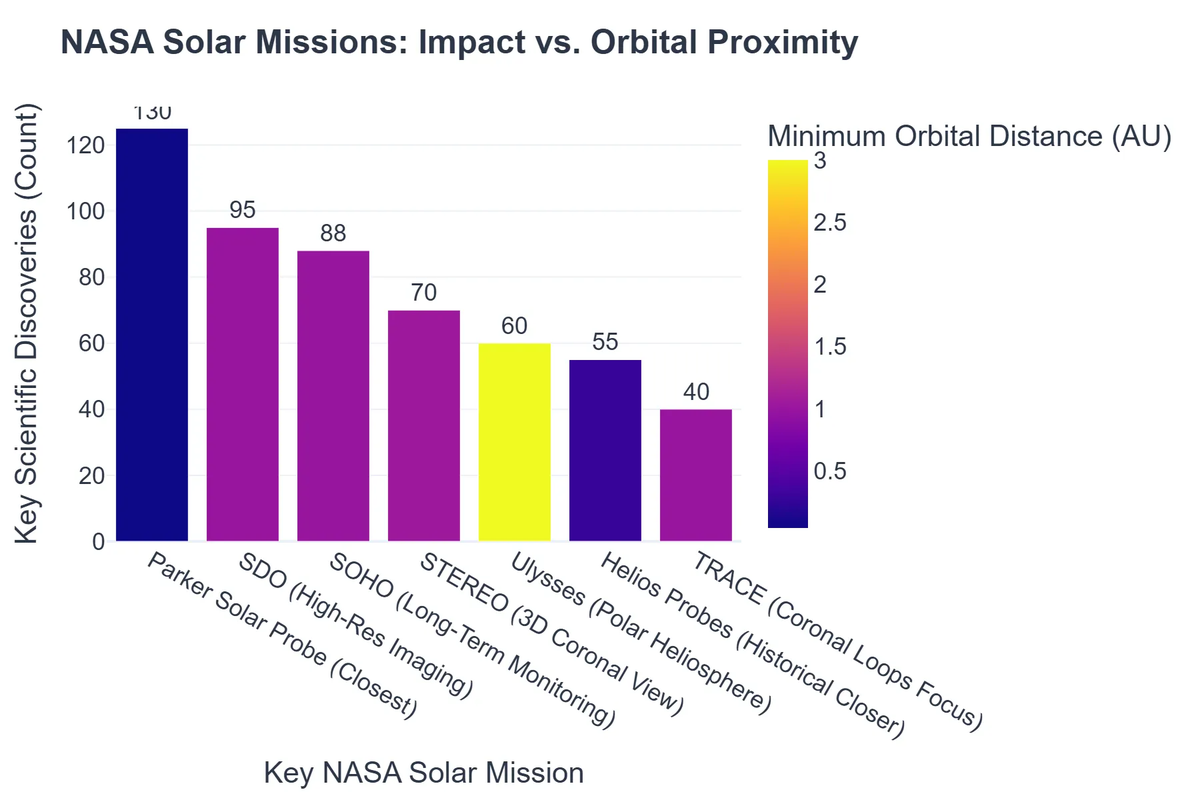
More accurate data from missions like SDO and Parker Solar Probe directly feeds into space weather models. Improved forecasts allow power companies, satellite operators, and airlines to take precautionary measures, protecting vital infrastructure and potentially saving billions of dollars. Understanding the Sun’s dynamic behavior is as critical to modern society as understanding terrestrial weather.
⚛️ Fundamental Physics and Stellar Evolution
The Sun is a natural laboratory for extreme physics. Studying its magnetic reconnection, plasma heating, and particle acceleration processes contributes to fundamental physics understanding that can be applied to other astrophysical phenomena, from distant quasars to black holes. Each NASA mission to Sun helps refine our models of how stars are born, live, and die across the universe, offering a piece of the puzzle that explains the very existence of elements essential for life.
Just as NASA Moon missions advanced our understanding of planetary geology, and NASA’s Journey to Mars pushes the boundaries of interplanetary exploration, the continuous study of the Sun is foundational to our understanding of the solar system and beyond.
What are the primary goals of NASA’s sun missions?
NASA’s sun missions aim to understand the Sun’s behavior, including solar flares, coronal mass ejections, and the solar wind, to protect Earth and its technology from space weather effects.
Which are some of NASA’s most notable sun missions?
Key missions include the Parker Solar Probe, Solar Dynamics Observatory (SDO), STEREO, and upcoming missions like Helioswarm.
How does studying the Sun benefit life on Earth?
Understanding the Sun helps predict dangerous space weather, which can disrupt power grids, satellite communications, and GPS, thereby protecting critical infrastructure.
What is the Parker Solar Probe’s unique contribution?
The Parker Solar Probe is the first spacecraft to ‘touch’ the Sun’s corona, providing unprecedented data on the solar wind’s origin and the Sun’s outer atmosphere.