


Understanding Acoustic Black Holes: A Gateway to Analog Gravity
In the vast realm of Cosmic Queries: Probing the Mysteries of the Universe, physicists often employ ingenious methods to study phenomena that are otherwise inaccessible. One such powerful tool lies in the concept of an acoustic black hole. Unlike their cosmic counterparts, these are not colossal gravitational wells devouring light and matter but rather laboratory constructs where sound waves behave in ways analogous to how light behaves near a real black hole.
💡 Key Takeaways
- Acoustic black holes (ABHs) are laboratory systems where sound waves cannot escape, analogous to light in gravitational black holes.
- They leverage principles of fluid dynamics, particularly the flow of fluids, to simulate spacetime curvature and event horizons.
- Studying ABHs provides a unique, accessible platform to test theories of quantum gravity and Hawking radiation without extreme astrophysical conditions.
- These analogies reveal deep connections between seemingly disparate fields of physics, from acoustics to cosmology.
“The beauty of acoustic black holes lies in their ability to bridge the cosmic and the everyday. They offer a tangible, tabletop universe where we can probe the very fabric of spacetime through the elegant dance of fluid – a testament to the universality of physics’ most profound ideas.”
— Astrid Bellweather, Astrophysicist & Science Communicator
At its core, an acoustic black hole is a region in a medium (typically a fluid or a gas) where the flow velocity of the medium exceeds the local speed of sound. Imagine a river flowing progressively faster. If the river’s speed surpasses the speed at which a fish can swim upstream, the fish, no matter how hard it tries, will be swept downstream. Similarly, if a fluid’s flow velocity exceeds the speed of sound within that fluid, sound waves trying to propagate against the flow cannot escape; they are effectively trapped.
This fascinating area of physics, often termed “analog gravity,” provides a tangible, controllable environment to explore complex theoretical concepts of general relativity and quantum mechanics in curved spacetimes. It bridges the gap between astrophysics and experimental physics, using principles of fluid dynamics to mimic cosmic phenomena.
In This Article
- → Understanding Acoustic Black Holes: A Gateway to Analog Gravity
- — 💡 Key Takeaways
- → The Profound Analogy to Gravitational Black Holes
- → Creating Acoustic Black Holes: Fluid Dynamics in Action
- — ⚙️ Experimental Setups:
- → Beyond the Horizon: Research & Applications
- — 🔬 Advancing Fundamental Physics:
- — 🛠️ Practical Implications:
The Profound Analogy to Gravitational Black Holes
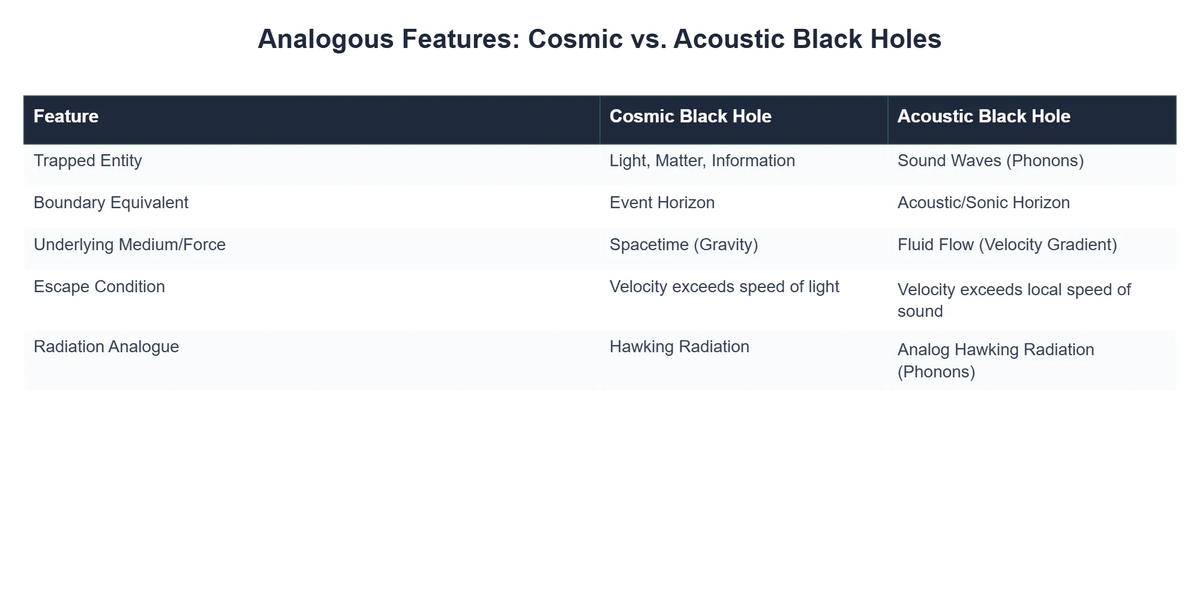
The beauty of an acoustic black hole lies in its striking resemblance to a gravitational black hole analogy. The parallels are not merely superficial but extend to fundamental physical principles:
- ✅ Event Horizon: In a gravitational black hole, the event horizon is the boundary beyond which nothing, not even light, can escape. For an acoustic black hole, the “acoustic event horizon” is the point where the fluid’s flow velocity matches the speed of sound. Sound waves trying to propagate against the flow from beyond this point are swept back, unable to escape.
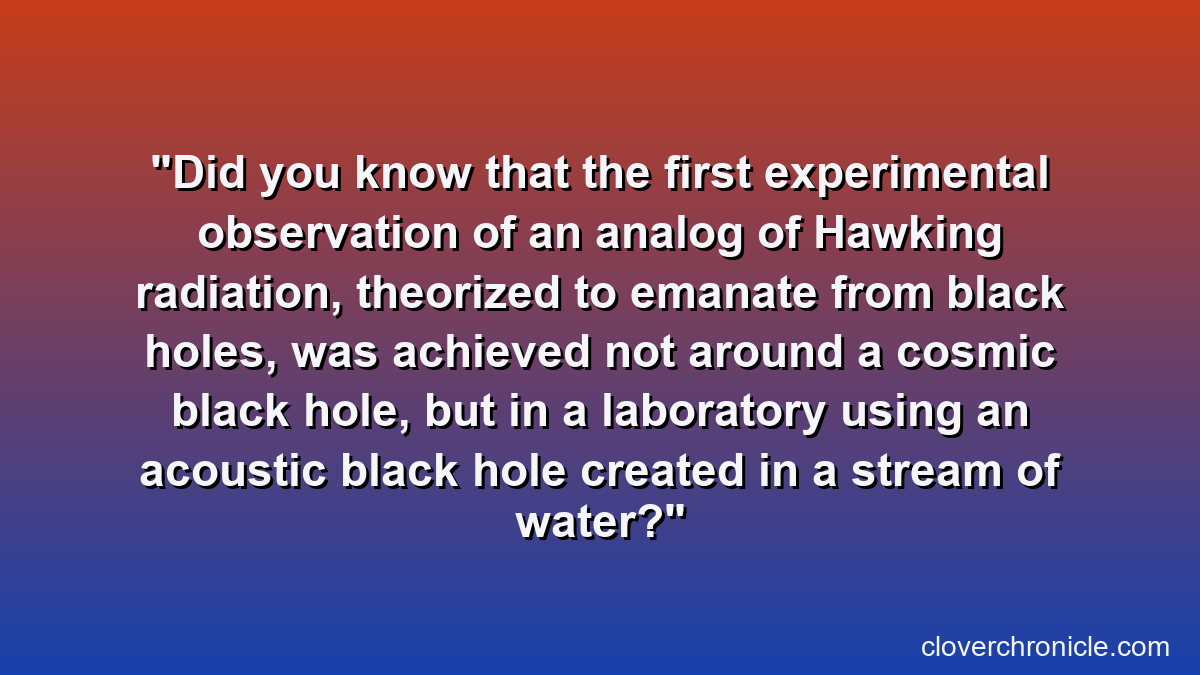
- ➡️ Hawking Radiation: One of the most groundbreaking predictions about black holes is Hawking radiation, where black holes are theorized to emit particles due to quantum effects near their event horizon. Acoustic black holes offer a unique experimental platform to study an analogous phenomenon. Quantum fluctuations in the fluid’s medium can give rise to phonons (quanta of sound) that mimic this emission. This could provide indirect evidence or deeper insight into real Hawking radiation.
- 💡 Ergosphere and Superradiance: Just as spinning gravitational black holes possess an ergosphere where objects are forced to co-rotate, spinning acoustic black holes can exhibit an analogous region. This leads to the phenomenon of superradiance, where waves extract rotational energy from the system, amplifying themselves. This concept is being explored in various analog black hole systems. For further insights into such complex phenomena, consider our article on Extremal Black Holes: Pushing Physics Boundaries.
These analogies are incredibly powerful because they allow physicists to perform experiments in a lab that would be impossible in a cosmic setting. By observing the behavior of sound waves in specially designed fluid flows, researchers can gain insights into the perplexing nature of spacetime, gravity, and quantum phenomena at the very edge of black holes.
Creating Acoustic Black Holes: Fluid Dynamics in Action
Crafting an acoustic black hole in a laboratory setting requires precise control over fluid dynamics. Researchers employ various ingenious methods to achieve the necessary conditions, typically focusing on creating a region where the fluid’s velocity transitions from subsonic to supersonic relative to sound waves within that medium.
⚙️ Experimental Setups:
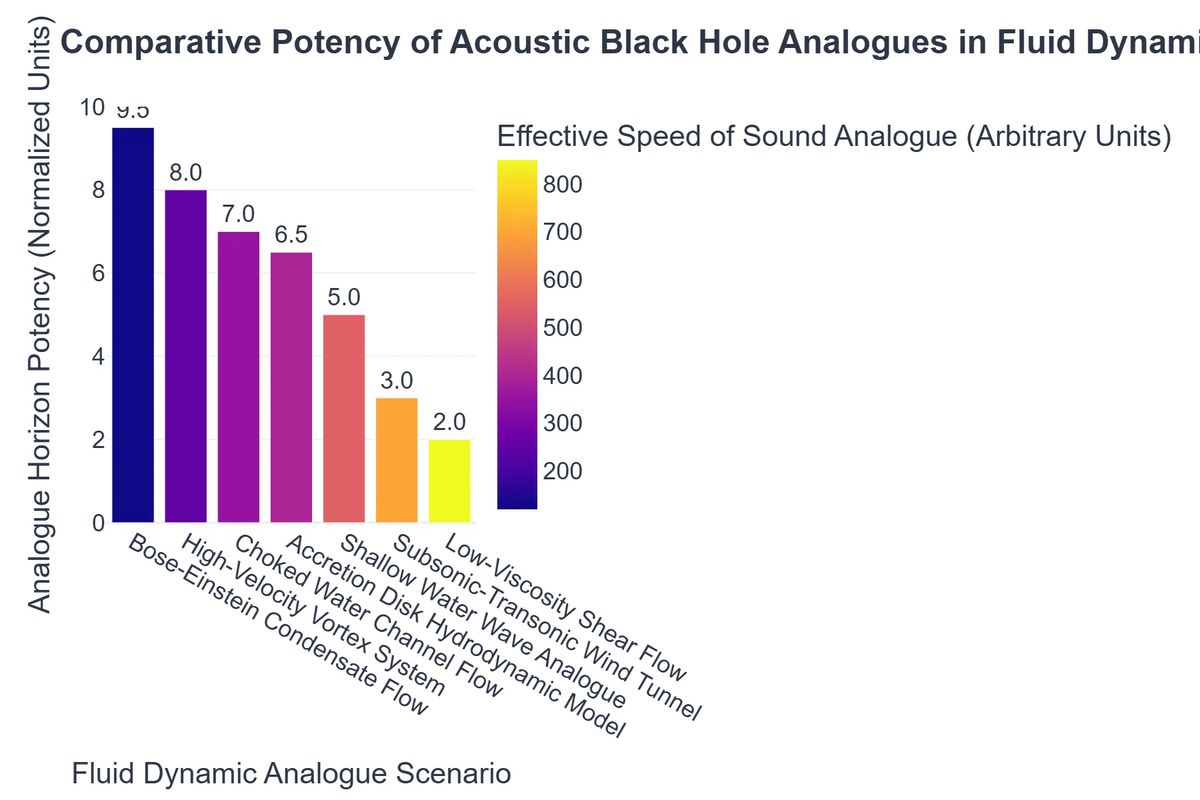
- ✅ Water Flumes: A common method involves a water flume, where water flows over an obstacle or through a constriction. By carefully adjusting the flow rate and the geometry, regions can be created where the water’s speed exceeds the wave speed on its surface. Surface waves then behave like sound waves in this analog gravity environment.
- ➡️ Bose-Einstein Condensates (BECs): These are ultra-cold gases where atoms behave as a single quantum entity. By manipulating laser fields, researchers can create flowing BECs and generate density waves (which act as sound waves). The “speed of sound” in a BEC can be made incredibly low, making it easier to create a “supersonic” flow for sound waves, thus forming an acoustic event horizon. This quantum analog offers a pristine environment for studying quantum effects related to black holes, such as an analogue to a Kerr black hole, as discussed in research by Phys. Rev. B.
- 💡 Fluid Jets and Sinks: Another approach involves creating a fluid jet or a sink (a point where fluid is drained). As fluid approaches the sink, its velocity increases, potentially reaching the critical speed. Similarly, a jet of fluid can be designed to have regions where the flow is faster than sound.
The key challenge is to create a smooth, stable flow where the transition from subsonic to supersonic velocity occurs sharply enough to form a well-defined horizon, yet gently enough to avoid turbulence that would obscure the subtle effects being studied. For those interested in real cosmic phenomena, our article on LIGO and Black Holes: Detecting Gravitational Waves provides context on how actual black holes are observed.
Recommended Video
Beyond the Horizon: Research & Applications
The study of acoustic black holes is far from a mere academic exercise; it offers profound implications for our understanding of the universe and has several exciting potential applications.
🔬 Advancing Fundamental Physics:
- ✅ Testing Quantum Gravity Theories: Since it’s nearly impossible to directly observe quantum gravity effects near cosmic black holes, analog systems provide a vital testbed. The detection of analog Hawking radiation in a lab would be a massive leap in validating theoretical predictions about quantum field theory in curved spacetimes.
- ➡️ Understanding Gravitational Black Holes: By observing the behavior of sound waves in these analogs, physicists can gain deeper insights into the complex dynamics of actual gravitational black holes, including phenomena like superradiance and the stability of horizons. Research into concepts like a spinning black hole in a fluid, as explored by Phys. Rev. D, directly contributes to this understanding.
- 💡 Exploring Information Paradox: The black hole information paradox, a major unsolved problem in physics, questions whether information is lost when it falls into a black hole. Acoustic black holes, by allowing controlled experiments on information propagation across an analog horizon, could offer clues.
🛠️ Practical Implications:
- ✅ Acoustic Damping and Control: Understanding how sound waves behave in acoustic black holes can lead to novel ways of absorbing or redirecting sound. This has potential applications in noise reduction technologies, acoustic cloaking, and improved sonar systems.
- ➡️ Quantum Computing and Information: The highly controlled environments of BEC-based acoustic black holes could serve as platforms for exploring quantum information processing or even new states of matter.
The field is constantly evolving, pushing the boundaries of experimental physics and theoretical understanding. From the grand scale of the cosmos to the intricate dynamics of a fluid in a lab, the journey into acoustic black holes is a testament to the interconnectedness of physics disciplines and our relentless pursuit of knowledge about Cosmic Queries: Probing the Mysteries of the Universe. For those curious about smaller-scale cosmic phenomena, explore our piece on Micro Black Holes: Tiny Giants or Curiosities?.
What is an Acoustic Black Hole?
An Acoustic Black Hole (ABH) is a region in a fluid flow where sound waves cannot escape, much like light cannot escape a gravitational black hole. This phenomenon occurs when the fluid flow velocity exceeds the speed of sound, creating an ‘acoustic event horizon’.
How do Acoustic Black Holes relate to Fluid Dynamics?
ABHs are inherently fluid dynamic phenomena. They rely on creating specific flow conditions in fluids (like water or Bose-Einstein condensates) where the fluid speed changes, mimicking the gravitational potential well that causes spacetime curvature in a cosmic black hole.
Why are Acoustic Black Holes important for physics research?
ABHs provide experimental platforms to study complex gravitational phenomena, such as Hawking radiation, in a controlled lab setting. They allow physicists to test theories of quantum gravity and black hole thermodynamics that are otherwise impossible to observe directly in astrophysical black holes.
Can acoustic black holes trap anything other than sound?
While primarily designed to trap sound waves, the principles of analog gravity explored through acoustic black holes can be extended to other wave phenomena. The core idea is the creation of an effective ‘horizon’ beyond which certain excitations cannot propagate upstream against a flow.