


What is Representative Bias? Understanding Cognitive Shortcuts
In the vast landscape of human cognition, our brains are constantly seeking efficiencies. To navigate a complex world, we often employ mental shortcuts, known as heuristics. One of the most prevalent and often subtle of these is the representative bias, also referred to as the representativeness heuristic. At its core, representative bias is our tendency to judge the probability of an event or the characteristics of a person or object by how much it resembles a pre-existing prototype or stereotype in our minds, rather than by considering actual statistical probabilities or objective data.
💡 Key Takeaways
- Representative bias involves judging likelihood based on stereotypes or prototypes, often ignoring base rates.
- It’s a mental shortcut that can lead to flawed judgments and decisions in various contexts.
- Recognizing this bias is the crucial first step to mitigating its pervasive influence.
- Strategies like seeking diverse information and questioning assumptions can help overcome its effects.
“Representative bias highlights our brain’s efficiency, often at the cost of accuracy. It’s a reminder that our mental shortcuts, while rapid, require conscious vigilance to prevent misjudgments.”
— Dr. Eleanor Vance, PhD, Cognitive Neuroscientist & Human Potential Researcher
This cognitive shortcut allows us to make rapid judgments, particularly when faced with uncertainty. Instead of meticulously analyzing all available information, our minds quickly compare new input to categories we already understand. While often helpful for quick decision-making, it can lead to significant errors when the ‘representativeness’ of something is misleading, causing us to overlook crucial base rates or logical principles. To delve deeper into the overall architecture of our minds, consider exploring The Human Enigma: Unlocking the Secrets of Our Body and Mind. For a broader understanding of how these mental shortcuts impact our daily lives, our guide on Cognitive Biases: Understanding Mental Shortcuts and Heuristics offers invaluable insights.
In This Article
- → What is Representative Bias? Understanding Cognitive Shortcuts
- — 💡 Key Takeaways
- → How Representative Bias Works (and When It Fails)
- → Classic Examples of Representative Bias
- — The Linda Problem
- — The Gambler’s Fallacy
- — Perceived Professionalism Based on Appearance
- → The Impact of Representative Bias on Decision-Making
- → Mitigating Representative Bias: Strategies for Clearer Thinking
How Representative Bias Works (and When It Fails)
The mechanism behind representative bias is fascinating yet deceptively simple. When presented with a person, situation, or piece of information, our brain attempts to categorize it. It does this by asking: “How similar is this to my mental prototype for X?” If the similarity is high, we tend to assume a strong probability that the new item belongs to that category, even if the statistical likelihood (the base rate) suggests otherwise.
Representative Bias: The Efficiency and Risks of Cognitive Shortcuts
Pros
- ✔Facilitates rapid decision-making in complex situations.
- ✔Reduces cognitive load, saving mental energy.
- ✔Aids in quick pattern recognition and categorization.
- ✔Enables efficient navigation of uncertain environments.
Cons
- ✖Often leads to inaccurate judgments and logical errors.
- ✖Causes neglect of base rate probabilities and statistical data.
- ✖Can reinforce stereotypes and contribute to prejudice.
- ✖Results in suboptimal or biased decisions in critical contexts.
This heuristic operates on the principle that “like goes with like.” We assume that members of a category will possess the defining characteristics of that category’s prototype, and conversely, that items displaying those characteristics are likely members of that category. This often leads to:
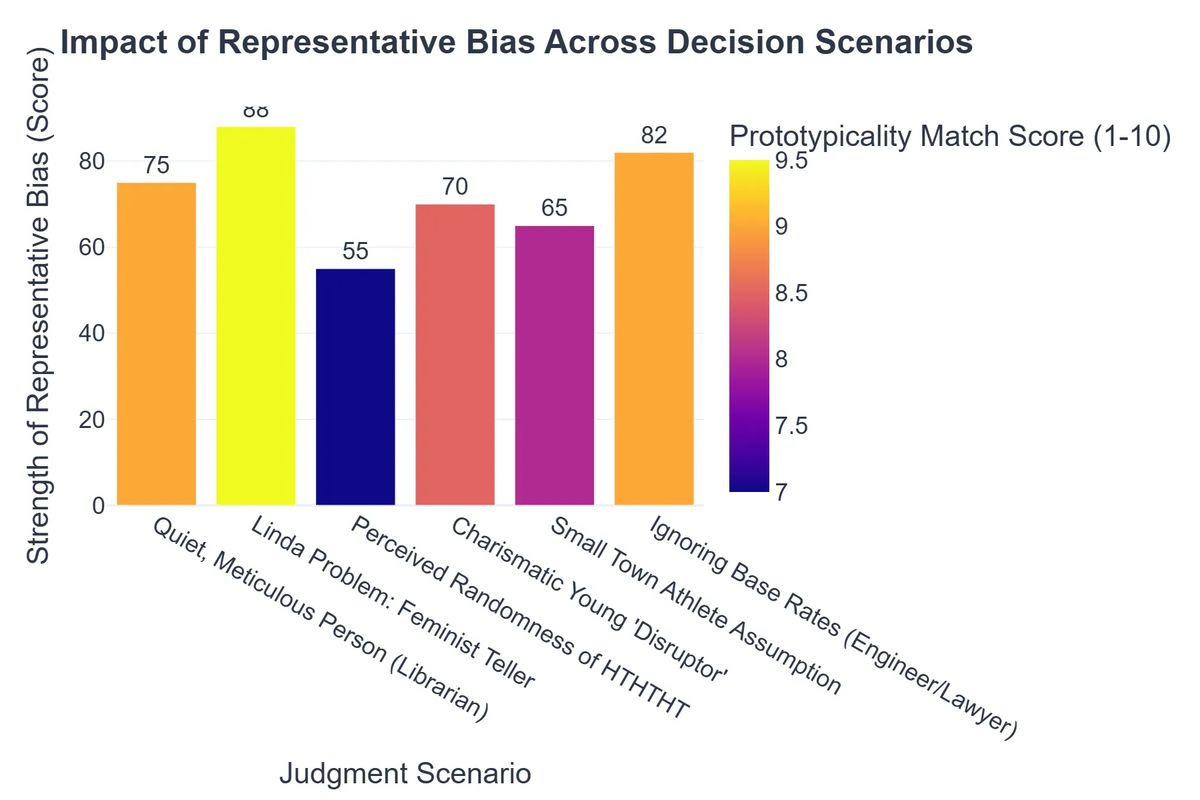
- ✅ Ignoring Base Rates: Overlooking the actual statistical frequency of an event or characteristic in the population. For instance, if you meet someone who fits the stereotype of a librarian (quiet, loves books), you might assume they are a librarian even if there are far more salespeople in the world than librarians.
- ➡️ Insensitivity to Sample Size: Believing that a small sample will be representative of the larger population. A string of heads in coin flips might lead someone to believe tails is “due” because they expect randomness to look random even in short sequences.
- 💡 Conjunction Fallacy: Judging that the conjunction of two events is more probable than one of the events alone, simply because the combination seems more “representative” or plausible.
While this shortcut can save mental energy, its failure points arise when the perceived similarity overrides logical and statistical considerations. As Daniel Kahneman and Amos Tversky, pioneers in the study of cognitive biases, extensively researched, our reliance on representativeness can lead to systematic errors in judgment. For a foundational understanding, you can refer to the comprehensive overview of the representativeness heuristic on Wikipedia.
Classic Examples of Representative Bias
Understanding representative bias examples brings this abstract concept to life, illustrating its pervasive influence on our perceptions and decisions.
The Linda Problem
This is perhaps the most famous example, devised by Tversky and Kahneman. Participants were told about Linda, who is 31, single, outspoken, and very bright. As a student, she was deeply concerned with issues of discrimination and social justice and participated in anti-nuclear demonstrations. They were then asked to rank the probability of several statements, including:
- Linda is a bank teller.
- Linda is a bank teller and is active in the feminist movement.
A majority of people judged the second option as more probable, even though it’s logically impossible. The set of “bank tellers and feminists” is a subset of “bank tellers,” so it can never be more probable than the larger set. However, “Linda is a bank teller and is active in the feminist movement” is more representative of her description than just “Linda is a bank teller.” This highlights the conjunction fallacy at play.
The Gambler’s Fallacy
Imagine flipping a fair coin five times, and it lands on heads every time. Many people would intuitively feel that the next flip is “due” to be tails. They believe that a random sequence should “look random,” and a streak of heads doesn’t fit their mental prototype of randomness. However, for a fair coin, each flip is an independent event, and the probability of landing on tails remains 50% regardless of previous outcomes. This is a classic representative bias example where people ignore the independence of events.
Perceived Professionalism Based on Appearance
Consider a situation where you need legal advice. You meet two lawyers: one is dressed impeccably in a tailored suit, has a briefcase, and speaks with polished articulation. The other is dressed casually, has a slightly disheveled look, and speaks less formally. Without any further information, many people would instinctively rate the first lawyer as more competent, simply because they fit the stereotype or prototype of a “successful lawyer” better. This judgment is based on representativeness rather than actual legal skill or experience. For a deeper dive into how our minds can be swayed by such influences, consider our article on Confirmation Bias: Meaning, Examples, & Impact.
The Impact of Representative Bias on Decision-Making
The insidious nature of representative bias lies in its ability to subtly steer our judgments across various domains, often with significant consequences.
- ✅ Hiring and Recruitment: Employers might subconsciously favor candidates who “look” or “sound” like their mental prototype of a successful employee for a certain role, overlooking equally or more qualified candidates who don’t fit that mold. This can lead to a lack of diversity and missed talent.
- ➡️ Medical Diagnosis: Doctors, relying on their experience, might quickly diagnose a patient based on symptoms that are highly representative of a common illness, potentially overlooking rarer conditions that present similarly but require different treatment.
- 💡 Financial Decisions: Investors might predict the future success of a company based on how well its current performance aligns with their mental image of a “successful growth stock,” rather than on rigorous financial analysis and market trends. This can lead to irrational exuberance or unwarranted pessimism.
- 🤝 Social Judgments: Beyond professional settings, representative bias affects how we perceive individuals and groups, often reinforcing stereotypes. We might judge a person’s character or abilities based on how well they fit a particular group’s stereotype, rather than on their individual merits.
Understanding these impacts is crucial, as it highlights the need for conscious effort to counteract our inherent cognitive leanings. Our primal brain, evolved for rapid assessment, doesn’t always align with the complexities of modern decision-making. You can learn more about how our inherent tendencies influence behavior in Human Behavior: An Introduction to Behavioral Biology.
Mitigating Representative Bias: Strategies for Clearer Thinking
While cognitive shortcuts like representative bias are hardwired into our brains, recognizing their existence is the first step toward mitigating their influence. By adopting specific strategies, we can make more objective and rational decisions.
- ✅ Consider Base Rates: Before making a judgment based on similarity, actively ask yourself: “What are the statistical odds of this event or characteristic occurring in the general population?” For instance, if someone fits the profile of a rare profession, remember that rare professions are, by definition, rare. This simple mental check can significantly reduce errors.
- ➡️ Seek Disconfirming Evidence: Instead of looking for information that confirms your initial representative judgment, actively search for evidence that might challenge it. This is a powerful antidote to many cognitive biases.
- 💡 Break Down Stereotypes: Consciously challenge your mental prototypes. Are they based on accurate data or ingrained societal stereotypes? The more nuanced and multifaceted your mental categories become, the less likely you are to fall prey to oversimplification.
- 📊 Think Statistically, Not Just Qualitatively: Train yourself to consider numbers, probabilities, and sample sizes. Recognize that random sequences don’t always “look” random and that small samples can be unrepresentative. The Verywell Mind article on the representativeness heuristic offers further strategies for recognizing its effects.
- 🧠 Practice Deliberate Processing: When making important decisions, slow down. Engage your analytical system rather than relying solely on intuitive, rapid judgments. This allows for a more thorough evaluation of all relevant information.
In conclusion, recognizing and actively counteracting representative bias is a vital step toward sharper critical thinking and more equitable decision-making in all aspects of life. By consciously applying these strategies, we can reduce the errors caused by our inherent cognitive shortcuts and foster a more objective understanding of the world around us.
Recommended Video
What is representative bias?
Representative bias is a cognitive shortcut where we judge the likelihood of something belonging to a group based on how typical it seems of that group, often ignoring base rates or other statistical information.
How does representative bias affect decisions?
It can lead to stereotypes, misjudgments, and flawed conclusions because it prioritizes intuitive resemblance over logical probability, impacting areas from hiring to medical diagnoses.
Can representative bias be avoided?
While it’s difficult to completely avoid, awareness and deliberate strategies like considering base rates, seeking diverse information, and questioning assumptions can significantly mitigate its influence.