


Understanding Biochemical Evolution: Origin of Life’s Molecules
The journey from a lifeless planet to one teeming with biological diversity is perhaps the most profound story in the universe, and at its very heart lies biochemical evolution theory. This critical scientific concept explores how simple inorganic molecules on early Earth transformed into the complex organic compounds—the very building blocks of life—that eventually assembled into the first living cells. It’s the grand narrative of how chemistry became biology.
💡 Key Takeaways
- Life’s building blocks emerged from non-living matter through a series of biochemical processes.
- Early Earth conditions, including volcanic activity and atmospheric composition, favored the synthesis of complex organic molecules.
- Key chemical reactions like polymerization were crucial for forming macromolecules such as proteins and nucleic acids.
- The transition from simple molecules to self-replicating systems remains a central mystery and focus of origin-of-life research.
“Understanding biochemical evolution isn’t just about tracing the past; it’s about revealing the fundamental chemical logic that underpins all life, from its simplest origins to its most complex forms.”
— Julian Aris, PhD, Geneticist & Evolutionary Biologist
Unlike biological evolution, which focuses on the changes in living organisms over generations through natural selection, biochemical evolution delves into the realm of abiogenesis – the spontaneous generation of life from non-living matter. It bridges the gap between the primordial soup and the earliest forms of cellular life, mapping the pathways for the creation of essential molecules such as amino acids, nucleotides, lipids, and carbohydrates.
In This Article
- → Understanding Biochemical Evolution: Origin of Life’s Molecules
- — 💡 Key Takeaways
- — Distinguishing Chemical and Biochemical Evolution
- → The Prebiotic Earth: Setting the Stage for Molecular Genesis
- → Key Experiments & Hypotheses: Proving Life’s Building Blocks Could Form
- — The Miller-Urey Experiment (1953)
- — Hydrothermal Vent Hypothesis
- — The RNA World Hypothesis
- → From Monomers to Polymers: Building Life’s Macromolecules
- → The Emergence of Protocells: Encapsulation and Organization
- — The Importance of Compartmentalization
- — Formation of Protocells
Distinguishing Chemical and Biochemical Evolution
While often used interchangeably, it’s helpful to draw a distinction:
- ✅ Chemical Evolution: Primarily refers to the formation of small organic molecules (monomers) from inorganic precursors. This stage involves the creation of the fundamental ‘ingredients’ like amino acids, sugars, and nitrogenous bases under early Earth conditions.
- ➡️ Biochemical Evolution: Encompasses the subsequent steps. It includes the polymerization of these monomers into complex macromolecules (proteins, nucleic acids, polysaccharides) and their organization into self-replicating systems and proto-cells. It describes the assembly and functional integration of these molecules.
This process is foundational to understanding The Code of Life: Decoding Genetics, Evolution, and Existence itself, as it lays the groundwork for all subsequent biological complexity and diversity.
The Prebiotic Earth: Setting the Stage for Molecular Genesis
For biochemical evolution to commence, specific environmental conditions were essential. Scientists hypothesize that early Earth was vastly different from our oxygen-rich world today, creating a unique chemical laboratory:
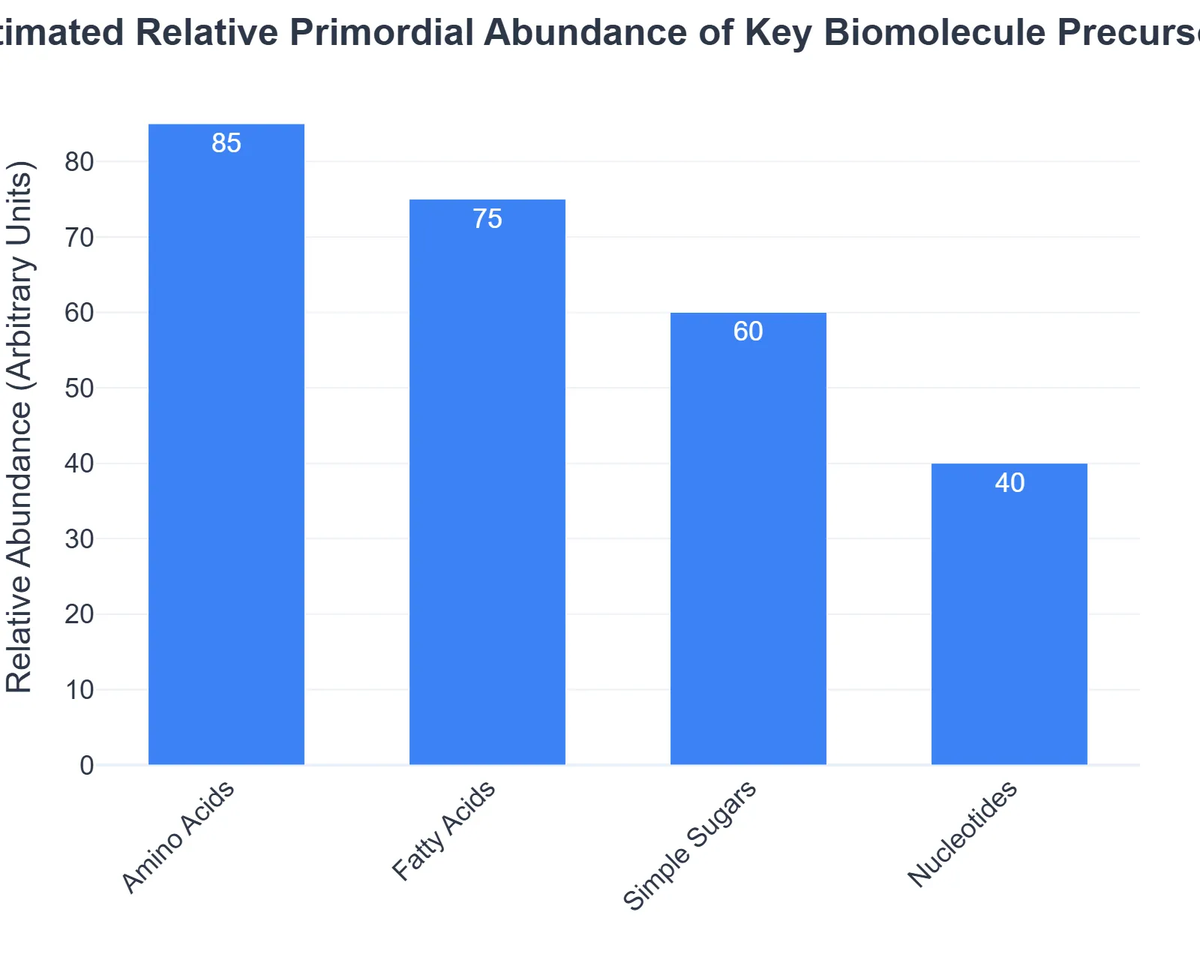
- 💡 Atmosphere: Likely a “reducing” atmosphere, meaning it contained gases like methane (CH4), ammonia (NH3), water vapor (H2O), and hydrogen (H2), but very little free oxygen. This anoxic environment was crucial because oxygen is highly reactive and would have rapidly broken down newly formed organic molecules.
- ⚡ Energy Sources: Abundant energy was available to drive chemical reactions. This included intense ultraviolet (UV) radiation (due to the lack of an ozone layer), frequent lightning storms, volcanic activity, and geothermal heat from deep-sea hydrothermal vents.
- 🌊 The “Primordial Soup”: Alexander Oparin and J.B.S. Haldane independently proposed the concept of a “primordial soup” – a warm, dilute broth of organic molecules formed in the early oceans, where reactions could occur and molecules could accumulate. For more on this, consider exploring Chemical Evolution: The Origin of Life on Earth.
- 🪨 Mineral Surfaces: Clay minerals and pyrite (iron sulfide) are thought to have played a significant role. These surfaces could concentrate organic molecules, provide catalytic sites for reactions, and protect fragile molecules from degradation.
Key Experiments & Hypotheses: Proving Life’s Building Blocks Could Form
The plausibility of biochemical evolution is strongly supported by groundbreaking experiments and compelling hypotheses:
The Miller-Urey Experiment (1953)
This landmark experiment by Stanley Miller and Harold Urey provided the first empirical evidence that organic molecules could form spontaneously under primitive Earth conditions. They created a closed system simulating the early Earth’s atmosphere and ocean, then subjected it to electric sparks (simulating lightning).
Within a week, they observed the formation of various amino acids (the building blocks of proteins), along with other organic compounds. This experiment validated the “primordial soup” hypothesis and profoundly influenced our understanding of abiogenesis. You can learn more about these hypotheses at Khan Academy.
Hydrothermal Vent Hypothesis
An alternative to the “primordial soup” model suggests that life may have originated not at the surface, but in the deep sea at hydrothermal vents. These vents release superheated, mineral-rich water from Earth’s crust, creating unique chemical environments that could support the formation of organic molecules, shielded from harmful UV radiation. The steep temperature and chemical gradients around these vents provide ample energy and diverse reaction pathways.
The RNA World Hypothesis
One of the most compelling hypotheses in biochemical evolution is the RNA World. This proposes that RNA (ribonucleic acid), not DNA, was the primary genetic material and catalyst in early life. This is due to RNA’s dual capabilities:
- 🧬 Information Storage: Like DNA, RNA can store genetic information.
- 🧪 Catalytic Activity: Certain RNA molecules, called ribozymes, can act as enzymes, catalyzing biochemical reactions (e.g., peptide bond formation in ribosomes). This “ribozyme” function is crucial.
This hypothesis elegantly solves the “chicken and egg” problem: which came first, genetic information (DNA) or the proteins needed to process it? The RNA world suggests RNA could do both. For further reading, the NCBI provides insights into The RNA World and the Origins of Life.
From Monomers to Polymers: Building Life’s Macromolecules
Once simple organic monomers (like amino acids and nucleotides) formed, the next crucial step in biochemical evolution was their polymerization into larger, more complex macromolecules. This process presented significant challenges:
Biochemical Evolution: Understanding Life’s Molecular Origins
Pros
- ✔Provides a scientific framework for the abiotic synthesis of life’s building blocks.
- ✔Supported by experimental evidence demonstrating the formation of organic molecules from inorganic precursors.
- ✔Offers plausible mechanisms for the gradual increase in molecular complexity.
- ✔Helps explain the universal chemistry underlying all known life.
Cons
- ✖The precise transition from complex molecules to self-replicating systems is not fully understood.
- ✖Early Earth environmental conditions crucial for these processes remain subjects of debate.
- ✖Challenges in explaining the spontaneous emergence of highly complex and interdependent molecular machinery.
- ✖The low probability of some specific molecular arrangements occurring naturally is a theoretical hurdle.
- 💧 Dehydration Synthesis: The formation of polymers typically involves dehydration synthesis, where a water molecule is removed for each bond formed. This is thermodynamically unfavorable in a dilute aqueous solution (like the early ocean).
- ✨ Concentration & Catalysis: Various mechanisms are proposed to overcome this:
- ✅ Evaporation: Cycles of wetting and drying in tidal pools could concentrate monomers.
- ✅ Mineral Surfaces: Clay minerals, with their charged surfaces, could attract and concentrate monomers, facilitating their polymerization. Pyrite and other mineral catalysts may have also played a role.
- ✅ Hydrothermal Vents: The high temperatures and specific chemical conditions around vents could also promote polymerization.
The successful formation of long chains of amino acids (peptides/proteins) and nucleotides (RNA/DNA strands) was a monumental leap. These polymers possess the complexity and diversity required for essential biological functions, from catalysis to information storage. This complex molecular machinery is what ultimately underpins Molecular Evolution: Unpacking Genetic Change.

Recommended Video
The Emergence of Protocells: Encapsulation and Organization
The final, pivotal stage of biochemical evolution involves the organization of these macromolecules into self-contained, self-replicating systems – the precursors to the first true cells, often referred to as protocells.
The Importance of Compartmentalization
For life to emerge, a boundary was needed to separate the internal chemical environment from the external surroundings. This boundary would allow for:
- 💡 Concentration: Keeping necessary molecules together.
- 💡 Protection: Shielding delicate internal chemistry from harsh external conditions.
- 💡 Specialization: Creating an internal environment conducive to specific metabolic reactions.
Formation of Protocells
Lipids, which can spontaneously form vesicles (spherical structures with a double-layered membrane) in water, are thought to have provided this crucial compartmentalization. These early membranes were likely simpler than modern cell membranes but possessed key properties:
- ➡️ Semi-permeability: Allowing some molecules to pass through while retaining others.
- ➡️ Self-assembly: Forming spontaneously under certain conditions.
Within these protocells, the newly formed macromolecules—especially RNA molecules with catalytic and self-replicating capabilities—could be concentrated, interact more efficiently, and begin to form rudimentary metabolic pathways. This feedback loop, where molecules within a protocell could replicate and evolve, marks the transition from pure chemistry to the earliest forms of biological organization, leading eventually to what we understand as Biological Evolution: Understanding Life’s Diversity.
The emergence of protocells with inherited information and a primitive metabolism represents the threshold where biochemical evolution concludes and biological evolution begins, setting the stage for the incredible diversity of life we see today.
What is biochemical evolution?
Biochemical evolution refers to the scientific study of how life’s essential organic molecules (like amino acids, nucleotides, and lipids) formed from inorganic matter on early Earth, preceding the first living cells.
What was the ‘primordial soup’ theory?
The ‘primordial soup’ theory, proposed by Oparin and Haldane, suggests that early Earth’s oceans contained a rich mixture of organic compounds, where life could have first arisen through chemical reactions energized by lightning or UV radiation.
Are there alternative theories to the primordial soup for life’s origin?
Yes, other prominent theories include the hypothesis of life originating at deep-sea hydrothermal vents, the delivery of organic molecules via meteorites, and the RNA world hypothesis, which posits RNA as the primary genetic and catalytic molecule in early life.