
The intricate dance between individual thought and collective influence has long fascinated psychologists. Among the most pivotal investigations into this phenomenon are the Asch conformity experiment, a groundbreaking series of studies conducted by Polish-American psychologist Solomon Asch in the 1950s. These experiments vividly demonstrated the power of social influence and group pressure on individual perception and judgment, even in situations where the correct answer was unambiguously clear.
💡 Key Takeaways
- The Asch experiments demonstrated how strong group pressure can lead individuals to conform, even when they know the group is wrong.
- Conformity is often driven by the desire to fit in (normative influence) or the belief that the group is more informed (informational influence).
- Even a single dissenter or ally can significantly reduce the power of conformity within a group.
- Understanding social influence helps explain various real-world phenomena, from fashion trends to political polarization.
“The Asch experiments reveal the subtle yet profound neural dance between our individual perceptions and the compelling pull of collective reality, highlighting the brain’s innate drive for social cohesion.”
— Dr. Eleanor Vance, PhD, Cognitive Neuroscientist & Human Potential Researcher
Asch’s work laid a foundational stone in the field of social psychology, revealing the startling extent to which individuals might abandon their own convictions to align with a group. It shifted our understanding of how `group pressure` can sway decisions, offering profound insights into human behavior that remain relevant today.
In This Article
The Architect of Understanding: Who Was Solomon Asch?
Born in Warsaw, Poland, in 1907, Solomon Asch immigrated to the United States at the age of 13. He became a prominent figure in Gestalt psychology, focusing on how individuals perceive wholes rather than discrete parts. His academic journey led him to the New School for Social Research and later to Swarthmore College, where he conducted his most famous work.
Asch was deeply influenced by the research of Muzafer Sherif on conformity, particularly Sherif’s autokinetic effect experiment. However, Asch believed Sherif’s experiment left room for ambiguity, as participants were unsure of the correct answer, leading them to naturally rely on group consensus. Asch aimed to test conformity in an unambiguous situation – where the correct answer was obvious – to truly understand the force of social pressure. His pioneering studies sought to answer a crucial question: Would people conform to an incorrect majority when faced with clear evidence to the contrary?

His meticulous approach and profound findings solidified his legacy as a central figure in the study of social influence.
Deconstructing the Asch Conformity Experiment
The experimental setup of the original Asch experiment was elegantly simple yet powerfully revealing. It involved a group of participants, though only one was the true subject, while the others were confederates (actors working with the experimenter).
- 📏 The Task: Participants were shown two cards. One card had a single vertical line, and the other had three vertical lines of varying lengths. The task was to identify which of the three lines on the second card matched the length of the single line on the first card. The correct answer was always evident.
- 👥 The Setup: Typically, groups consisted of one genuine participant and several confederates (usually 7-9). The genuine participant was usually seated towards the end of the group, ensuring they heard most of the confederates’ responses before giving their own.
- 🔄 The Trials: The experiment involved 18 trials. In the first few “control” trials, confederates gave correct answers. However, in 12 “critical trials,” the confederates unanimously gave an incorrect answer, deliberately choosing a line that was clearly either longer or shorter than the target line.
- 👂 The Observation: Asch observed how the genuine participant reacted to the unanimous, incorrect majority. Would they trust their own eyes or conform to the group?
This careful design allowed Asch to isolate the impact of `group pressure` on individual judgment, moving beyond situations where ambiguity might naturally lead to conformity. For a deeper dive into similar setups, explore Conformity Experiment: Understanding Social Pressure and Influence.
Key Findings and Insights from Asch’s Research
The results of the Asch conformity experiment were both startling and highly influential, reshaping our understanding of human behavior in social settings.
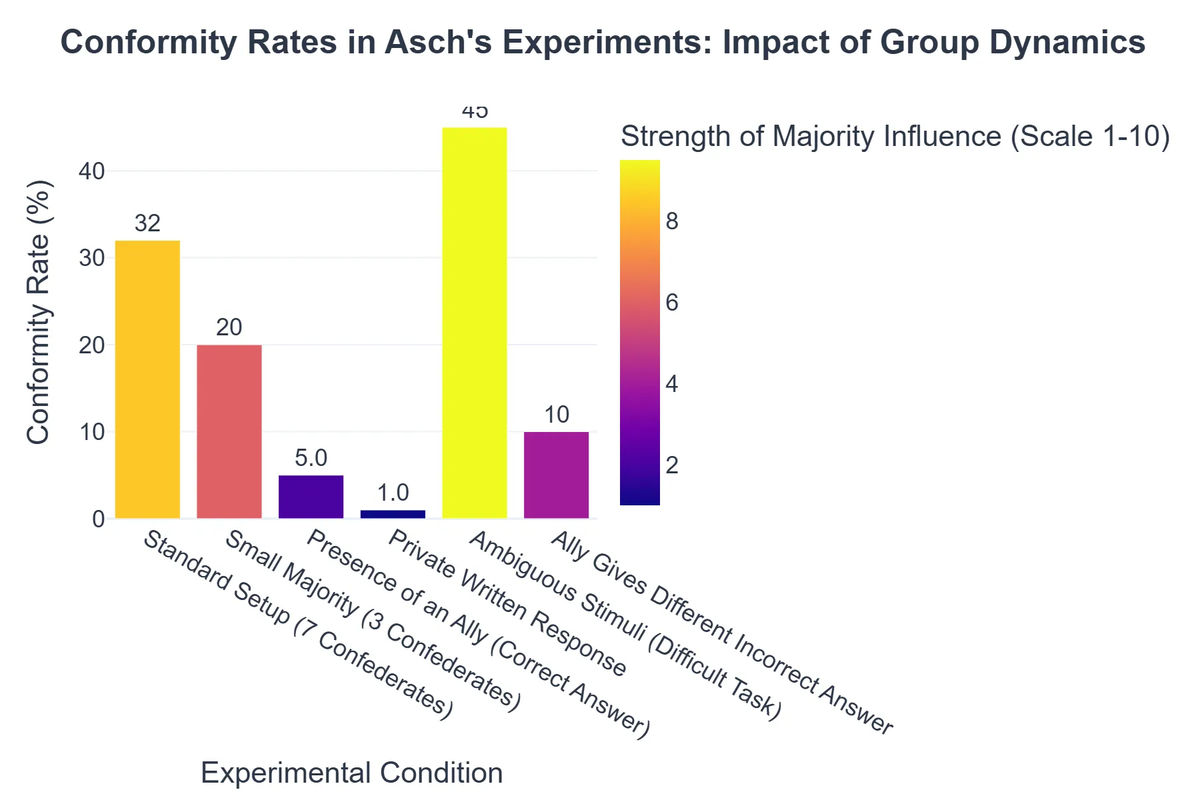
- 📊 Conformity Rates: Across numerous trials, approximately 32% of participants conformed to the incorrect majority on the critical trials. Even more strikingly, about 75% of participants conformed at least once during the experiment.
- 🧠 Reasons for Conformity: Post-experiment interviews revealed that participants often conformed for one of two main reasons:
- Normative Influence: The desire to fit in, be liked, or avoid standing out. Participants knew the group was wrong but went along to avoid disapproval.
- Informational Influence (less common in Asch’s setup): A belief that the group might be better informed or that their own perception was somehow flawed, even when the answer was obvious.
- 💪 The Power of One Dissenter: A crucial variation of the `asch experiment` showed that if just one confederate gave the correct answer, conformity rates dropped dramatically to about 5-10%. This highlights the immense power of an ally in resisting `social influence`.
- 👀 Individual Differences: While many conformed, a significant minority (around 25%) consistently resisted the group pressure. This demonstrated that individual differences in personality, self-confidence, and belief in one’s own judgment also play a role.
These findings underscored that even in the face of unambiguous reality, the pressure to conform to a group can be immense. For more detail on these groundbreaking outcomes, refer to sources like Simply Psychology’s Asch Conformity Line Experiment.
Factors Influencing Conformity in the Asch Experiment
Beyond the core findings, Asch and subsequent researchers explored various factors that either increased or decreased the likelihood of conformity during his conformity experiment:
- 📈 Group Size: Conformity tended to increase with group size, but only up to a point. Adding more confederates beyond three or four had little additional effect. The presence of just one other person disagreeing with the participant was enough to exert significant pressure.
- 🤝 Unanimity of the Group: This was perhaps the most critical factor. As mentioned, even one dissenter (a confederate who gave the correct answer or a different incorrect answer) dramatically reduced conformity. Breaking the group’s unanimous front empowered participants to trust their own judgment.
- 🗣️ Public vs. Private Response: When participants were allowed to write down their answers privately instead of announcing them aloud, conformity rates significantly decreased. This suggests that the fear of social disapproval was a major driver of conformity.
- 🎯 Task Difficulty: While Asch’s task was unambiguous, other conformity studies show that when a task is more difficult or ambiguous, informational social influence becomes more prominent, and people are more likely to conform because they genuinely believe the group might be right.
- 🌍 Cultural Differences: Subsequent research has indicated that conformity rates can vary across cultures, with collectivist cultures sometimes showing higher rates of conformity than individualistic ones, reflecting different societal values regarding group harmony versus individual autonomy.
Understanding these variables provides a richer picture of how `social influence` operates in different contexts. Explore more related insights in Asch’s Conformity Study: Social Influence Insights.
Beyond the Lab: Real-World Implications of Asch’s Work
The lessons gleaned from the Asch conformity experiment extend far beyond the confines of the laboratory, offering crucial insights into everyday human behavior and societal dynamics. The principle of `group pressure` elucidated by Asch helps us understand a myriad of real-world phenomena:
- ⚖️ Jury Deliberations: In legal settings, Asch’s work highlights how a lone juror might feel compelled to agree with a unanimous majority, even if they have doubts, potentially leading to miscarriages of justice.
- 🏢 Workplace Dynamics: Groupthink, a phenomenon where a group makes faulty decisions because members prioritize harmony and conformity over critical evaluation, is a direct manifestation of Asch’s findings. It explains why employees might not voice dissenting opinions in meetings.
- ファッション Social Trends and Fashion: The drive to fit in and be accepted often dictates consumer choices, from clothing styles to technology adoption, illustrating normative `social influence` at play.
- 📢 Political Behavior: During elections or referendums, individuals might align their views with a dominant public opinion or peer group, even if it contradicts their private beliefs.
- 🚫 Bystander Effect: While not directly studied by Asch, the principles of `group pressure` and the diffusion of responsibility explored in his work contribute to understanding why individuals might fail to act in emergency situations when others are present.
Asch’s work serves as a powerful reminder of the importance of independent thought and critical reasoning in the face of majority influence. It underscores the challenges individuals face in maintaining their autonomy within a social fabric, a key aspect we explore in The Human Enigma: Unlocking the Secrets of Our Body and Mind. For additional perspectives on how these experiments highlight social dynamics, consider sources such as Verywell Mind’s analysis of the Asch Conformity Experiments.
Recommended Video
What was the main purpose of the Asch conformity experiments?
The main purpose was to investigate the extent to which social pressure from a majority group could influence a person to conform to an obviously incorrect answer.
How did Solomon Asch measure conformity?
Asch measured conformity by having participants judge line lengths in a group where confederates (actors) deliberately gave incorrect answers, observing if the true participant conformed to the false consensus.
What were the key findings of the Asch experiments?
Asch found that participants conformed to the incorrect majority answer about 32% of the time, and 75% conformed at least once, highlighting the significant power of group pressure.
Can conformity be resisted?
Yes, Asch’s research showed that the presence of even one dissenter (an ally) who gave the correct answer significantly reduced conformity rates, empowering individuals to stand their ground.