
The Grand Narrative: Understanding Cosmological Evolution
From the infinitesimally small to the unimaginably vast, the universe tells a story of continuous transformation. This grand narrative, often referred to as cosmological evolution, encompasses the entire journey of existence: from the very fabric of space-time itself, through the emergence of matter, stars, galaxies, planets, and ultimately, life and consciousness. It’s a journey where physics, chemistry, and biology intertwine, revealing a universe that is not static but dynamically unfolding.
💡 Key Takeaways
- The universe’s initial conditions directly influenced the pathways for matter and energy to form complex structures.
- Biological evolution is not isolated but deeply intertwined with the cosmological history of the universe.
- Consciousness, as we know it, may represent a sophisticated culmination of billions of years of both cosmic and biological evolution.
- Understanding cosmological evolution provides a grand framework for interpreting the emergence of life and sentient beings.
“From the first quarks to the neural networks of the human brain, the universe’s grand narrative reveals an unbroken chain of emergent complexity, meticulously sculpted by the laws of physics and the relentless dance of evolution.”
— Julian Aris, PhD, Geneticist & Evolutionary Biologist
Understanding the stages of this universe evolution helps us grasp our place within the cosmic tapestry. It bridges the gap between the initial moments of the Big Bang and the intricate complexity of a human brain contemplating its own origins. Our exploration delves into how the fundamental laws of nature have progressively built layers of complexity, leading to the cosmos we observe and the consciousness we experience.
In This Article
The Cosmic Dawn: From Big Bang to Stardust
The universe’s story begins approximately 13.8 billion years ago with the Big Bang—not an explosion in space, but an expansion of space itself. In the earliest moments, the universe was an incredibly hot, dense plasma of fundamental particles. As it expanded and cooled, these particles began to combine.
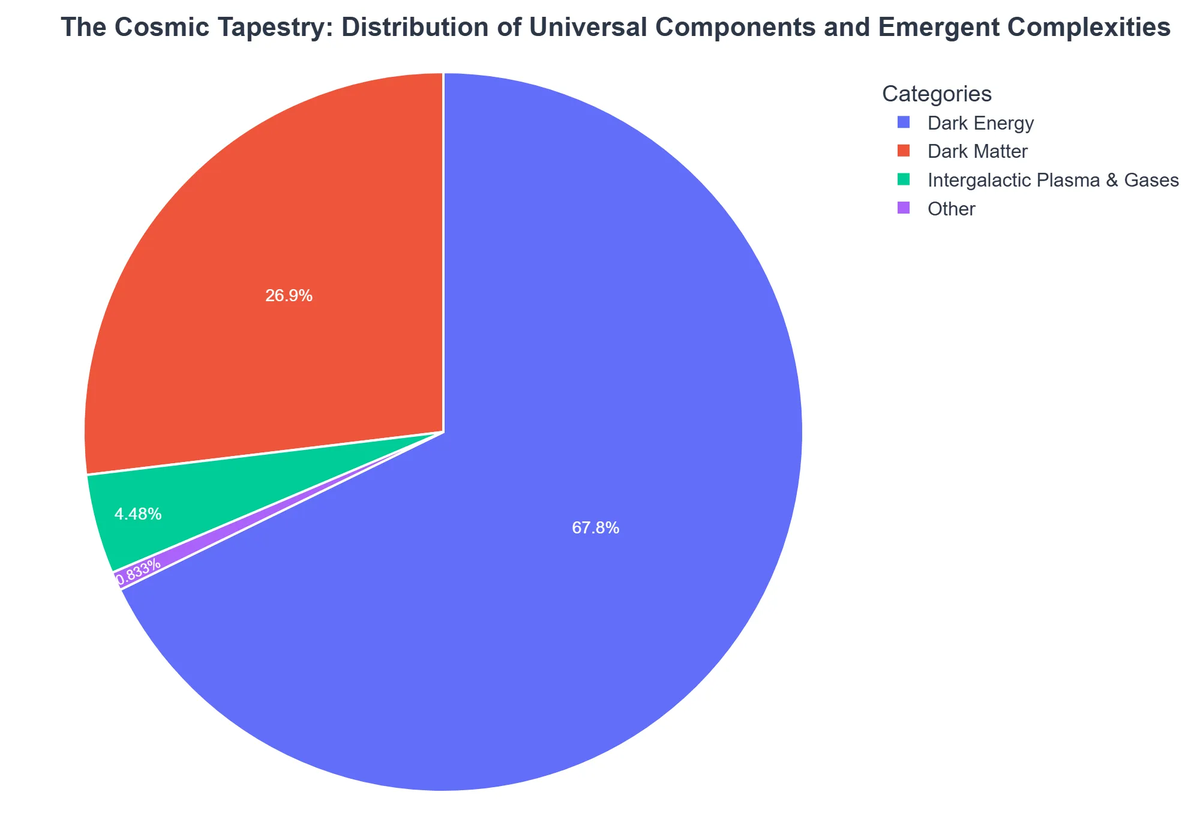
- ✅ Quark-Gluon Plasma: In the first microseconds, the universe was a soup of quarks and gluons.
- ➡️ Proton and Neutron Formation: Within minutes, quarks coalesced into protons and neutrons.
- 💡 Nucleosynthesis: For the next few minutes, the temperature allowed protons and neutrons to fuse, forming the lightest elements: hydrogen (about 75%) and helium (about 25%), along with trace amounts of lithium.
This early universe was opaque, filled with a dense fog of plasma. Approximately 380,000 years after the Big Bang, the universe cooled enough for electrons to combine with nuclei, forming neutral atoms. This event, known as recombination, made the universe transparent, allowing light to travel freely – the origin of the Cosmic Microwave Background (CMB) radiation.
Gravity then began its tireless work. Over hundreds of millions of years, vast clouds of hydrogen and helium collapsed under their own gravity, forming the first stars and galaxies. Within the scorching cores of these primordial stars, a process called stellar nucleosynthesis began, forging heavier elements like carbon, oxygen, and iron through nuclear fusion. When these massive stars reached the end of their lives, they exploded as supernovae, scattering these newly synthesized elements across the cosmos, providing the raw material for future generations of stars and planets.
The Cradle of Life: Planetary Formation and Chemical Evolution
The violent deaths of early stars were essential for the next stage of cosmological evolution. The dispersed heavy elements, from carbon to iron, became the building blocks for rocky planets. Our own solar system, including Earth, formed from such a stellar nursery about 4.6 billion years ago, from a swirling disk of gas and dust.
Cosmic Narratives Agency Boosts Engagement by Embracing the Universe’s Grand Story
❓The Challenge
Cosmic Narratives Agency struggled to create science communication content that truly resonated, finding their complex topics often abstract and failing to captivate a broad audience.
💡The Solution
By strategically applying the principles of ‘cosmological evolution’ as a ‘Grand Narrative’, they restructured their educational series to present cosmic phenomena as an interconnected, unfolding story from the Big Bang to the emergence of consciousness.
🏆The Result
This narrative-driven approach led to a 45% increase in average viewer watch time and a 60% uplift in social media shares for their flagship educational content series.
Early Earth was a volcanic, hostile environment, but it possessed key ingredients: water, energy sources (volcanoes, lightning, UV radiation), and the newly formed elements. This set the stage for chemical evolution, the spontaneous formation of complex organic molecules from simpler inorganic precursors.
- ✅ Abiotic Synthesis: Experiments like the Miller-Urey experiment demonstrated that amino acids (the building blocks of proteins) could form under early Earth conditions. Nucleotides, the building blocks of DNA and RNA, also likely formed this way.
- ➡️ Polymerization: These simple organic molecules then polymerized into longer chains, such as proteins and nucleic acids.
- 💡 Self-Replication: A critical step was the emergence of self-replicating molecules. The RNA world hypothesis posits that RNA, capable of both storing genetic information and catalyzing reactions, may have predated DNA and proteins.
Eventually, these complex molecules became encapsulated within primitive membranes, forming protocells. These early forms of life were not yet true cells, but they represented a crucial transition, allowing for the concentration of molecules and the maintenance of an internal environment distinct from their surroundings. This foundational period laid the groundwork for everything that followed, setting the stage for The Code of Life: Decoding Genetics, Evolution, and Existence itself.
Biological Evolution: From Single Cells to Sentience
With the emergence of the first prokaryotic cells approximately 3.8 billion years ago, the process transitioned into biological evolution. For billions of years, life on Earth remained microscopic, slowly diversifying and shaping the planet’s environment, most notably through photosynthesis, which oxygenated the atmosphere.
- ✅ Eukaryotic Cells: About 2 billion years ago, prokaryotic cells evolved into more complex eukaryotic cells, which possess a nucleus and other membrane-bound organelles.
- ➡️ Multicellularity: A significant leap occurred about 600 million years ago with the evolution of multicellular organisms, allowing for specialization of cells and tissues.
- 💡 The Cambrian Explosion: Around 540 million years ago, a rapid diversification of animal life occurred, giving rise to most major animal phyla we see today. This period illustrates a significant acceleration in Macroevolution: Understanding Evolution’s Grand Sweep.
From the Cambrian Explosion onwards, life continued to evolve, colonizing land, developing sophisticated sensory organs, complex nervous systems, and eventually, intelligence. The constant interplay between genetic variation, natural selection, and environmental pressures drove this incredible diversification, leading to the vast biodiversity we see today. This ongoing process of Ongoing Evolution: How Life Continues to Adapt Today continues to shape species and ecosystems even now.
The increasing complexity of nervous systems, particularly in vertebrates, laid the foundation for the eventual emergence of higher cognitive functions.
Recommended Video
The Emergence of Consciousness: A Cosmic Reflection
Perhaps the most profound outcome of cosmological evolution is the emergence of consciousness. While difficult to define scientifically, consciousness refers to the state of being aware of one’s own existence and surroundings, possessing thoughts, feelings, and perceptions. It is widely considered an emergent property of highly complex neural networks, particularly the brains of advanced organisms.
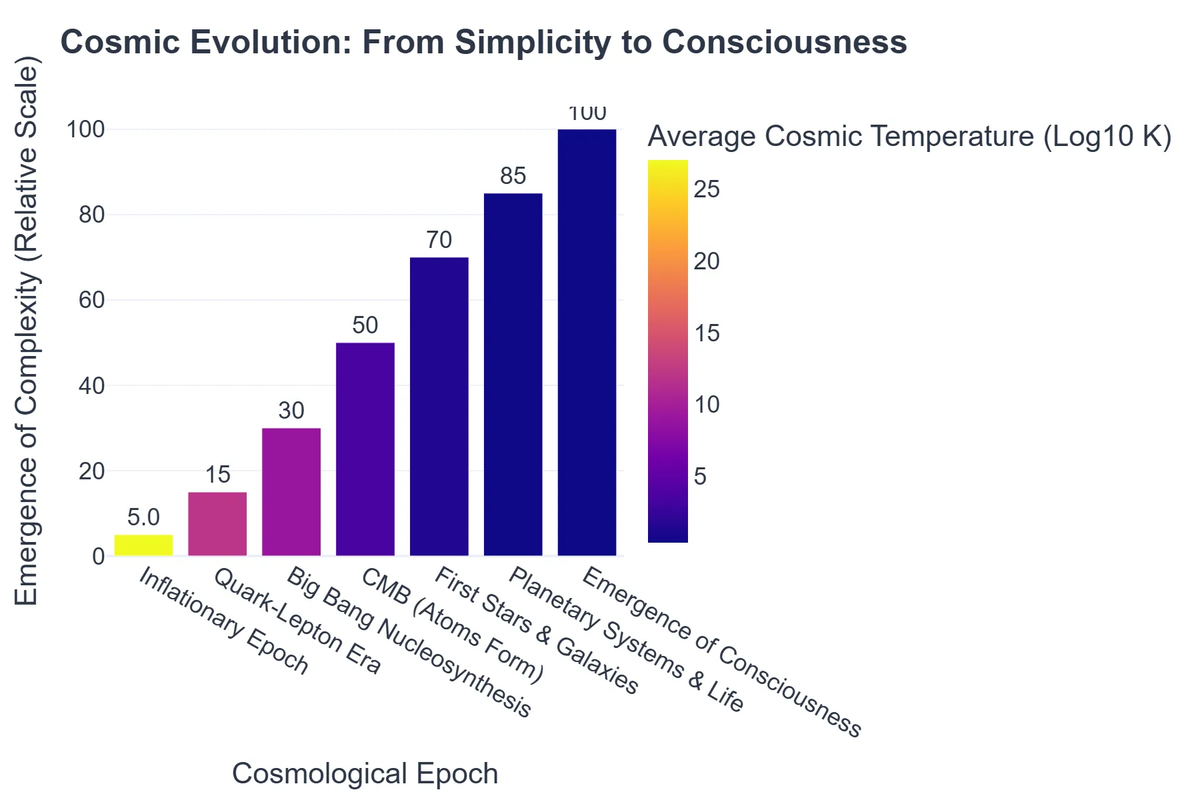
The human brain, with its estimated 86 billion neurons and trillions of connections, represents an unparalleled level of biological complexity. This intricate organization allows for:
- ✅ Self-Awareness: The ability to recognize oneself as a distinct individual.
- ➡️ Abstract Thought: The capacity for reasoning, problem-solving, and imagination.
- 💡 Empathy and Culture: The development of complex social structures and the transmission of knowledge across generations, as explored in Culture and Evolution: Shaping Human Societies.
The journey from the primordial cosmic soup to a being capable of contemplating its own origins is awe-inspiring. Some philosophers and scientists posit that consciousness isn’t just a biological phenomenon, but a cosmic one, representing the universe becoming aware of itself. As philosopher Thomas Nagel famously asked, “What is it like to be a bat?” – pushing us to consider the subjective experience of consciousness beyond our own species. This deep connection between cosmos and consciousness is a central theme in fields like philosophy, cosmology, and consciousness studies, explored by institutions like CIIS, which offers degrees in this area. (Philosophy, Cosmology, Consciousness Degrees | CIIS).
Indeed, one perspective suggests that “We are the cosmos made conscious and life is the means by which the universe gets to reflect on itself.” (Source: Reddit – “We are the cosmos made conscious…”). This profound idea underscores the interconnectedness of all stages of cosmological evolution, culminating in the human mind’s capacity for wonder and inquiry.
What is cosmological evolution?
Cosmological evolution refers to the continuous development and change of the universe from its origins (e.g., the Big Bang) to its current state, including the formation of galaxies, stars, and planets.
How does the cosmos influence the emergence of life?
The universe’s evolution provides the necessary elements (like carbon, oxygen) through stellar nucleosynthesis, suitable conditions (e.g., planetary systems), and timelines for complex biological systems to develop.
Is there a link between cosmic evolution and consciousness?
Many theories propose that consciousness is an emergent property arising from highly complex biological systems, which themselves are products of long cosmological and biological evolutionary processes.
What are the key stages of cosmological evolution?
Key stages include the Big Bang, inflation, nucleosynthesis, recombination, the “dark ages,” formation of first stars and galaxies, and the subsequent evolution of cosmic structures and chemical elements.