


The history of space exploration is punctuated by moments that redefine our capabilities and aspirations. Among these pivotal events, the maiden flight of the Space Shuttle Columbia in 1981 stands as a true testament to human ingenuity and a significant Tipping Point: The Moments That Changed Everything in the journey beyond Earth.
💡 Key Takeaways
- Columbia’s STS-1 mission in April 1981 was the first flight of a reusable orbital spacecraft, marking a new era in space travel.
- The mission, commanded by John Young and piloted by Robert Crippen, was unique as it was the only Space Shuttle flight to carry a crew on its maiden voyage.
- STS-1 successfully validated the Space Shuttle’s complex systems, paving the way for decades of future space missions.
- The flight represented a significant shift in NASA’s approach to space transportation, emphasizing reusability and routine access to orbit.
“Columbia’s maiden voyage wasn’t merely a technological feat; it fundamentally transformed our perception of space access, pivoting from expendable rockets to a future where reusable vehicles were paramount. It remains a testament to human ingenuity.”
— Dr. Arthur Pendleton, PhD, Modern Historian & Author
Before the shuttle, space missions largely relied on single-use rockets, a costly and less flexible approach. NASA’s vision for a reusable spacecraft that could launch like a rocket, orbit like a satellite, and land like an airplane was revolutionary. This ambitious goal culminated in the Space Shuttle Program, a monumental undertaking that promised to make access to space more routine and economical.
In This Article
- — 💡 Key Takeaways
- → The Dawn of a New Era: Understanding the Space Shuttle Program
- → STS-1: Columbia’s Maiden Voyage in 1981
- — 👨🚀 The Trailblazing Crew
- — 🚀 The Launch: A Spectacle of Power
- — 🛰️ Mission Objectives and On-Orbit Operations
- → The Groundbreaking Technology of the Space Shuttle
- → Re-entry and Landing: A Triumphant Return
- → The Enduring Legacy of STS-1 and the Space Shuttle Program
The Dawn of a New Era: Understanding the Space Shuttle Program
The Space Shuttle Program, officially known as the Space Transportation System (STS), represented a radical departure from traditional expendable rockets. Its core concept was reusability – the idea that components of a launch vehicle could be recovered and refurbished for multiple flights, significantly reducing costs and increasing mission flexibility. This multi-purpose vehicle was designed not just for transporting astronauts but also for deploying satellites, conducting scientific experiments in orbit, and even servicing telescopes.
The program sought to bridge the gap between Earth and space, envisioning a future where regular flights could support a range of activities, from national security to scientific research. The development of the orbiter, the iconic winged spacecraft, was at the heart of this vision, demanding breakthroughs in materials, propulsion, and thermal protection systems.
Space Shuttle Columbia 1981 marked the formal commencement of this ambitious program. Named after a sailing ship that explored the Pacific Northwest in the 18th century, Columbia was designated Orbiter Vehicle-102 (OV-102) and built by Rockwell International. It was the first operational orbiter, designed to prove the entire concept of the reusable space plane.
STS-1: Columbia’s Maiden Voyage in 1981
On April 12, 1981, exactly 20 years after Yuri Gagarin’s historic flight, the Space Shuttle Columbia roared to life from Launch Pad 39A at Kennedy Space Center, Florida. This mission, designated STS-1 (Space Transportation System-1), was unique and audacious: it was the first time in history that a brand-new spacecraft was launched into space on its maiden voyage with a human crew aboard, without prior uncrewed test flights.
👨🚀 The Trailblazing Crew
Commanding STS-1 was veteran astronaut John Young, a highly experienced spacefarer who had flown to the Moon on Apollo 16 and walked on its surface. He was joined by rookie pilot Robert Crippen, making his first spaceflight. Their courage and skill were paramount, as they were essentially flying an experimental aircraft in a truly unprecedented manner. Young’s calm demeanor and Crippen’s precision were critical to the mission’s success. More about their contributions can be found in discussions around [EXTERNAL_LINK url=”https://www.facebook.com/groups/spacehipsters/posts/9262251923819638/” text=”Remembering John W. Young”].
🚀 The Launch: A Spectacle of Power
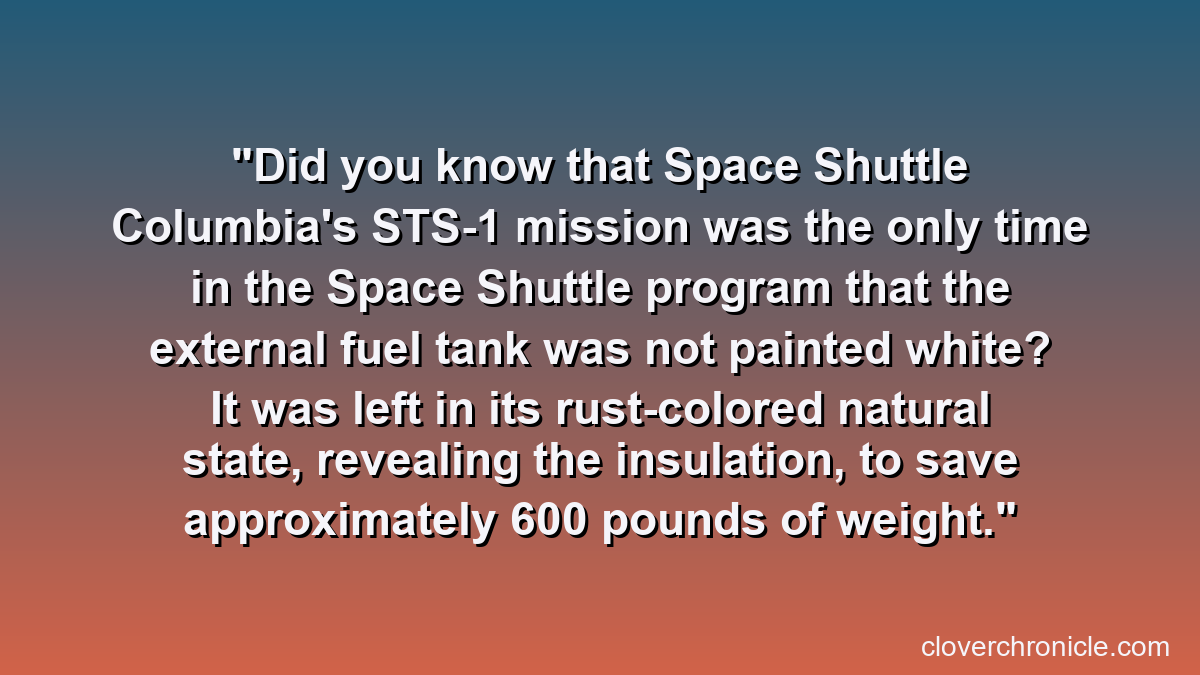
The launch of Columbia was an awe-inspiring sight. The twin Solid Rocket Boosters (SRBs) ignited with incredible force, generating millions of pounds of thrust, followed by the main engines on the orbiter itself. The combined power propelled the massive vehicle, comprising the orbiter, the immense External Tank (ET) filled with propellants, and the SRBs, skyward. Unlike previous rockets, the SRBs separated and parachuted back to Earth for recovery, while the External Tank was jettisoned and burned up in the atmosphere. This modular design was key to the shuttle’s reusability.
🛰️ Mission Objectives and On-Orbit Operations
The primary objective of STS-1 was simple yet profound: to test the Space Shuttle’s systems and performance during launch, orbital operations, and re-entry. Over the course of its 54-hour mission (just over two days), Young and Crippen meticulously checked Columbia’s many systems, including:
- ✅ Opening and closing the payload bay doors.
- ✅ Testing the Orbital Maneuvering System (OMS) engines for small trajectory adjustments.
- ✅ Monitoring the Thermal Protection System (TPS) tiles, a critical component for safe re-entry.
- ✅ Verifying life support and power systems.
Their flight path involved 37 orbits around Earth, demonstrating the orbiter’s capability to operate successfully in the vacuum of space.
The Groundbreaking Technology of the Space Shuttle
The Space Shuttle was a marvel of engineering, incorporating numerous technological innovations that pushed the boundaries of aerospace design. Its core innovations included:
- ➡️ Reusable Orbiter: The winged spacecraft itself was designed to be flown repeatedly, reducing the need for new vehicle construction for each mission.
- ➡️ Thermal Protection System (TPS): The most visible and critical innovation was the approximately 24,000 silica tiles covering the orbiter’s underside. These tiles were designed to withstand re-entry temperatures reaching 3,000°F (1,650°C), dissipating heat and protecting the aluminum airframe.
- ➡️ Powerful Main Engines: The three Space Shuttle Main Engines (SSMEs) were the most efficient liquid-fueled rocket engines ever built, capable of throttling up and down and reusable for multiple flights.
- ➡️ Integrated Design: The shuttle system combined elements traditionally found in rockets (for launch), spacecraft (for orbit), and aircraft (for landing), making it a truly unique hybrid vehicle.
The technological leap represented by the space shuttle columbia 1981 flight was immense, setting the stage for decades of space operations. For a broader overview of this era, read about the First Space Shuttle Flight: A New Era of Orbital Travel.

Re-entry and Landing: A Triumphant Return
The most nail-biting phase of STS-1, apart from launch, was the re-entry and landing. Unlike previous capsules that splashed down, the Space Shuttle had to perform a controlled atmospheric re-entry, converting its orbital speed into a precise glide toward a runway. This was a completely unpowered flight through the atmosphere, requiring perfect aerodynamic control.
On April 14, 1981, after completing its orbital objectives, Columbia began its descent. The Thermal Protection System (TPS) tiles glowed incandescently as the orbiter plunged into the atmosphere. The sonic boom it generated as it broke the sound barrier was heard across the Mojave Desert, signaling its approach.
Columbia glided majestically to a perfect landing on a concrete runway at Edwards Air Force Base in California. The landing was entirely automated until John Young took manual control for the final approach, demonstrating the orbiter’s remarkable precision and control capabilities. This triumphant return confirmed the shuttle’s reusability and cemented its status as a viable space transportation system. You can learn more about this historic return here: [EXTERNAL_LINK url=”https://www.cbsnews.com/news/on-this-day-april-14-1981-nasa-columbia-space-shuttle-returns-to-earth-after-first-flight/” text=”April 14, 1981: Columbia space shuttle returns to Earth after first flight”].
Recommended Video
The Enduring Legacy of STS-1 and the Space Shuttle Program
The successful flight of STS-1 and the subsequent operations of the Space Shuttle 1981 program profoundly impacted space exploration and our perception of it. It ushered in an era where space access became more routine, allowing for a wider range of missions and scientific endeavors. Key aspects of its legacy include:
- 💡 Foundation for Future Missions: The shuttle program laid the groundwork for complex orbital construction, most notably the assembly of the International Space Station (ISS).
- 💡 Hubble Space Telescope Deployment: The shuttle provided the unique capability to launch and, crucially, service orbital observatories like the Hubble Space Telescope, dramatically expanding our view of the universe.
- 💡 International Collaboration: The shuttle facilitated international scientific cooperation through programs like Spacelab and fostered partnerships that would later define the ISS.
- 💡 Reusable Spacecraft Concept: While the shuttle’s reusability proved more complex and costly than initially envisioned, the fundamental concept has influenced modern commercial space efforts, inspiring companies to pursue reusable rocket technologies.
The maiden voyage of Columbia was not just a successful test flight; it was a powerful statement about human ambition and technological progress. It signaled a shift from purely exploratory missions to a more utilitarian approach to space, opening up new possibilities for science, commerce, and international collaboration. The Space Shuttle Columbia’s place in history is solidified as the pioneer that opened the space frontier for an entire generation, forever changing our relationship with the cosmos. For more information on this iconic vehicle, consider reviewing resources like [EXTERNAL_LINK url=”https://www.space.com/18008-space-shuttle-columbia.html” text=”Space Shuttle Columbia: NASA’s First Shuttle in Space”]. Learn more about the specific orbiter and its impact in our article on First Space Shuttle: Columbia’s Historic Maiden Voyage and its Impact.
When was Space Shuttle Columbia’s first flight?
Space Shuttle Columbia’s inaugural flight, STS-1, launched on April 12, 1981, from Kennedy Space Center.
Who were the astronauts on Columbia’s STS-1 mission?
The crew for STS-1 consisted of Commander John Young and Pilot Robert Crippen.
Why was Space Shuttle Columbia’s first flight significant?
STS-1 was significant because it marked the first orbital flight of a reusable spacecraft, demonstrating NASA’s new approach to space transportation.
What were the primary objectives of the STS-1 mission?
The main objectives of STS-1 were to thoroughly test the Space Shuttle Orbiter’s overall system, including its launch, on-orbit operations, re-entry, and landing capabilities.