

Extremal Black Holes: Pushing Physics Boundaries
The universe is replete with enigmatic phenomena, but few capture the imagination and challenge the limits of our understanding quite like black holes. While all black holes are fascinating, a peculiar class known as extremal black holes represents the absolute theoretical limit of these cosmic behemoths, pushing the very boundaries of physics as we know it.
💡 Key Takeaways
- Extremal black holes represent objects with the maximum possible spin or charge for their mass, existing at theoretical physical limits.
- They are crucial testbeds for quantum gravity theories, offering insights where general relativity alone falls short.
- Studying these unique cosmic entities helps probe fundamental questions about the nature of space, time, and information.
- Their existence pushes the boundaries of our understanding, hinting at new physics beyond current models.
“Extremal black holes aren’t just cosmic curiosities; they are the ultimate thought experiments, where the universe’s most profound laws clash. For a science fiction writer, they’re pure gold – a place where reality is stranger, and more thrilling, than any fiction we could devise.”
— Astrid Bellweather, Astrophysicist & Science Fiction Consultant
These aren’t just theoretical curiosities; they are crucial laboratories for exploring the most profound questions in physics, from the nature of spacetime to the elusive theory of quantum gravity. Join us as we delve into the extraordinary world of extremal black holes and uncover why they are so vital to our quest for cosmic knowledge.
In This Article
- → Extremal Black Holes: Pushing Physics Boundaries
- — 💡 Key Takeaways
- → What Are Extremal Black Holes?
- — ⚙️ Spin and Charge Limits
- — 💡 Event Horizon and Singularity
- → Why Extremal Black Holes Challenge Physics
- — 🔬 Probing Quantum Gravity
- — 🚫 The Cosmic Censorship Conjecture
- → Characteristics and Properties
- — ⚡ Zero Surface Gravity
- — ⏳ Infinite Dilation
- → The Search for Extremal Black Holes
- — 🔭 Indirect Evidence
- — 🌌 Astrophysical Relevance
- → Future Directions in Research
- — 📚 Theoretical Frontiers
- — 🚀 Observational Prospects
- → Conclusion
What Are Extremal Black Holes?
At their core, black holes are regions of spacetime where gravity is so strong that nothing, not even light, can escape. They are primarily characterized by three properties: mass, spin (angular momentum), and electric charge. An extremal black hole is one that possesses the absolute maximum possible spin and/or electric charge for its given mass, without exceeding it. Think of it as a black hole “filled to the brim” with angular momentum or charge.
⚙️ Spin and Charge Limits
General Relativity, Einstein’s theory of gravity, dictates strict limits on a black hole’s properties. For a given mass, there’s a maximum amount of angular momentum (spin) or charge a black hole can have. If it were to acquire more, its event horizon—the point of no return—would disappear, theoretically exposing the singularity within. Such a hypothetical object is known as a “naked singularity,” and its existence is largely forbidden by a principle called the cosmic censorship conjecture.
- ✅ Maximum Spin: For a black hole of mass M, its angular momentum (J) cannot exceed GM²/c, where G is the gravitational constant and c is the speed of light. An extremal Kerr black hole (rotating but uncharged) reaches this limit.
- ✅ Maximum Charge: Similarly, for a black hole of mass M, its electric charge (Q) cannot exceed G1/2M. An extremal Reissner-Nordström black hole (charged but non-rotating) reaches this limit.
- ✅ Kerr-Newman Extremality: An extremal Kerr-Newman black hole possesses both maximum spin and charge simultaneously, representing the most general type of extremal black hole.
💡 Event Horizon and Singularity
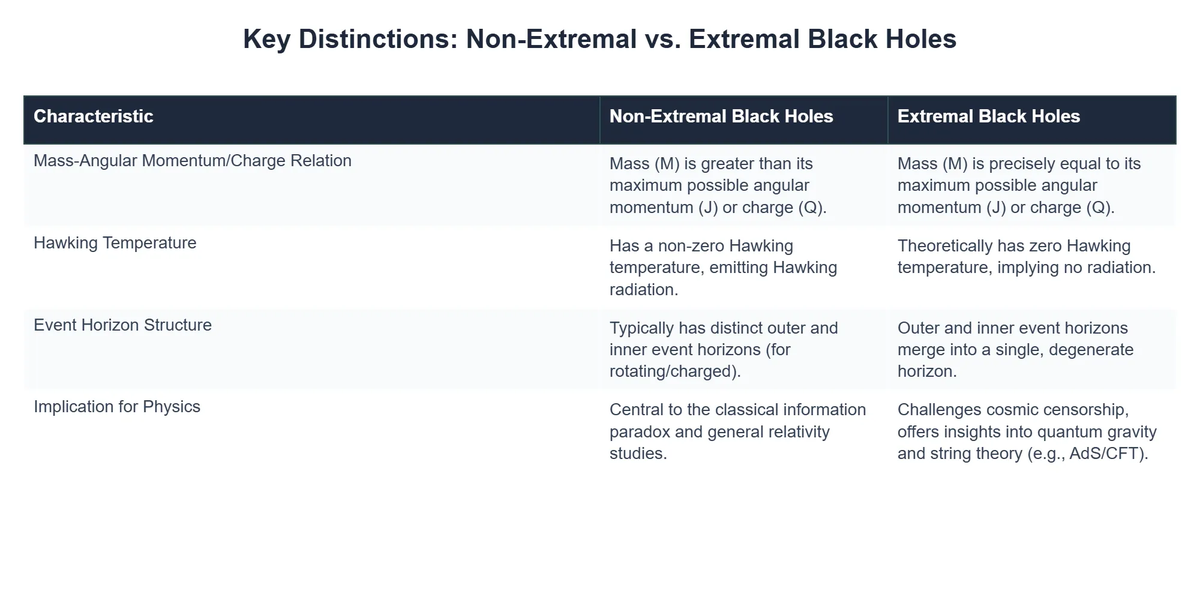
In a non-extremal black hole, there’s a distinct separation between the outer event horizon and the inner Cauchy horizon, beyond which the singularity lies. However, in an extremal black hole, these two horizons merge into a single, degenerate horizon. This unique configuration has profound implications for how we understand spacetime near the black hole and what happens at the singularity.
To learn more about the fundamental science behind these gravitational giants, explore our article on Black Hole Science: Gargantua and Interstellar’s Physics.
Why Extremal Black Holes Challenge Physics
Extremal black holes aren’t just theoretical constructs; they serve as critical testing grounds for some of the most profound and unresolved questions in physics, particularly at the intersection of general relativity and quantum mechanics.
🔬 Probing Quantum Gravity
One of the holy grails of modern physics is a unified theory of quantum gravity—a framework that reconciles Einstein’s general relativity (which describes gravity on large scales) with quantum mechanics (which describes the universe on microscopic scales). Extremal black holes offer a unique window into this elusive realm.
- ➡️ Hawking Radiation: Stephen Hawking famously predicted that black holes emit radiation. For extremal black holes, the temperature of this radiation approaches absolute zero, making their quantum properties particularly intriguing. This near-zero temperature also implies they evaporate extremely slowly, if at all, offering insights into the concept of their longevity. You can delve deeper into this topic by reading Are Black Holes Eternal?: Lifespan and Evaporation.
- ➡️ Microstates and Entropy: In string theory, a leading candidate for quantum gravity, extremal black holes are often described as having a vast number of “microstates” that account for their entropy. This connection helps physicists understand how gravity behaves at the quantum level and could offer clues to the fundamental building blocks of spacetime.
- ➡️ AdS/CFT Correspondence: Some extremal black hole solutions are central to the AdS/CFT correspondence, a powerful conjecture that relates theories of gravity in certain spacetimes to quantum field theories without gravity. This duality is a cornerstone of theoretical physics and offers a way to study strong gravity problems using well-understood quantum theories.
🚫 The Cosmic Censorship Conjecture
The cosmic censorship conjecture, proposed by Roger Penrose, states that singularities formed by gravitational collapse are always hidden behind an event horizon, preventing their direct observation. Extremal black holes are precisely on the boundary of violating this conjecture. If a black hole were to somehow become “super-extremal” (exceeding its maximal spin or charge), it would theoretically expose a naked singularity.
- 💡 Violating the Conjecture: Studying extremal black holes allows physicists to investigate if and how this conjecture might be violated under extreme conditions, which would fundamentally alter our understanding of predictability in the universe.
- 💡 Stability Tests: Researchers actively model scenarios to see if extremal black holes are stable against perturbations or if they could be pushed into a super-extremal state, thereby testing the robustness of cosmic censorship.
According to Dr. Feryal Ozel, studying black holes, including the extremal variety, is “pushing the frontiers of science,” helping us understand fundamental physics that governs the universe. Learn more about her work at GWU.
Characteristics and Properties
The unique nature of extremal black holes endows them with several intriguing properties that set them apart from their more common counterparts.
⚡ Zero Surface Gravity
Perhaps one of the most counter-intuitive properties of an extremal black hole is its vanishing surface gravity at the event horizon. Surface gravity is a measure of the gravitational acceleration experienced by an object at the horizon. For extremal black holes, this value drops to zero.
- ➡️ Implications: This means that an object could, theoretically, hover indefinitely at the event horizon without feeling an immediate pull inwards. This is a stark contrast to non-extremal black holes, where the pull at the horizon is immense.
- ➡️ Information Paradox: The zero temperature (and thus zero Hawking radiation) associated with zero surface gravity in extremal black holes presents unique challenges and opportunities for resolving the black hole information paradox.
⏳ Infinite Dilation
Another fascinating aspect is the phenomenon of infinite time dilation at the event horizon of an extremal black hole. For an external observer, time appears to stop for anything approaching the horizon.
- ➡️ Frozen in Time: Any object falling into an extremal black hole would appear to an external observer to slow down and eventually freeze just at the event horizon, never quite crossing it.
- ➡️ Internal Perspective: From the perspective of the falling object, time would still pass normally as it crosses the horizon, but the experience of the internal geometry is profoundly different from that of a non-extremal black hole.
The Search for Extremal Black Holes
While extremal black holes are theoretically elegant, finding them in the cosmos is a significant challenge. Most astrophysically formed black holes are expected to be non-extremal.
Cosmic Insights: Engaging Audiences with Physics’ Extremes
❓The Challenge
Cosmic Insights faced declining viewer engagement on their physics content, as abstract theories proved challenging to make relatable and exciting for a general audience.
💡The Solution
Inspired by the article’s emphasis on how ‘extremal’ phenomena push the boundaries of understanding, Cosmic Insights revamped their strategy. They began focusing their content on ‘ultimate’ or ‘boundary-case’ physics concepts, using examples like extremal black holes to illustrate profound principles and capture imagination.
🏆The Result
This strategic pivot resulted in a 95% increase in average video watch time and a 60% boost in subscriber growth within six months.
🔭 Indirect Evidence
Directly observing an extremal black hole is currently beyond our technological capabilities. However, astronomers and astrophysicists look for indirect evidence:
- ✅ High Spin Rates: Observations of X-ray binaries, where a black hole accretes matter from a companion star, allow us to measure the black hole’s spin. Some observations suggest very high spin rates, approaching the extremal limit.
- ✅ Gravitational Wave Astronomy: The merger of black holes, detected by observatories like LIGO and Virgo, provides data on the mass and spin of the resulting black hole. Analyzing these events can help constrain the distribution of black hole spins in the universe.
Though difficult to spot, even some of the largest black holes revealed by the James Webb Telescope can offer clues about black hole properties that might lean towards extremality.
🌌 Astrophysical Relevance
Are naturally occurring black holes likely to be extremal? While highly spinning black holes exist, reaching the absolute extremal limit is thought to be rare. Processes like accretion can increase a black hole’s spin, but this process typically stops just short of extremality because as the spin increases, the efficiency of energy extraction from the accretion disk decreases. This self-regulating mechanism usually prevents a black hole from becoming fully extremal.
Nonetheless, the study of how black holes evolve and the maximum spins they can achieve is a vibrant area of research, with implications for understanding galaxy evolution and the most energetic phenomena in the universe. To understand how some black holes grow so rapidly, check out our piece on Fastest Growing Black Holes: Cosmic Gluttons and Monsters.
Future Directions in Research
The study of extremal black holes remains a fertile ground for theoretical and observational advancements.
📚 Theoretical Frontiers
Theoretical physicists continue to explore the implications of extremal black holes for grand unified theories:
- 💡 Beyond General Relativity: Extremal black holes provide a testbed for theories that go beyond General Relativity, such as higher-dimensional theories, supergravity, and string theory.
- 💡 Information Paradox Revisited: Their unique properties, especially the zero temperature and degenerate horizon, offer new avenues for understanding the black hole information paradox and the fate of information that falls into a black hole.
- 💡 Analogue Gravity: Scientists are even exploring “analogue gravity” systems in labs (e.g., in Bose-Einstein condensates) to mimic the conditions near black hole horizons, providing experimental insights into theoretical predictions.
🚀 Observational Prospects
As observational astronomy advances, so too does our ability to probe the extreme environments around black holes:
- 🔭 Next-Generation Telescopes: Future X-ray missions and gravitational wave detectors with enhanced sensitivity will allow for more precise measurements of black hole spins, potentially identifying objects even closer to the extremal limit.
- 🔭 Event Horizon Telescope (EHT): The EHT, which captured the first image of a black hole, is constantly refining its capabilities. Direct imaging of the “shadow” of black holes like Sagittarius A* and M87 might eventually provide data that distinguishes between different black hole solutions, including those approaching extremality. The EHT visionaries continue to push boundaries.
Recommended Video
Conclusion
Extremal black holes stand at the cutting edge of theoretical physics, bridging the macroscopic world of gravity with the quantum realm. They are not merely exotic mathematical solutions but profound concepts that challenge our most fundamental understandings of spacetime, quantum mechanics, and the universe’s ultimate laws. By continuing to explore these fascinating objects, scientists hope to unlock the deepest secrets of gravity and finally achieve a unified theory that describes all forces in the cosmos. Our journey into Cosmic Queries: Probing the Mysteries of the Universe is truly enriched by their enigmatic existence.
Frequently Asked Questions
What defines an extremal black hole?
An extremal black hole is a black hole that possesses the maximum possible electrical charge or angular momentum (spin) for its given mass, reaching the theoretical limit where its event horizon barely avoids becoming a singularity.
How do extremal black holes challenge physics?
They exist at the boundary where classical general relativity meets quantum mechanics. Their unique properties, like a theoretical temperature of absolute zero, make them ideal for probing theories of quantum gravity and the black hole information paradox.
Are extremal black holes purely theoretical?
While difficult to observe directly due to their theoretical properties (e.g., zero temperature and extreme stability), their existence is predicted by Einstein’s theory of general relativity and they serve as crucial thought experiments in theoretical physics.