


The dawn of a new era in space travel is here, spearheaded by the ambitious Orion spacecraft. Designed by Lockheed Martin for NASA, Orion stands as the cornerstone of humanity’s return to the Moon and its further ventures into the cosmos. This revolutionary vehicle is purpose-built to carry astronauts deeper into space than ever before, enabling sustained human presence and exploration beyond low-Earth orbit.
💡 Key Takeaways
- Orion is NASA’s multi-purpose crew vehicle (MPCV) designed for sustained human exploration beyond low-Earth orbit.
- It is a critical component of the Artemis program, aiming to return humans to the Moon and eventually Mars.
- Orion boasts advanced life support systems and radiation shielding to protect astronauts on long-duration deep space missions.
- The spacecraft has undergone rigorous testing, including uncrewed flights, to validate its capabilities for future crewed journeys.
“Orion isn’t just a capsule; it’s humanity’s next giant leap, a robust testament to our enduring desire to push boundaries and unlock the cosmos’ deepest secrets.”
— Astrid Bellweather, Astrophysicist & Science Communicator
As part of NASA’s grand vision for human deep space exploration, Orion represents a critical leap forward. It combines the best of past space exploration technologies with cutting-edge innovations, preparing us for destinations like Mars and beyond. Understanding Orion is key to grasping the future of human endeavors in the vast expanse of the universe. For a broader perspective on cosmic exploration, delve into our pillar guide: Cosmic Queries: Probing the Mysteries of the Universe.
In This Article
- — 💡 Key Takeaways
- → What is the Orion Spacecraft? The Gateway to Deep Space
- → 🚀 Key Features and Technological Marvels
- — Enhanced Life Support and Environmental Control
- — Advanced Heat Shield and Re-entry Capabilities
- — 🛡️ Radiation Protection
- — Robust Communications and Navigation
- → Orion’s Pivotal Role in the NASA Artemis Program
- → Milestones and the Path Ahead for Deep Space Exploration
- — Exploration Flight Test-1 (EFT-1)
- — Artemis I: A Resounding Success
- — Future Missions and Martian Ambitions
What is the Orion Spacecraft? The Gateway to Deep Space
The Orion spacecraft is NASA’s next-generation crew vehicle, engineered to transport astronauts to the Moon, asteroids, and eventually Mars. It is a highly robust and capable capsule designed to withstand the rigors of deep space environments, ensuring the safety and survival of its crew over extended missions.
Developed primarily by Lockheed Martin, the lockheed orion spacecraft features a distinct capsule design reminiscent of the Apollo command modules, but significantly larger and more advanced. It is composed of two primary modules:
- ✅ Crew Module (CM): The living and working quarters for astronauts, designed to carry up to four crew members. It’s the only part of Orion that returns to Earth.
- ✅ European Service Module (ESM): Provided by the European Space Agency (ESA), this module provides propulsion, power, thermal control, and life support systems for the spacecraft. It’s critical for long-duration missions.
This dual-module architecture allows for unprecedented mission flexibility and capability, distinguishing Orion from previous human-rated spacecraft.
🚀 Key Features and Technological Marvels
Orion’s ability to facilitate human deep space exploration relies on a suite of advanced technologies, each vital for surviving and operating far from Earth’s protective embrace. These innovations address challenges such as radiation, extreme temperatures, and communication delays.
Enhanced Life Support and Environmental Control
Unlike missions to low-Earth orbit, deep space missions require self-sustaining life support systems that can operate for weeks or months without resupply. Orion’s Environmental Control and Life Support System (ECLSS) recycles water, regenerates oxygen, and removes carbon dioxide, maximizing resource efficiency.
Orion Spacecraft: Deep Space Exploration – Pros and Cons
Pros
- ✔Enables human return to the Moon and future deep space missions (e.g., Mars).
- ✔Designed with advanced life support and radiation shielding for astronaut safety.
- ✔Provides a critical capability for crewed missions beyond low-Earth orbit.
- ✔Modular design allows for flexibility in mission profiles.
Cons
- ✖Extremely high development and operational costs.
- ✖Requires the Space Launch System (SLS), which has also faced significant delays and cost overruns.
- ✖Limited crew capacity (4 astronauts) for ambitious deep space expeditions.
- ✖Still in early operational phases, with full deep space capabilities yet to be proven.
Advanced Heat Shield and Re-entry Capabilities
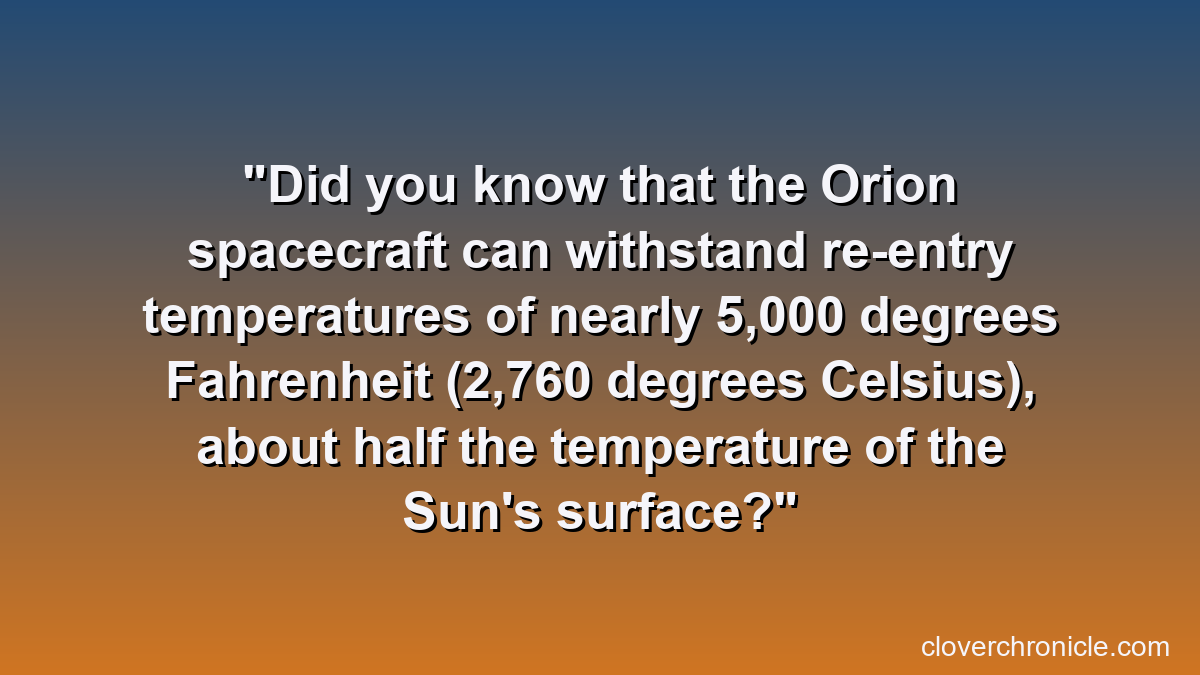
Returning from deep space, Orion will hit Earth’s atmosphere at speeds far greater than those experienced by Apollo or Space Shuttle missions. Its 16.5-foot (5-meter) diameter heat shield, made of Avcoat ablative material, is the largest of its kind ever built, designed to endure temperatures up to 5,000 degrees Fahrenheit (2,760 degrees Celsius).
🛡️ Radiation Protection
Beyond Earth’s magnetic field, astronauts are exposed to harmful galactic cosmic rays and solar particle events. Orion incorporates advanced shielding and a storm shelter area within the capsule to protect the crew during severe solar events. This protection is paramount for long-duration missions to distant destinations.
Robust Communications and Navigation
Communicating over vast distances requires powerful and reliable systems. Orion utilizes high-gain antennas and advanced transponders to maintain contact with Earth, even as it travels hundreds of thousands of miles away. Autonomous navigation systems also reduce reliance on ground control, crucial for missions with significant communication delays.
For more on how spacecraft navigate the cosmos, consider exploring Orbiter Spacecraft: Eyes and Ears in Planetary Exploration.
Orion’s Pivotal Role in the NASA Artemis Program
The Orion spacecraft is the centerpiece of the NASA Artemis program, which aims to return humans to the Moon by 2025 and establish a sustainable lunar presence. Artemis is not merely a repeat of Apollo; it’s a stepping stone to Mars, with Orion playing the vital role of the crew transport vehicle.
The Artemis program is structured in a series of increasingly complex missions:
- ➡️ Artemis I: An uncrewed test flight of Orion and the Space Launch System (SLS) rocket around the Moon. Successfully completed in late 2022, this mission validated Orion’s performance in deep space environments and its re-entry capabilities.
- ➡️ Artemis II: The first crewed Orion mission around the Moon, scheduled for 2024. This mission will carry astronauts farther than any human has traveled before, testing Orion’s life support systems with a crew aboard.
- ➡️ Artemis III: The mission that will land humans on the Moon, targeting the lunar South Pole, no earlier than 2025. Orion will transport the crew to lunar orbit, where they will transfer to a Human Landing System for the descent to the surface.
The long-term vision includes establishing a lunar Gateway space station in orbit around the Moon, which Orion will use as a rendezvous point for future lunar and Mars missions. This strategic approach ensures a systematic expansion of human deep space exploration capabilities.
Learn more about the broader scope of NASA’s lunar ambitions by reading our article: Artemis Program: The Future of Lunar Exploration.
Milestones and the Path Ahead for Deep Space Exploration
Orion’s journey to becoming the workhorse for deep space travel has been long and meticulous, marked by significant test flights and developmental milestones. Each step has brought NASA closer to its ambitious goals.
Exploration Flight Test-1 (EFT-1)
In December 2014, Orion completed its first uncrewed test flight, EFT-1. Launched atop a Delta IV Heavy rocket, Orion traveled 3,600 miles (5,800 km) into space, tested its systems, and performed a high-speed re-entry. This critical test validated its structural integrity, avionics, and thermal protection system.
Artemis I: A Resounding Success
The uncrewed Artemis I mission, launched in November 2022, saw Orion travel approximately 270,000 miles (430,000 km) beyond Earth, spending 25 days in space, including six days in a distant retrograde orbit around the Moon. This mission provided invaluable data on Orion’s performance in the deep space radiation environment, its advanced communication systems, and its precise splashdown in the Pacific Ocean.
The success of Artemis I has paved the way for subsequent crewed missions, signifying a monumental step forward in human deep space exploration.
Future Missions and Martian Ambitions
Beyond returning to the Moon, Orion is foundational for future missions to Mars. Its design allows for long-duration missions, and it will eventually serve as the primary crew transport for the journey to the Red Planet. This involves developing new propulsion technologies and life support systems that can sustain crews for months or even years in transit.
The data and experience gained from Artemis lunar missions will be directly applied to designing and executing crewed missions to Mars, truly pushing the boundaries of what’s possible for human spaceflight. For a look at the history and future of moon landings, refer to Astronaut Moon Landing: History and Future of Lunar Exploration.
Recommended Video
In summary, the Orion spacecraft is more than just a vehicle; it’s a testament to human ingenuity and a beacon for our collective ambition to explore the deep reaches of space. As the cornerstone of the Artemis program, Orion is not only paving the way back to the Moon but is also setting the stage for humanity’s monumental journey to Mars and beyond, ensuring a future where the cosmos is within our grasp.
What is the primary purpose of the Orion spacecraft?
The Orion spacecraft is designed to transport astronauts beyond low-Earth orbit, facilitating deep space missions to the Moon, Mars, and potentially other destinations.
Which space program is Orion a part of?
Orion is a central component of NASA’s Artemis program, which aims to land the first woman and next man on the Moon, setting the stage for human exploration of Mars.
How many astronauts can Orion carry?
The Orion spacecraft is designed to carry a crew of up to four astronauts for deep space missions.
What makes Orion different from previous spacecraft like Apollo?
While similar in some ways, Orion is designed for longer-duration missions, incorporates more advanced technology, and features improved life support and radiation protection systems for journeys far beyond lunar orbit.