


Orbiter Spacecraft: Eyes and Ears in Planetary Exploration
In the vast expanse of our cosmos, our quest to understand distant worlds relies heavily on a specialized class of robotic explorers: the orbiter spacecraft. These remarkable machines are designed to achieve and maintain orbit around celestial bodies—planets, moons, asteroids, and even comets—acting as persistent sentinels. Far from mere flyby probes, orbiters provide an unparalleled, long-term vantage point, allowing scientists to meticulously map surfaces, analyze atmospheres, probe gravity fields, and monitor environmental changes over extended periods. They are, quite literally, the eyes and ears of humanity in deep space, revolutionizing our understanding of planetary exploration.
💡 Key Takeaways
- Orbiter spacecraft provide long-term, high-resolution data collection from a safe distance.
- They are crucial for detailed mapping, atmospheric studies, and identifying potential landing sites.
- Orbiters play a key role in understanding planetary geology, climate, and the potential for life beyond Earth.
- Their continuous observations significantly advance our knowledge of the solar system without direct surface interaction.
“Orbiters are the ultimate slow-burn thrill: patiently gathering data that redefines our understanding of alien worlds, turning science fiction into meticulous, orbital fact. They are the silent, watchful sentinels of cosmic truth.”
— Astrid Bellweather, Astrophysicist & Science Fiction Consultant
This comprehensive guide will delve into the critical role of orbiter spacecraft, exploring their sophisticated technologies, highlighting their most iconic missions, and examining their indispensable contribution to our ongoing cosmic quest. For a broader perspective on how various craft contribute to our understanding, explore our Cosmic Queries: Probing the Mysteries of the Universe pillar page.
In This Article
- → Orbiter Spacecraft: Eyes and Ears in Planetary Exploration
- — 💡 Key Takeaways
- → What Are Orbiter Spacecraft? Defining Their Crucial Role
- — Beyond Flybys: The Advantage of Orbital Missions
- — Core Components of an Orbiter
- → ⚙️ Key Technologies and Scientific Instruments on Orbiters
- — Remote Sensing: The “Eyes” of Orbiters
- — Data Transmission and Power Systems
- → Iconic Orbiter Missions: A Legacy of Discovery
- — Mars Reconnaissance Orbiter (MRO)
- — Cassini-Huygens at Saturn
- — Lunar Reconnaissance Orbiter (LRO)
- — Other Notable Orbiters
- → The Indispensable Role of Orbiters in Future Planetary Exploration
- — Site Selection for Landers and Rovers
- — Long-Term Monitoring of Planetary Changes
- — Supporting Human Missions
- → Challenges and Innovations in Orbiter Design
- — Surviving Harsh Space Environments
- — Miniaturization and CubeSats
- → Conclusion: Orbiters – Our Persistent Probes of the Cosmos
What Are Orbiter Spacecraft? Defining Their Crucial Role
An orbiter spacecraft is a robotic probe specifically engineered to enter orbit around a target celestial body and remain there for an extended duration, sometimes for years or even decades. Unlike flyby missions that offer fleeting glimpses, orbiters provide continuous, high-resolution data, transforming our understanding of planetary environments.
Beyond Flybys: The Advantage of Orbital Missions
While Spacecraft Flybys: Exploring Distant Worlds offer the first reconnaissance of a new world, orbiters take scientific investigation to the next level. Their key advantages include:
- ✅ Long-term Observation: Orbiters can monitor seasonal changes, atmospheric dynamics, and geological processes over years, providing invaluable time-series data.
- ✅ Comprehensive Mapping: They enable the creation of detailed global maps, revealing surface features, mineral compositions, and topographical variations with high precision.
- ✅ Targeted Data Collection: Scientists can command orbiters to focus on specific regions of interest, such as potential landing sites or areas exhibiting unusual phenomena.
- ✅ Precursor for Landers/Rovers: Orbiters often serve as critical reconnaissance missions, identifying safe and scientifically interesting landing sites for subsequent missions like rovers or human landings.
Core Components of an Orbiter
Every orbiter is a marvel of engineering, equipped with systems tailored for long-duration operation in harsh space environments. Key components typically include:
- ➡️ Scientific Instruments: The core payload, comprising cameras, spectrometers, radar, magnetometers, and other sensors.
- ➡️ Propulsion System: Engines and fuel tanks for orbital insertion, trajectory corrections, and station-keeping maneuvers.
- ➡️ Power System: Solar panels (for inner solar system missions) or Radioisotope Thermoelectric Generators (RTGs) (for outer solar system missions) to generate electricity.
- ➡️ Communication System: Antennas and transceivers to send scientific data and receive commands from Earth.
- ➡️ Navigation and Attitude Control: Star trackers, gyroscopes, and reaction wheels to determine and maintain the spacecraft’s orientation and position.
- ➡️ Thermal Control: Systems to regulate internal temperatures, protecting sensitive electronics from extreme heat and cold.
⚙️ Key Technologies and Scientific Instruments on Orbiters
The true power of an orbiter lies in its sophisticated array of scientific instruments, designed to collect a vast spectrum of data about its target body.
Remote Sensing: The “Eyes” of Orbiters
Most orbiter instruments fall under the category of remote sensing, meaning they gather information without direct contact with the surface.
- 💡 High-Resolution Cameras: Provide detailed imagery for mapping surface features, identifying geological structures, and monitoring changes.
- 💡 Spectrometers (Visible, Infrared, Gamma-Ray, X-ray): Analyze the light reflected or emitted from a surface or atmosphere to determine chemical and mineral composition. This is crucial for identifying water, ice, and various rock types.
- 💡 Radar Systems: Can penetrate through clouds or ice to map sub-surface features, measure surface topography, and even detect underground water reservoirs.
- 💡 Magnetometers: Measure the strength and direction of magnetic fields, revealing insights into a planet’s interior structure and past geological activity.
- 💡 Gravity Science Instruments: By tracking tiny changes in an orbiter’s trajectory, scientists can map variations in a planet’s gravitational field, inferring internal mass distribution.
Data Transmission and Power Systems
Robust communication systems are paramount. Orbiters transmit enormous volumes of data—images, spectral readings, telemetry—across vast distances back to Earth. This requires large, directional antennas and powerful transmitters. The longevity of a mission often hinges on its power source; solar panels are effective closer to the sun, while RTGs provide reliable power for missions to the outer solar system where sunlight is too dim.
Iconic Orbiter Missions: A Legacy of Discovery
Throughout the history of space exploration, numerous orbiters have redefined our understanding of our solar system. For a comprehensive overview of pioneering missions, you might find our article on Historic Spacecraft: The Pioneers of Space Exploration insightful.
Mars Reconnaissance Orbiter (MRO)
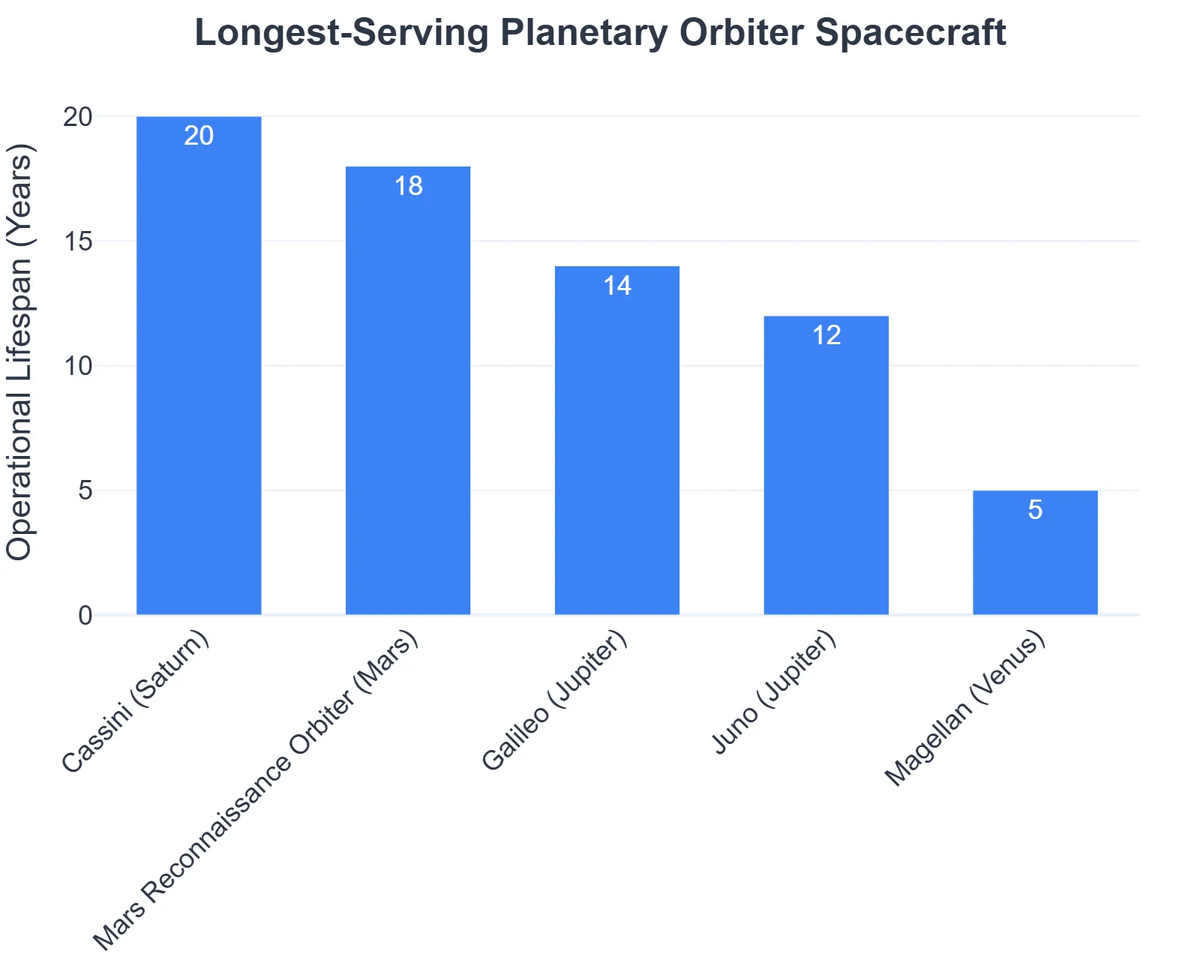
Launched in 2005, MRO has been instrumental in studying Mars. Its High Resolution Imaging Science Experiment (HiRISE) camera has provided stunningly detailed images of the Martian surface, revealing everything from avalanches on polar ice caps to potential ancient riverbeds. MRO also acts as a crucial data relay for surface missions like the Perseverance rover. Its instruments, much like those on Mars rovers, provide comprehensive data on the planet’s geology and atmosphere. Learn more about the components that enable such detailed exploration on NASA Science.
Cassini-Huygens at Saturn
One of the most ambitious and successful planetary missions, Cassini orbited Saturn from 2004 to 2017. It unveiled the intricate details of Saturn’s rings, discovered new moons, and profoundly changed our understanding of the gas giant’s complex system. The Huygens probe, deployed from Cassini, successfully landed on Saturn’s largest moon, Titan, providing the first direct measurements of that mysterious world. The mission concluded with a controlled plunge into Saturn’s atmosphere. The Cassini Orbiter truly redefined our understanding of the Saturnian system. Discover more about the Cassini Orbiter and its incredible journey on NASA Solar System Exploration.
Lunar Reconnaissance Orbiter (LRO)
Since 2009, LRO has been meticulously mapping the Moon’s surface, providing crucial data for future lunar missions, including the Artemis program. LRO has identified potential resources, characterized radiation environments, and captured incredibly detailed images of landing sites, including those of the Apollo missions. LRO’s precise mapping and resource identification are vital for the upcoming human missions planned by the Artemis Program: The Future of Lunar Exploration.
Other Notable Orbiters
- ✅ Juno (Jupiter): Providing unprecedented views of Jupiter’s polar regions and probing its deep atmosphere and magnetic field.
- ✅ Magellan (Venus): Used radar to map 98% of Venus’s surface through its thick, cloudy atmosphere, revealing a world dominated by volcanic features.
- ✅ Dawn (Vesta & Ceres): The first mission to orbit two extraterrestrial targets, providing detailed studies of these protoplanets in the asteroid belt.
- ✅ Rosetta (Comet 67P): While famous for its Philae lander, the Rosetta orbiter spent years studying Comet 67P, revealing its composition, activity, and evolution. You can read more about this groundbreaking mission in Rosetta Spacecraft: Comet 67P Exploration and Cosmic Discoveries.
The Indispensable Role of Orbiters in Future Planetary Exploration
As we push the boundaries of human and robotic exploration, orbiters will continue to be foundational to our efforts.
Site Selection for Landers and Rovers
Before any lander or rover can touch down, an orbiter is often dispatched to characterize potential landing sites. They identify safe, flat areas free of large rocks, assess slopes, and pinpoint regions of high scientific interest. This pre-mission scouting drastically increases the success rate of complex surface missions.
How ‘Cosmic Classroom Content’ Launched Deeper Engagement
❓The Challenge
An online science education platform, struggled to convert general interest in space exploration into sustained, in-depth audience engagement with their content.
💡The Solution
Inspired by the ‘orbiter spacecraft’ article, they shifted from ‘flyby’ content (brief overviews) to ‘deep-dive’ series, providing continuous, high-resolution insights into specific missions’ long-term data collection and scientific discoveries.
🏆The Result
This strategic pivot resulted in a 150% increase in average watch time for their premium series and a 30% rise in course sign-ups within six months.
Long-Term Monitoring of Planetary Changes
Planets are dynamic. Orbiters enable us to monitor long-term changes, such as seasonal ice cap dynamics on Mars, variations in planetary magnetic fields, or atmospheric cycles on gas giants. This data is critical for understanding planetary evolution and climate.
Supporting Human Missions
For future human missions to the Moon and Mars, orbiters will play a vital role in communication relay, high-resolution mapping for astronaut traverses, and monitoring space weather to protect crews. Their persistent presence around a celestial body makes them invaluable assets for human pioneers.
Challenges and Innovations in Orbiter Design
Designing and operating orbiters presents unique challenges, pushing the boundaries of engineering and scientific innovation.
Surviving Harsh Space Environments
Orbiters must withstand extreme temperature fluctuations, vacuum conditions, radiation exposure, and micrometeoroid impacts for years. Robust shielding, redundant systems, and advanced materials are crucial for mission longevity. The hazards are significant, and mitigation strategies are constantly evolving.
Miniaturization and CubeSats
A growing trend in orbiter technology is miniaturization, particularly with the advent of CubeSats. These small, standardized satellites can be deployed in swarms, offering cost-effective ways to gather data, test new technologies, or provide supplemental observations. While not replacing large, complex missions, they open new avenues for focused research and multi-point measurements.
Recommended Video
Conclusion: Orbiters – Our Persistent Probes of the Cosmos
From mapping the dusty plains of Mars to peering beneath the icy crusts of Jupiter’s moons, orbiter spacecraft have fundamentally reshaped our understanding of the universe. These robotic sentinels, with their sophisticated scientific instruments and unwavering persistence, provide the long-term observational capabilities essential for deep planetary exploration.
As technology advances, new generations of orbiters will continue to push the boundaries of discovery, identifying potential habitable environments, supporting human endeavors, and unraveling the enduring mysteries of cosmic bodies. They are, and will remain, our indispensable eyes and ears in the vast, awe-inspiring cosmos.
Frequently Asked Questions
What is an orbiter spacecraft?
An orbiter is a robotic space probe designed to orbit a celestial body (like a planet or moon) to conduct long-term scientific observations and collect data from a stable vantage point without landing.
How do orbiters gather data?
Orbiters are equipped with various scientific instruments, including high-resolution cameras, spectrometers, radar, and magnetometers, which enable them to map surfaces, analyze atmospheric composition, study magnetic fields, and capture detailed imagery.
What are some famous orbiter missions?
Notable orbiter missions include NASA’s Mars Reconnaissance Orbiter (MRO), Cassini (which orbited Saturn), Juno (at Jupiter), and ESA’s Mars Express and Venus Express, all of which have provided groundbreaking data.