


The universe, in its vastness and complexity, is not a static entity. Instead, it is a dynamic, ever-changing cosmic tapestry, continually evolving from its fiery birth to its uncertain future. Understanding this process, known as cosmic evolution, is fundamental to grasping the origins of everything around us – from the smallest subatomic particles to the grandest galaxy clusters, and even life itself.
💡 Key Takeaways
- The universe’s story spans 13.8 billion years, from the Big Bang to its current complex structure.
- Cosmic evolution describes the formation and transformation of all matter, energy, and structures in the universe.
- Key stages include nucleosynthesis, star and galaxy formation, and the expansion-driven evolution of cosmic structures.
- Understanding cosmic evolution provides insight into our origins and the potential future of the cosmos.
“The universe isn’t static; it’s a dynamic, unfolding narrative of creation and transformation. Every star, every galaxy, is a chapter in the epic story of everything.”
— Astrid Bellweather, Astrophysicist & Science Communicator
Cosmic evolution encompasses the entire history of the universe, detailing how its fundamental properties, structure, and composition have changed over billions of years. It’s a grand narrative woven from physics, astronomy, and chemistry, providing a scientific “story of everything” from the Big Bang to the present day, and projecting into the far future. This journey of transformation is a core concept within the field of cosmology, seeking to explain the universe’s ultimate origins, development, and fate.
In This Article
- — 💡 Key Takeaways
- → The Grand Narrative: What is Cosmic Evolution?
- → From Primordial Soup to Structures: Key Eras of Universe Evolution
- → The Mysterious Influence: Dark Matter and Dark Energy in Cosmic Evolution
- — 🌌 Dark Matter’s Gravitational Architect Role
- — Accelerating Expansion: The Power of Dark Energy
- → The Future of the Cosmos: What Lies Ahead?
- → 🔭 Studying Cosmic Evolution: The Science of Cosmology
- — Key Observational Pillars of Cosmology:
The Grand Narrative: What is Cosmic Evolution?
At its core, cosmic evolution describes the progressive sequence of changes that the universe has undergone since its inception. This isn’t merely about the expansion of space; it’s about the emergence of complexity from simplicity, the formation of structures from uniform matter, and the creation of diversity from a homogenous beginning. It’s a multidisciplinary concept, bridging the gaps between astrophysics, particle physics, and even astrobiology, to paint a complete picture of cosmic history.
This evolutionary journey is marked by distinct phases, each characterized by dominant physical processes and the emergence of new structures. From the initial moments of unimaginable density and heat, through the formation of fundamental forces and particles, to the birth of stars, galaxies, and eventually planets capable of harboring life, every step is a consequence of the preceding one. It’s a testament to the universe’s inherent capacity for self-organization and transformation, driven by the fundamental laws of physics.
From Primordial Soup to Structures: Key Eras of Universe Evolution
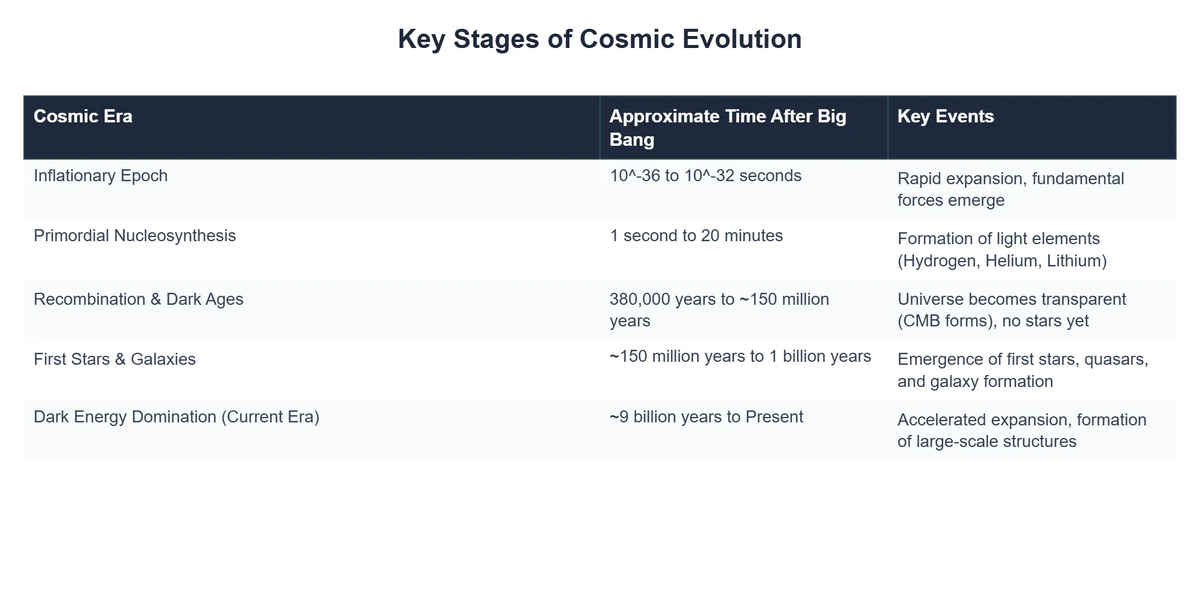
The story of universe evolution begins at an incredible point of singularity and rapidly unfolds through several pivotal eras, each shaping the cosmos into what we observe today.
- ✅ The Big Bang & Inflation: The universe began approximately 13.8 billion years ago from an extremely hot, dense state. This initial expansion, the Big Bang, was followed almost immediately by a period of exponential growth known as cosmic inflation. Inflation smoothed out initial irregularities and set the stage for the large-scale structure of the universe. For a deeper dive, explore our article on Universe Evolution: From Big Bang to Beyond.
- ➡️ Quark-Gluon Plasma & Particle Formation: In the first micro-seconds, the universe was a superheated soup of elementary particles. As it expanded and cooled, quarks combined to form protons and neutrons.
- 💡 Nucleosynthesis: Within the first few minutes, the universe was cool enough for protons and neutrons to fuse, forming the first light elements: hydrogen, helium, and trace amounts of lithium. This set the fundamental cosmic abundance of elements.
- 🌠 Recombination (Decoupling): Approximately 380,000 years after the Big Bang, the universe cooled sufficiently for electrons to combine with nuclei, forming neutral atoms. This event made the universe transparent, allowing photons to travel freely, which we observe today as the Cosmic Microwave Background (CMB) radiation.
- 🌌 The Dark Ages: Following recombination, the universe entered a period known as the “Dark Ages.” There were no stars or galaxies, only neutral hydrogen and helium gas, and dark matter, slowly collapsing under gravity.
- ✨ First Stars & Reionization: Around 100-200 million years after the Big Bang, the first stars, massive and short-lived, ignited. Their intense ultraviolet radiation reionized the neutral hydrogen, ending the Dark Ages and paving the way for galaxy formation. Learn more about the universe’s rapid expansion in Cosmological Inflation: The Universe’s Rapid Expansion Explained.
- 🪐 Galaxy & Structure Formation: Over billions of years, gravity continued to pull matter together, forming larger structures like galaxies, clusters, and superclusters. Dark matter played a crucial role in scaffolding this large-scale structure.
The Mysterious Influence: Dark Matter and Dark Energy in Cosmic Evolution
The story of cosmic evolution is profoundly shaped by two enigmatic components that collectively make up about 95% of the universe’s energy and mass budget: dark matter and dark energy.
🌌 Dark Matter’s Gravitational Architect Role
While invisible and non-interacting with light, dark matter exerts a significant gravitational pull. It acted as the crucial gravitational glue and scaffold that allowed visible matter (baryonic matter) to clump together, forming galaxies and larger cosmic structures. Without dark matter, the universe’s structures would not have formed as they did, and the galaxies we observe would likely fly apart. It’s a fundamental component in our models of galaxy formation and evolution.
Accelerating Expansion: The Power of Dark Energy
Even more mysterious is dark energy, a force that is causing the expansion of the universe to accelerate. Discovered in the late 1990s, its existence implies that the fate of the universe might be very different from what was previously thought. While dark matter was dominant in the early universe, assisting in structure formation, dark energy began to dominate the expansion about 5-6 billion years ago, pushing cosmic structures further apart. This leads to profound implications for the universe’s long-term future and explains phenomena like the Flatness Problem: Why Our Universe is So Precisely Flat.
The Future of the Cosmos: What Lies Ahead?
Just as the universe has evolved through distinct past phases, its future is also subject to the ongoing interplay of its fundamental constituents, particularly the influence of dark energy. While speculative, the prevailing models in cosmology offer several potential scenarios for the universe’s ultimate fate:
- 🔥 The Big Freeze (Heat Death): This is the most widely accepted scenario, given the current accelerating expansion driven by dark energy. In this future, the universe continues to expand, cooling indefinitely. Stars will eventually exhaust their fuel, black holes will evaporate through Hawking radiation, and the universe will become a cold, dark, empty expanse, devoid of all thermodynamic energy differences – a state of maximum entropy.
- 💥 The Big Rip: If dark energy’s density increases over time, it could become so powerful that it overcomes all gravitational forces, tearing apart galaxies, stars, planets, and eventually even atoms themselves, in a catastrophic “rip” of spacetime.
- 🌀 The Big Crunch: Less likely under current observations of accelerating expansion, this scenario would occur if the universe’s density were high enough (or if dark energy were to dissipate or reverse). Gravity would eventually halt the expansion and cause the universe to contract, possibly returning to a state similar to the Big Bang.
The trajectory of universe evolution in the distant future remains an active area of research, with ongoing observations of distant supernovae and the cosmic microwave background providing crucial data points.
🔭 Studying Cosmic Evolution: The Science of Cosmology
The study of cosmic evolution falls under the broad and exciting field of cosmology. This scientific discipline investigates the origin, evolution, large-scale structure, and ultimate fate of the universe. Modern cosmology is an empirical science, relying heavily on observations and theoretical frameworks to construct its models.
Key Observational Pillars of Cosmology:
- 🌟 Cosmic Microwave Background (CMB): The faint afterglow of the Big Bang, providing a snapshot of the universe when it was just 380,000 years old.
- 💫 Redshift of Galaxies (Hubble’s Law): The observation that galaxies are moving away from us, with more distant galaxies receding faster, indicating an expanding universe.
- ✨ Abundance of Light Elements: The precise ratios of hydrogen, helium, and lithium in the universe match predictions from Big Bang nucleosynthesis.
- 🌌 Large-Scale Structure: The observed distribution of galaxies and galaxy clusters, forming a vast cosmic web, aligns with simulations that include dark matter.
- 🚀 Type Ia Supernovae: Used as “standard candles” to measure cosmic distances, these observations led to the discovery of accelerating cosmic expansion and the inference of dark energy.
Through these observations, coupled with sophisticated theoretical models primarily based on Einstein’s General Theory of Relativity, scientists are continually refining our understanding of the universe’s incredible story. For a more comprehensive look at the field, consider our main hub: Cosmic Queries: Probing the Mysteries of the Universe.
Recommended Video
What is cosmic evolution?
Cosmic evolution is the scientific study of the changes the universe has undergone since its inception, including the formation of galaxies, stars, planets, and life.
How old is the universe?
Current scientific estimates place the age of the universe at approximately 13.8 billion years, determined primarily through the expansion rate and cosmic microwave background radiation.
What role does the Big Bang play in cosmic evolution?
The Big Bang theory describes the initial rapid expansion of the universe from an extremely hot, dense state, marking the beginning of cosmic evolution and setting the stage for all subsequent developments.
What are the major stages of the universe’s evolution?
Major stages include the Planck epoch, inflation, nucleosynthesis, recombination, dark ages, reionization, and the formation of stars, galaxies, and galaxy clusters.