

The Cosmic Genesis: From Singularity to Expansion
The journey of the universe, often referred to as its cosmic evolution, represents a story of unimaginable scale and complexity, unfolding over billions of years. Our current understanding, primarily rooted in the Big Bang theory, posits that the universe began from an infinitely hot, dense singularity approximately 13.8 billion years ago. This theory serves as the cornerstone for understanding the universe’s origin and subsequent development.
💡 Key Takeaways
- The Big Bang theory describes the universe’s origin as an incredibly hot, dense point that rapidly expanded.
- Key stages of cosmic evolution include inflation, formation of fundamental particles, nucleosynthesis, and galaxy formation.
- Dark matter and dark energy play crucial roles in the universe’s structure and its accelerating expansion.
- Current scientific models predict several potential ultimate fates for the universe, including the Big Freeze or Big Rip.
“The universe’s story is a grand narrative of transformation, from the primordial soup of the Big Bang to the intricate web of galaxies we observe today. Understanding its evolution is to understand our own cosmic address.”
— Astrid Bellweather, Astrophysicist & Science Communicator
Following this initial singularity, a period of rapid expansion known as cosmic inflation is believed to have occurred, expanding the nascent universe exponentially in a fraction of a second. This inflationary epoch elegantly addresses several puzzles, such as the flatness problem and the horizon problem, paving the way for the universe we observe today.
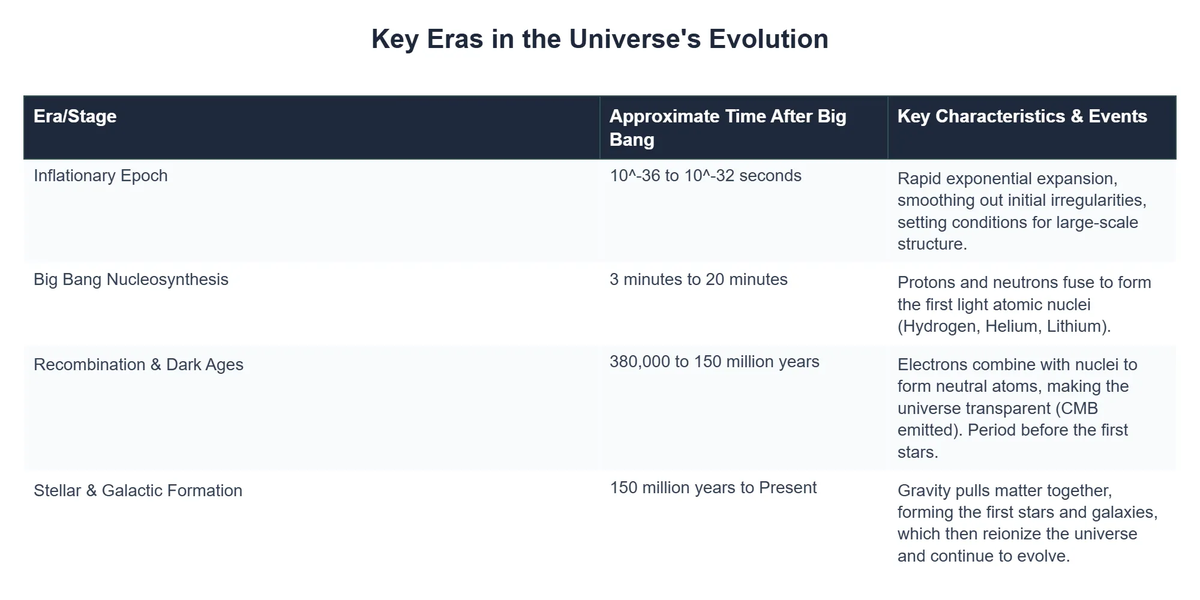
- ✅ Planck Epoch: The earliest conceivable moment, where all four fundamental forces were unified.
- ➡️ Inflationary Epoch: Rapid, exponential expansion smoothing out inhomogeneities. For a deeper dive, explore Chaotic Inflation Theory: An Introduction to the Universe’s Expansion.
- 💡 Quark-Gluon Plasma: The universe was a hot, dense soup of fundamental particles.
- 🔬 Nucleosynthesis: As the universe cooled, protons and neutrons fused to form light atomic nuclei (hydrogen, helium).
- ✨ Recombination (380,000 years): Electrons combined with nuclei to form neutral atoms, making the universe transparent to light. This released the Cosmic Microwave Background (CMB), the “afterglow” of the Big Bang. For a comprehensive overview, read our guide on the Big Bang Theory: A Comprehensive Guide to the Universe’s Origin.
These early stages laid the foundational conditions for everything that followed. Understanding these initial moments is key to grasping the full scope of the universe’s long and complex story. If you’re curious about other explanations, our article on Universe Origin Theories: How Did Everything Begin? offers further insights.
In This Article
- → The Cosmic Genesis: From Singularity to Expansion
- — 💡 Key Takeaways
- → Formation of the First Structures: Stars, Galaxies, and Beyond
- → The Universe in Motion: Dark Matter, Dark Energy, and Accelerating Expansion
- → From Cosmic Dust to Sentience: The Origin and Evolution of Life
- → The Future of the Cosmos: Diverse Scenarios
Formation of the First Structures: Stars, Galaxies, and Beyond
Following recombination, the universe entered the “Cosmic Dark Ages,” dominated by neutral hydrogen and helium gas with no light sources. Gravity, however, began drawing together slight density fluctuations from the Big Bang and inflation. This gravitational collapse was the genesis of all large-scale structures we see today.
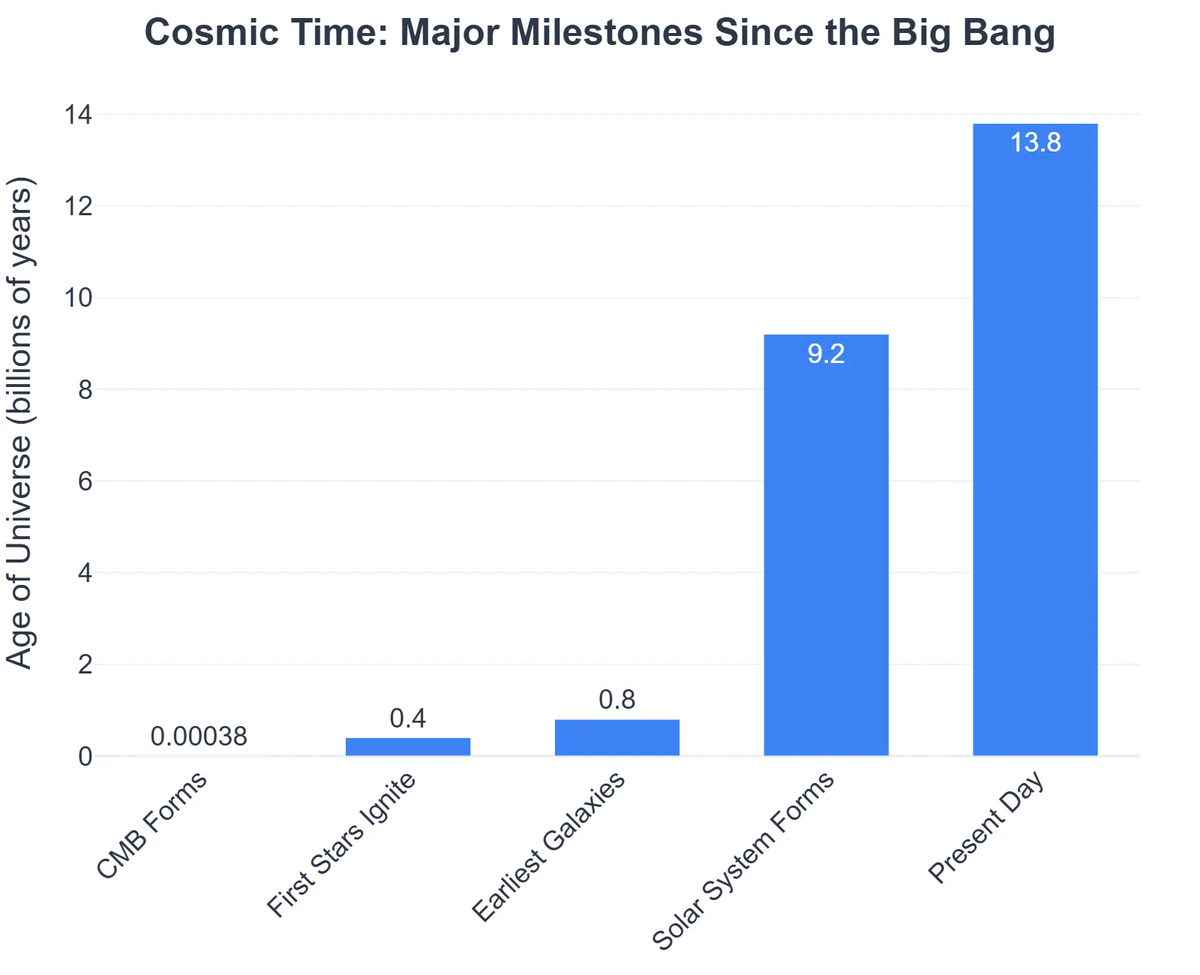
The first stars, called Population III stars, formed a few hundred million years after the Big Bang. These were immense, short-lived behemoths of hydrogen and helium. Their nuclear fusion forged the first heavy elements, which were then distributed into the cosmos upon their deaths as supernovae. These elements became the building blocks for future generations of stars, planets, and ultimately, life itself.
- 🌌 Reionization: Intense UV radiation from these first stars and early quasars gradually reionized neutral hydrogen, lifting the universe out of its Dark Ages.
- 🌠 Galaxy Formation: As gravity continued to pull matter, first stars coalesced into protogalaxies. Over billions of years, these smaller structures merged and grew into the grand spiral and elliptical galaxies we know. Our own Milky Way is a product of these ongoing processes.
- 🪐 Planetary Systems: Within maturing galaxies, subsequent generations of stars formed from gas and dust enriched with heavier elements. These elements (carbon, oxygen, iron, silicon) were essential for rocky planets.
This continuous cycle of star birth, death, and element distribution is fundamental to the universe’s ongoing cosmic evolution. The visible universe, with its billions of galaxies, is a testament to this incredible structural formation process.
Universe Evolution Theories: A Balanced View
Pros
- ✔Provides a coherent framework for the universe’s origin and development.
- ✔Big Bang theory has made successful predictions, like the Cosmic Microwave Background.
- ✔Unifies various astronomical observations, such as redshift and element abundances.
- ✔Serves as the foundational paradigm for modern cosmology research.
Cons
- ✖Leaves significant unanswered questions (e.g., nature of dark matter/energy, initial singularity).
- ✖Early universe and distant future are largely theoretical and beyond current direct observation.
- ✖Complexity of underlying physics can make it challenging for the general public to fully grasp.
- ✖Relies on extrapolating current physical laws to extreme conditions.
The Universe in Motion: Dark Matter, Dark Energy, and Accelerating Expansion
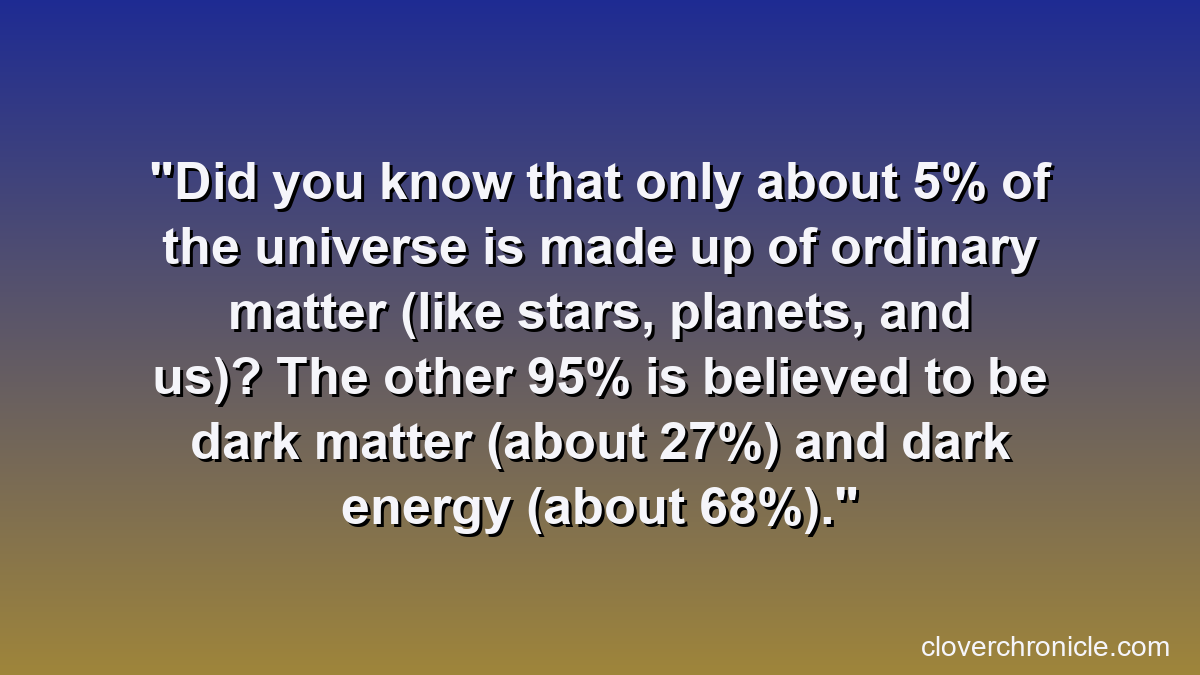
While visible matter (stars, galaxies, gas) accounts for only about 5% of the universe’s total mass-energy, the remaining 95% comprises mysterious components: dark matter and dark energy. These enigmatic entities pivotally shape the cosmos.
- 👻 Dark Matter: Approximately 27% of the universe. It doesn’t interact with light, making it invisible. Its presence is inferred solely through gravitational effects.
- 🔭 Evidence for Dark Matter:
- ✅ Galaxy Rotation Curves: Galaxies rotate faster than visible matter suggests.
- ✅ Gravitational Lensing: Light from distant objects bends more than expected around clusters.
- ✅ CMB Anisotropies: Patterns reveal early dark matter distribution, providing gravitational scaffolding for galaxies.
- ⚡ Dark Energy: About 68% of the universe. Responsible for the accelerating expansion, it appears to be pushing space apart.
- 🚀 Evidence for Dark Energy:
- ✅ Type Ia Supernovae: Distant supernovae appear dimmer, indicating accelerating expansion.
- ✅ Large-Scale Structure: Galaxy distribution aligns with models including dark energy.
- ✅ Cosmic Microwave Background: CMB data further supports dark energy.
The interplay between dark matter, dark energy, and ordinary matter dictates the universe’s ultimate fate. The accelerating expansion, driven by dark energy, strongly suggests a future where galaxies drift further apart, making the universe colder and emptier. This understanding is crucial for any comprehensive view of the universe’s evolution. For a deeper understanding of fundamental cosmic questions, dive into Cosmic Queries: Probing the Mysteries of the Universe. The existence of dark energy also contributes to why our universe appears so precisely balanced, a concept explored in the Flatness Problem: Why Our Universe is So Precisely Flat.
From Cosmic Dust to Sentience: The Origin and Evolution of Life
The universe’s evolution isn’t just about stars and galaxies; it’s also about creating conditions for life. The “Cosmic Genesis” forged fundamental forces and particles, and the “Formation of Structures” created the chemical elements and planetary systems. This highlights how deeply intertwined the universe’s physical evolution is with the origin and evolution of life.
Within galaxies, successive generations of stars enriched the interstellar medium with heavier elements—carbon, oxygen, nitrogen, iron—forged in their cores and dispersed through supernovae. These elements are the building blocks of biological life. Rocky planets, orbiting stable stars in “habitable zones,” provided necessary environments for complex chemistry.
- 🧪 Abiogenesis: On Earth, under favorable conditions, complex organic molecules formed from simpler precursors, leading to self-replicating molecules and the first simple life forms.
- 🌿 Biological Evolution: Over billions of years, natural selection and adaptation diversified life on Earth, leading to the vast array of species we see today.
- 🧠 Human Origin and Evolution: Humanity is a product of this long cosmic and biological chain. From the Big Bang’s hydrogen to the carbon in our bodies, our existence is a testament to the universe’s capacity for complexity. Understanding our place within this cosmic tapestry is a core aspect of probing its mysteries.
While life’s emergence specifics are intensely researched, the universe’s evolutionary framework provides the essential stage. The universe created the raw materials, conditions, and time for life to emerge, adapt, and contemplate its origins.
Recommended Video
The Future of the Cosmos: Diverse Scenarios
As the universe continues its relentless expansion, its ultimate fate remains a captivating cosmological inquiry. Based on current observations, particularly the accelerating expansion driven by dark energy, several scenarios for the long-term evolution of the universe are considered. While definitive answers are elusive, theoretical models provide compelling possibilities:
- ❄️ The Big Freeze (Heat Death): Currently the most favored scenario. If expansion continues indefinitely and accelerates, galaxies will drift apart. Star formation will cease as gas and dust thin. Existing stars will burn out, black holes will evaporate, and the universe will become a cold, dark, empty expanse of photons and elementary particles.
- 💥 The Big Rip: A more extreme scenario where dark energy becomes increasingly powerful, eventually overcoming all other forces and tearing apart galaxies, solar systems, planets, and even atoms. Less likely given current data, but a theoretical possibility.
- 🌌 The Big Crunch (or Big Bounce): If universe density were high enough, gravity would halt expansion, causing contraction back into a hot, dense singularity. Aesthetically appealing for its cyclical nature, but current accelerating expansion observations strongly argue against it. For a counter-perspective on the Big Bang’s finality, consider “Endless Universe: Beyond the Big Bang.”
The vast scale of cosmic time means these scenarios unfold over trillions of years. Our current understanding suggests a future dominated by dark energy, leading to a cold, desolate fate. However, the universe has surprised us before, and research continues to refine our models and knowledge of its ultimate destiny.
What is the Big Bang theory?
The Big Bang theory is the prevailing cosmological model for the universe’s earliest known periods, stating that it began in an extremely hot, dense state and has been expanding and cooling ever since.
How old is the universe?
Current scientific estimates, based on observations of the cosmic microwave background and cosmic expansion rates, place the age of the universe at approximately 13.8 billion years.
What are dark matter and dark energy?
Dark matter is a mysterious substance that does not emit or interact with light, but its gravitational effects are observed. Dark energy is an unknown form of energy thought to be responsible for the universe’s accelerating expansion.
What is the ultimate fate of the universe?
The ultimate fate of the universe depends on the properties of dark energy. Leading theories include the Big Freeze (or Heat Death), where the universe expands indefinitely and cools, or less likely, the Big Rip or Big Crunch.