

The Dawn of a New Era: Understanding the James Webb Space Telescope
The James Webb Space Telescope (JWST) represents a monumental leap forward in humanity’s quest to understand the cosmos. As the successor to the venerable Hubble Space Telescope, JWST is designed to peer deeper into the universe than ever before, observing in infrared light, which allows it to cut through cosmic dust and gas to reveal phenomena hidden from visible-light telescopes.
💡 Key Takeaways
- The JWST is revealing unprecedented details about the universe’s infancy, including the formation of the first galaxies.
- Its infrared capabilities allow scientists to peer through cosmic dust, observing exoplanet atmospheres and star birth regions.
- JWST data is fundamentally changing our understanding of cosmic evolution and the potential for life beyond Earth.
- Future observations promise to deepen our knowledge of black holes, dark matter, and the solar system.
“The James Webb Space Telescope isn’t just a machine; it’s a time machine, allowing us to witness the universe’s grand narrative unfold, pixel by pixel, from its earliest moments. It’s truly rewriting our cosmic story.”
— Astrid Bellweather, Astrophysicist & Science Communicator
Developed through an international collaboration led by NASA with its partners, the European Space Agency (ESA) and the Canadian Space Agency (CSA), Webb is poised to revolutionize our understanding of everything from the formation of the first galaxies to the potential for life on exoplanets. Its capabilities are so profound that it’s often described as a “time machine,” capable of observing light that has traveled for billions of years, showing us the universe as it was shortly after the Big Bang.
In This Article
- → The Dawn of a New Era: Understanding the James Webb Space Telescope
- — 💡 Key Takeaways
- — 🔬 What Makes JWST Unique?
- → 🚀 The James Webb Telescope’s Orbit and Launch
- — 🛰️ The L2 Halo Orbit Advantage
- → 🌌 Unveiling Cosmic Mysteries: JWST’s Groundbreaking Discoveries
- — 🔭 Peering Back to the Big Bang
- — 🪐 Exploring Exoplanets: From Proxima b to HIP 65426 b
- — ⚫️ Witnessing Black Holes in Action
- → 💰 The Cost and Future of James Webb
🔬 What Makes JWST Unique?
Several key features set the James Webb Telescope apart from its predecessors:
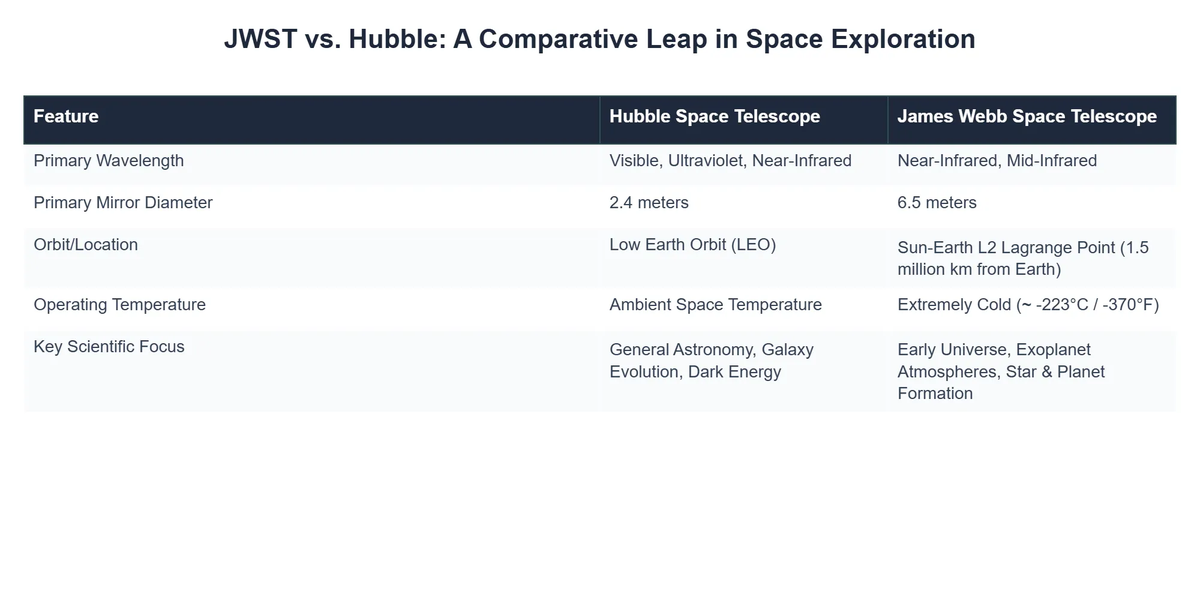
- ✅ Infrared Vision: Unlike Hubble, which primarily observes in visible and ultraviolet light, JWST is optimized for infrared. This is crucial for two reasons:
- ➡️ Light from the early universe is stretched by the expansion of space into infrared wavelengths (redshift).
- ➡️ Infrared light can penetrate dust clouds, allowing us to see star formation and exoplanet atmospheres more clearly.
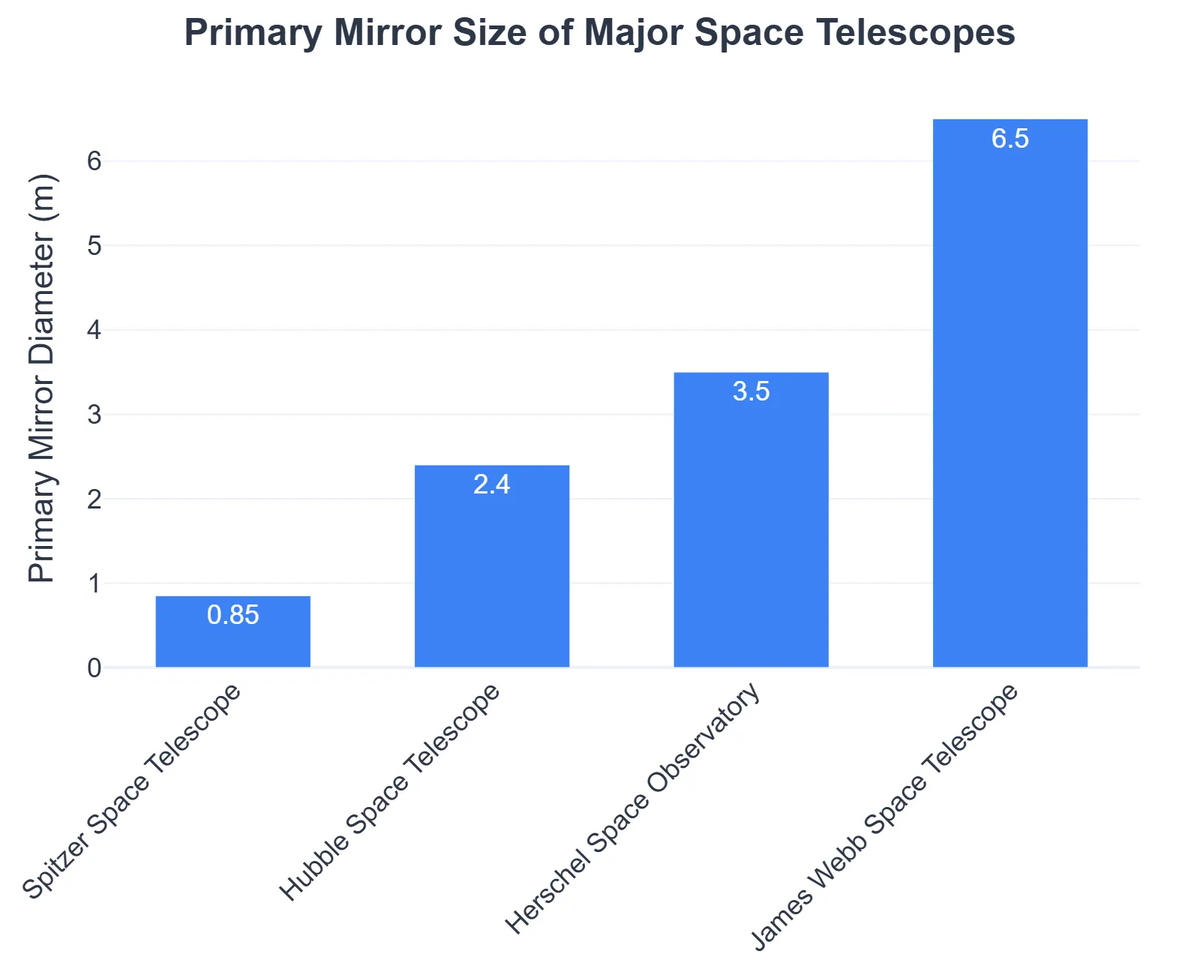
- 💡 Massive Primary Mirror: Webb boasts a primary mirror 6.5 meters (21 feet) in diameter, composed of 18 hexagonal, gold-coated beryllium segments. This makes it significantly larger than Hubble’s 2.4-meter mirror, collecting far more light and offering unparalleled resolution.
- ❄️ Cryogenic Cooling: To detect faint infrared signals, the telescope must be kept incredibly cold, below -223°C (-370°F). A tennis-court-sized sunshield protects it from the heat of the Sun, Earth, and Moon.
- ⚙️ Advanced Instruments: Equipped with four primary instruments—NIRCam (Near-Infrared Camera), NIRSpec (Near-Infrared Spectrograph), MIRI (Mid-Infrared Instrument), and FGS/NIRISS (Fine Guidance Sensor/Near Infrared Imager and Slitless Spectrograph)—JWST can capture images, analyze chemical compositions, and track objects with extreme precision.
🚀 The James Webb Telescope’s Orbit and Launch
The journey to deployment for the James Webb Space Telescope was a long and complex one, culminating in its successful launch and intricate orbital maneuvers.
The James Webb Telescope launch occurred on December 25, 2021, aboard an Arianespace Ariane 5 rocket from Europe’s Spaceport in Kourou, French Guiana. The launch was executed with remarkable precision, placing JWST directly on its trajectory toward its unique operational orbit. Following launch, a critical series of deployments began, involving thousands of single points of failure, including the unfolding of its massive sunshield and primary mirror segments.
🛰️ The L2 Halo Orbit Advantage
Unlike Hubble, which orbits Earth, the James Webb Telescope orbit is around the Sun, at the second Sun-Earth Lagrangian point (L2). This location, approximately 1.5 million kilometers (1 million miles) from Earth, offers several strategic advantages:
- ✅ Stable Gravitational Point: L2 provides a relatively stable gravitational environment, requiring minimal fuel for station-keeping.
- ➡️ Consistent Viewing: From L2, Webb can maintain a constant orientation relative to the Sun, Earth, and Moon, allowing its sunshield to continuously block their light and heat, crucial for its infrared sensitivity.
- 💡 Uninterrupted Observations: Away from Earth’s thermal and light interference, JWST enjoys nearly continuous, high-quality observing time.
This distant orbit also means that, unlike Hubble, Webb is not designed to be serviced by astronauts. Its mission relies entirely on the successful deployment and flawless operation of its systems from Earth.
🌌 Unveiling Cosmic Mysteries: JWST’s Groundbreaking Discoveries
Since becoming operational, the James Webb Space Telescope has delivered breathtaking images and unprecedented data, pushing the boundaries of our cosmic understanding. It has already begun to answer some of the universe’s most profound questions, while also raising new ones.
🔭 Peering Back to the Big Bang
One of JWST’s primary missions is to observe the first galaxies that formed after the Big Bang. By detecting the highly redshifted light from these extremely distant objects, Webb is providing crucial insights into the universe’s infancy. Early observations have revealed galaxies that are unexpectedly bright and mature for their age, challenging existing cosmological models about galaxy evolution immediately after the james webb big bang event. Learn more about how JWST is transforming our view of the early universe from NASA’s official resources, such as NASA’s Webb Delivers Deepest Infrared Image of Universe Yet.
How ‘Insightful Marketing Solutions’ Unveiled Hidden Consumer Behaviors for 35% ROI Increase
❓The Challenge
The agency struggled with providing truly differentiated client strategies, as traditional market research offered only surface-level insights, missing subtle yet crucial consumer behaviors obscured by data noise.
💡The Solution
Inspired by the Webb Telescope’s ability to reveal hidden cosmic phenomena by cutting through dust, the agency implemented an AI-driven behavioral analytics platform. This allowed them to peer deeper into customer data, identifying faint yet significant patterns and ‘redshifted’ emerging trends previously invisible.
🏆The Result
Within six months, this unparalleled data resolution led to an average 35% increase in client campaign ROI and boosted the accuracy of customer lifetime value predictions by 50%.
🪐 Exploring Exoplanets: From Proxima b to HIP 65426 b
Webb’s infrared capabilities are a game-changer for exoplanet research. It can analyze the atmospheres of distant worlds to detect the presence of water, methane, carbon dioxide, and other molecules that could indicate habitability or biological activity. While observing exoplanets like proxima b james webb has provided valuable atmospheric data, its direct imaging capabilities have also opened new frontiers.
A significant breakthrough includes the direct imaging of exoplanets, such as HIP 65426 b: James Webb Telescope Unveils Giant Exoplanet, a gas giant orbiting a star 385 light-years away. This demonstration of JWST’s ability to directly image exoplanets, combined with its spectroscopic analysis, is paving the way for profound discoveries about the diversity of planetary systems beyond our own. The james webb exoplanet observations are redefining our search for other Earth-like worlds.
⚫️ Witnessing Black Holes in Action
The James Webb Telescope is also shedding new light on the mysterious realm of black holes. Its ability to penetrate dust clouds allows astronomers to observe active galactic nuclei (AGN), which are supermassive black holes actively accreting matter at the centers of galaxies. JWST’s observations are helping to understand how these cosmic giants grow and influence the evolution of their host galaxies. For context on how telescopes probe these phenomena, consider exploring Black Hole Telescope: How Telescopes Detect Black Holes and how this differs from earlier missions like the Hubble Space Telescope: Revolutionizing Our View of the Universe.

Early data has suggested the presence of ancient, supermassive black holes that formed surprisingly early in the universe’s history, further complicating existing models of black hole growth and galaxy co-evolution. This contributes significantly to our understanding of the james webb telescope black hole research objectives. For a broader context on cosmic exploration, including black holes, delve into Cosmic Queries: Probing the Mysteries of the Universe.
The James Webb telescope has even detected evidence of the first possible “failed stars” beyond the Milky Way, which could unlock new secrets about the universe’s early formation, as detailed in reports like James Webb telescope finds 1st possible ‘failed stars’ beyond the Milky Way.
Recommended Video
💰 The Cost and Future of James Webb
The cost of James Webb Telescope has been a subject of considerable discussion, reflecting the immense engineering and scientific ambition behind the project. With a total development and operational cost projected to exceed $10 billion, it represents one of the most expensive scientific instruments ever built.
This significant investment, however, is yielding unprecedented scientific returns. The telescope’s operational lifetime is expected to be at least five to ten years, though its L2 halo orbit and efficient fuel consumption for station-keeping could potentially extend its mission much further, potentially for decades. As it continues its observations, the james webb space telescope will undoubtedly keep delivering groundbreaking insights, inspiring new generations of scientists and expanding the frontiers of human knowledge. Its mission is a testament to international collaboration and the pursuit of fundamental scientific discovery.
What is the primary mission of the James Webb Space Telescope?
The JWST’s primary mission is to study the infrared universe, allowing scientists to look back in time to the first galaxies, observe the birth of stars and planetary systems, and analyze exoplanet atmospheres.
How does the James Webb Telescope differ from the Hubble Space Telescope?
While Hubble primarily observes in visible and ultraviolet light, JWST operates in infrared, enabling it to penetrate dust clouds and detect the redshifted light from the very early universe, which appears as infrared light.
What are some of JWST’s most significant discoveries so far?
JWST has delivered stunning images of the universe, discovered incredibly distant galaxies, provided detailed atmospheric analyses of exoplanets, and revealed new insights into star formation and galaxy evolution.
Where is the James Webb Space Telescope located?
JWST orbits the Sun at the second Lagrange point (L2), approximately 1.5 million kilometers (930,000 miles) from Earth. This stable position allows it to maintain a cold operating temperature and efficient communications.