


What is Human Factors Psychology?
In a world increasingly shaped by technology and complex systems, the interaction between humans and their environment is paramount. This is precisely where human factors psychology steps in. Often referred to simply as human factors or ergonomics, this fascinating field is dedicated to understanding how people interact with products, systems, and environments.
💡 Key Takeaways
- Human Factors Psychology bridges human behavior understanding with design principles.
- It aims to optimize systems, products, and environments for human capabilities and limitations.
- The core goals include enhancing safety, efficiency, and overall user experience.
- Applications span diverse fields, from aviation and healthcare to software and consumer products.
“Human Factors Psychology isn’t merely about making things easy to use; it’s about deeply understanding the cognitive architecture and potential of the human mind to craft environments where we can truly thrive and perform at our best.”
— Dr. Eleanor Vance, PhD, Cognitive Neuroscientist & Human Potential Researcher
At its core, human factors psychology is an interdisciplinary science that applies knowledge about human capabilities and limitations to the design of systems. The primary goal is to optimize human well-being and overall system performance. It draws heavily from psychology, but also incorporates principles from engineering, computer science, industrial design, and even anthropology.
💡 A Holistic Approach to Design
- ✅ Focuses on the “fit” between the user, equipment, and environment.
- ✅ Aims to enhance efficiency, safety, comfort, and usability.
- ✅ Addresses both physical and cognitive aspects of human interaction.
- ✅ Seeks to minimize errors, accidents, and user frustration.
Unlike traditional design that might focus solely on aesthetics or pure engineering functionality, human factors prioritizes the user experience from a scientific perspective. It’s about designing things “for people,” considering how our brains process information, how our bodies move, and how we make decisions under various conditions. For a broader understanding of how our body and mind work, explore The Human Enigma: Unlocking the Secrets of Our Body and Mind.
According to Michigan Technological University, human factors “is the scientific discipline concerned with the understanding of interactions among humans and other elements of a system, and the profession that applies theory, principles, data and methods to design in order to optimize human well-being and overall system performance.” (What is Human Factors? | Michigan Technological University).
In This Article
- → What is Human Factors Psychology?
- — 💡 Key Takeaways
- — 💡 A Holistic Approach to Design
- → Core Principles Driving Human Factors Design
- — 🧠 Understanding Human Cognition
- — 💪 Considering Human Capabilities and Limitations
- — 🛡️ Prioritizing Safety and Error Prevention
- → Key Areas and Applications of Human Factors
- — ✈️ Aviation and Aerospace
- — 🏥 Healthcare and Medical Devices
- — 🚗 Automotive and Transportation
- — 🖥️ Software, Web, and Industrial Design
- → The Profound Impact of Human Factors on Daily Life
- — 📈 Enhancing Efficiency and Productivity
- — 📉 Minimizing Errors and Accidents
- — 😊 Improving User Satisfaction and Well-being
- → Pursuing a Career in Human Factors Psychology
- — 🎓 Educational Pathways
- — ⚙️ Typical Job Roles and Industries
- — 🔑 Essential Skills for Human Factors Professionals
Core Principles Driving Human Factors Design
The methodologies of human factors of psychology are built upon several fundamental principles that guide the design process. These principles ensure that products, systems, and environments are not only functional but also intuitive, safe, and efficient for their human operators.

🧠 Understanding Human Cognition
A significant part of human factors psych involves understanding how the human mind works. This includes:
- ✅ Perception: How users perceive information (e.g., visual displays, auditory cues).
- ✅ Attention: How users focus on relevant information and manage distractions.
- ✅ Memory: How users encode, store, and retrieve information (e.g., remembering how to use a complex system).
- ✅ Decision-Making: How users process information and make choices, especially under pressure or uncertainty.
Understanding these cognitive processes is crucial for designing interfaces that present information clearly, guide user attention effectively, and reduce cognitive load. Delve deeper into how we process information with our article on Cognition in Psychology: Understanding How We Think.
💪 Considering Human Capabilities and Limitations
Beyond cognition, human factors also considers physical aspects:
- ➡️ Anthropometry: The study of human body measurements to ensure comfortable and safe sizing of equipment and workspaces.
- ➡️ Biomechanics: The study of human movement and mechanics, crucial for designing tools and tasks that minimize physical strain and injury.
- ➡️ Physiology: Understanding human physiological responses to environmental stressors like heat, cold, noise, and vibration.
By accounting for these factors, human factors professionals can design systems that accommodate a diverse range of users, reducing fatigue and the risk of musculoskeletal disorders.
🛡️ Prioritizing Safety and Error Prevention
A paramount goal of human factors is to minimize human error and enhance safety. This involves:

- 💡 Error-Proofing (Poka-Yoke): Designing systems to prevent errors from occurring or to make them immediately obvious when they do.
- 💡 Affordances and Constraints: Designing elements that clearly suggest their proper use (affordances) and prevent incorrect actions (constraints).
- 💡 Feedback: Providing clear and timely information to users about the system’s state and their actions.
Implementing these principles leads to more resilient and forgiving systems, critical in high-stakes environments like healthcare or aviation.
Key Areas and Applications of Human Factors
The reach of human factors psychology extends across virtually every industry where humans interact with technology or complex environments. Its principles are vital for creating systems that are not just functional but truly user-friendly and safe.
✈️ Aviation and Aerospace
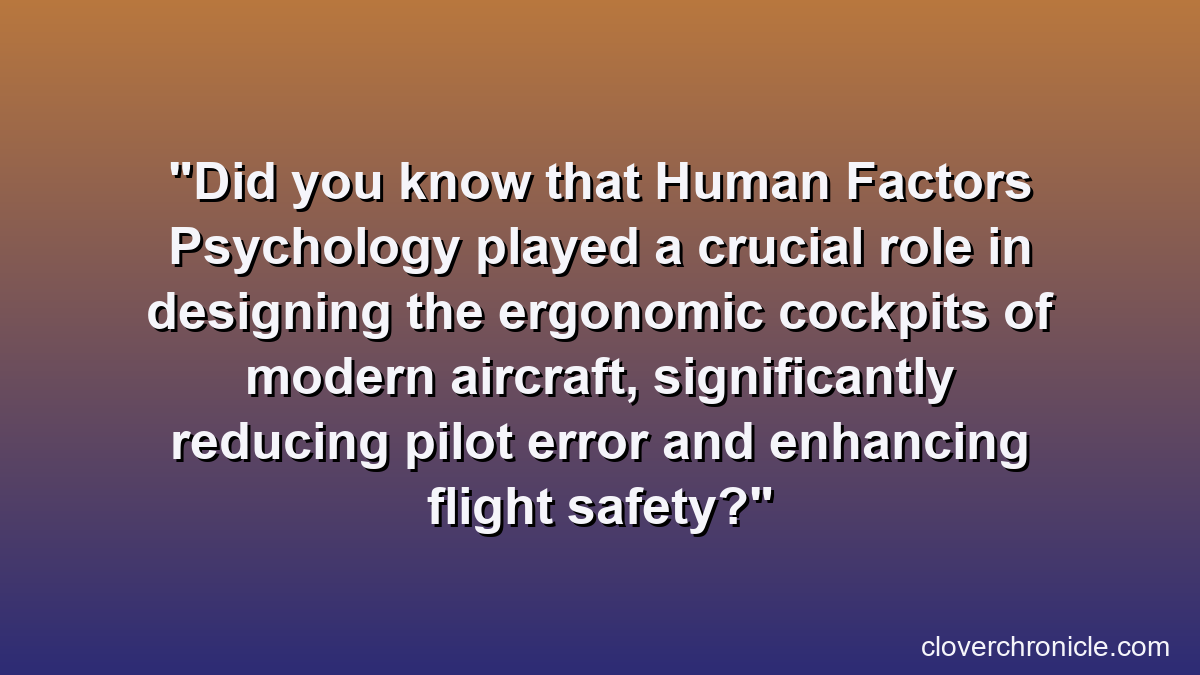
- ✅ Cockpit Design: Optimizing instrument layouts, control placement, and display readability to reduce pilot workload and error.
- ✅ Air Traffic Control: Designing intuitive interfaces for controllers to manage complex airspace safely and efficiently.
- ✅ Training Systems: Developing effective simulators and training programs based on how pilots learn and perform.
🏥 Healthcare and Medical Devices
- ➡️ Medical Device Usability: Designing user interfaces for pumps, monitors, and surgical equipment to prevent medication errors or misoperation.
- ➡️ Patient Safety: Redesigning workflows in hospitals to reduce human error in diagnosis, treatment, and communication.
- ➡️ Electronic Health Records (EHRs): Improving EHR interfaces to reduce clinician burnout and improve data entry accuracy.
🚗 Automotive and Transportation
- 💡 In-Vehicle Infotainment Systems: Designing intuitive touchscreens and controls that minimize driver distraction.
- 💡 Driver Assistance Systems: Developing effective alerts and feedback for features like lane keeping assist and adaptive cruise control.
- 💡 Autonomous Vehicle Interfaces: Designing how self-driving cars communicate their status and intentions to occupants and pedestrians.
🖥️ Software, Web, and Industrial Design
The principles of human factors psych are fundamental to User Experience (UX) and User Interface (UI) design, ensuring digital products are intuitive and enjoyable. This closely ties into Engineering Psychology: Designing for a Better Human Experience.
- ✅ Usability Testing: Conducting experiments to observe how users interact with software and identify areas for improvement.
- ✅ Information Architecture: Structuring websites and applications logically so users can easily find what they need.
- ✅ Ergonomics in Industrial Settings: Designing workstations, tools, and assembly lines to prevent injuries and optimize productivity.
The application of human factors principles leads to more effective, safer, and more satisfying experiences for users across a multitude of domains (Human Factor Principles in UX Design – UX Magazine).
The Profound Impact of Human Factors on Daily Life
While often operating behind the scenes, the influence of human factors psychology is pervasive, profoundly impacting our daily lives in ways we might not even consciously recognize. From the ease with which we operate our smartphones to the safety features in our cars, human factors principles are at play.
📈 Enhancing Efficiency and Productivity
- ✅ Streamlined Workflows: Well-designed systems reduce unnecessary steps, cognitive load, and time spent on tasks.
- ✅ Reduced Learning Curves: Intuitive interfaces mean users can quickly understand and operate new technologies without extensive training.
- ✅ Optimized Performance: When tools and environments are aligned with human capabilities, performance naturally improves.
📉 Minimizing Errors and Accidents
This is arguably one of the most critical contributions of human factors. By proactively identifying potential points of failure in human-system interaction, designers can build in safeguards.
- ➡️ Reduced Human Error: Designing clear controls, providing immediate feedback, and creating consistent interfaces minimize mistakes.
- ➡️ Fewer Accidents: In high-risk environments like aviation, nuclear power, and medicine, human factors interventions have dramatically improved safety records.
- ➡️ Lower Costs: Fewer errors and accidents lead to significant savings in terms of repairs, liability, and lost productivity.
😊 Improving User Satisfaction and Well-being
Beyond efficiency and safety, human factors also contributes significantly to the quality of life and user experience.
- 💡 Increased Comfort: Ergonomically designed furniture, tools, and vehicle interiors reduce physical strain and discomfort.
- 💡 Reduced Frustration: When systems are intuitive and responsive, users feel more in control and less stressed.
- 💡 Greater Trust: Users develop more trust in systems that are reliable, predictable, and easy to use, leading to greater adoption and engagement.
Ultimately, human factors psych is about making the world work better for people. It’s about creating harmony between humans and the increasingly complex tools and environments they navigate, ensuring that technology serves humanity, rather than frustrating or endangering it.
Recommended Video
Pursuing a Career in Human Factors Psychology
For those fascinated by the intersection of psychology, design, and technology, a career in human factors psychology offers diverse and impactful opportunities. It’s a field for individuals who enjoy problem-solving, understanding human behavior, and improving the world around them.
🎓 Educational Pathways
A strong foundation in psychology, engineering, or a related field is typically required. Many professionals enter the field with:
- ✅ Bachelor’s Degrees: While a bachelor’s in human factors is offered by some universities (e.g., Embry-Riddle Aeronautical University: Bachelor’s Degree in Human Factors Psychology), many start with degrees in psychology, industrial engineering, or cognitive science.
- ✅ Master’s Degrees: Master’s programs specifically in Human Factors, Ergonomics, or Engineering Psychology are common and often preferred for entry into the profession (e.g., Bentley University’s Master’s in Human Factors in Information Design: Master’s in Human Factors in Information Design).
- ✅ Doctoral Degrees (Ph.D.): For research-intensive roles, academia, or advanced consulting, a Ph.D. provides the deepest level of expertise.
⚙️ Typical Job Roles and Industries
Professionals with expertise in human factors psych can be found in a wide array of sectors:
- ➡️ UX Researcher/Designer: In tech companies, designing user-friendly software and websites.
- ➡️ Human Factors Engineer: In aerospace, automotive, or medical device companies, focusing on product safety and usability.
- ➡️ Ergonomist: In manufacturing or office environments, optimizing workstations and reducing musculoskeletal injuries.
- ➡️ Usability Analyst: Evaluating products and systems for ease of use and efficiency.
- ➡️ Consultant: Providing expert advice to various industries on design, safety, and training.
🔑 Essential Skills for Human Factors Professionals
- 💡 Analytical Thinking: Ability to break down complex problems and identify root causes of human error or poor performance.
- 💡 Research Methodologies: Proficiency in conducting user research, usability testing, and statistical analysis.
- 💡 Interpersonal Skills: Collaboration with engineers, designers, and project managers is crucial.
- 💡 Problem-Solving: Developing creative and practical solutions to design challenges.
- 💡 Understanding of Human Behavior: A deep appreciation for how people perceive, think, and interact.
The demand for human factors expertise continues to grow as technology becomes more integrated into every aspect of our lives. It’s a field that offers the unique satisfaction of making tangible improvements to people’s safety, efficiency, and overall experience with the world around them.
What is Human Factors Psychology?
It is the study of how humans interact with products, systems, and environments, focusing on designing them to optimize human well-being and overall performance.
Why is Human Factors important in design?
It is crucial because it enhances safety, improves efficiency, reduces errors, and boosts user satisfaction by aligning designs with human cognitive and physical capabilities.
Where is Human Factors Psychology applied?
It is applied across various sectors including aerospace, healthcare, transportation, software development, product design, and military systems.
How does it differ from UX Design?
While related, Human Factors Psychology is a broader field, encompassing physical, cognitive, and organizational ergonomics, whereas UX design often focuses specifically on the user’s experience with digital interfaces.