


Ancient Mysteries: Unraveling the World’s Most Enduring Enigmas
For millennia, humanity has looked back at its own history, encountering countless questions that defy easy answers. From monumental structures built with unknown techniques to cryptic texts that remain undeciphered, the world is replete with ancient mysteries that continue to puzzle historians, archaeologists, and enthusiasts alike. These unexplained phenomena beckon us to delve deeper, challenging our understanding of ancient civilizations, their capabilities, and their very existence.
💡 Key Takeaways
- Explore humanity’s fascination with unexplained historical phenomena.
- Understand the ongoing efforts by archaeologists and historians to decode ancient riddles.
- Discover how new technologies are shedding light on age-old mysteries.
- Contemplate the enduring questions that challenge our understanding of the past.
“Every unearthed artifact and deciphered inscription is a whispered clue from the past. Unraveling these ancient mysteries isn’t just about discovery; it’s about reconstructing the very fabric of human experience.”
— Sebastian Thorne, Archaeologist & Historical Forensics Expert
In this comprehensive guide, we’ll journey through some of the most captivating enigmas of the past, exploring the facts, the theories, and the ongoing efforts to unravel their secrets. Prepare to have your curiosity piqued as we embark on an intellectual expedition into the heart of forgotten histories.
In This Article
- → Ancient Mysteries: Unraveling the World’s Most Enduring Enigmas
- — 💡 Key Takeaways
- → The Allure of the Unexplained: Why Ancient Mysteries Fascinate Us
- — 🤔 What Defines an Ancient Mystery?
- — 💡 The Human Quest for Knowledge
- → Iconic Ancient Places & Their Enduring Questions
- — 🇪🇬 The Pyramids of Giza: Architectural Wonders
- — 🇬🇧 Stonehenge: A Megalithic Enigma
- — 🇵🇪 Nazca Lines: Geoglyphs from the Desert
- — 🇲🇽 Palenque & The Maya: Lost Civilizations
- → Enigmatic Ancient Things & Obscure Origins
- — 📜 The Voynich Manuscript: An Unreadable Tome
- — ⚡ The Baghdad Battery: An Out-of-Place Artifact?
- — ⚙️ Antikythera Mechanism: Ancient Astronomical Computer
- → Theories & Interpretations: Attempting to Solve the Riddles
- — 🔬 Archaeological & Scientific Approaches
- — 📚 Historical & Cultural Context
- — 👽 Fringe Theories & Speculation
- → The Ongoing Pursuit: Modern Tools & Discoveries
- — 🛰️ Satellite Imagery & Remote Sensing
- — 💧 Underwater Archaeology
- — 🔬 Advanced Dating Techniques
- → Conclusion: The Enduring Legacy of the Unexplained
The Allure of the Unexplained: Why Ancient Mysteries Fascinate Us
The human mind is inherently driven by curiosity. When confronted with remnants of the past that defy conventional explanation, our imagination takes flight. This deep-seated fascination with the unknown fuels research, exploration, and countless debates, pushing the boundaries of historical and scientific inquiry.
🤔 What Defines an Ancient Mystery?
- ✅ A phenomenon or artifact from ancient times whose origin, purpose, or construction methods are not fully understood by modern scholarship.
- ➡️ Often involves sophisticated engineering, advanced knowledge, or unexplained disappearances that challenge our perception of ancient capabilities.
- 💡 Spans across continents and cultures, demonstrating a universal thread of human ingenuity and unresolved questions.
💡 The Human Quest for Knowledge
Our desire to understand ancient mysteries is not just about satisfying curiosity; it’s about understanding ourselves. By piecing together clues from the past, we gain insights into human innovation, cultural practices, and the profound challenges faced by our ancestors. For a broader perspective on how we approach these grand narratives, explore Lost Worlds & Forgotten Histories: Unearthing the Past’s Greatest Riddles.
Iconic Ancient Places & Their Enduring Questions
Some of the most enduring mysteries are tied to incredible ancient places. These sites stand as testaments to human ambition, yet their full stories remain shrouded in the mists of time.
🇪🇬 The Pyramids of Giza: Architectural Wonders
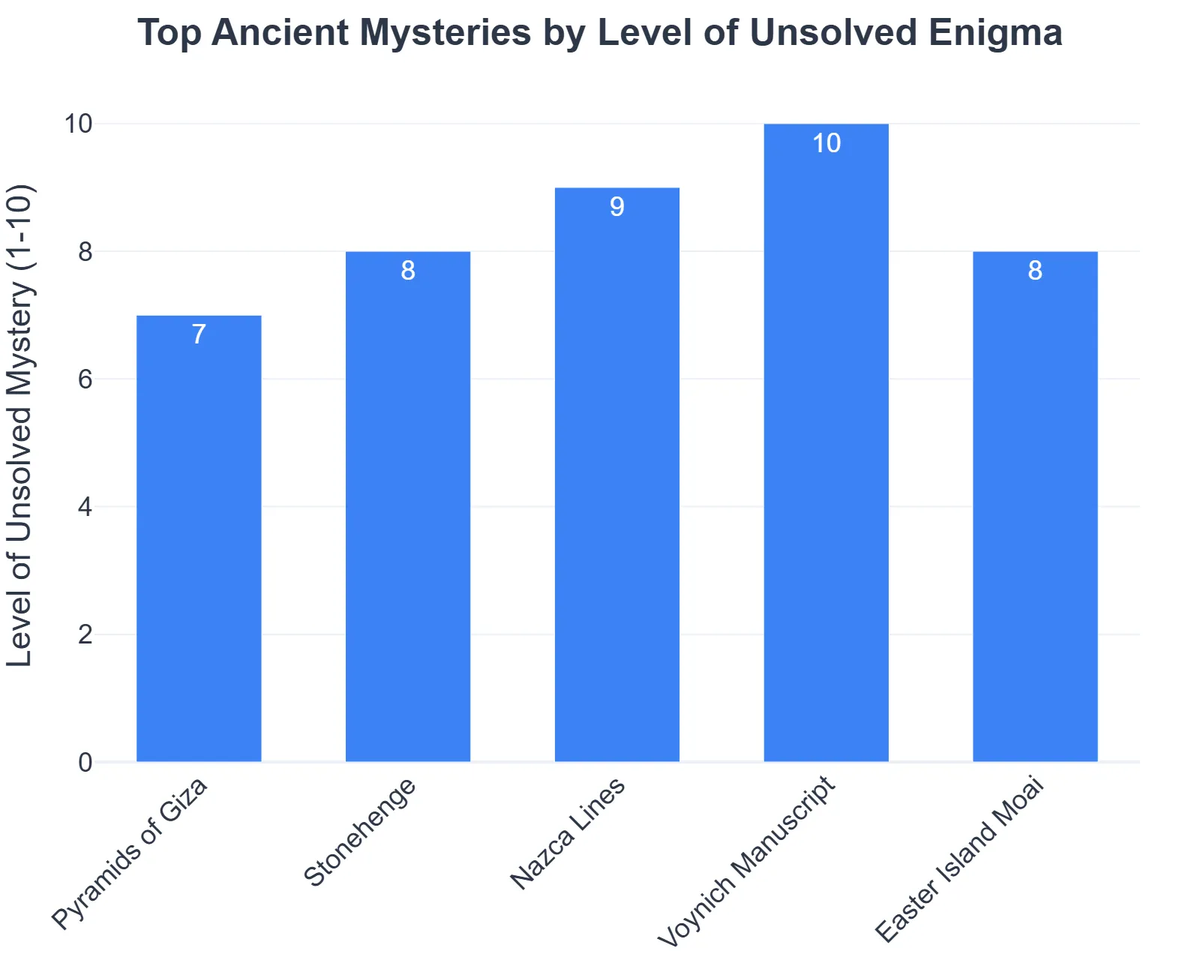
The Pyramids of Giza, particularly the Great Pyramid, are perhaps the most famous of all ancient structures. Their sheer scale, precision engineering, and the logistics involved in their construction continue to inspire awe and speculation.
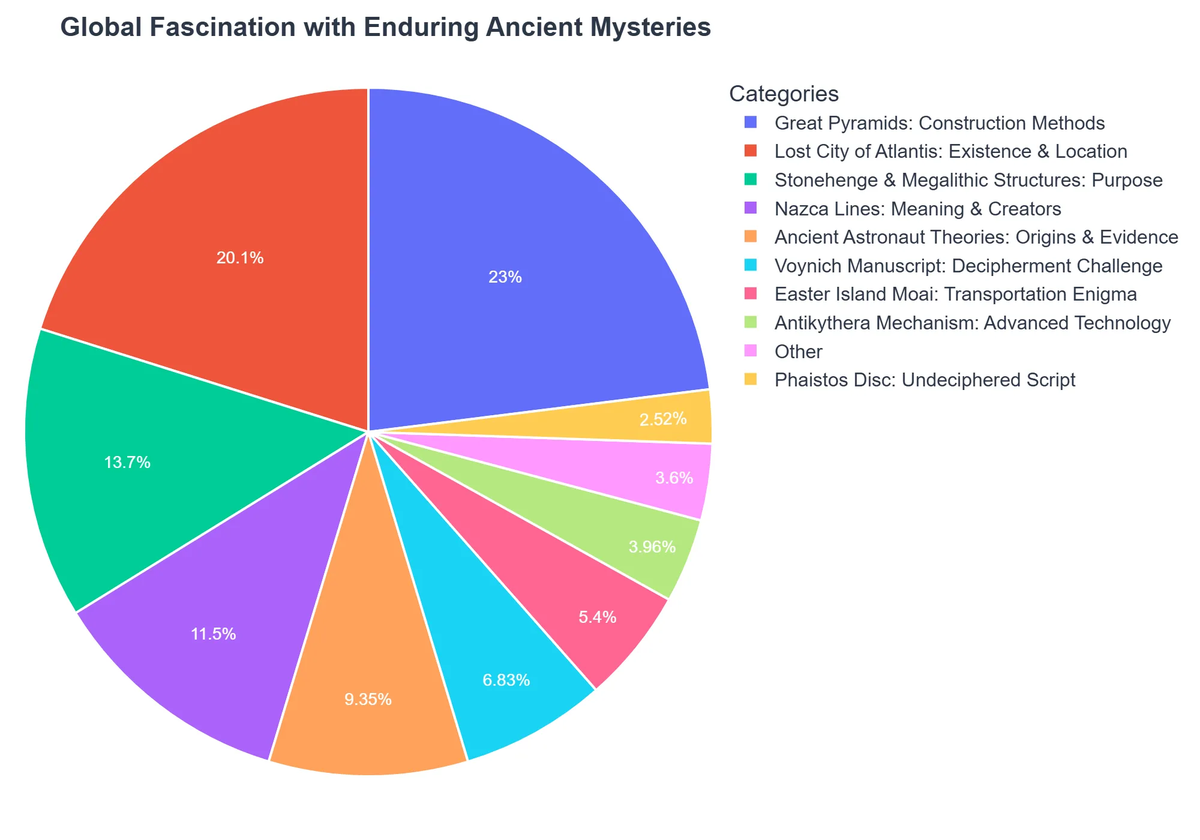
- ✅ Construction Methods: How did the ancient Egyptians quarry, transport, and lift millions of colossal stone blocks, some weighing many tons, to such heights with the technology available to them?
- ➡️ Alignment & Purpose: Their near-perfect alignment with cardinal points and certain celestial bodies suggests advanced astronomical knowledge. Beyond being tombs, did they serve other functions?
- 💡 Labor Force: While long debunked as slave labor, the organization of a workforce of tens of thousands to complete such a project is a monumental achievement in itself.
🇬🇧 Stonehenge: A Megalithic Enigma
Located in Wiltshire, England, Stonehenge is a prehistoric monument composed of a ring of standing stones. Dating back to 3000-2000 BC, its purpose and the methods of its creation are hotly debated.
- ✅ Transportation of Stones: The sarsen stones (up to 30 tons) were sourced from Marlborough Downs, 20 miles away, while the bluestones (up to 4 tons) came from the Preseli Hills in Wales, over 150 miles away. How were these immense stones moved such vast distances?
- ➡️ Astronomical Alignment: The monument is precisely aligned with the summer solstice sunrise and winter solstice sunset, suggesting an astronomical or calendrical function.
- 💡 Cultural Significance: Was it a temple, a burial ground, an observatory, or a healing center? Evidence suggests multiple uses over its long history. For more on such captivating ruins, consider exploring Historic Ruins: Exploring the World’s Most Captivating Sites.
🇵🇪 Nazca Lines: Geoglyphs from the Desert
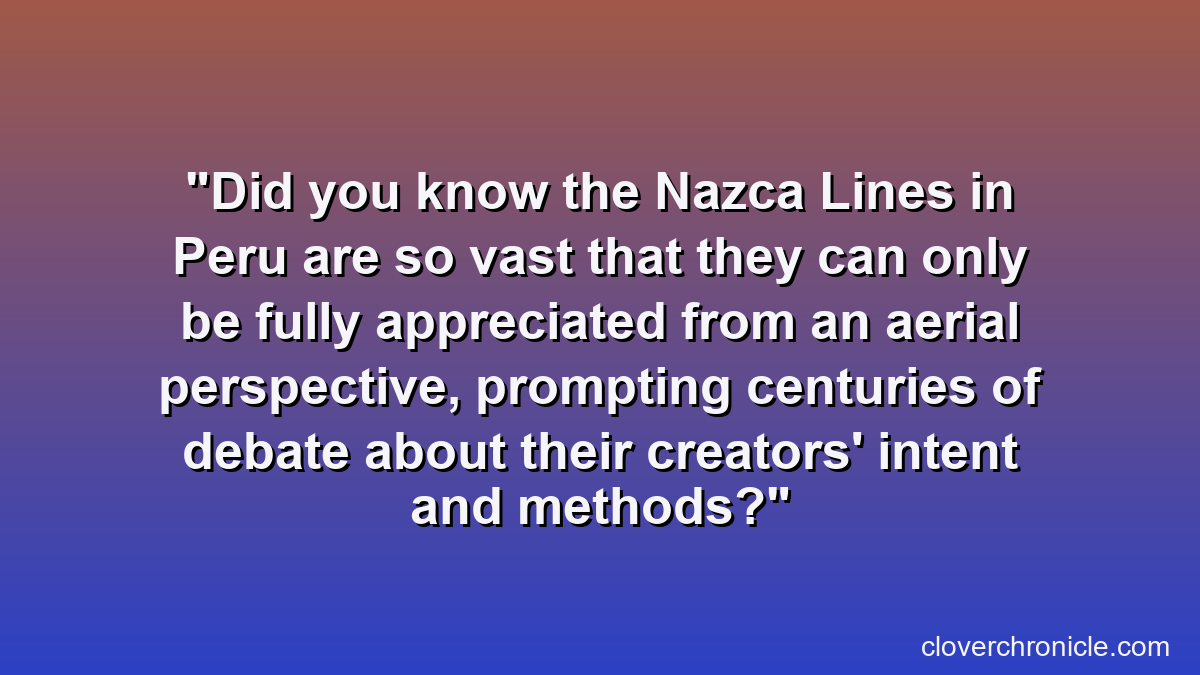
Etched into the desert floor of Peru, the Nazca Lines are massive geoglyphs depicting animals, plants, and geometric shapes. Created by the ancient Nazca culture between 500 BC and 500 AD, their scale and purpose are a source of ongoing intrigue.
- ✅ Creation Methods: How were such precise, enormous designs created on a flat desert plain, visible only from a great height, without any apparent elevated vantage points?
- ➡️ Purpose: Were they astronomical calendars, religious offerings, pathways for rituals, or something else entirely? Theories range from practical to highly spiritual.
🇲🇽 Palenque & The Maya: Lost Civilizations
The ancient Maya civilization, particularly sites like Palenque, offers numerous puzzles. Their advanced calendar system, sophisticated writing, and sudden decline in some regions continue to baffle scholars.
- ✅ Pakal’s Sarcophagus: The intricate carving on the sarcophagus lid of Lord Pakal at Palenque has been interpreted in various ways, sparking debates about its true meaning.
- ➡️ Collapse of Maya Cities: Why did many major Maya cities decline or become abandoned around the 9th century AD? Theories include drought, warfare, deforestation, or a combination of factors.
Enigmatic Ancient Things & Obscure Origins
Beyond massive structures, certain ancient things and artifacts present their own unique challenges to our understanding of the past.
📜 The Voynich Manuscript: An Unreadable Tome
Discovered in 1912, the Voynich Manuscript is an illustrated codex written in an unknown writing system, believed to be from the early 15th century. Despite numerous attempts by cryptographers and linguists, it remains undeciphered.
- ✅ Unidentified Language: Is it an unknown language, an elaborate hoax, or a coded message?
- ➡️ Illustrations: The manuscript contains detailed illustrations of plants that don’t match known species, astronomical diagrams, and unusual figures, adding to its mystery.
⚡ The Baghdad Battery: An Out-of-Place Artifact?
Found near Baghdad in 1938, this artifact consists of a clay jar, a copper cylinder, and an iron rod. Some theories suggest it might have functioned as a primitive electric battery, dating back to the Parthian era (250 BC – 224 AD).
- ✅ Functionality: If it was indeed a battery, what was its purpose? Electroplating? Medical treatment? Or was it simply a storage vessel for scrolls?
- ➡️ Technological Anomaly: Its potential use as a battery would suggest knowledge of electricity far predating modern discoveries, making it an “out-of-place artifact.”
⚙️ Antikythera Mechanism: Ancient Astronomical Computer
Discovered in a shipwreck off the coast of the Greek island Antikythera in 1901, this complex ancient tool is considered the world’s first analog computer. Dating to 205 BC, it was used to predict astronomical positions and eclipses decades in advance.
- ✅ Unprecedented Complexity: Its intricate gears and sophisticated design are far beyond anything else known from that period.
- ➡️ Lost Technology: There is no record of similar advanced ancient tools being developed or used for over a thousand years after its creation, suggesting a lost lineage of knowledge.
Theories & Interpretations: Attempting to Solve the Riddles
While many ancient mysteries persist, scholars and researchers are continually striving to unlock their secrets. This involves rigorous scientific methods, historical analysis, and sometimes, bold new interpretations.
🔬 Archaeological & Scientific Approaches
Modern archaeology employs cutting-edge technologies and interdisciplinary studies to shed light on ancient puzzles. Advances in dating techniques, geological analysis, and structural engineering allow for more accurate assessments of what was possible in the past. To keep up with current developments, you might be interested in Archaeology’s Latest Finds: Unearthing Ancient Mysteries.
Exploring Ancient Mysteries: Pros and Cons
Pros
- ✔Sparks curiosity and encourages critical thinking about the past.
- ✔Promotes interdisciplinary research and new historical insights.
- ✔Offers fascinating narratives that connect us to ancient civilizations.
- ✔Potential for groundbreaking archaeological or scientific discoveries.
Cons
- ✖Often lacks definitive evidence, leading to speculation.
- ✖Risk of misinterpretation or pseudoscientific exploitation.
- ✖Research can be incredibly challenging, costly, and time-consuming.
- ✖Focus on enigma can sometimes overshadow established historical understanding.
📚 Historical & Cultural Context
Understanding the social, religious, and political environments of ancient civilizations is crucial. Many mysteries can be partially unraveled by carefully examining historical records, myths, and cultural practices. For instance, understanding the Eleusinian Mysteries helps contextualize ancient Greek religious practices: Eleusinian Mysteries: Unearthing Ancient Greece’s Sacred Rites.
👽 Fringe Theories & Speculation
It’s important to distinguish between evidence-based research and speculative theories. While captivating, notions involving extraterrestrial intervention or lost super-civilizations often lack verifiable archaeological or historical support. Our focus remains on what can be factually presented and scientifically investigated, respecting the immense ingenuity of ancient peoples. For a glimpse into common “unexplained” topics, you can find a list of common mysteries discussed at HISTORY.com.
The Ongoing Pursuit: Modern Tools & Discoveries
The quest to unravel ancient mysteries is far from over. New technologies and collaborative international efforts are constantly bringing fresh perspectives and surprising discoveries.
🛰️ Satellite Imagery & Remote Sensing
From space, archaeologists can identify subtle features on the landscape that indicate ancient settlements, roads, or even previously undiscovered geoglyphs. This non-invasive technique allows for broad-scale surveys and pinpointing areas for ground excavation.
💧 Underwater Archaeology
Rising sea levels and seismic activity have submerged countless ancient sites. Underwater archaeology, utilizing advanced sonar, ROVs (Remotely Operated Vehicles), and specialized diving techniques, is revealing sunken cities, shipwrecks, and artifacts that offer unique insights into forgotten worlds.
🔬 Advanced Dating Techniques
Techniques like radiocarbon dating, thermoluminescence, and dendrochronology continue to be refined, providing increasingly precise timelines for artifacts and structures, helping to place them accurately within historical contexts and challenge previous assumptions.
The study of ancient mysteries is a vibrant, evolving field. Every new discovery has the potential to rewrite history, deepen our appreciation for past civilizations, and provide valuable lessons for our own future.
Recommended Video
Conclusion: The Enduring Legacy of the Unexplained
The world’s most enduring ancient mysteries serve as powerful reminders of humanity’s long and complex journey. From the monumental architecture of the Pyramids to the intricate mechanisms of the Antikythera Device, these unsolved puzzles ignite our imagination and challenge our understanding of what was possible in antiquity. While some riddles may forever remain unanswered, the ongoing pursuit of knowledge enriches our lives and connects us to the incredible legacy of those who came before us.
As we continue to explore and innovate, the boundaries of what is known expand, and perhaps, one day, more of these profound enigmas will yield their secrets. Until then, they stand as silent, awe-inspiring testaments to the human spirit’s boundless capacity for creation, and indeed, for mystery itself.
Frequently Asked Questions
What are some of the most famous ancient mysteries?
Popular examples include the construction of the Egyptian Pyramids, the disappearance of the Mayan civilization, the purpose of Stonehenge, and the fate of Atlantis.
How do archaeologists investigate ancient mysteries?
They use methods like excavation, carbon dating, forensic analysis of remains, interpretation of ancient texts, and advanced imaging technologies to gather and analyze evidence.
Will all ancient mysteries eventually be solved?
While scientific and historical research continually reveals new insights, some mysteries may remain partially or wholly unsolved due to lost evidence, lack of context, or the sheer passage of time.