


Unveiling the Abyss: What is a Black Hole Simulator?
Delving into the enigmatic depths of the cosmos, few phenomena captivate the human imagination as profoundly as black holes. These cosmic behemoths, regions of spacetime where gravity is so intense that nothing—not even light—can escape, remain largely mysterious. How can we possibly comprehend such extreme physics? The answer lies in the power of a black hole simulator.
💡 Key Takeaways
- Experience the relativistic effects near a black hole’s event horizon.
- Understand key concepts like spaghettification and gravitational lensing through interactive simulation.
- Explore various types of black holes, from stellar to supermassive.
- Learn how black hole simulators aid in astrophysics research and public understanding.
“This black hole simulator isn’t just a game; it’s a powerful tool that brings the most extreme environments in the universe within our grasp, making complex physics tangible and awe-inspiring.”
— Astrid Bellweather, Astrophysicist & Science Communicator
A black hole simulator is a sophisticated computational model designed to visualize, interact with, and predict the behavior of light and matter around a black hole. These digital environments translate the complex equations of Einstein’s general relativity into tangible, often immersive, experiences. They are not mere animations; they are intricate scientific tools built on robust physics engines, allowing users to safely explore phenomena that are otherwise impossible to observe directly.
In This Article
- → Unveiling the Abyss: What is a Black Hole Simulator?
- — 💡 Key Takeaways
- — 🚀 Purpose and Impact of Simulations
- → The Science Behind the Simulation: Modeling Cosmic Extremes
- — ⚙️ Key Phenomena Modeled
- → Experiencing the Abyss: Types of Black Hole Simulators
- — 💻 Desktop and Web-Based Simulators
- — 🕶️ Virtual Reality (VR) Experiences
- — 🎮 Gaming Integrations
- → Why Simulators Matter: Education, Research, and Exploration
- — 🔭 Education and Public Engagement
- — 🔬 Research and Theoretical Validation
🚀 Purpose and Impact of Simulations
- ✅ Education: They transform abstract theoretical concepts like gravitational lensing, time dilation, and spaghettification into understandable visual narratives.
- ✅ Research: Scientists use them to test hypotheses, model accretion disk dynamics, and prepare for future astronomical observations.
- ✅ Exploration: For enthusiasts, they offer a thrilling, albeit simulated, journey into the most extreme environments in the universe.
The Science Behind the Simulation: Modeling Cosmic Extremes
Creating a realistic black hole simulator is an immense computational challenge. It requires meticulously accurate adherence to the principles of general relativity, which describes how gravity arises from the curvature of spacetime. Unlike traditional Newtonian physics, which only approximates gravity’s effects, relativity accounts for the bending of light and the distortion of time in strong gravitational fields.
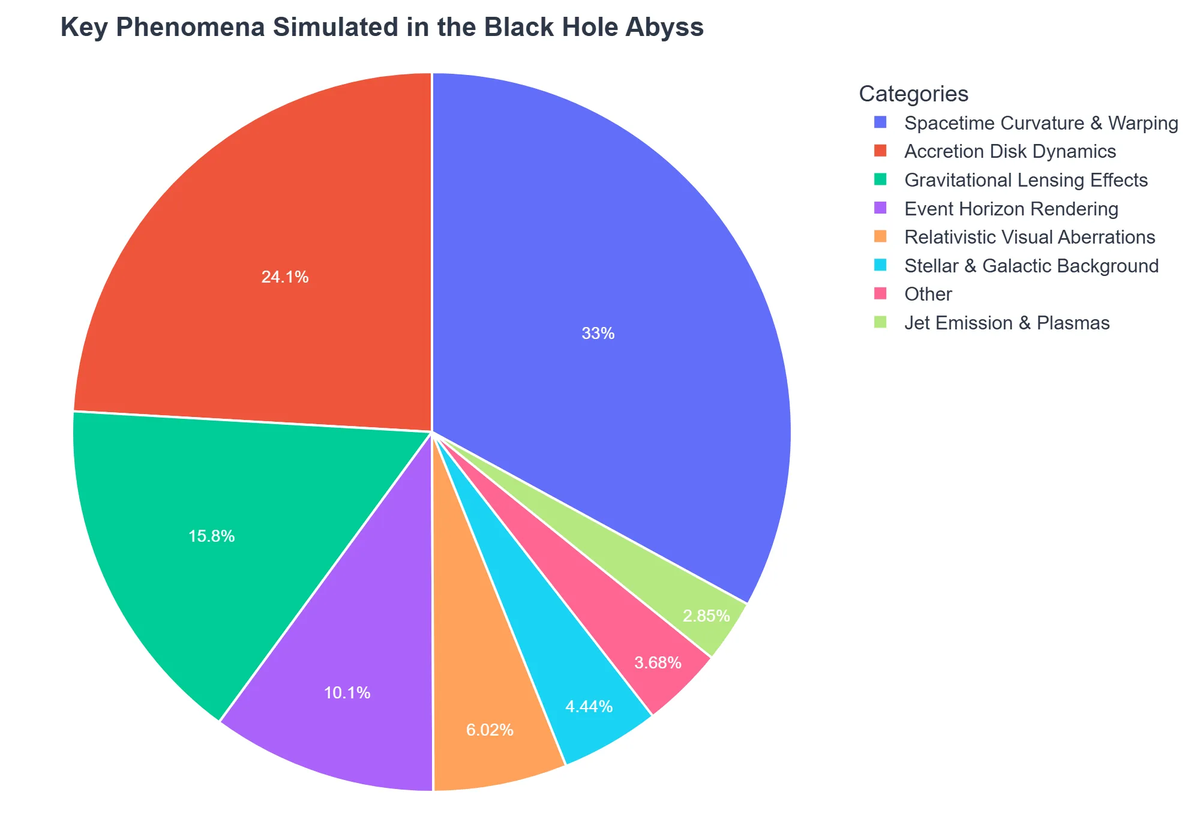
At the core of most simulators is a technique known as ray tracing. Instead of modeling the black hole itself, which is largely empty space, the simulator traces the paths of individual light rays as they travel through the warped spacetime around the black hole. Each ray is calculated based on its initial direction and the gravitational pull it experiences, revealing how the background stars, galaxies, or even the user’s virtual spaceship would appear distorted.
⚙️ Key Phenomena Modeled
- ➡️ Gravitational Lensing: The bending of light around the black hole, creating distorted, multiple, or magnified images of objects behind it. This is a crucial visual cue in any accurate simulator.
- ➡️ Event Horizon: The boundary beyond which nothing can escape. Simulators must accurately depict this “point of no return,” often appearing as a dark, perfect sphere.
- ➡️ Spaghettification: The extreme tidal forces that would stretch and tear apart any object (or person) approaching a black hole. While not always visually explicit in simpler simulators, advanced ones may attempt to convey this horrifying process.
- ➡️ Time Dilation: The slowing of time in strong gravitational fields. While difficult to visualize directly, its effects on observed light (e.g., redshift) can be incorporated.
Leading organizations like NASA have developed incredibly detailed visualizations to help the public grasp these complex phenomena. For instance, [EXTERNAL_LINK url=”https://science.nasa.gov/universe/black-holes/supermassive-black-holes/new-nasa-black-hole-visualization-takes-viewers-beyond-the-brink/” text=”NASA’s advanced visualizations”] offer a breathtaking look at what it might be like to approach a supermassive black hole.
Experiencing the Abyss: Types of Black Hole Simulators
The landscape of black hole simulators is diverse, ranging from highly accurate scientific tools to immersive entertainment experiences. Each offers a unique perspective on these cosmic wonders.
CosmoVR Education Boosts Engagement with Black Hole Simulator
❓The Challenge
CosmoVR Education faced a significant challenge in making abstract astrophysical concepts, particularly black holes and general relativity, engaging and understandable for their students.
💡The Solution
They integrated a sophisticated Black Hole Simulator module, leveraging its power to transform complex theoretical ideas like gravitational lensing and spaghettification into immersive, interactive visual narratives, allowing students to explore cosmic extremes firsthand.
🏆The Result
Student engagement with their astrophysics curriculum soared by 65%, leading to a 30% increase in module completion rates and overwhelmingly positive user feedback.
💻 Desktop and Web-Based Simulators
These are often applications or online tools that allow users to manipulate variables (like black hole mass or spin) and observe the resulting gravitational effects. Examples include educational websites and dedicated astronomy simulation software that integrate black hole models.
🕶️ Virtual Reality (VR) Experiences
By placing users directly into a simulated environment, VR significantly enhances the sense of immersion, making the abstract feel incredibly real. For an in-depth look at the cutting edge, explore Black Hole Simulators: Best VR Experiences. As [EXTERNAL_LINK url=”https://www.quantamagazine.org/plunge-into-a-virtual-reality-black-hole-20171204/” text=”Quanta Magazine highlighted”], these virtual plunges offer unparalleled insight.
🎮 Gaming Integrations
Many space exploration games now feature realistic black hole models. Titles like Elite Dangerous or SpaceEngine allow players to fly near accurately rendered black holes, experiencing gravitational effects and visual distortions that are true to scientific principles.

Why Simulators Matter: Education, Research, and Exploration
Beyond their captivating visual appeal, black hole simulators serve crucial roles in advancing our understanding and appreciation of the universe.
🔭 Education and Public Engagement
Simulators democratize access to complex astrophysics. They allow students and the general public to visualize and interact with concepts that are otherwise confined to textbooks and scientific papers. This hands-on, experiential learning fosters a deeper understanding and sparks curiosity about the cosmos. For instance, understanding the real-world discovery of Cygnus X-1: The Pioneering Black Hole Discovery becomes far more tangible when its properties can be manipulated in a simulator.
🔬 Research and Theoretical Validation
For astrophysicists, simulators are invaluable research tools. They allow scientists to:
- 💡 Test Theories: Model how different physical theories (e.g., alternative gravity models) predict black hole behavior.
- 💡 Visualize Data: Translate complex numerical simulations of phenomena like black hole mergers or accretion disk dynamics into visual forms that can reveal new insights.
- 💡 Plan Observations: Predict what future telescopes might see when observing black holes, helping to optimize observation strategies.
They provide a safe, controlled environment to explore scenarios that are impossible or too dangerous in reality. While the idea of Creating a Black Hole: Science and Speculation remains largely theoretical and beyond current capabilities, simulators allow us to ponder such extreme possibilities.
Ultimately, black hole simulators are more than just software; they are gateways to the unknown, allowing us to journey into the abyss from the safety of our screens. They embody the spirit of Cosmic Queries: Probing the Mysteries of the Universe, pushing the boundaries of human understanding and inspiring future generations of explorers and scientists.
Recommended Video
What is a black hole simulator?
A black hole simulator is a digital or virtual reality application designed to visually represent the effects of a black hole on its surroundings, allowing users to experience phenomena like gravitational lensing, time dilation, and the event horizon.
How accurate are black hole simulators?
Modern simulators are built on general relativity equations, making them highly accurate in depicting the known physics around black holes, though they simplify some aspects for accessibility.
Can I truly ‘enter’ a black hole in a simulator?
Simulators allow you to visualize the perspective of crossing the event horizon, illustrating what might happen to light and space-time, but it’s a virtual, not a physical, experience.