


The concept of the multiverse theory proposes the existence of an infinite or finite number of universes beyond our own. Far from science fiction, this idea emerges from various branches of modern physics, including quantum mechanics, cosmology, and string theory. It challenges our traditional understanding of reality, suggesting that our universe might just be one of many in a vast cosmic tapestry.
💡 Key Takeaways
- The Multiverse Theory proposes the existence of multiple, distinct universes beyond our own.
- Different theoretical frameworks suggest various types of multiverses, from infinite parallel ‘bubble’ universes to those emerging from quantum mechanics.
- While highly theoretical, the concept addresses deep cosmological questions and is explored within fields like string theory and inflation theory.
- The implications of a multiverse challenge our traditional understanding of reality, time, and the uniqueness of our existence.
“The multiverse isn’t just science fiction; it’s a profound concept rooted in our deepest cosmological questions. Exploring it challenges our very notion of reality and opens up infinite possibilities.”
— Astrid Bellweather, Astrophysicist & Science Communicator
Exploring the idea of multiple universes invites us to reconsider fundamental questions about existence, the laws of physics, and our place within the cosmos. While direct observational evidence remains elusive, the theoretical frameworks supporting the multiverse provide compelling reasons to consider its profound implications. For a deeper dive into the foundational concepts, explore our main hub: Cosmic Queries: Probing the Mysteries of the Universe.

In This Article
What is the Multiverse Theory?
The multiverse theory posits that our universe is not the only one. Instead, it is one of many, perhaps an infinite number, of universes collectively making up a larger cosmic structure. This overarching framework is known as the multiverse. Each of these individual universes, or “parallel universes,” could have different physical constants, laws of physics, or initial conditions.
The notion of a multiverse arises from several scientific hypotheses, each offering a distinct mechanism for the creation and existence of these other universes. While they differ in their specifics, they all share the common theme that the observable universe is merely a small fraction of a much grander reality. The implications extend across cosmology, quantum physics, and even philosophy, leading to debates about probability, uniqueness, and the very nature of existence.
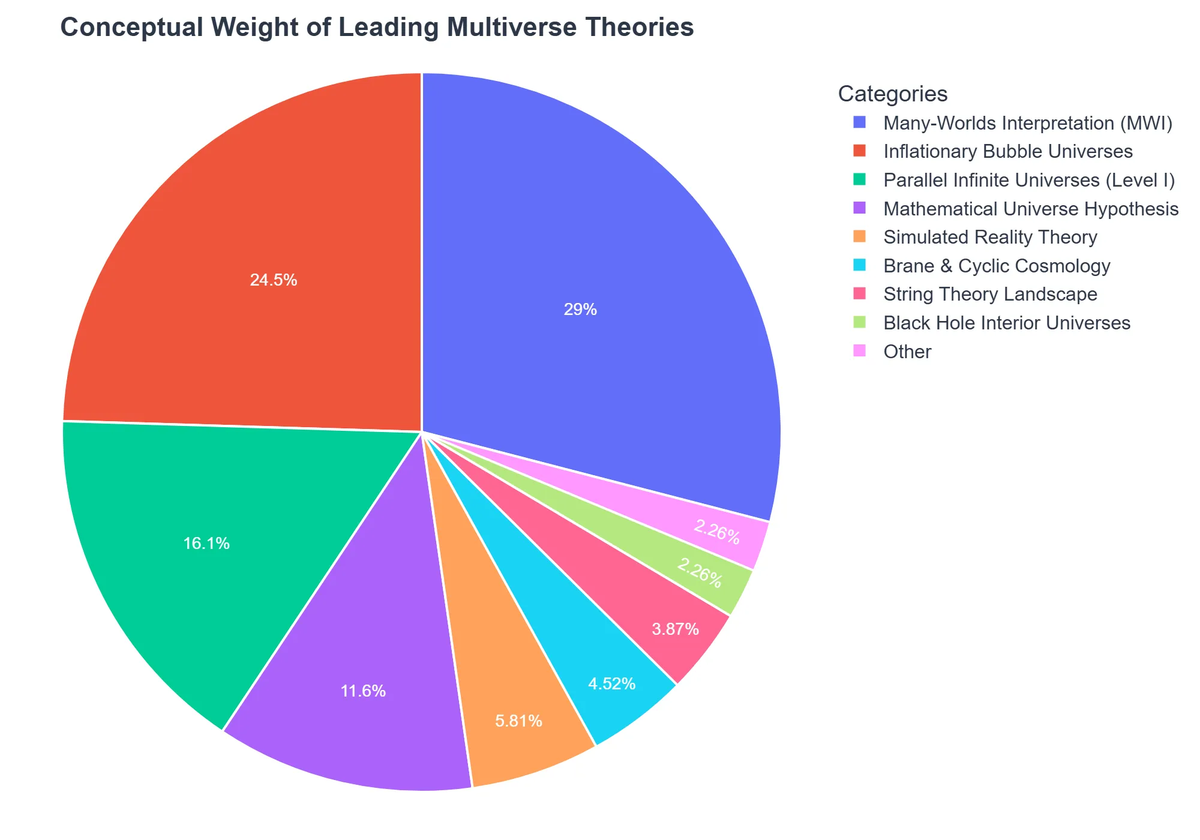
Leading Hypotheses for Multiple Universes
While definitive proof remains beyond our current technological grasp, several prominent scientific hypotheses propose mechanisms for the existence of a multiverse. These theories are largely theoretical, built upon existing frameworks in physics and cosmology:
- ✅ Infinite Universes (Level I Multiverse): This is the simplest type, stemming from the idea of an infinitely large universe. If the universe is truly infinite and uniform, then everything that can possibly happen will happen an infinite number of times. Distant patches of space would effectively be other universes, containing exact copies of us, or slightly different versions, due to the finite number of ways particles can arrange themselves.
- ✅ Bubble Universes (Level II Multiverse): Also known as inflationary multiverse or “many worlds,” this theory suggests that eternal inflation, a proposed rapid expansion of space in the very early universe, didn’t just happen once. Instead, it’s an ongoing process that continuously spawns new “bubble universes.” Each bubble universe could have different physical constants and dimensions, arising from random quantum fluctuations during its birth. You can learn more about this in Infinite Multiverses: Exploring Parallel Realities.
- ✅ Many-Worlds Interpretation (MWI) of Quantum Mechanics (Level III Multiverse): This hypothesis, originating from quantum physics, posits that every time a quantum measurement or decision is made, the universe “splits” into multiple branches. Each branch represents a different possible outcome of that measurement, creating a vast tree of diverging parallel realities. For more on this, check out Quantum Physics and Parallel Universes: Do Multiple Realities Exist?.
- ✅ Mathematical Universes (Level IV Multiverse): This most abstract type suggests that all mathematically consistent structures exist. Our universe, with its specific laws and constants, is just one such structure among an infinite number of others, each corresponding to a different mathematical framework.
- ✅ Brane Multiverse (from String Theory): Originating from string theory, this concept suggests our universe is a “brane”—a membrane-like structure—floating within a higher-dimensional space called the “bulk.” Other branes, representing other universes, could also exist in this bulk, sometimes colliding or interacting, which could potentially explain phenomena like the Big Bang. For deeper insight into the theoretical underpinnings, see Quantum Mechanics & String Theory: Beyond the Standard Model.
Each of these models offers a unique perspective on how parallel universes might arise, showcasing the breadth of scientific inquiry into the cosmos. Learn more about their distinctions in Multiple Universe Theories: Unpacking the Multiverse.
Quantum Leap Consulting: Unlocking Breakthroughs with ‘Multiverse Thinking’
❓The Challenge
Quantum Leap Consulting struggled to deliver truly groundbreaking strategies, often finding their client solutions remained within conventional industry boundaries, leading to incremental rather than transformative growth.
💡The Solution
Inspired by the Multiverse Theory’s concept of infinite possibilities, Quantum Leap Consulting integrated a ‘parallel universe thinking’ framework into their workshops. They guided clients to envision radically different market conditions, alternative business models, and ‘what-if’ scenarios beyond their current industry ‘universe,’ fostering genuinely disruptive ideas.
🏆The Result
This innovative approach led to a 30% increase in client-reported ‘breakthrough’ strategies implemented and a 20% rise in new, high-value innovation consulting contracts within the quarter.
Scientific Support and Challenges
The concept of a multiverse, while compelling, remains a highly speculative area of theoretical physics. Here’s a look at the scientific backing and the significant challenges it faces:
➡️ Indirect Evidence and Theoretical Underpinnings
- 💡 Cosmic Microwave Background (CMB) Anomalies: Some theorists speculate that certain anomalies or “cold spots” in the CMB (the afterglow of the Big Bang) could be imprints from collisions with other bubble universes. However, this is highly speculative and alternative explanations exist.
- 💡 Fine-Tuning of Physical Constants: The observation that the fundamental physical constants of our universe seem perfectly “tuned” for the existence of life is often cited. If there were multiple universes with varying constants, ours would simply be one where life could arise. This is an argument for environmental selection rather than direct evidence.
- 💡 Predictions from Inflationary Cosmology: The theory of cosmic inflation, widely accepted as explaining features of our universe like its flatness and uniformity, naturally leads to the idea of eternal inflation, which in turn predicts a bubble multiverse.
- 💡 Quantum Mechanics: The Many-Worlds Interpretation offers a way to resolve some perplexing aspects of quantum mechanics, such as wave function collapse, by positing that all possibilities are realized in different branches of the universe.
⚙️ Challenges and Criticisms
- ❌ Lack of Direct Observational Evidence: The most significant hurdle is the absence of any direct empirical evidence for other universes. By definition, these universes might be causally disconnected from ours, making direct observation incredibly difficult, if not impossible.
- ❌ Falsifiability: A core principle of the scientific method is falsifiability – the ability to prove a theory wrong through experiment or observation. Many multiverse theories are criticized for being unfalsifiable, making them philosophical concepts rather than testable scientific hypotheses in their current form.
- ❌ The “Measure Problem” in Quantum Mechanics: While MWI resolves some issues, it introduces its own set of philosophical and interpretive challenges, particularly regarding probability and the nature of consciousness.
- ❌ Occam’s Razor: This principle suggests that, among competing hypotheses, the one with the fewest assumptions should be preferred. Proposing an infinite number of universes is seen by some as an unnecessarily complex solution to observed phenomena.
Despite these challenges, research into the multiverse continues, pushing the boundaries of theoretical physics and our understanding of existence. For further reading, an insightful perspective can be found on Space.com’s exploration of parallel universes.

Implications of Existing in Multiple Universes
If the multiverse theory were proven true, its implications would be nothing short of revolutionary, impacting our understanding of physics, philosophy, and even our daily lives. The idea of parallel universes challenges deeply ingrained notions about reality:
- ➡️ Rethinking Uniqueness: The concept of “you” or “our universe” as singular entities might be profoundly altered. If infinite copies or variations exist across other universes, what does that mean for individuality or the specialness of our own existence?
- ➡️ Cosmological Explanations: The multiverse could provide a natural explanation for the fine-tuning problem, suggesting that our universe’s life-permitting constants are simply one outcome among countless possibilities. It could also offer insights into the origins of the Big Bang, perhaps as a collision of branes.
- ➡️ Quantum Reality: The Many-Worlds Interpretation offers a deterministic view of quantum mechanics, where every potential outcome of a quantum event is actualized in a different universe, removing the need for a ‘collapse’ of the wave function. This changes how we interpret probability and causality at the quantum level.
- ➡️ Philosophical Debates: The multiverse fuels philosophical discussions about free will, destiny, the nature of consciousness, and the very definition of “reality.” If every choice creates a new universe, do we truly have free will, or are all outcomes predetermined across the multiverse?
While the profound implications of multiple universes are captivating, it’s crucial to remember that these are largely theoretical discussions based on scientific hypotheses, not yet confirmed observations. However, the pursuit of answers continues to drive innovation in physics and cosmology. For more on the leading theories, consider reading The Top Three Multiverse Theories from the Adler Planetarium.

Recommended Video
What is the Multiverse Theory?
The Multiverse Theory is a hypothetical concept suggesting that our universe is just one of many, perhaps infinite, universes that exist. These other universes, called parallel universes or alternative universes, may have different physical laws or conditions.
Are there different types of multiverses?
Yes, cosmologists and physicists have proposed several types of multiverses, often categorized into levels (e.g., Level I to Level IV). These include infinite parallel universes, bubble universes, quantum multiverses, and mathematical multiverses, each based on different theoretical foundations.
Is there any scientific evidence for the multiverse?
Currently, there is no direct empirical evidence to confirm the existence of a multiverse. However, the concept arises from various well-accepted scientific theories, such as cosmic inflation and quantum mechanics, which suggest that a multiverse might be a logical consequence of their principles.
How does the Multiverse Theory relate to other physics concepts?
The Multiverse Theory is closely intertwined with concepts like the Big Bang theory, cosmic inflation, string theory, and quantum mechanics. For instance, eternal inflation could create a ‘multiverse of bubbles,’ and quantum mechanics suggests the branching of reality into different possibilities.