


As a leading authority in the intricate world of Paradoxes & Puzzles: Challenges to Logic and Reality, we constantly delve into the fascinating ways our minds perceive and process information. One of the most subtle yet powerful cognitive shortcuts our brains employ is the anchoring effect. This pervasive psychological phenomenon profoundly influences our judgments and decisions, often without us even realizing it.
💡 Key Takeaways
- The anchoring effect describes our tendency to rely too heavily on the first piece of information offered (the ‘anchor’) when making decisions.
- This bias can subtly influence a wide range of judgments, including pricing, negotiations, and even legal sentencing.
- Anchors can be irrelevant or arbitrary, yet still exert significant influence on our final estimations or choices.
- Recognizing the anchoring effect is the first step toward mitigating its impact on your rational decision-making.
“The anchoring effect reveals not just a bias, but a profound paradox of human reason: our minds, in their quest for certainty, often find themselves tethered to the very first numerical whisper, even if that whisper is merely arbitrary noise. It’s the illusion of a fixed point in a fluid world of judgment.”
— Isolde Farrow, Philosopher of Science & Paradox Specialist
The anchoring effect, or anchoring bias, illustrates how our minds disproportionately rely on the first piece of information encountered (the “anchor”) when making subsequent decisions. This initial data point, whether it’s a price, a number, or a suggestion, sets a powerful precedent, shaping our evaluations and estimations that follow. Understanding this bias is crucial, whether you’re navigating complex negotiations, evaluating product prices, or simply trying to make more rational everyday choices.
In this comprehensive guide, we’ll peel back the layers of the anchoring effect, exploring its psychological underpinnings, real-world manifestations, and practical strategies to mitigate its influence. Prepare to challenge your own assumptions and sharpen your decision-making prowess.
In This Article
- — 💡 Key Takeaways
- → Understanding the Anchoring Effect: The Mind’s Sticky Start
- — 💡 The Classic Studies: Tversky & Kahneman
- — 🧠 Why Does Our Brain Do This?
- → Real-World Manifestations: Where Anchoring Shapes Our Choices
- — 🏷️ Pricing & Retail
- — 🤝 Negotiation & Sales
- — ⚖️ Legal Judgments
- — 🍽️ Everyday Decisions
- → Mitigating the Anchoring Effect: Strategies for Rationality
- — 🔍 Be Aware and Self-Monitor
- — 📚 Seek Diverse Information & Multiple Perspectives
- — ⚖️ Deliberate Decision-Making
- — 🔄 Reframe the Problem
- → Anchoring in Business: A Double-Edged Sword
- — 💼 Pricing Strategies
- — 💵 Salary Negotiations
- — 📊 Financial Decisions
- → Related Cognitive Biases: The Interconnected Mind
- — 🛠️ The IKEA Effect
- → Conclusion: Mastering Your Mental Frameworks
Understanding the Anchoring Effect: The Mind’s Sticky Start
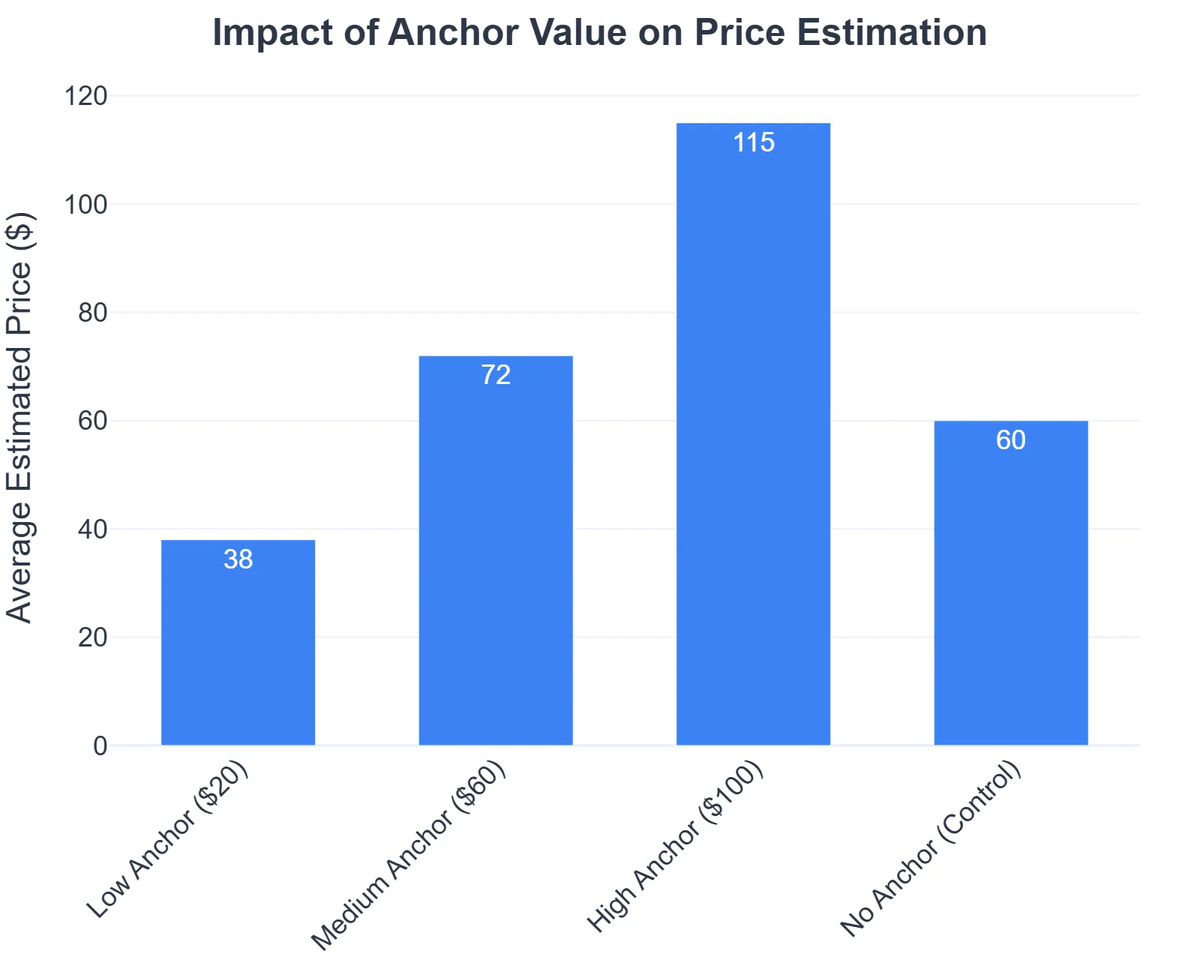
At its core, the anchoring effect describes our tendency to fixate on an initial piece of information, or “anchor,” when estimating or deciding. Subsequent judgments are then made by adjusting away from this anchor, but often, the adjustment is insufficient. The anchor’s influence remains, subtly skewing our final assessment.
💡 The Classic Studies: Tversky & Kahneman
The concept of anchoring was famously demonstrated by psychologists Amos Tversky and Daniel Kahneman in their groundbreaking work on cognitive biases. In one notable experiment, participants were asked to spin a “wheel of fortune” that landed on either 10 or 65. Afterward, they were asked to estimate the percentage of African nations in the United Nations. Those whose wheel landed on 10 estimated a much lower percentage, while those whose wheel landed on 65 estimated a significantly higher percentage, illustrating the powerful, albeit arbitrary, influence of the initial number (the anchor).
🧠 Why Does Our Brain Do This?
The precise mechanisms behind anchoring are still debated, but two primary theories prevail:
- ➡️ Insufficient Adjustment: This theory suggests that people start with the anchor and then adjust their estimate, but stop adjusting too early. They don’t move far enough away from the initial number, even if it’s clearly irrelevant.
- ✅ Selective Accessibility: When an anchor is presented, our minds subconsciously start searching for information consistent with that anchor. If you hear a high anchor, you might more easily recall arguments or data points that support a higher value, biasing your subsequent judgment.
Real-World Manifestations: Where Anchoring Shapes Our Choices

The anchoring effect isn’t just a lab phenomenon; it’s a powerful force in everyday life, subtly influencing our perceptions and decisions across various domains.
🏷️ Pricing & Retail
Perhaps the most common manifestation of anchoring is in pricing. Retailers frequently use it to their advantage:
- ✅ Original Price vs. Sale Price: Seeing an item listed at “$100” with a prominent “Now $50!” makes the $50 seem like an incredible deal, even if its intrinsic value might be lower. The $100 acts as the anchor.
- 🛒 Premium Products: Introducing a very high-priced, luxury item can make other, slightly less expensive items seem more reasonable by comparison, even if they are still expensive in absolute terms.
- ➡️ Quantity Limits: Phrases like “Limit 5 per customer” can imply high demand and good value, making you more likely to buy more, even if you only needed one.
🤝 Negotiation & Sales
In any negotiation, the first offer often sets the anchor:
- 💰 First Offer Advantage: Whether buying a car, a house, or negotiating a salary, the party who makes the first offer often establishes a powerful anchor. Future counter-offers tend to revolve around this initial number.
- 📈 Upselling & Cross-selling: Salespeople might start with a high-end product or service (the anchor) to make a mid-range option seem more palatable and affordable.
⚖️ Legal Judgments
Even in legal contexts, research has shown that arbitrary anchors can influence judgments, such as sentencing decisions by judges or compensation awards by juries. An initial, potentially irrelevant, number mentioned early in a discussion can sway the final figure.
🍽️ Everyday Decisions
From estimating how long a task will take to judging the cost of home repairs, our initial guesses or suggestions often serve as anchors for our final estimations. This is why when tackling complex problems, developing strong Critical Thinking Skills: Essential Skills for Navigating Complex Information is paramount to avoid being swayed by arbitrary starting points.
Mitigating the Anchoring Effect: Strategies for Rationality
While the anchoring effect is a deeply ingrained cognitive bias, understanding it is the first step toward minimizing its influence. Here’s how to become a more deliberate decision-maker:
🔍 Be Aware and Self-Monitor
The most crucial step is simply knowing that the anchoring effect exists. When making an important decision, pause and ask yourself: “What initial information am I relying on? Is it truly relevant, or is it an arbitrary anchor?” This self-awareness can help you identify potential biases. For more insights into common pitfalls, explore Bias and Fallacies: Navigating Deception.
📚 Seek Diverse Information & Multiple Perspectives
Don’t rely solely on the first piece of data you encounter. Actively seek out alternative perspectives, different price points, or various estimates. The more independent data points you gather, the less power a single anchor will have.
- ✅ Do Your Research: Before making a purchase or a critical decision, research average prices, common practices, or expert opinions.
- 💡 Generate Independent Estimates: Before hearing an offer or a proposed figure, try to generate your own independent estimate based on your research and criteria. This internal anchor can help counteract external ones.
⚖️ Deliberate Decision-Making
Slow down the decision-making process. Avoid making snap judgments. Take time to analyze the information, consider its true value, and assess whether the initial number truly aligns with your objectives and criteria. For similar challenges in decision-making, consider the impact of Availability Bias: How Recalled Information Shapes Decisions.
🔄 Reframe the Problem
If you’re stuck on an anchor, try to reframe the problem or decision. Instead of focusing on adjusting from the anchor, shift your focus to the intrinsic value, your specific needs, or alternative solutions that don’t involve the initial anchor.
Anchoring in Business: A Double-Edged Sword
Businesses, marketers, and negotiators can leverage the anchoring effect to their advantage, but they must also be wary of its pitfalls when negotiating with others.
💼 Pricing Strategies
As mentioned, setting a high initial price can make subsequent, lower prices appear more attractive. This is a common tactic in various industries. However, setting an anchor that is too high might alienate customers or be perceived as unrealistic.
How ‘Digital Gadget Emporium’ Boosted Smartwatch Sales by 25% Using Anchoring
❓The Challenge
Digital Gadget Emporium’s new line of premium smartwatches struggled with low conversion rates, as customers perceived the prices as too high without sufficient context.
💡The Solution
Inspired by the anchoring effect, they redesigned their product pages to first display a ‘Platinum Bundle’ priced at $1200, which included the smartwatch plus high-value accessories. This established a high anchor, making the standalone smartwatch’s $600 price appear significantly more attractive and reasonable by comparison.
🏆The Result
Within three months, the conversion rate for the standard smartwatch model increased by 25%, and the average order value for related products rose by 15%.
💵 Salary Negotiations
Job applicants who state their desired salary first, setting a high but reasonable anchor, often end up with higher compensation than those who wait for the employer’s offer. Conversely, employers who make a reasonable first offer can set the negotiation baseline. For a detailed exploration of such psychological phenomena, you might find valuable insights in this article on Anchoring Bias by The Decision Lab.
📊 Financial Decisions
Investors can fall victim to anchoring when evaluating stocks. The price they initially paid for a stock (the anchor) can unduly influence their decision to hold or sell, even if the underlying fundamentals have changed. For more on how initial information skews decision-making, see this article on Anchoring Bias: How Initial Information Skews Decision Making.
Related Cognitive Biases: The Interconnected Mind
The anchoring effect doesn’t operate in a vacuum. It often interacts with, or is confused with, other cognitive biases that similarly distort our rational judgment. While distinct, understanding these connections enhances our overall awareness of mental shortcuts.
🛠️ The IKEA Effect
While not a direct sibling of anchoring, the IKEA effect shares a commonality in how our minds assign value. The IKEA effect describes the cognitive bias where consumers place a disproportionately higher value on products they partially created or assembled themselves. Unlike anchoring, which biases our judgment based on an initial number, the IKEA effect biases our valuation based on our emotional investment and effort. Both demonstrate how seemingly irrational factors can skew our perceptions of value, highlighting the complexity of our decision-making processes.
Recommended Video
Conclusion: Mastering Your Mental Frameworks
The anchoring effect is a powerful illustration of how our minds, in their quest for efficiency, can sometimes lead us astray. Initial pieces of information, whether relevant or not, can stick like anchors, subtly pulling our judgments towards them. From retail pricing to salary negotiations, its influence is pervasive.
By understanding this ubiquitous cognitive bias, and by actively implementing strategies like seeking diverse information, generating independent estimates, and engaging in deliberate decision-making, you can significantly reduce its sway. Armed with this awareness, you’re not just making smarter decisions; you’re taking greater control over your own mental frameworks, moving closer to a more rational and discerning approach to life’s many challenges.
Frequently Asked Questions
What is the anchoring effect?
The anchoring effect is a cognitive bias where an individual’s first exposure to a number or piece of information ‘anchors’ subsequent judgments and decisions, even if the initial information is irrelevant.
Can the anchoring effect be avoided?
While it’s difficult to completely eliminate, awareness of the anchoring effect and actively considering multiple perspectives or alternative anchors can help mitigate its influence.
Where can the anchoring effect be observed?
It’s commonly seen in pricing (e.g., original price vs. sale price), negotiations, legal judgments, real estate valuations, and even medical diagnoses.
How does the anchoring effect impact decision-making?
It skews our perception of value, probability, or quantity towards the initial anchor, leading to potentially irrational or suboptimal choices that are disproportionately influenced by that first piece of data.