


Applied Geology: Solving Real-World Challenges
In a world increasingly impacted by climate change, natural hazards, and the escalating demand for resources, the role of geology extends far beyond academic study. This is where applied geology steps in, transforming fundamental Earth science knowledge into practical solutions for complex societal and environmental issues. It’s the critical bridge that connects our understanding of Earth’s dynamic processes with real-world applications, directly influencing how we live, build, and interact with our planet.
💡 Key Takeaways
- Applied geology bridges theoretical knowledge with practical solutions for societal challenges.
- It’s essential for sustainable resource exploration and management (water, minerals, energy).
- The field plays a critical role in mitigating risks from natural disasters like earthquakes and landslides.
- Geological insights are vital for robust infrastructure planning and environmental protection.
“Applied geology isn’t just about rocks; it’s about understanding Earth’s intricate dynamics to protect our planet and wisely manage its resources for generations to come.”
— Marcus Sterling, Geophysical Explorer & Climate Dynamics Analyst
From ensuring the stability of skyscrapers to safeguarding our water supplies and locating vital mineral deposits, applied geology is at the forefront of tackling some of humanity’s greatest challenges. It’s an essential aspect of understanding Earth’s Unseen Forces: The Hidden Dynamics of Our Planet, providing the insights needed to navigate its complexities.
In This Article
- → Applied Geology: Solving Real-World Challenges
- — 💡 Key Takeaways
- → What is Applied Geology? Unearthing Practical Solutions
- — 🛠️ Bridging Theory and Practice
- — Key Disciplines within Applied Geology
- → Environmental Geology: Safeguarding Our Planet
- — 💧 Water Resource Management
- — Contaminant Hydrology and Remediation
- — Natural Hazard Mitigation
- → Engineering Geology: Building a Resilient Infrastructure
- — Site Characterization for Construction
- — Geotechnical Design and Stability
- → Resource Exploration: Powering Our World
- — Locating Mineral Deposits
- — Energy Resource Assessment
- → Hydrogeology: Understanding Earth’s Water Systems
- — Groundwater Flow and Aquifer Characterization
- — Water Supply and Management Challenges
- → The Tools and Techniques of Applied Geology
- — Field Investigations and Mapping
- — Geophysical Methods
- — Geochemical Analysis
- — Remote Sensing and GIS
- → Conclusion: The Indispensable Role of Applied Geology
What is Applied Geology? Unearthing Practical Solutions
Applied geology is the practical application of geological principles and knowledge to solve problems related to human activity and the natural environment. It’s an interdisciplinary field that draws upon various branches of geology, integrating them with engineering, environmental science, and urban planning to address immediate and long-term concerns.
🛠️ Bridging Theory and Practice
At its core, applied geology takes the theoretical frameworks developed in fields like petrology, stratigraphy, and structural geology, and uses them to inform decision-making in sectors ranging from construction and infrastructure development to resource management and hazard mitigation. It’s about predicting Earth’s behavior and designing solutions that work in harmony with its systems.
- ✅ Understanding geological risks for urban planning.
- ✅ Optimizing the extraction of natural resources.
- ✅ Protecting and managing precious water supplies.
- ✅ Assessing and remediating environmental contamination.
Key Disciplines within Applied Geology
Applied geology encompasses several specialized areas, each focusing on unique sets of challenges:
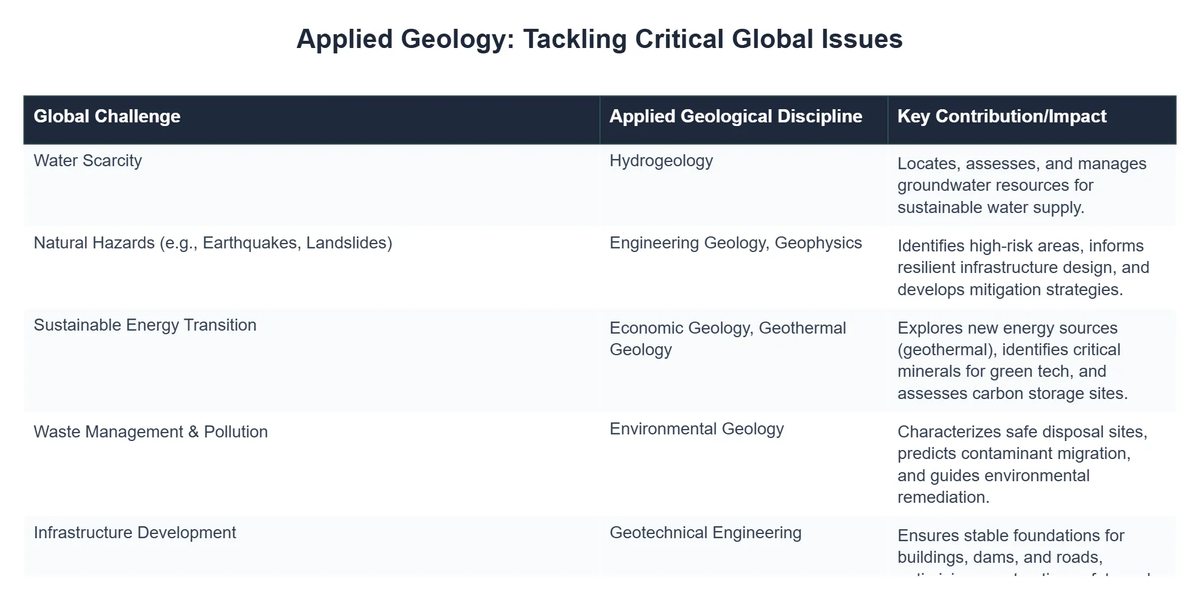
- ➡️ Engineering Geology: Focuses on the geological factors affecting the design, construction, and operation of engineering structures.
- ➡️ Environmental Geology: Deals with the interactions between humans and the geological environment, including pollution, waste disposal, and natural hazards.
- ➡️ Hydrogeology: Specializes in the study of groundwater, its movement, distribution, and quality.
- ➡️ Resource Exploration: Involves locating and evaluating economically viable deposits of minerals, fossil fuels, and geothermal energy.
- ➡️ Geophysics: Uses physical methods to investigate subsurface geological conditions.
Environmental Geology: Safeguarding Our Planet
Environmental geology is a critical sub-discipline of applied geology that focuses on the complex interactions between human activity and the geological environment. Its primary goal is to protect and improve environmental quality by understanding natural processes and mitigating anthropogenic impacts. For a deeper understanding of this vital field, explore our comprehensive guide on Environmental Geology: Protecting Earth’s Natural Systems.
💧 Water Resource Management
One of the most crucial aspects of environmental geology is the study of water resources, particularly groundwater, which falls under the domain of hydrogeology. Geologists assess aquifer systems, predict groundwater flow, and evaluate water quality to ensure sustainable water supplies for communities, agriculture, and industry.
- 💡 Identifying potential sites for new water wells.
- 💡 Monitoring groundwater levels and quality.
- 💡 Developing strategies for aquifer recharge.
Contaminant Hydrology and Remediation
When industrial activities or natural events lead to contamination of soil and groundwater, environmental geologists are instrumental in assessing the extent of pollution and designing effective remediation strategies. They use geological and hydrological principles to trace contaminant plumes and develop plans to clean up affected areas.
Natural Hazard Mitigation
Applied geologists play a vital role in understanding, predicting, and mitigating the risks associated with natural geological hazards such as earthquakes, landslides, volcanic eruptions, and tsunamis. Their work informs land-use planning, building codes, and emergency preparedness strategies.
- ✅ Mapping fault lines and seismic risk zones.
- ✅ Analyzing slope stability to prevent landslides.
- ✅ Developing early warning systems for volcanic activity.
Engineering Geology: Building a Resilient Infrastructure
Engineering geology is the application of geological principles to engineering practice, ensuring that human-made structures are safely and economically constructed. It’s a cornerstone of any major construction project, from bridges and tunnels to dams and high-rise buildings. For more detailed insights, see our article on Engineering Geology: Building Safely on Earth.
Applied Geology: Benefits and Challenges
Pros
- ✔Directly addresses critical global issues like natural hazards, resource scarcity, and environmental degradation.
- ✔Offers diverse and impactful career paths in industries such as mining, energy, civil engineering, and environmental consulting.
- ✔Integrates scientific understanding with practical engineering solutions for real-world problems.
- ✔Essential for sustainable resource management, infrastructure development, and land-use planning.
Cons
- ✖Projects can be costly, time-consuming, and involve significant logistical and regulatory challenges.
- ✖Certain applications (e.g., resource extraction) may carry potential environmental and social impacts.
- ✖Involves inherent uncertainties due to subsurface complexity and the interpretative nature of geological data.
- ✖Fieldwork often requires working in challenging, remote, or potentially hazardous environments.
Site Characterization for Construction
Before any major construction begins, engineering geologists conduct thorough site investigations to understand the subsurface conditions. This includes analyzing soil and rock properties, identifying geological hazards, and determining groundwater levels. This crucial information guides foundation design and construction methods.
- ➡️ Drilling boreholes and collecting samples.
- ➡️ Performing in-situ tests to determine strength and deformability.
- ➡️ Mapping geological features like faults, folds, and joint sets.
Geotechnical Design and Stability
Based on their site characterization, engineering geologists provide recommendations for slope stability, foundation design, and tunneling. They assess the risk of landslides, settlement, and other ground-related failures that could compromise the integrity of structures. Understanding factors like RQD in Geology: Assessing Rock Quality for Engineering is paramount in these assessments.
Resource Exploration: Powering Our World
The relentless demand for raw materials and energy makes resource exploration a cornerstone of applied geology. Geologists use their understanding of Earth processes to locate and evaluate deposits of minerals, fossil fuels, and alternative energy sources.
Locating Mineral Deposits
Finding new mineral resources requires a deep understanding of ore formation processes, geological structures, and geochemical signatures. Applied geologists employ a range of techniques to pinpoint economically viable deposits of metals (like copper, gold, iron) and industrial minerals (like gypsum, limestone, sand, and gravel, including materials like Marl in Geology: Clay, Silt, and Carbonate Deposits). They often look for specific geological settings where minerals might form, such as complex structures like Stockwork Geology: Unraveling Complex Mineral Deposits or even in smaller, hidden cavities known as Vugs in Geology: Uncovering Hidden Rock Chambers. Understanding how minerals change form, as discussed in Polymorphism in Geology: How Minerals Change Form, also aids in exploration.
- ⛏️ Analyzing geological maps and satellite imagery.
- ⛏️ Conducting geophysical surveys to detect subsurface anomalies.
- ⛏️ Collecting and analyzing rock and soil samples for geochemical clues.
Energy Resource Assessment
Whether it’s traditional fossil fuels like oil and natural gas, or emerging sources like geothermal energy, applied geologists are essential for identifying and assessing potential reservoirs. They study sedimentary basins for hydrocarbons and investigate volcanic and tectonic regions for geothermal potential.
UrbanScape Developments Mitigates Risk with Applied Geology, Saving Millions
❓The Challenge
UrbanScape faced significant delays and budget overruns on a new high-rise project due to unexpected subsurface geological instability and groundwater issues discovered during initial excavation.
💡The Solution
They engaged a team of applied geology specialists who employed engineering geology and hydrogeological principles to conduct thorough subsurface investigations, accurately mapping geological risks and groundwater dynamics, leading to informed foundational redesigns.
🏆The Result
By integrating applied geology, the project’s foundational phase was completed 20% under budget and 2 months ahead of schedule, leading to an estimated savings of $3.5 million.
Hydrogeology: Understanding Earth’s Water Systems
Hydrogeology, a specialized field within applied geology, focuses specifically on the occurrence, movement, and quality of water beneath the Earth’s surface. Given that groundwater constitutes a significant portion of the world’s accessible freshwater, the expertise of hydrogeologists is invaluable.
Groundwater Flow and Aquifer Characterization
Hydrogeologists map and characterize aquifers – underground layers of permeable rock or sediment that can hold or transmit groundwater. They use geological data, hydrological measurements, and numerical models to understand how groundwater moves, where it discharges, and how it interacts with surface water bodies.
- 💧 Delineating aquifer boundaries and properties.
- 💧 Measuring hydraulic conductivity and transmissivity.
- 💧 Modeling groundwater flow paths.
Water Supply and Management Challenges
The increasing demand for fresh water, coupled with the impacts of climate change, places immense pressure on groundwater resources. Hydrogeologists develop sustainable management plans, assess the impact of pumping on water tables, and address issues like saltwater intrusion in coastal areas.
The Tools and Techniques of Applied Geology
Applied geologists utilize a diverse arsenal of tools and techniques to gather data, analyze conditions, and formulate solutions:
Field Investigations and Mapping
Direct observation and mapping are fundamental. Geologists spend time in the field, examining rock outcrops, soil profiles, and geological structures. This provides essential ground-truth data for their analyses.
Geophysical Methods
These non-invasive techniques use physical properties of Earth materials to infer subsurface conditions without extensive drilling. Examples include seismic surveys, electrical resistivity imaging, gravity surveys, and magnetic surveys.
Geochemical Analysis
Analyzing the chemical composition of rocks, soils, and water provides crucial information about the presence of minerals, contaminants, and the overall geological environment. This often involves laboratory analysis of samples collected in the field.
Remote Sensing and GIS
Satellite imagery, aerial photographs, and Light Detection and Ranging (LiDAR) data provide large-scale geological context. Geographic Information Systems (GIS) are used to integrate, analyze, and visualize vast amounts of spatial data, creating powerful geological models and maps.
Recommended Video
Conclusion: The Indispensable Role of Applied Geology
Applied geology is not just an academic discipline; it’s a dynamic and essential field that directly addresses the pressing challenges of our modern world. From securing vital resources and ensuring safe infrastructure to protecting our environment and mitigating natural hazards, geological engineering professionals provide the critical insights and solutions needed for sustainable development. As our planet faces increasing pressures, the expertise of applied geologists will only become more indispensable, guiding us towards a more resilient and sustainable future.
Frequently Asked Questions
How does applied geology help in resource management?
It identifies and assesses deposits of minerals, water, and energy, ensuring sustainable extraction and optimal utilization.
What role does it play in natural hazard mitigation?
Applied geology helps identify landslide risks, assess earthquake potential, and plan protective measures for communities.
Can applied geology contribute to environmental protection?
Yes, it’s crucial for managing waste disposal, remediating contaminated sites, and understanding groundwater pollution.