The universe, in its incomprehensible vastness, has always captivated human curiosity. From the twinkling stars to distant galaxies, we constantly strive to understand its fundamental nature. Among the most profound questions is that of its shape. Is it curved like a sphere, open like a saddle, or simply… flat?
💡 Key Takeaways
- The universe’s perceived shape significantly influences predictions about its ultimate fate and expansion.
- Current observations of the Cosmic Microwave Background (CMB) strongly suggest that our universe is geometrically flat.
- The ‘flatness problem’ highlights how precisely balanced the universe’s density must be for it to appear flat, often explained by cosmic inflation.
- A truly flat universe implies that it is infinite in extent and will continue to expand indefinitely.
“The universe’s flatness isn’t just an abstract geometric concept; it fundamentally shapes the story of existence, dictating its past, present, and the myriad futures we might imagine across the cosmos.”
— Astrid Bellweather, Astrophysicist & Science Fiction Consultant
The concept of a flat universe theory might sound counter-intuitive, conjuring images of a cosmic pancake. However, in cosmology, “flat” refers not to a two-dimensional plane but to the three-dimensional spatial curvature of the universe. Current scientific consensus, bolstered by decades of observational data, strongly suggests that the universe is indeed flat, or at least very close to it. This understanding has profound implications for its past, present, and ultimate future.
Join us on Cosmic Queries: Probing the Mysteries of the Universe as we delve into what a “flat” universe truly means, the compelling evidence that supports this theory, and why it’s a cornerstone of modern cosmology.
In This Article
- — 💡 Key Takeaways
- → What Does “Flat Universe” Actually Mean?
- — 🌌 More Than Just 2D Geometry
- — The Critical Density and Omega_0
- → The Compelling Evidence for a Flat Universe
- — 🔭 Cosmic Microwave Background (CMB) Radiation
- — 🚀 The Role of Cosmic Inflation
- — 💫 Observations of Large-Scale Structure
- → Implications of a Flat Universe
- — ➡️ The Universe’s Ultimate Fate
- — ♾️ Is the Universe Infinite?
- → Common Misconceptions and Nuances
- — Misinterpreting “Flat” in 3D Space
- — The “Perfectly” Flat Universe: Is It Really?
- → Future Research and Lingering Questions
- — Dark Energy and Dark Matter’s Influence
- — Pushing the Boundaries of Measurement
- → Conclusion
What Does “Flat Universe” Actually Mean?
When cosmologists discuss the “flatness” of the universe, they are referring to its global geometry, or more precisely, its spatial curvature. This is a concept rooted in Albert Einstein’s General Theory of Relativity, which describes gravity as the curvature of spacetime caused by mass and energy.

🌌 More Than Just 2D Geometry
Imagine the surface of a three-dimensional object:
- ✅ Positive Curvature (Closed): Similar to the surface of a sphere. If you drew two parallel lines on a sphere, they would eventually converge. In a positively curved universe, light rays would eventually converge, and the universe would be finite in size, though unbounded.
- ➡️ Negative Curvature (Open): Resembles the surface of a saddle. Parallel lines would diverge. In a negatively curved universe, light rays would always diverge, and the universe would be infinite.
- 💡 Zero Curvature (Flat): Like a perfectly flat sheet of paper. Parallel lines remain parallel forever. In a spatially flat universe, light rays travel in straight lines, and the universe is infinite in extent.
Our observable universe appears to conform to this “flat” geometry, meaning that on the largest scales, space doesn’t curve back on itself or spread out at an increasing rate. This is distinct from the spacetime curvature that causes gravity around massive objects like planets and stars; we’re talking about the overall shape of the entire cosmos.
The Critical Density and Omega_0
The geometry of the universe is intrinsically linked to its overall density. There’s a specific value called the critical density. This is the average density of matter and energy the universe would need to be spatially flat. Scientists use a parameter called Omega (Ω) to describe the ratio of the actual density of the universe (ρ) to the critical density (ρc):
Ω = ρ / ρc
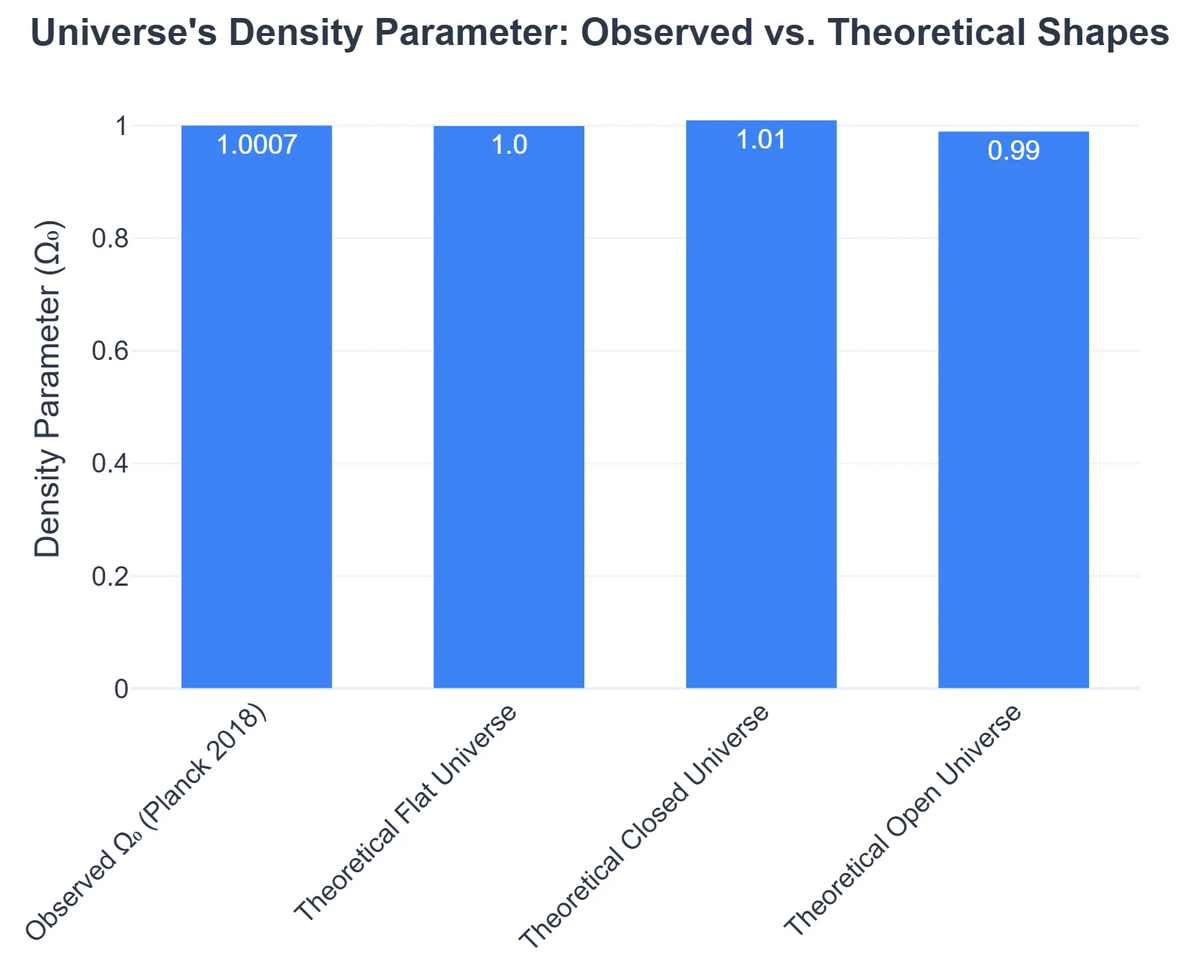
- ✅ If Ω > 1, the universe has positive curvature (closed).
- ➡️ If Ω < 1, the universe has negative curvature (open).
- 💡 If Ω = 1, the universe is spatially flat.
Current measurements suggest that Omega is extremely close to 1, strongly indicating a flat universe.
The Compelling Evidence for a Flat Universe
The idea that the universe is flat isn’t just a theoretical construct; it’s backed by powerful observational data, particularly from the early universe.
🔭 Cosmic Microwave Background (CMB) Radiation
The most compelling evidence for the universe being flat comes from precise measurements of the Cosmic Microwave Background (CMB) radiation. The CMB is the faint afterglow of the Big Bang, a relic light from when the universe was only about 380,000 years old, cool enough for atoms to form and light to travel freely. The CMB contains tiny temperature fluctuations, or anisotropies, which represent the seeds of all future cosmic structures.
- ✅ WMAP and Planck Missions: Satellites like NASA’s WMAP (Wilkinson Microwave Anisotropy Probe) and ESA’s Planck mission have mapped these anisotropies with incredible precision. Scientists analyze the angular size of these “hot spots” and “cold spots” in the CMB.
- ➡️ Measuring Curvature: The apparent size of these fluctuations on the sky depends on the universe’s geometry. In a positively curved universe, these spots would appear larger than they are; in a negatively curved one, they’d appear smaller. For a flat universe, they appear at their true angular size.
- 💡 Results: Both WMAP and Planck data overwhelmingly indicate that the characteristic size of these fluctuations is consistent with a flat geometry. As NASA’s WMAP mission page states, “WMAP measured the angular size of the tiny hot and cold spots in the CMB to a high precision, mapping out the curvature of space.” (WMAP – Shape of the Universe)
🚀 The Role of Cosmic Inflation
The flatness observed in the CMB data is also a strong prediction of the inflationary theory. Cosmic inflation is a hypothetical period of extremely rapid, exponential expansion that the universe underwent in its first tiny fraction of a second after the Big Bang. This theory was proposed to solve several puzzles with the standard Big Bang model, including the “flatness problem.”

- ✅ Smoothing Out Curvature: Just as inflating a balloon to an enormous size makes any small curve on its surface appear flat from a local perspective, inflation would have stretched any initial curvature of the universe to such an immense scale that it would appear effectively flat to us.
- ➡️ A Natural Outcome: If inflation occurred, it would naturally drive the universe’s spatial curvature to zero, making it very nearly flat. This theoretical prediction aligns perfectly with the observational evidence from the CMB. For more on this, explore Chaotic Inflation Theory: An Introduction to the Universe’s Expansion.
💫 Observations of Large-Scale Structure
Beyond the CMB, the distribution of galaxies and galaxy clusters on vast cosmic scales also supports the idea that the universe is flat. Cosmologists study how structures like galaxy superclusters have formed and evolved over billions of years. The growth of these structures is sensitive to the universe’s overall geometry. Current models of structure formation, when compared with observational surveys, are most consistent with a flat cosmological model.
Implications of a Flat Universe
The flatness of the universe has profound implications for its ultimate fate and its overall size.
➡️ The Universe’s Ultimate Fate
The geometry of the universe, along with the amount of dark energy, dictates its long-term expansion. For a spatially flat universe:
- ✅ Perpetual Expansion: A flat universe, especially one dominated by dark energy (as ours appears to be), will continue to expand forever, though the rate of expansion might change. It won’t recollapse in a “Big Crunch” or expand indefinitely to a “Big Freeze” (though a Big Freeze is a plausible outcome for a flat, dark-energy-dominated universe).
- ➡️ Critical Balance: The total energy density (matter, radiation, and dark energy) is precisely balanced against the expansion, preventing either collapse or runaway acceleration (though dark energy is causing acceleration). This balance leads to an ever-expanding, but not necessarily infinitely accelerating, cosmos. To understand more about future cosmic scenarios, read about False Vacuum Theory: The Fate of the Universe.
♾️ Is the Universe Infinite?
A common misconception is that a flat universe definitively means an infinite universe. While a spatially flat universe can be infinite, it isn’t necessarily so. The flatness refers to its local geometry. The global topology (its overall shape and connectedness) could still be finite, even if it has zero local curvature. Think of a doughnut shape (a torus) – it has zero local curvature, but it’s finite in size. However, the simplest and most natural interpretation of a flat universe, without any detected global topological features, is that it is infinite.
The Flat Universe Theory: Pros and Cons
Pros
- ✔Strongly supported by high-precision Cosmic Microwave Background (CMB) measurements.
- ✔Consistent with the prevailing Lambda-CDM standard model of cosmology.
- ✔Simplifies cosmological calculations and theoretical frameworks.
- ✔Predicted by the inflationary universe theory, which addresses the ‘flatness problem’.
Cons
- ✖Observational data has a margin of error, meaning a very slight curvature is not entirely ruled out.
- ✖Explaining *why* the universe is so precisely flat remains a theoretical challenge (the ‘flatness problem’).
- ✖Local flatness within our observable universe does not guarantee global flatness across the entire cosmos.
- ✖Relies on the validity of inflation theory, which itself has unproven aspects.
Common Misconceptions and Nuances
Understanding the concept of a flat universe often leads to common misunderstandings.
Misinterpreting “Flat” in 3D Space
The biggest misconception is imagining the universe as a 2D sheet or a pancake. It’s crucial to remember that “flat” in cosmology refers to the intrinsic curvature of its three spatial dimensions, not that it lacks depth or is constrained within higher dimensions. We are talking about the geometry of space itself, not its appearance.
The “Perfectly” Flat Universe: Is It Really?
While the evidence strongly supports a flat universe, it’s more accurate to say that it’s “flat within the limits of our current measurement precision.” We have measured Omega to be incredibly close to 1, perhaps 0.998 or 1.002, with very small error bars. This means that if there is any curvature, it is so slight that the radius of curvature would be far larger than the size of the observable universe. For all practical purposes and within our observable horizon, the universe behaves as if it is perfectly flat. As Big Think explains, the universe is “flat to within 0.25%.” (The Universe is flat. Here’s what that teaches us. – Big Think)
Future Research and Lingering Questions
While the flatness of the universe is largely accepted, ongoing research continues to refine our understanding and explore related mysteries.
Dark Energy and Dark Matter’s Influence
The universe’s flatness is achieved by a specific cosmic recipe: roughly 5% normal matter, 27% dark matter, and 68% dark energy. Dark energy, in particular, is responsible for the accelerating expansion of the universe. Understanding the precise nature of dark energy and dark matter remains one of the greatest challenges in cosmology. Their exact properties could still subtly influence the future evolution of a flat universe.
Pushing the Boundaries of Measurement
Future missions and ground-based telescopes, with even greater sensitivity and resolution, will continue to map the CMB and large-scale structures with even higher precision. These efforts aim to tighten the constraints on Omega even further, potentially revealing any minute deviation from perfect flatness, or simply confirming our current understanding with even greater certainty.

Recommended Video
Conclusion
The concept that the universe is flat is a profound triumph of modern cosmology, born from meticulous observation and sophisticated theoretical frameworks. It means that on the grandest scales, space adheres to the familiar rules of Euclidean geometry, implying an infinite cosmos that will continue to expand indefinitely.
From the precise mapping of the Cosmic Microwave Background by missions like WMAP and Planck, to the theoretical predictions of cosmic inflation, the evidence overwhelmingly points towards a spatially flat universe. This understanding forms a critical pillar in our comprehensive model of cosmic evolution, from Big Bang: When It Happened? Tracing the Universe’s Origin to its distant future.
As we continue to probe the depths of space and time, the flat universe theory stands as a testament to humanity’s relentless quest to uncover the fundamental truths of our existence within the vast cosmic tapestry.
Frequently Asked Questions
What does ‘flat universe’ mean?
A flat universe implies that space follows Euclidean geometry, meaning parallel lines never meet, and the sum of angles in a triangle always equals 180 degrees. It refers to the global curvature of spacetime.
What evidence supports a flat universe?
The strongest evidence comes from precise measurements of the Cosmic Microwave Background (CMB) radiation, particularly its temperature fluctuations, which align perfectly with predictions for a flat geometry.
What is the ‘flatness problem’?
The flatness problem is a cosmological puzzle: the universe’s density is incredibly close to the critical density required for flatness. Without inflation theory, this precision would require extremely fine-tuned initial conditions.
How does dark energy relate to a flat universe?
Dark energy, along with matter, contributes to the total energy density of the universe. Current measurements show that these combined densities sum very closely to the critical density needed for a flat universe.